


Why Every Cloud Engineer Needs AI Skills in 2026
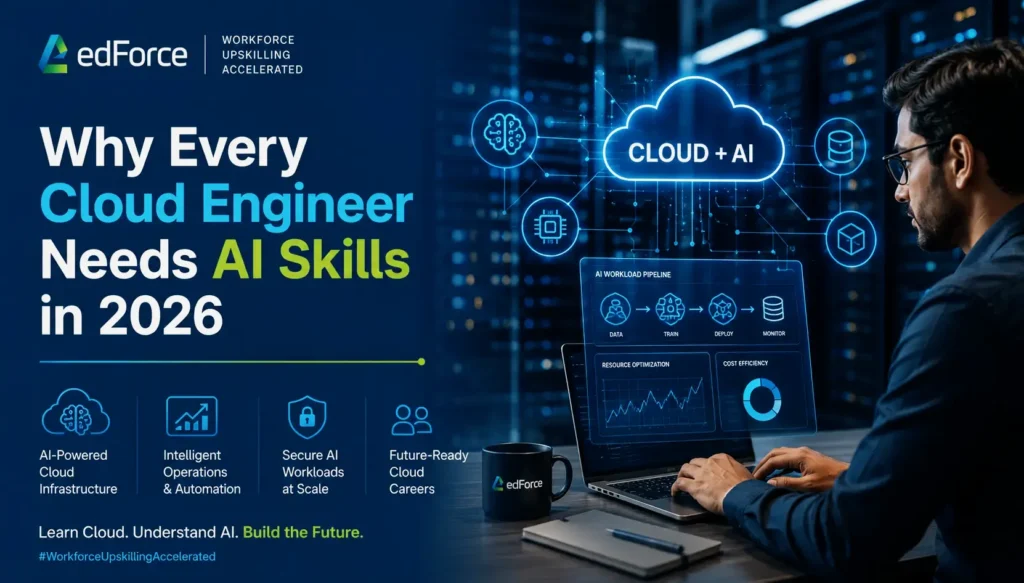
A couple of years ago, becoming a cloud engineer meant understanding platforms like AWS, Azure, or Google Cloud and learning how to deploy, manage, and scale infrastructure. Those skills alone could create significant career opportunities. The situation in 2026 looks very different. Cloud infrastructure is still vital. However, employers are increasingly looking for professionals who can combine cloud expertise with AI capabilities. The reason is simple. Modern companies aren’t using cloud services only to host applications. They use cloud computing to run AI workloads, process massive amounts of data, automate operations, and support intelligent business systems. As a result, the role of the cloud engineer is gradually evolving. Many professionals still view AI and cloud computing as separate career paths. Enterprises do not. For many organizations, the cloud engineer of the future is someone who understands both. The Cloud Industry Is Entering a New Phase The initial phase of cloud adoption was focused on migration. Companies moved databases, applications, and infrastructure from on-premises environments to cloud platforms. The second phase focused on optimization. Businesses wanted scalable systems, better performance, and reduced infrastructure costs. The phase we are entering now is different. Cloud Is Becoming the Foundation for AI Organizations are increasingly asking: “How can we use cloud environments to support AI-driven operations?” This question is changing hiring priorities. Cloud engineers are now working alongside: AI teams Machine Learning Engineers Data scientists Automation specialists Platform engineering teams Cloud computing has become the foundation for enterprise AI initiatives. This is why AI expertise is becoming a valuable advantage for cloud professionals. Infrastructure Is No Longer Just Infrastructure One of the most interesting shifts happening across enterprises is that infrastructure teams are becoming more involved in business innovation. Five years ago, cloud engineers spent most of their time managing deployments, resources, networking, and security. How Cloud Teams Are Evolving Today, cloud teams are increasingly involved in: AI model deployment GPU infrastructure planning AI workload optimization Data pipeline support Intelligent automation projects The conversation has moved beyond simply keeping systems operational. Businesses need cloud engineers who understand how modern AI systems function within cloud environments. That does not mean every cloud engineer must become a data scientist. However, it does mean understanding how AI workloads influence infrastructure decisions. The Skill Gap Companies Are Starting to Notice Many organizations have invested heavily in AI tools during the past two years. What they are discovering is that AI projects often move slower than expected because workforce capabilities have not grown at the same pace as technology investments. The Challenge Many Enterprises Face A common situation looks like this: The company has cloud engineers. The company has AI initiatives. Very few people understand both. This creates communication gaps between teams and slows implementation. Increasingly, employers are searching for professionals who can bridge that gap. These individuals are valuable because they understand infrastructure requirements while also understanding the goals AI teams need to achieve. AI Is Changing Daily Cloud Operations Another reason AI skills are becoming important is that AI is beginning to influence day-to-day cloud operations. Many modern cloud environments now include: AI-powered monitoring Automated incident management Predictive resource optimization Intelligent security systems Automated troubleshooting support What Cloud Engineers Need to Understand Cloud engineers do not need to build every AI system themselves. However, they need to understand: How these systems work Where they provide value When human oversight is required How AI impacts operational workflows Professionals who understand this shift tend to adapt faster as organizations modernize infrastructure operations. The Most Valuable Cloud Engineers Are Becoming More Adaptable One pattern becoming increasingly clear is that companies are valuing adaptability alongside specialization. Technology evolves too quickly for static skill sets. Cloud engineers experiencing the strongest career growth are often those who continuously expand their expertise into adjacent fields. Why AI Is Becoming a Core Skill AI is rapidly becoming one of the most important complementary skills. Not because AI will replace cloud engineering. But because AI is becoming a core part of the cloud environments cloud engineers support every day. Professionals who understand both infrastructure and AI workflows can contribute to more projects than those focused on only one area. Why AI Skills Matter Even If You Never Build Models This is where many professionals become confused. They assume AI skills mean learning advanced mathematics, neural network architectures, or machine learning research. For most cloud engineers, that is not the primary goal. Practical AI Knowledge for Cloud Engineers The value comes from understanding: AI infrastructure requirements Model deployment environments GPU-based computing AI security considerations Cloud-native AI services Enterprise AI workflows In many organizations, these practical skills are becoming more valuable than building AI models from scratch. Professionals need to support AI adoption in practical business environments, not only academic ones. What Enterprises Are Looking For in 2026 Hiring conversations are changing. Companies are increasingly attracted to cloud engineers who understand how AI integrates into enterprise operations. Skills Employers Want Organizations are looking for professionals who can: Support AI deployment projects Manage modern cloud infrastructure Understand AI workloads Collaborate across technical teams Adapt to emerging technologies The market does not always require AI researchers. It increasingly requires cloud professionals who can work effectively in AI-powered environments. The Future Cloud Engineer Will Work Alongside AI One prediction that is becoming increasingly likely is that cloud engineering roles will continue shifting toward AI-powered operations and automated platform management. The job itself is not disappearing. The responsibility is expanding. Managing Intelligent Systems Future cloud engineers may spend less time manually managing infrastructure and more time supervising intelligent systems that automate portions of the work. Professionals who prepare for this transition early will likely be better positioned as enterprise technology continues to evolve. Why Training Is Becoming More Important Many organizations now recognize that hiring AI-ready cloud professionals can be difficult. This is one reason businesses are investing more in workforce training programs that combine cloud and AI skills. Building AI-Ready Cloud Teams At edForce.co, cloud and AI training programs focus
Agentic AI vs Generative AI: What Enterprises Should Train Teams On in 2026
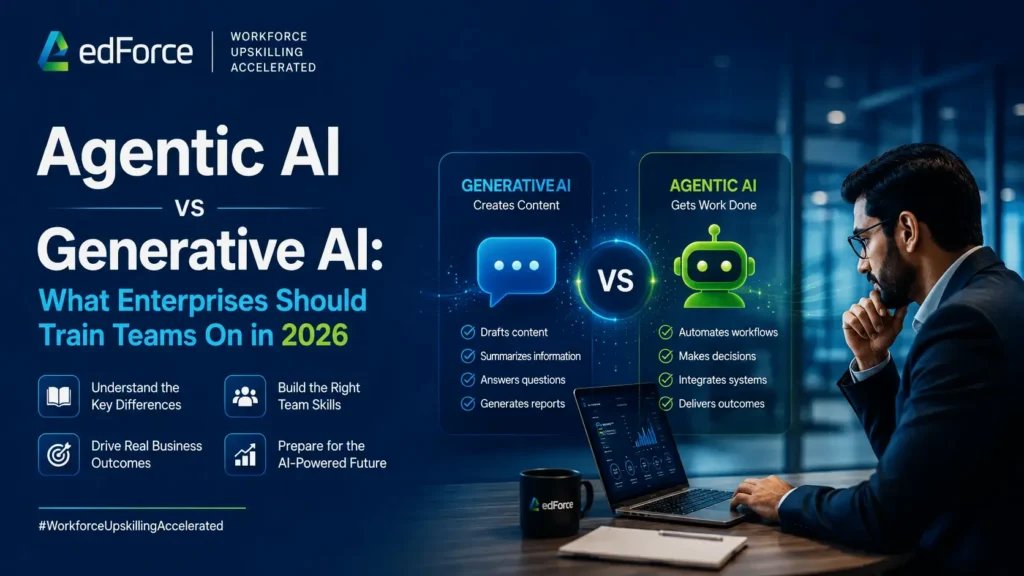
In the past two years, the majority of discussions in the workplace on AI have been focused on AI tools that produce documents, create emails, summarize information, generate reports, or respond to questions. Employees became accustomed to chat-based AI systems, and companies eagerly explored productivity improvements. The conversation is now evolving. Many companies are wondering if the next stage of AI isn’t solely about creating content, but also about finishing work. This is where Agentic AI enters the picture. Many business leaders are being introduced to terms such as Generative AI, Agentic AI, AI agents, or self-contained workflows. The problem is that these terms are often used as if they’re all the same thing. They’re not. Understanding the distinction is important since it directly affects workforce education choices. Many businesses are already planning Agentic AI initiatives while their employees are still learning to utilize Generative AI effectively. This gap could be one of the major issues facing workers in 2026. The First Wave Was About Content Creation Generative AI has changed the way individuals interact with information. How Teams Started Using Generative AI Teams began using AI to: Draft emails Summarize documents Create content Research and support Create systems for storing information Generate reports For many companies, this was their first experience with AI within routine work processes. The value was evident. Employees can complete information-based tasks faster and spend less time on repetitive work. However, something very interesting occurred. The most significant productivity improvements did not come from employees who simply used AI tools. These gains came from employees who learned to integrate these tools into their routine processes. This is crucial because it’s being repeated through Agentic AI. Agentic AI Is About Action, Not Just Output Generative AI primarily helps employees create information. Agentic AI was designed to act. What AI Agents Can Do Instead of producing reports and waiting for users to decide what to do next, an AI agent can: Collect details Analyze information Trigger workflows Communicate with systems Perform multiple tasks at once This is a significant difference. Generative AI aids work. Agentic AI participates in work. Many companies are excited about its potential. It is also the reason workforce readiness is becoming more crucial. Many Companies Are Asking the Wrong Question A common question in boardrooms today is: “Should we train employees on Generative AI or Agentic AI?” A better question is: “Which skills will employees need as AI becomes more autonomous?” Since, in the real world, businesses require both. Generative AI and Agentic AI solve different problems. One helps employees work faster. The other changes how work gets done. Businesses that view these technologies as rivals could overlook the larger opportunity. What Should Enterprises Train Teams On First? The most common error organizations make is chasing the latest technology without establishing foundational capabilities. The Foundation Still Matters Many companies are eager to explore Agentic AI, but some teams are still struggling with: Prompt quality Output verification Responsible AI usage Workflow integration Information management Without these fundamentals, Agentic AI adoption can become chaotic. Employees need to understand how AI integrates into workflows before they can effectively manage systems that make decisions or perform tasks on their own. For many companies, Generative AI literacy remains the primary step. Not because it is more important, but because it provides the foundation for everything that follows. The Real Skill Gap Is Not Technical The majority of discussions on AI are focused on technology. The most difficult challenge is often behavior. Skills Employees Need to Develop Many people are just beginning to learn: When to trust AI When to question AI outputs How to review details How to ensure accountability How to work with automated systems These abilities become more essential as organizations shift toward Agentic AI. One prediction that is becoming more likely is that future AI education programs will spend less time teaching tools and more time teaching decision-making. As AI systems become smarter, human judgment becomes more important, not less. Why Workforce Training Will Change Traditional corporate training usually focuses on teaching employees how to operate a platform. AI is different. Future Workforce Capabilities Today’s employees must understand: Workflow redesign AI supervision Operational accountability Exception handling Governance practices These are not purely technical capabilities. They are business capabilities. This is why many organizations are realizing that AI readiness can no longer remain only within IT departments. Management teams, operations teams, HR managers, project teams, and other business functions require an understanding of how AI can affect the way work is done. The Enterprises Seeing Success Are Taking a Different Approach Some companies still view AI implementation as a software rollout. Others describe it as a workplace transformation initiative. The second group is typically seeing better results. Why Transformation Beats Technology Alone Because technology adoption is usually more straightforward than changing behavior. Most employees can master a new tool quickly. Changing how people make decisions, collaborate, review work, and manage workflows often takes longer. The companies that are planning effectively for Agentic AI are usually the ones investing in workforce capabilities before large-scale deployment. What Skills Will Matter Most in 2026? Interestingly, the most valuable AI skills in 2026 may not be the ones people expect. The Skills That Will Define Future Teams Businesses are increasingly seeking employees who can: Redesign workflows Critically evaluate AI outputs Manage AI-assisted processes Work with automated systems Maintain quality and accountability These capabilities apply to employees using either Generative AI or Agentic AI. The next workforce advantage may belong to those who can combine AI efficiency with strong human judgment. Why Agentic AI Training Cannot Wait Too Long Though many organizations are still building Generative AI capabilities, waiting too long to prepare for Agentic AI could create its own challenges. Preparing for Autonomous Workflows As autonomous systems become more common, workers will need to understand: How AI agents function When human supervision is required How workflow ownership changes How accountability is managed The businesses that begin building this understanding
Why Corporate Training Is Changing Rapidly in 2026
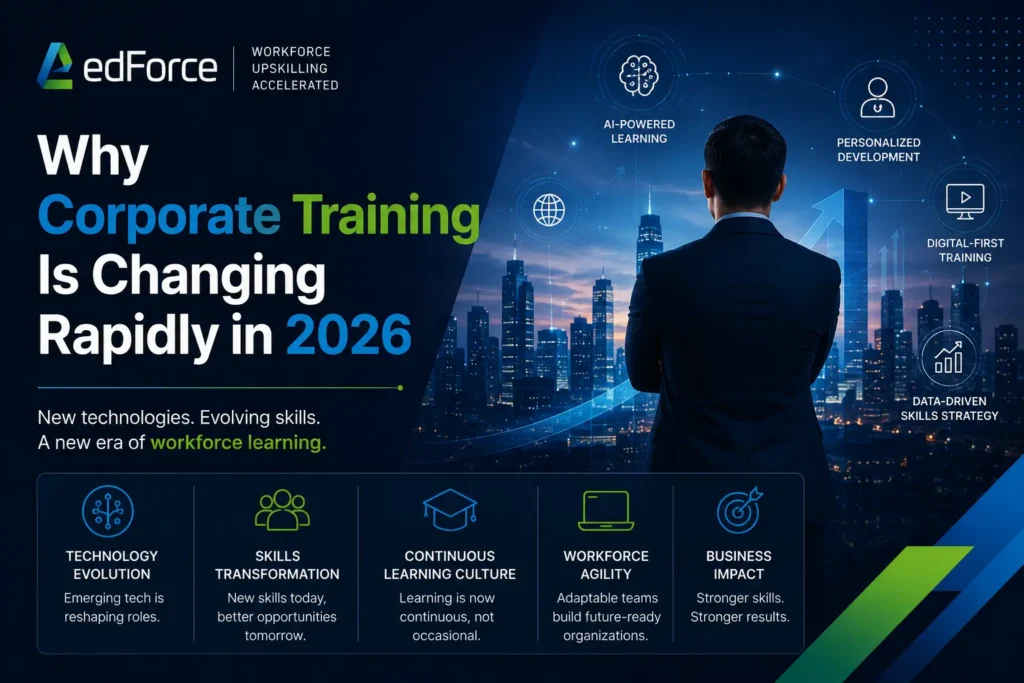
Corporate training has gone through one of the biggest workplace changes in recent years. Earlier, companies mainly focused on learning programs, certifications, and attendance tracking. Today, businesses are asking a different question. Does the training improve employee performance? This single shift is changing the corporate learning industry. Employees in many organizations already have access to thousands of courses, learning platforms, and certification programs. Even then, many companies still struggle with skill gaps, slow technology adoption, and teams being unable to apply learning in real projects. Information is no longer the problem. The real challenge is helping employees adapt quickly to new tools, workflows, and business expectations. Corporate training is changing rapidly in 2026. The Workplace Is Evolving Faster Than Traditional Learning One major reason behind this shift is the speed of workplace change. Today, teams work in environments shaped by: Many traditional learning systems were built for slower business environments. Employees could learn one skill and use it for years without major changes. That model no longer works. Today, technology changes quickly, workflows constantly evolve, and employees must adapt continuously. Learning systems now need to keep up with real business operations instead of remaining separate from them. This is why many organizations are rethinking workforce training. Employers Care More About Skill Application Than Course Completion A few years ago, businesses measured training success using: But those metrics alone are no longer enough. Many employees complete training programs successfully but still struggle to apply the learning. Managers often notice that employees understand concepts during training but face difficulty using them in real workflows. This has created an important realization for enterprises. Training creates value only when employees feel confident applying skills at work. Because of this, businesses now focus more on: This shift away from passive learning models is driving more practical and experience-based training approaches. Information Overload Is Becoming a Workplace Problem Another reason corporate training is changing is because employees already deal with too much information every day. Most professionals work with: When training becomes another disconnected stream of information, engagement drops quickly. Employees no longer want repetitive or overly theoretical learning that feels unrelated to their work. They want learning that helps solve real workplace problems. Modern workforce development is becoming more workflow-focused and role-based. Businesses now understand that employees learn better when training directly connects with their daily responsibilities. AI Is Changing Corporate Learning Expectations Artificial intelligence is also changing corporate learning faster than most companies expected. Earlier, much of workplace training focused on memorizing processes and manually understanding systems. Today, AI tools can automate many repetitive tasks. Because of this, businesses increasingly want employees who can: This represents a major shift in learning priorities. Employers no longer want employees who only “know information.” They want employees who can adapt confidently inside fast-changing environments. This requires a very different learning approach. Practical Learning Is Becoming More Important The demand for practical training is growing strongly in 2026. Many companies now realize that theory alone does not prepare employees for real operational situations. In real workplaces, teams deal with: Employees need more than conceptual understanding. They need confidence handling real situations. That is why businesses increasingly prefer: Employees build stronger confidence and retention when they actively apply skills instead of passively consuming information. Enterprise Upskilling Is Becoming Continuous Upskilling is no longer a one-time activity. In many industries, skills become outdated much faster than before. Companies can no longer depend only on occasional training sessions. To stay competitive, organizations are building continuous learning cultures where employees regularly improve skills alongside changing technologies. This is especially visible in areas like: Companies that adapt the fastest are usually the ones treating workforce learning as a business function instead of a one-time HR task. Employees Want Learning That Supports Career Growth Modern employees are also becoming more selective about training. People no longer want courses only to collect certificates. Employees want learning that: This is pushing organizations to rethink how training programs are designed. Employees become more engaged when they clearly understand: Corporate learning is becoming more employee-focused instead of only compliance-driven. Why Companies Are Choosing More Flexible Training Models Traditional learning systems are often rigid and difficult to scale. Modern businesses need learning systems that support: That is why companies are moving toward flexible learning models that combine: At edForce, enterprise training programs are designed around modern workforce and operational needs. The focus is on helping teams build skills that improve real business performance instead of simply completing training modules. The Real Reason Corporate Training Is Evolving Corporate training is changing because businesses now understand that workforce capability directly affects business performance. Skill gaps no longer impact only HR reports. They now affect: Strong learning systems are becoming a major business advantage. That is why training is becoming more connected to real business strategy instead of functioning only as a support activity. Final Thoughts In 2026, corporate training is no longer only about teaching information. It is about helping employees adapt quickly, apply skills confidently, and work effectively inside changing business environments.
The Growing Demand for GPU Accelerated Computing Skills
A few years ago, GPU computing was mainly connected with gaming, graphics rendering, and specialized environments. Today, it has become one of the key technologies behind modern AI, cloud computing, and data processing. The demand for GPU-accelerated computing skills is growing rapidly across industries as businesses adopt AI and large-scale computing workloads. However, many companies are now facing a new challenge. They are investing heavily in GPU infrastructure and AI systems but still struggle to find professionals who understand how to work effectively with these environments. This skill gap is becoming a major workforce challenge in 2026. Why GPU Computing Is Becoming So Important Modern businesses process far more data today than ever before. Companies now work with: Traditional CPU-based systems often struggle to handle these workloads efficiently at scale. GPU-accelerated computing allows systems to process large numbers of parallel tasks much faster. GPUs are now a major part of: GPUs are now at the center of many AI technologies businesses use today. AI Growth Is Increasing the Demand for GPU Skills One major reason GPU computing skills are becoming more valuable is the rapid growth of AI adoption. Today, businesses are building: AI projects require more than just software knowledge. Organizations also need professionals who understand: AI workloads are becoming larger and more complex. Companies investing in AI need teams that can support these systems not only conceptually, but also operationally. Companies Are Realizing Infrastructure Skills Matter Again Infrastructure capability is becoming important again in enterprise technology. Earlier, many companies focused mainly on software innovation while depending heavily on external providers for infrastructure expertise. As AI systems become more important for businesses, companies are realizing the need for stronger in-house technical capability. Businesses are starting to understand that: This is why GPU-accelerated computing skills are becoming highly valuable in enterprise environments. GPU Computing Is No Longer Limited to Research Teams Earlier, GPU computing was mostly used by research labs, universities, and highly specialized technical teams. That is changing quickly. Today, GPU workloads are used across: Businesses now need professionals who understand GPU-powered systems. The demand is growing far beyond niche technical roles. Why Practical GPU Skills Matter More Than Theory Many companies are realizing that theoretical knowledge of GPU computing alone is not enough. Real-world systems involve: Professionals need practical understanding of how accelerated computing works in operational environments. That is why hands-on GPU training is becoming more valuable than passive theory alone. When employees work with: They build skills that are much more useful in enterprise environments. The Rise of NVIDIA GPU-Centric AI Infrastructure NVIDIA technology now powers a large part of modern AI infrastructure worldwide. As organizations adopt more AI systems, demand is increasing for professionals who understand: Companies are also realizing something important. Buying advanced infrastructure is much easier than building teams that know how to use it effectively. That is why there is strong demand for training focused on GPU-accelerated computing skills by Nvidia Training. Why GPU Skills Create Long-Term Career Value One major advantage of GPU-accelerated computing skills is that they connect with many future-focused technologies. Professionals with GPU knowledge work in areas like: This creates strong long-term career flexibility. As AI adoption grows, GPU-related skills will likely remain highly relevant because accelerated computing powers many modern AI systems. Businesses Need Teams That Can Scale AI Effectively Scalability is another major reason GPU expertise matters. Many organizations launch AI projects successfully but struggle to scale them across enterprise environments. This often happens because: Professionals who know how to scale AI systems while maintaining performance and cost control are in very high demand. GPU-accelerated computing is now becoming a mainstream enterprise workforce skill. Why Continuous Learning Is Important in GPU Computing GPU technologies and AI infrastructure continue evolving very quickly. Continuous learning is important because: Businesses increasingly prefer professionals who continue building technical skills over time. In accelerated computing environments, outdated knowledge quickly loses value. Enterprise Workforce Development Around GPU Skills Many organizations are now investing in GPU-focused workforce training instead of relying only on outside specialists. At edForce, NVIDIA and GPU-accelerated training programs focus on real-world implementation, enterprise AI workflows, and hands-on learning environments so professionals can build practical computing skills for modern AI systems. This helps organizations: Final Thoughts The growing demand for GPU-accelerated computing skills reflects larger changes and CUDA training happening across the technology industry. Businesses are moving beyond simple AI experimentation and building larger, infrastructure-heavy systems that require practical technical expertise. Professionals who understand GPU-accelerated environments will become increasingly valuable as AI, cloud computing, and high-performance workloads continue expanding. By 2026, strong computing capability will no longer depend only on software knowledge. Understanding the infrastructure behind modern intelligent systems will become equally important.
Why Claude AI Adoption Requires Workforce Training
AI is being used in many companies, but actual AI usage inside most organizations still feels inconsistent. One team may use AI daily and save hours of work. Another team may barely use it because employees do not know how to use it properly. Some professionals get excellent results from AI systems, while others struggle to get useful outputs. This is making large-scale AI adoption difficult for businesses. Access to AI is no longer the problem. Most companies already have powerful AI platforms. The real challenge is helping employees understand how to use AI in real business workflows. That is why Claude AI adoption requires proper workforce training. Without structured learning, AI can create confusion, fragmented workflows, and inconsistent outputs across teams. AI Tools Alone Will Not Increase Productivity Many organizations believed employees would automatically learn how to use AI during the early stages of AI adoption. But this rarely happens. Most professionals quickly understand the basics of AI usage. However, enterprise environments require much more than basic usage. Employees need to understand: Without training, employees often use AI randomly instead of strategically. This creates uneven productivity across departments. Why Claude AI Is Different in Enterprise Environments Claude AI is increasingly being used in businesses because it handles structured communication, long-context understanding, documentation workflows, and detailed information processing very effectively. It can support: These use cases require employees to think differently about how they interact with AI systems. Employees need to understand: That is why workforce training becomes important when adopting Claude AI. Most Employees Still Do Not Know How AI Fits Into Daily Work One common challenge businesses face today is that employees understand AI conceptually but struggle with practical implementation. They know AI can be useful, but they are unsure: This uncertainty slows adoption. Many companies notice that employees complete AI training but still hesitate to use AI in daily work because the training feels disconnected from real business situations. That is why practical AI training matters more than basic AI awareness sessions. Workforce Training Helps Standardize AI Usage AI is not a uniform tool. Some employees use vague instructions. Others use detailed prompts. Some carefully review outputs, while others rely too heavily on AI-generated responses. Over time, this creates inconsistency across teams. Businesses then face problems such as: Structured Claude AI training helps organizations create more consistent AI workflows across departments. Employees learn: This improves both productivity and workflow reliability. AI Adoption Is More About Workflow Change Than Technology Many companies still treat AI adoption as only a technology project. In reality, AI adoption is mostly a workforce challenge. The biggest challenge is not installing AI tools. The real challenge is helping teams change how they work. Employees need to develop: This transition requires proper guidance. Without support, businesses often face: That is why many companies now invest in enterprise AI training instead of relying only on software deployment. Why Practical AI Training Matters More Than Generic AI Courses Many online AI courses explain AI concepts in a general way, but employees often struggle to apply AI inside real business operations. Real workplace environments involve: These situations require practical learning. The best Claude AI training programs focus on: This helps employees feel more confident using AI in real operational environments. Companies Need AI-Literate Teams, Not Just AI Tools In 2026, businesses are realizing that AI success depends heavily on workforce capability. The same AI platform can produce very different results for two companies depending on: Companies that see the strongest AI productivity improvements are usually the ones investing in both workforce training and technology adoption. This is quickly becoming a major competitive advantage. Why Employees Need Confidence When Using AI Lack of confidence is one of the hidden barriers to AI adoption. Employees often worry about: Without proper guidance, employees may either avoid AI completely or depend on it too much. Both situations create problems. Training helps employees understand: This makes AI adoption more effective and reliable inside organizations. Enterprise AI Adoption Requires Long-Term Learning Businesses are also realizing that AI training cannot be treated as a one-time workshop. AI systems evolve quickly. Workflows continuously change. Teams constantly discover new use cases and operational challenges. This means enterprise AI learning has become a continuous workforce development process instead of a one-time training activity. At edForce, Claude AI training focuses on real business use cases, workflow-based learning, and practical enterprise implementation. This helps organizations build stronger internal AI capability instead of simply introducing AI tools. Final Thoughts Successful AI adoption depends heavily on workforce training because AI implementation is more about people and workflows than just software. Businesses need employees who can confidently, consistently, and responsibly use AI in real operational environments. The companies gaining the most value from AI are not simply the ones adopting tools faster.
Why NVIDIA Skills Are Becoming Critical for AI Careers
Many professionals are unaware that AI systems depend heavily on computing infrastructure. People often focus only on AI models, tools, or prompts. But when enterprises build AI environments, they are equally focused on the infrastructure powering those systems. By 2026, NVIDIA-related AI skills are becoming essential for AI careers. The demand for AI professionals is growing as businesses invest heavily in: And this is no longer limited to advanced research teams. AI infrastructure is becoming an important enterprise skill. AI Growth Is Increasing the Demand for GPU Expertise A few years ago, AI was mostly focused on algorithms and data science concepts. Today, businesses are running much larger AI workloads. Organizations now work with: The computing power needed to run these environments is massive. Traditional CPU-based systems often struggle to handle modern AI workloads, especially when enterprises scale AI operations across large environments. This is where NVIDIA technologies become highly valuable. GPU-accelerated computing allows AI systems to process large amounts of data much faster, helping enterprises scale AI more efficiently. Why Enterprises Need More Than AI Theory Many professionals understand AI concepts but not the infrastructure behind them. This creates a challenge for businesses. Enterprises increasingly need teams that understand: Enterprise AI projects are becoming much more complex. AI is no longer limited to experimentation. Businesses now need professionals who can support AI implementation in real operational environments. NVIDIA Skills Are Becoming Valuable Across Multiple Roles Earlier, GPU computing was mainly associated with engineers and research environments. That is changing quickly. Today, NVIDIA-related skills are valuable for: Modern AI systems increasingly connect software workflows with infrastructure performance. Businesses now need professionals who understand both sides. The AI Industry Is Facing an Infrastructure Skill Gap One hidden challenge many companies face today is infrastructure dependency. Organizations invest heavily in: But many internal teams still lack the practical skills needed to manage and optimize these environments effectively. This often creates: AI growth requires more than software. It also requires strong workforce capability. That is one reason NVIDIA AI and GPU-focused training programs are growing rapidly. Why Practical NVIDIA Skills Matter More Than Surface-Level AI Knowledge A large part of online AI education still focuses mainly on: But enterprise AI environments involve much more complex operational challenges. Teams often deal with: This is where practical NVIDIA skills become highly valuable. Professionals who understand accelerated computing environments deeply are often much better prepared to support enterprise AI systems than those with only surface-level AI knowledge. AI Careers Are Becoming More Infrastructure-Oriented One major shift happening in 2026 is that AI careers are becoming more infrastructure-focused. Employers increasingly value professionals who understand: AI systems are becoming more complex and computationally intensive. Businesses need employees who can help AI systems run efficiently in real operational environments. NVIDIA Skills Support Long-Term Career Growth NVIDIA expertise connects with many future-focused industries. GPU-accelerated computing now supports: Because accelerated computing is expanding across industries, professionals with these skills often gain stronger long-term career flexibility. NVIDIA-related expertise is becoming valuable far beyond traditional AI engineering roles. Why Businesses Invest in AI Infrastructure Training Many companies now realize they cannot scale AI successfully without stronger technical capability. Earlier, businesses often depended heavily on outside consultants and vendors for AI infrastructure support. Today, organizations increasingly want in-house teams that can: That is why workforce development around NVIDIA accelerated computing and enterprise AI learning is becoming more important. The Real Difference Between Learning AI and Building AI Systems Many professionals eventually realize that using AI tools is very different from supporting AI systems. Real enterprise AI environments involve: Professionals with NVIDIA Training and GPU computing expertise usually understand these deeper operational realities much better. This practical understanding is becoming increasingly important for enterprise AI careers. Why Continuous Learning Matters in AI Infrastructure AI technologies continue evolving very quickly. GPU architectures, AI frameworks, infrastructure systems, and optimization methods keep changing every year. Businesses increasingly look for professionals who can: Today, the strongest AI professionals are often those who combine: At edForce, NVIDIA AI and GPU-accelerated computing training programs focus on hands-on learning, enterprise AI workflows, and practical implementation. This helps professionals build real-world AI capability instead of only theoretical understanding. Final Thoughts NVIDIA-related skills are becoming critical for AI careers because modern AI systems depend heavily on accelerated computing infrastructure. As AI adoption continues to grow, companies increasingly need professionals who understand not only AI concepts, but also the systems powering them. By 2026, AI careers will no longer depend only on software expertise. Understanding how to support, optimize, and scale real AI infrastructure will become equally important.
Best Self Paced Automotive Courses Online for Working Professionals
The automotive industry is evolving faster than most professionals anticipated. Today’s vehicles are not just mechanical systems. Today’s automotive environments combine electronic, diagnostics and software systems with automation, EV technology and smart manufacturing processes. Many professionals realize that their old skills are not enough to remain competitive. Most professionals are unable to leave their job in order to enroll in full-time classroom courses. Most people already have to manage their busy schedules and responsibilities, including project deadlines, shifting work, and operational duties. Self-paced automotive courses will be more popular online in 2026. There is also another reason for this growth. Professionals of today are not satisfied with certificates. They are looking for practical skills to improve their job prospects, adapt to changes in the industry, and grow their career. This is a new approach to automotive education. Why working professionals prefer self-paced learning Modern work environments are not always conducive to traditional training models. There are many professionals who work in: It is difficult to maintain fixed classroom programs on a regular basis. Auto courses that are self-paced offer learners greater flexibility, as they can develop their skills without disrupting their current work obligations. Flexibility alone isn’t the greatest advantage. Learning at a rate that is appropriate to your actual understanding, rather than rushing through training topics in order to complete the schedule, will be more beneficial. When professionals can practice, review, and apply their learning in real-world situations, they are better able to understand the technical concepts. The Automotive Industry is Facing a Skills Shift The automotive industry is experiencing rapid changes in job roles. In the past, most automotive jobs were centered around mechanical systems. Companies today are increasingly looking for professionals who can: The shift in the industry creates new job opportunities but also skill gaps. Now, many experienced professionals face a new challenge. Although they are familiar with automotive operations, they must update their technical knowledge in order to keep up with the latest systems. Online automotive courses are important for both beginners and experienced professionals. Why practical automotive learning is more important than theory Many technical courses are good at explaining concepts, but they don’t prepare students for the real world. It is a problem that becomes more serious in the automotive industry, where employees are often faced with: The theory alone is not enough to build confidence. When training is practical and connected to the real work environment, it helps working professionals learn more quickly. The best auto courses are not just about delivering information. They also focuses on: Professionals will remember skills better if they can see where and how they are used. Automotive Careers are Increasingly Technology-Driven The increasing importance of technology in the automotive industry is another reason why the growth in automotive learning has been rapid. Modern vehicles are now: Automotive professionals will need to be more technical-adaptable and mechanically literate. Employers no longer hire only those with traditional repair skills. Employers are now looking for professionals who have the confidence to work with new systems and technologies. It is for this reason that professionals who invest in upskilling themselves today will have better career prospects over the long term. Why self-paced courses are good for career growth Control is something that many professionals who are working appreciate when it comes to self-paced learning. You can: This can reduce the learning pressure, and improve retention. Many traditional classrooms are rushed to meet schedules. Automotive learning can be self-paced to allow professionals to gain understanding more easily and consistently. This is important for technical learning. The best automotive courses focus on industry-relevant skills Some automotive courses are not as valuable as others. Many programs are outdated and still heavily reliant on older technology, while the modern workplace increasingly requires updated technical knowledge. Today’s best automotive training programs focus on: The career benefits of courses that are aligned to real industry demands such like edForce can be much greater. Why Employees Upskill Instead of Switching Industries In 2026, many automotive professionals will choose to upgrade their skills instead of changing careers. In the past, workers often quit industries because technology changed too fast. More professionals today choose to adapt and update their skills instead of leaving the industry. The automotive industry is changing. Modern automotive environments include: Professionals who constantly improve their skills are more likely to adapt quickly to changing roles. Learn Flexibility is a Major ADVANTAGE Consistency is a hidden benefit of self-paced learning. Most working professionals who stop learning do not do so because they lack motivation but because it is difficult to balance work and family responsibilities with traditional training models. Online automotive courses are a great way to relieve some of the pressure. The learner can build skills without changing routines. This creates more long-term learning habits than short-term, high-pressure programs. Why Businesses Value Continuous Learning Today, employers are increasingly looking for employees who can improve their skills on their own. The automotive and manufacturing industries are not immune to the constant changes in technology. Actively learning professionals: Continuous upskilling has become highly valued in many technical industries. The automotive training programs at are geared towards practical workplace learning and the development of industry-relevant skills. This allows working professionals to improve their technical capabilities while still balancing other responsibilities. What professionals should look for before choosing a course The longest course does not necessarily mean the best. Professionals should concentrate on: When a course improves the actual capabilities of the student, it is more valuable than merely adding another certificate. Final Thoughts Professionals who are willing to learn more about the automotive industry will be better able to keep up with technology changes. Online self-paced automotive courses are popular because they allow working professionals to develop practical skills while maintaining their careers. They also allow students to gradually adapt to new automotive technologies and workplace demands. Career growth in 2026 will be more dependent on adaptability, learning, and confidence with modern systems than on knowledge that
What Enterprises Actually Expect From AI Skilled Employees
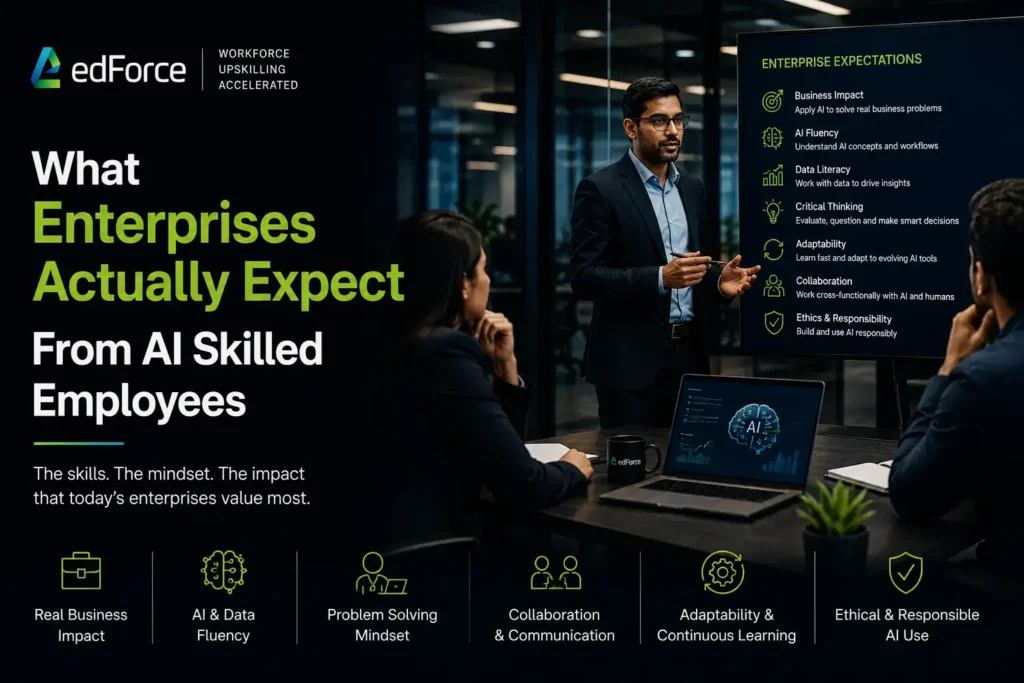
Many professionals believe that “AI skills” simply means knowing how to use AI software. But workplace expectations are changing. Companies are no longer impressed just because employees can create content with AI or write prompts. Businesses now want professionals who can use AI in real operational environments in a responsible and workflow-focused way. This shift is becoming much bigger in 2026. The conversation around AI skills is moving beyond: “Can employees use AI?” toward: “Can employees improve business performance using AI?” This difference is important. Enterprises Do Not Want Random AI Usage One major problem companies face after adopting AI is inconsistency. Some employees use AI in ways that improve productivity. Others use AI in ways that create confusion, poor results, or workflow disruptions. This creates uneven work quality across teams. Without structure, AI can create operational problems instead of efficiency. That is why employers increasingly expect employees to understand: These skills are far more valuable than basic AI experiments. Practical Thinking Is the Most Valuable AI Skill Many online discussions still focus heavily on prompts and AI tools. But in enterprises, the most valuable employees are the ones who think strategically. Professionals who understand business operations are in high demand. This includes understanding: AI becomes useful only when employees can apply it effectively in these areas. For example, employers value employees who can: This is very different from using AI casually. Businesses Expect Employees to Work With AI, Not Depend on It Enterprise environments are moving away from blind dependence on AI. Many organizations are becoming more careful about how employees rely on AI-generated outputs. Companies increasingly expect AI-skilled professionals to: This is especially important in: Businesses are not looking for uncontrolled automation. They want balanced and responsible AI usage. AI Skills Are Becoming Important Across Every Department Earlier, AI skills were mostly associated with technical teams. That is changing rapidly. Today, AI is becoming important across departments such as: Why? Because modern work has become highly information-driven. Employees now spend large amounts of time: AI can simplify many of these tasks, but only when employees know how to use it properly. That is why businesses now see AI skills as more than just technical knowledge. Businesses Value Adaptability More Than Tool Expertise Hiring priorities are changing. Companies are becoming less focused on mastery of a single AI tool and more focused on adaptability. Businesses understand that AI platforms will continue evolving quickly. New systems, models, and workflows will keep appearing. Because of this, employers increasingly prefer professionals who can: Developing the right mindset is becoming more important than memorizing AI features. The strongest AI-skilled employees are usually the ones who can adapt their work style as technology changes. Workflow Understanding Matters More Than Prompt Writing Many professionals still think AI expertise is mainly about writing prompts. But enterprises are increasingly focused on workflow integration. Anyone can use AI tools to generate output. The bigger challenge is understanding: Many businesses still struggle in these areas. Employees may know AI tools, but team workflows often remain inconsistent. This is one reason businesses are investing more in workforce AI training instead of only providing access to tools. Why AI Communication Skills Matter Clear communication has become an increasingly valuable skill. AI-assisted work requires: The way employees communicate with AI systems directly affects output quality. Businesses increasingly value professionals who can: Interestingly, AI is making strong communication skills even more valuable. Businesses Expect Employees to Improve Productivity Responsibly Many companies adopted AI expecting instant productivity improvements. Now businesses realize productivity improvements are not automatic. Employees need to understand: This requires more than technical curiosity. It requires operational maturity. That is why enterprises increasingly value practical AI literacy over surface-level AI awareness. Why Workforce AI Training Is Becoming More Important Businesses now understand that successful AI adoption depends heavily on workforce capability. Without proper training: That is why enterprises are investing more in structured AI workforce development programs. At edForce, enterprise AI training focuses not only on AI tools, but also on responsible usage, workflow understanding, and operational learning. This helps teams apply AI effectively in real business environments instead of treating AI as a separate tool. Real Skill Is What Enterprises Actually Need In the end, employers are not simply looking for employees who “know AI.” They want professionals who can: This combination of AI knowledge and practical thinking is far more valuable. Final Thoughts Employer expectations for AI-skilled professionals are changing quickly. Businesses are no longer interested in isolated AI knowledge or random AI experimentation. They want professionals who can integrate AI into real workflows and improve operational efficiency. In 2026, strong AI capability will be less about casually using tools and more about helping organizations work faster, smarter, and more consistently.
Red Hat Training and Certification Guide for 2026
Linux skills will be more valuable in 2026 for a different reason. Red Hat certifications used to be primarily associated with infrastructure teams and system administrators. Linux knowledge today is associated with much larger fields like cloud computing and DevOps. It also includes automation, cybersecurity, enterprise infrastructure management, and containerization. Companies are actively seeking professionals with experience in enterprise Linux systems to help them move towards hybrid cloud environments. Red Hat’s training and certification program is in high demand among enterprises and technology teams. Many professionals continue to ask the same question. Does Red Hat certification really matter in 2026? Yes, but only if the learning is relevant and aligned to real job roles. Red Hat Skills Still Matter Technology changes quickly, but enterprise infrastructure does not change overnight. Many businesses still heavily rely on Linux-based platforms for: Red Hat Enterprise Linux is one of the most popular enterprise Linux platforms, because it offers stability, security and long-term support. It is for this reason that companies value professionals who are familiar with Linux environments rather than those who only learn cloud platforms on a superficial level. What is the biggest problem with IT certifications today? Many professionals today are faced with certification overload. Many people have multiple certifications, but struggle with real-life implementation tasks. The employers are becoming more cautious when evaluating the candidates, as many certifications do not guarantee practical ability. It is particularly true for roles in cloud and infrastructure. Although many students understand theory and commands, they often struggle with the practical application. Practical Red Hat training is more important than just passing an exam. Red Hat Certification: What it Really Means Red Hat certifications are more than just credentials for a resume. This shows that the professional has a good understanding of how Linux systems operate in enterprise environments. Included in this is: Red Hat certifications have a reputation for being performance-oriented, unlike many certifications that are heavy on theory. This is why employers still value them when it comes to technical hiring. What Red Hat certifications are important in 2026? Different certifications can be useful for different career paths. It depends on what type of cloud or infrastructure role you want to pursue. Red Hat Certified System Administration (RHCSA). RHCSA is one of the most popular Linux certifications among professionals who are entering roles in enterprise infrastructure and Linux administration. The focus is on: This certification is often regarded as the basis for further Red Hat learning. Red Hat Certified Engineer (RHCE) RHCE is a more advanced version of RHCE and places a greater emphasis on: RHCE is a valuable certification for professionals in DevOps or enterprise operations as well as infrastructure management. Red Hat OpenShift and Automation certifications OpenShift skills are growing rapidly as enterprises adopt Kubernetes and containers. Professionals who can understand the needs of companies are in high demand. It is for this reason that advanced Red Hat training goes beyond Linux administration. Why enterprises still invest in Red Hat Training Today, many businesses face major infrastructure challenges. The adoption of cloud computing is growing rapidly, yet many teams lack a deep understanding of Linux and infrastructure. This leads to a dependency on external teams for support and slows operational execution. Enterprise Red Hat training has become important once again. Organisations invest in Linux training because a strong infrastructure helps: Companies that focus on skill development over certifications are more likely to see positive results. Red Hat Training for Modern Infrastructure Roles In 2026, Linux skills will no longer be limited to the system administrator role. Red Hat Training supports professionals in the following areas: Red Hat certifications are more flexible than most people think. Experts with a combination of Linux and cloud knowledge, as well as automation skills, are highly valued in enterprise environments. What is the Difference between Learning Linux and Working with Linux? Many online courses are very good at explaining Linux concepts, but the reality of enterprise environments is different. Teams are involved in the actual business operation of: Hands-on Red Hat Training is more effective than passive video training alone. Red Hat’s training programs at edforce.co are based on a practical approach, guided learning and the development of enterprise-focused skills, rather than a theoretical preparation. This allows professionals to gain confidence when working in Linux environments. What professionals should focus on in 2026 Many learners are guilty of chasing certifications, without gaining operational understanding. Employers will increasingly look for professionals with the following skills in 2026: It is more important to have a practical understanding of the material than memorize it. When a certification reflects real skill readiness, it becomes valuable. Does Red Hat certification still make sense in 2026? Yes, if you are a professional in the infrastructure, cloud, DevOps or enterprise operations. The certificate is not the only thing that adds value. Real value is found in: Businesses still need professionals to understand the modern systems that run on cloud and AI platforms. Red Hat certification and training will still be relevant in 2026. Final Thoughts Enterprise systems are still heavily dependent on a strong infrastructure, despite the fact that technology is constantly changing. Red Hat certifications are still valuable because they emphasize practical Linux knowledge instead of just theoretical knowledge. Linux knowledge is a valuable long-term asset for professionals who want to advance their careers in DevOps and cloud computing, enterprise operations, infrastructure, or DevOps. In 2026, the professionals who will stand out are not the ones with the most certifications. The professionals who will stand out in 2026 are not the ones with the most certifications.
Best Corporate Training Company for Enterprise Upskilling
The majority of companies are not struggling today because employees don’t want to learn. The real issue is that corporate training is still disconnected from actual job roles and workplace requirements. Employees may attend training sessions, earn certifications, and complete learning modules, but when it comes to applying those skills in real projects, many still feel limited. Managers notice low adoption rates. Teams often return to old workflows, and productivity improvements remain smaller than expected. This is why enterprises are becoming more selective when choosing a corporate training company. Businesses are no longer interested in training that only looks good in reports. They want programs that improve daily operations, help employees adapt faster, and build long-term workforce capability. This shift is changing how enterprises approach upskilling in 2026. edForce is not just another course provider. The focus is on helping organizations build practical workforce skills that employees can confidently apply in real business environments. Why Upskilling Enterprises Has Become a Business Priority A few years ago, corporate training was often treated as a supporting function. Today, it directly impacts business growth, productivity, and technology adoption. The reason is simple: Technology is evolving much faster than traditional education systems. Companies are rapidly adopting AI, cloud technologies, automation platforms, cybersecurity systems, and new digital workflows. However, many employees still rely on outdated processes because organizational learning systems struggle to keep pace. This creates a growing gap between: Enterprise upskilling is no longer optional. It has become part of a long-term business strategy. What Makes a Good Corporate Training Company? Most training providers focus heavily on certifications and course catalogs. But today, enterprises need much more than access to content. A strong corporate training company should help organizations: The difference becomes visible when learning improves real workflows instead of staying limited to training dashboards. One major mistake companies make is selecting training vendors only based on brand recognition or the number of available courses. The best enterprise training partners understand how employees learn and apply skills in the workplace. Why Traditional Corporate Training Often Fails Many businesses face a common but overlooked problem: employees complete training programs but rarely change their work habits afterward. There are several reasons for this: Sometimes the learning is too theoretical. In other cases, the training becomes outdated before employees finish it. Often, the content has little connection to actual job responsibilities. The result is predictable: Employees do not need more random information. They need training designed around real workflows and real workplace challenges. Modern enterprise upskilling is becoming more practical and role-focused. Enterprise Training Needs Practical Learning, Not Just Content Online training is useful for explaining concepts, but it often fails to prepare employees for real-world situations. This is becoming a major challenge in areas such as: Employees may understand the terminology but still struggle with implementation. edForce training programs focus on real-world business use cases instead of disconnected theory. Learning is designed to help professionals apply skills in real enterprise environments through guided sessions, hands-on learning, and workflow-based models. This improves team confidence, increases retention, and speeds up skill adoption. The Biggest Workforce Shift Is Happening Now In 2026, companies will no longer hire only for current skills. Businesses are increasingly hiring and training employees for adaptability. Why? Because technology changes too quickly. Employees who can adapt to new workflows and learn emerging systems are becoming far more valuable. Organizations are changing the way they approach workforce development. Modern enterprise training now focuses on: This represents a major shift in corporate learning programs. Why Enterprises Are Looking for Long-Term Training Partners Many organizations are moving away from one-time training models. The reason is practicality. Upskilling has become an ongoing process and is now part of continuous workforce development. Today, businesses need partners who can support: That is why companies increasingly prefer corporate training firms that understand enterprise challenges instead of relying on generic learning modules. The strongest partnerships are formed when learning aligns with operational goals. How Enterprise Upskilling Impacts Business Performance Many businesses underestimate how strongly workforce capability affects overall performance. Skill gaps often lead to: Strong upskilling programs help organizations: Enterprise learning is now becoming a core part of business growth strategy, not just HR planning. What Businesses Should Consider Before Selecting a Training Partner The largest course library does not always mean the best corporate training provider. Businesses should focus on: Training providers should understand not only the technology itself, but also the operational challenges businesses face while adopting new systems. That difference matters more than marketing claims. Why Companies Choose edForce Enterprise Training edForce enterprise training primarily focuses on developing practical skills that match modern workforce challenges. The programs are designed to improve real team capabilities rather than provide generic learning experiences. The training focuses on: This helps employees adapt more effectively in a rapidly changing business environment. Final Thoughts Corporate learning is no longer just about completing courses. It is about helping employees apply skills effectively in real workplace situations. That is the biggest difference modern businesses are looking for today. Companies want training that improves execution, supports transformation, and helps teams adapt faster to new technologies and workflows. The best corporate trainer is not the one offering the most courses. It is the company that helps organizations build practical, long-term workplace capability while creating measurable business impact. FAQ‘s