


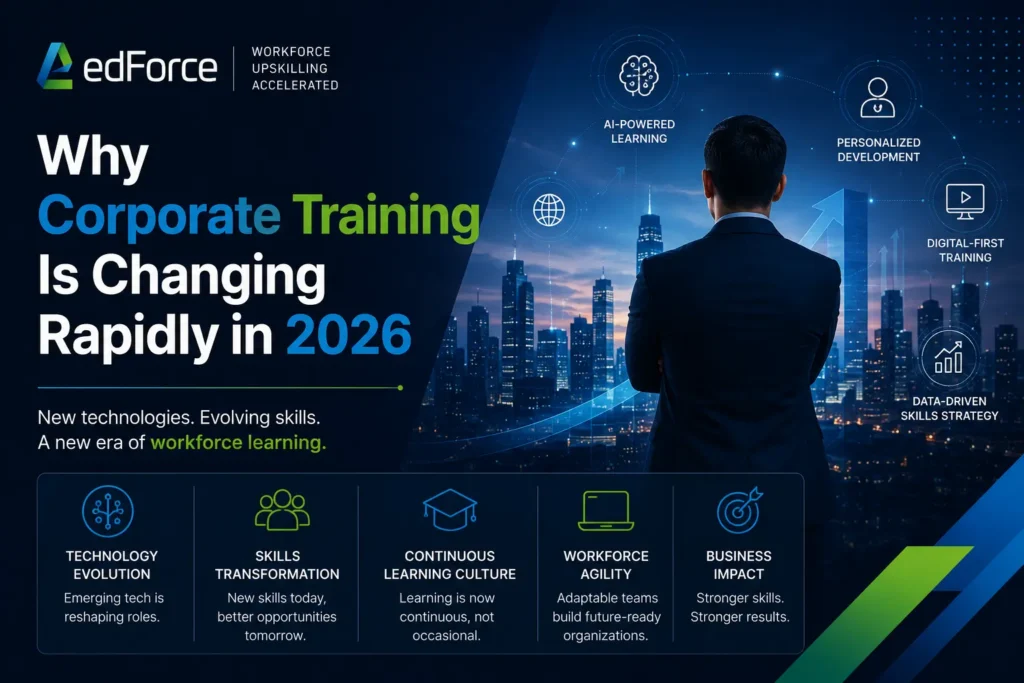
Corporate training has gone through one of the biggest workplace changes in recent years. Earlier, companies mainly focused on learning programs, certifications, and attendance tracking. Today, businesses are asking a different question.
Does the training improve employee performance?
This single shift is changing the corporate learning industry. Employees in many organizations already have access to thousands of courses, learning platforms, and certification programs. Even then, many companies still struggle with skill gaps, slow technology adoption, and teams being unable to apply learning in real projects.
Information is no longer the problem. The real challenge is helping employees adapt quickly to new tools, workflows, and business expectations. Corporate training is changing rapidly in 2026.
The Workplace Is Evolving Faster Than Traditional Learning
One major reason behind this shift is the speed of workplace change.
Today, teams work in environments shaped by:
- AI tools
- Automation systems
- Cloud platforms
- Remote collaboration
- Shorter project cycles
- Changing customer expectations
Many traditional learning systems were built for slower business environments. Employees could learn one skill and use it for years without major changes.
That model no longer works. Today, technology changes quickly, workflows constantly evolve, and employees must adapt continuously. Learning systems now need to keep up with real business operations instead of remaining separate from them.
This is why many organizations are rethinking workforce training.
Employers Care More About Skill Application Than Course Completion
A few years ago, businesses measured training success using:
- Completion rates
- Attendance
- Certification numbers
But those metrics alone are no longer enough. Many employees complete training programs successfully but still struggle to apply the learning. Managers often notice that employees understand concepts during training but face difficulty using them in real workflows.
This has created an important realization for enterprises.
Training creates value only when employees feel confident applying skills at work.
Because of this, businesses now focus more on:
- Practical implementation
- Workflow readiness
- Problem-solving ability
- Adaptability
- Operational confidence
This shift away from passive learning models is driving more practical and experience-based training approaches.
Information Overload Is Becoming a Workplace Problem
Another reason corporate training is changing is because employees already deal with too much information every day.
Most professionals work with:
- Constant notifications
- Meetings
- Dashboards
- Reports
- Emails
- Changing systems
When training becomes another disconnected stream of information, engagement drops quickly.
Employees no longer want repetitive or overly theoretical learning that feels unrelated to their work. They want learning that helps solve real workplace problems.
Modern workforce development is becoming more workflow-focused and role-based.
Businesses now understand that employees learn better when training directly connects with their daily responsibilities.
AI Is Changing Corporate Learning Expectations
Artificial intelligence is also changing corporate learning faster than most companies expected.
Earlier, much of workplace training focused on memorizing processes and manually understanding systems. Today, AI tools can automate many repetitive tasks.
Because of this, businesses increasingly want employees who can:
- Think critically
- Adapt quickly
- Work with AI-supported systems
- Solve operational problems
- Manage changing workflows
This represents a major shift in learning priorities.
Employers no longer want employees who only “know information.” They want employees who can adapt confidently inside fast-changing environments. This requires a very different learning approach.
Practical Learning Is Becoming More Important
The demand for practical training is growing strongly in 2026. Many companies now realize that theory alone does not prepare employees for real operational situations.
In real workplaces, teams deal with:
- Implementation pressure
- Workflow dependencies
- Communication gaps
- Unexpected technical issues
- Operational deadlines
Employees need more than conceptual understanding. They need confidence handling real situations.
That is why businesses increasingly prefer:
- Hands-on learning
- Guided implementation
- Real-world simulations
- Workflow-based training
- Instructor-led practical sessions
Employees build stronger confidence and retention when they actively apply skills instead of passively consuming information.
Enterprise Upskilling Is Becoming Continuous
Upskilling is no longer a one-time activity. In many industries, skills become outdated much faster than before. Companies can no longer depend only on occasional training sessions.
To stay competitive, organizations are building continuous learning cultures where employees regularly improve skills alongside changing technologies.
This is especially visible in areas like:
- AI
- Cloud computing
- Cybersecurity
- Automation
- DevOps
- Data analytics
Companies that adapt the fastest are usually the ones treating workforce learning as a business function instead of a one-time HR task.
Employees Want Learning That Supports Career Growth
Modern employees are also becoming more selective about training. People no longer want courses only to collect certificates. Employees want learning that:
- Supports career growth
- Builds confidence
- Develops practical capability
- Creates future opportunities
- Helps them stay relevant
This is pushing organizations to rethink how training programs are designed. Employees become more engaged when they clearly understand:
- Why learning matters
- How it supports their role
- Where they can apply it
- How it improves future growth
Corporate learning is becoming more employee-focused instead of only compliance-driven.
Why Companies Are Choosing More Flexible Training Models
Traditional learning systems are often rigid and difficult to scale. Modern businesses need learning systems that support:
- Remote teams
- Hybrid work environments
- Different skill levels
- Changing technologies
- Faster implementation cycles
That is why companies are moving toward flexible learning models that combine:
- Live training
- Practical workshops
- Guided labs
- Self-paced support
- Structured enterprise learning paths
At edForce, enterprise training programs are designed around modern workforce and operational needs. The focus is on helping teams build skills that improve real business performance instead of simply completing training modules.
The Real Reason Corporate Training Is Evolving
Corporate training is changing because businesses now understand that workforce capability directly affects business performance.
Skill gaps no longer impact only HR reports. They now affect:
- Execution speed
- Technology adoption
- Customer experience
- Operational efficiency
Strong learning systems are becoming a major business advantage. That is why training is becoming more connected to real business strategy instead of functioning only as a support activity.
Final Thoughts
In 2026, corporate training is no longer only about teaching information. It is about helping employees adapt quickly, apply skills confidently, and work effectively inside changing business environments.