


Cloud vs AI Certifications: Which Has Better Career Growth?
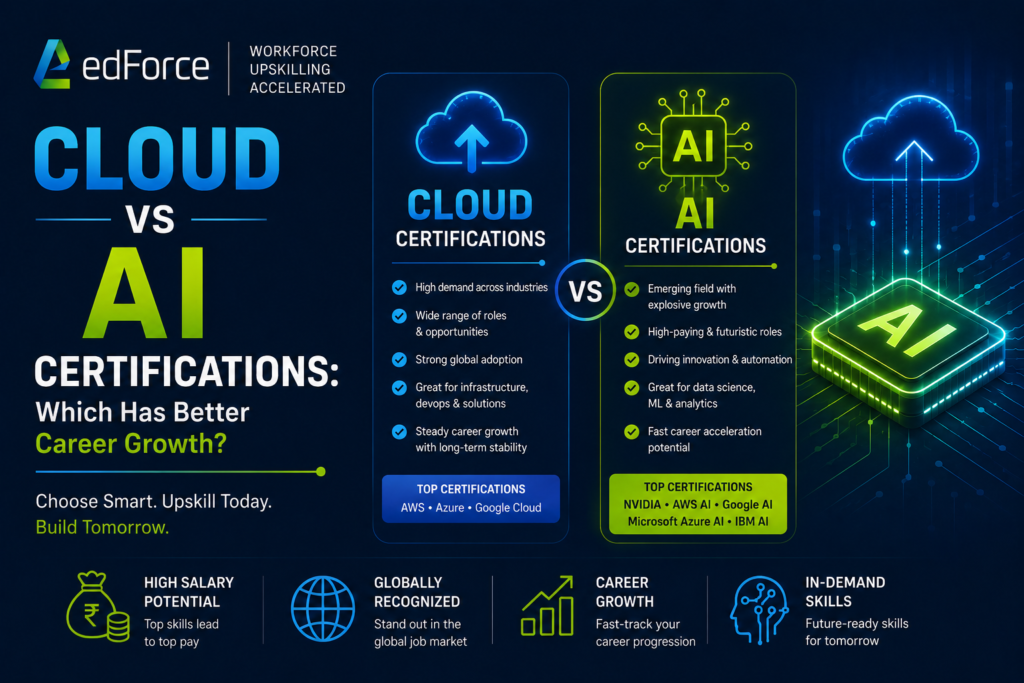
A few years back, selecting a technology certificate was relatively easy. You pursued AWS certifications, Azure certifications, and Google Cloud certificates if you were interested in working with cloud computing. You could also follow security-related learning paths if you are interested in cybersecurity. Software developers spent their time learning programming languages and frameworks. The decision today isn’t so simple. Artificial Intelligence is now a part of nearly every technology discussion. AI Engineers are being hired faster than ever by companies. Cloud computing is still the backbone of digital transformation and continues to power almost all modern applications. Many professionals are left with a question. Should you invest in AI or Cloud certifications when it comes to AI? There is no universal winner. Your current experience, your career goals and what you like to do will determine which is the best choice. The future belongs to those who can combine both. Why? Cloud Computing isn’t going anywhere People often think that older technology will lose value when a newer technology is popularized. Cloud computing has not been a failure. Cloud platforms have become even more popular since AI. Infrastructure is a necessity for every modern AI application. Models require computing power, storage and networking, as well as security, monitoring and deployment environments. Cloud services are the backbone for enterprise AI, whether an organization uses AWS or Microsoft Azure. Cloud professionals are in high demand. Cloud infrastructure is a key component of almost all digital businesses today. As a result, organizations continue to hire Cloud Engineers and Solutions Architects. They also continue to hire DevOps Engineers. AI does not replace cloud careers. It increases their importance. Why AI Certifications are Growing so Quickly AI offers new opportunities and AI Certifiations for careers, even though cloud computing is still essential. Businesses no longer experiment with AI. Businesses are now integrating AI into their customer service, software, marketing, healthcare and banking systems, as well as internal operations. As adoption increases, companies need professionals that understand: Generative AI Large Language Models Prompt Engineering Agentic AI AI deployment Retrieval – Enhanced Generation (RAG). AI Governance AI certifications are gaining in popularity because of this demand. One thing, however, is important to remember. AI is changing at an incredible rate. Every month, new models, frameworks, and tools are improved. Professionals who are constantly learning will always be at an advantage over professionals who only rely on one certification. Cloud computing and AI careers: The biggest differences The Cloud computing and AI can solve a variety of business problems. Cloud professionals create and maintain the infrastructure on which businesses rely every day. AI professionals are focused on developing intelligent applications, automating work flows, and helping companies use data better. This is a simple way of thinking about it. Clouds create the environment. AI is the intelligence. Both are needed by modern enterprises. AI applications are not scaleable without cloud infrastructure. Cloud platforms are powerful without AI but lack intelligent business capabilities. Many organizations hire professionals who are familiar with how these technologies interact rather than those who only understand them separately. What employers are looking for today Hiring for enterprise jobs is undergoing a significant shift. Several years ago, many companies hired specialists to work on specific technologies. Today, hiring managers prefer to hire professionals who have complementary skills. As an example: The Cloud Engineer with AI knowledge often stands out over someone who only has cloud knowledge. A AI Engineer with AWS or Azure knowledge can contribute to production deployments faster. DevOps professionals who are familiar with MLOps can be very valuable as they can help support the AI lifecycle. The traditional roles of technology are becoming increasingly blurred. This trend is expected to continue in the coming years. What certifications should you consider? It depends on your current location. Cloud certifications are a great way to start your career in technology. They teach you about infrastructure, networking and identity management. Popular choices include AWS Certified Solutions Architect Microsoft Azure Administrator Google Associate Cloud Engineer AI certifications are useful if you have experience in cloud computing or software development. There are many professionals who have recently explored certifications. NVIDIA AI Microsoft Azure AI AWS AI Google Machine Learning Generative AI Agentic AI These certifications do not replace cloud knowledge; they build upon it. Salary shouldn’t be the only decision Many professionals are on the lookout for the best-paying certification. Salary is important, but it shouldn’t drive your decision. Careers in technology are developed over many years. Cloud architecture is more likely for someone to develop expertise than AI, which they choose because it’s more popular. Professionals who are genuinely interested in AI innovations will also be more motivated to keep up with the changes as this field evolves. For long-term career advancement, it is best to develop deep expertise in a field you are passionate about and then expand into related technologies. The future belongs to hybrid professionals A prediction is becoming more and more realistic. In the next five to ten years, it is possible that the difference between Cloud Engineers (cloud engineers) and AI Engineers will be much smaller. Cloud infrastructure is already a major part of enterprise AI. AI services are being added to cloud platforms at a rapid pace. Organisations are looking for employees who have the skills to deploy AI applications, manage resources in the cloud, optimize infrastructure and understand business workflows. Companies are now valuing professionals who can combine multiple disciplines instead of hiring specialists for each technology. It’s a great opportunity. Many professionals could benefit from gaining expertise in both cloud computing and artificial intelligence. How to Create a Smart Learning Map Don’t consider certifications as isolated accomplishments if you are unsure of where to start. Consider them as building materials. As an example: Learn the basics of cloud computing. Learn Linux and network. DevOps is a concept that you should understand. Next, move on to AI, machine-learning, and Agentic AI. This sequence provides a solid foundation, because AI applications
Highest Paying AI Certifications in 2026
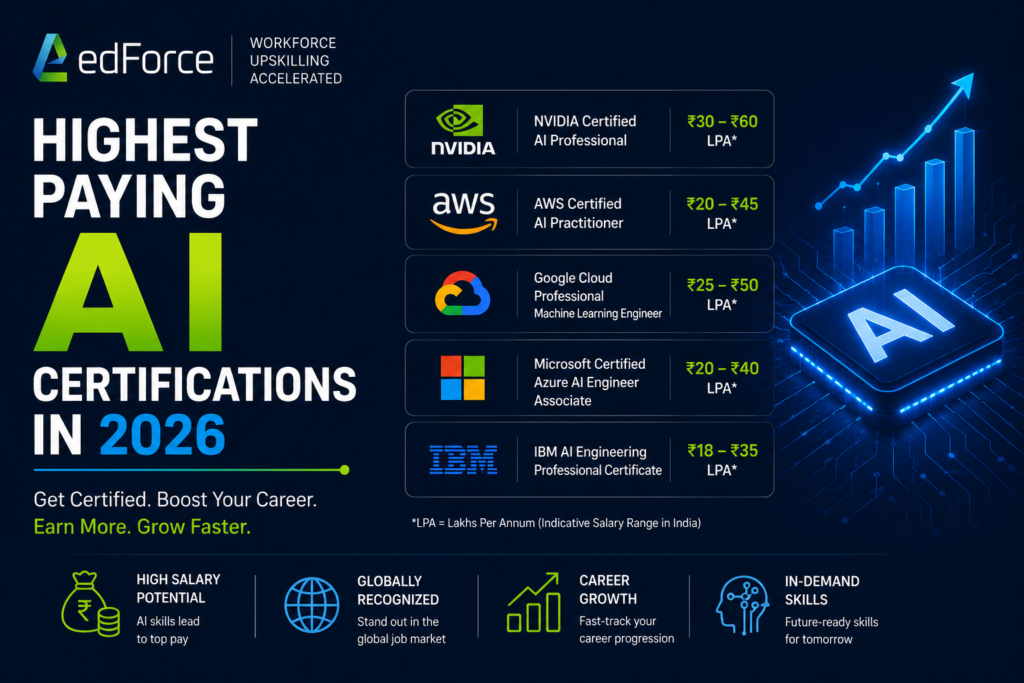
AI creates new job opportunities every month. You can find a variety of roles on any tech hiring portal, including AI Engineers, Generative AI developers, Machine Learning engineers, AI consultants, MLOps engineers, and AI Solutions architects. Many companies in banking, healthcare and retail are looking for AI professionals. One question that is often asked when there are so many options for careers is: “What should I do?” Which AI certifications help you to land high-paying positions? You may be surprised by the answer. It is not true that a certification will automatically lead to a higher wage. Employers pay more to professionals who are able to solve real-world business problems and not just those who have passed an exam. The right certification will help you develop the skills that employers are looking for, increase your credibility when hiring, and lead to better opportunities in the future. Look at the AI certifications which will create the most career opportunities by 2026. What makes an AI certification valuable? Most professionals select certifications on the basis of popularity. Asking a different question is a better way to go. Does this certification teach skills for which companies actively hire? Three things are common to the highest-paying certifications. They focus more on the practical application of theory than on the theoretical side. They are also compatible with enterprise technologies. They continue to evolve as AI changes. Cloud AI, Generative AI and GPU computing certifications, as well as AI engineering courses, are getting much more attention than general AI awareness classes. Google Cloud Professional Machine Learning Engineer Google’s Professional Machine Learning Engineer Certification continues to be one the most respected credentials among professionals who build production-ready AI systems. This course focuses on the design, deployment, monitoring and maintenance of machine learning solutions using Google Cloud. This certification is suitable for: Machine Learning Engineers AI Engineers Data Scientists MLOps Professionals It is highly valued by employers because it combines cloud deployment and machine learning skills. This area continues to be in high demand. Microsoft Azure AI Engineer Associate Microsoft technologies are already widely used by many enterprises. Azure AI Engineer Associate is one of the most sought-after AI certifications for enterprise hiring. Learn how to create, deploy and manage AI solutions with Azure AI services. This certification is particularly valuable for professionals who work with: Applications of Enterprise AI Conversational AI Computer Vision Natural Language Processing Responsible AI When organizations adopt Microsoft AI services, they often seek professionals with a thorough understanding of AI and Azure. AWS Skill Builder AWS is still one of the most popular cloud platforms for enterprises around the world. AI certifications have become increasingly valuable as they combine cloud-based knowledge with AI implementation. Popular options, depending on your level of experience, include: AWS Certified AI Practitioner AWS Machine Learning Engineer Associate These certifications will help professionals to understand AI services, machine-learning workflows, deployment and operational best practices in AWS environments. NVIDIA AI Certifications The demand for AI infrastructure professionals, and not just AI models, is growing in the enterprise. NVIDIA’s certifications are a standout. Businesses need AI professionals who are familiar with Generative AI and GPU-accelerated computing. Popular NVIDIA Learning Paths include: LLMs and Generative AI Accelerated computing AI Infrastructure Deep Learning These certifications will become increasingly important for AI engineers, infrastructure experts, developers, and enterprise AI team members working on modern AI applications. NVIDIA’s certification ecosystem has grown significantly as enterprises have invested more in AI production systems. Databricks Certifications for Generative AI When enterprises are ready to move beyond the experimentation phase, they will need AI professionals who can create AI systems based on production data. The Databricks Certifications have gained attention due to their focus on data engineering and machine learning workflows. These certifications will be of particular value to professionals who work with: AI data pipelines Enterprise Analytics Large Language Models Machine Learning Operations Databricks users often seek professionals who are able to connect data engineering and AI implementation. What certification pays the most? It is a question that every professional will ask. Employers pay for capabilities. A Machine Learning Engineer who has hands-on experience with cloud deployment, AI infrastructure and production systems, for example, will earn more money than someone holding only multiple certificates. Recent industry comparisons consistently rank advanced Google Cloud ML certifications, AWS Machine learning, Azure AI Engineer and the newer NVIDIA-focused certificates among the best options for high-paying AI positions, especially when paired alongside real project experience. Salary is not the only thing to chase Many professionals make the mistake of choosing a certification solely based on salary reports. It is better to match your certifications with the career you want. As an example: AWS AI or Azure certifications are a good choice if you like cloud technology. NVIDIA certifications and Generative AI certificates are increasingly important if you want to develop enterprise AI applications. Google Cloud Professional Machine Learning Engineer may be a good choice for you if you are interested in machine learning and AI production systems. Career growth is usually achieved when learning and interests are aligned. Trends to Watch A shift in the hiring process is taking place. The trend is to hire specialists with a wide range of skills, rather than hiring specialists that are experts in a single technology. They are instead looking for professionals with a combination of AI and cloud computing, DevOps or data engineering. It seems more and more likely that the future AI professional will require a broader knowledge of technology than just AI expertise. A person who is familiar with AI, cloud platforms and business processes will have an advantage over someone who only focuses on machine learning. Many professionals combine AI certifications and cloud and enterprise technologies certifications rather than pursuing them individually. Build AI skills that employers actually need Certificates are not the best way to grow your career. Combining learning with experience is the key. Passing an exam is not as valuable as working on projects, understanding the business
Red Hat Certifications That Employers Value Most
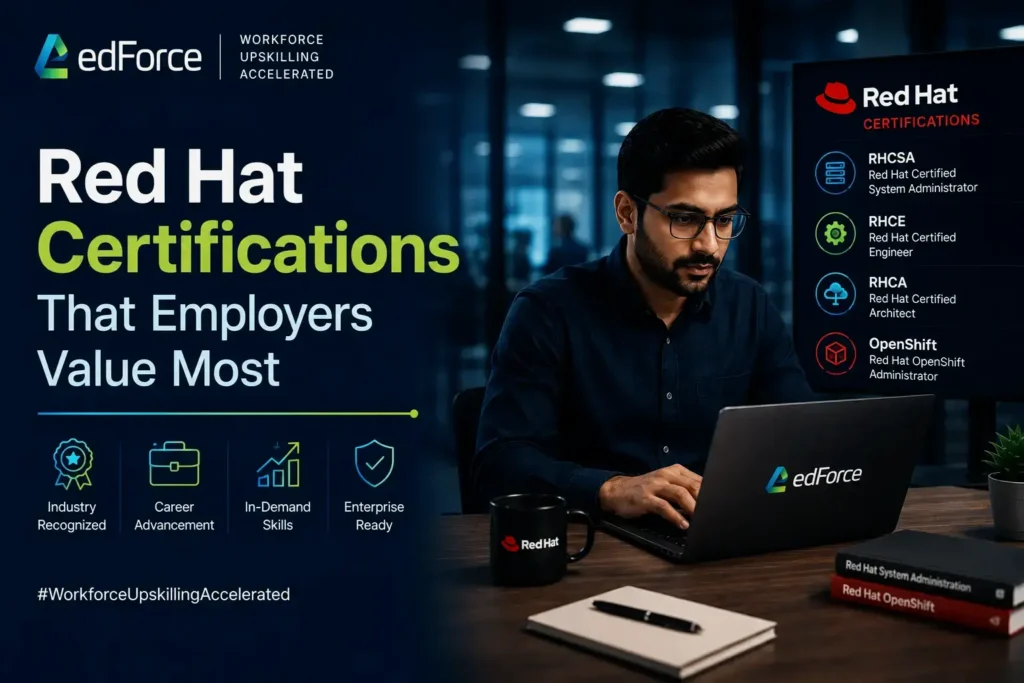
The hiring of technology professionals has changed dramatically over the past few years. In the past, employers mainly looked for professionals who had experience. Employers still value experience, but they also want to know that the candidate can use modern enterprise technology. Professional certifications are still valuable, particularly in the fields of cloud computing, Linux administration and automation, as well as enterprise infrastructure. Red Hat Certifications are among the most popular because they emphasize practical skills over theoretical knowledge. The candidates are required to complete real-life tasks rather than answering multiple choice questions. This makes a big difference for employers. Many professionals are unaware of this fact. The goal isn’t to get certified. The goal is to develop the skills organizations require to operate secure, reliable and scalable IT environments. Look at which Red Hat certifications employers most value and why they remain relevant to 2026. Red Hat certifications continue to matter Linux is a major part of the enterprise technology landscape today. Linux is the basis for many business-critical systems, including cloud platforms, banking systems, telecom networks, health applications, government infrastructure and healthcare applications. Red Hat Enterprise Linux users need professionals with the skills to secure, manage, troubleshoot and optimize their environments. Red Hat Certifications are a standout. Red Hat tests require that candidates demonstrate their practical skills. This hands-on approach is often appreciated by employers because it helps them feel more confident that professionals certified can make a contribution from the first day. Red Hat’s skills will continue to be in demand as businesses adopt hybrid cloud, automation and container technologies. Red Hat Certified System Administration (RHCSA) RHCSA is a good place to start for many IT professionals. This course focuses on essential Linux administration skills, which employers look for in system administrators and professionals who work with infrastructure. Rather than memorizing commands and solving practical tasks, learners use real systems to solve practical problems. Professionals who prepare for RHCSA learn: Manage Linux systems Configure storage and users Basics of networking Monitor system performance Manage security settings Troubleshoot common Linux issues RHCSA is often considered by organizations that hire junior Linux administrators or support engineers to be one of the best entry-level credentials because it validates actual skills rather than knowledge. Red Hat Certified Engineer (RHCE) Many professionals choose RHCE after they have become familiar with Linux administration. This certification goes beyond system administration, and is more focused on enterprise system management and advanced administration. Automation is now a common expectation in today’s business environments. It is no longer viewed as a skill. In order to manage infrastructure efficiently, teams are increasingly using tools instead of manually configuring hundreds or servers. RHCE is a valuable tool for professionals who work in the Linux environment, including system engineers, DevOps specialists, and senior Linux administrators. RHCE is often viewed by hiring managers as proof that a candidate has the ability to manage more complex and larger enterprise environments. Red Hat Certified Architect RHCA is the highest level of Red Hat Certification. Instead of focusing on one technology, it allows professionals develop expertise in multiple enterprise domains, such as cloud computing, automation, containers and virtualization, security and application platforms. Experienced professionals who work as: Infrastructure Architects Enterprise Architects Senior Consultants Cloud Specialists Technical Leads Professionals with advanced Red Hat knowledge often play a key role in helping organizations manage large IT environments. They can plan infrastructure, improve operational efficiency and support digital transformation initiatives. Red Hat OpenShift certifications Container technologies continue to reshape enterprise software development. OpenShift is becoming more valuable as organizations adopt Kubernetes, cloud-native apps and Kubernetes. Red Hat OpenShift Certifications provide professionals with the knowledge they need to understand: Container Platforms Kubernetes administration Application deployment Cluster Management Container operations These skills will be particularly valuable to DevOps teams and cloud engineers as well as organizations that are modernizing their application infrastructure. Many enterprises no longer hire only Kubernetes experts. They want people who know how Kubernetes integrates into enterprise operations, governance and security. This broader understanding opens up new career opportunities. Red Hat Ansible Automation certifications Enterprise IT has a new priority: automation. It is not practical to manage infrastructure manually for companies that operate hundreds or thousands systems. Red Hat Ansible Automation is gaining in popularity. Professionals will learn how to automate repetitive administrative duties, improve consistency, decrease manual errors, and enhance operational efficiency. Automation saves time and improves reliability in enterprise environments. Automation knowledge will become more valuable as infrastructure expands. What Certification Should you choose? Your current position and career goals will determine the certification you need. RHCSA is most beneficial to someone who is just starting out in a Linux-based career. RHCE is often used by professionals who manage enterprise Linux environments. RHCE can be combined with OpenShift and Ansible for cloud engineers or DevOps professionals. RHCA is a certification that allows architects to expand their enterprise knowledge. It is better to create a learning pathway where each certification helps you reach the next level of your career, rather than collecting certifications. What Employers Look for It is a common misconception that employers only hire people with certifications. Certifications are a great way to get candidates noticed. They can get hired with their skills. Employers often ask questions during interviews to determine how professionals use their knowledge in real-life situations. Are they able to solve production problems? Is it able to automate repetitive tasks Are they able to troubleshoot Linux environments Can they confidently support enterprise infrastructure? Professionals with certification and hands-on work experience tend to stand out more than those who only focus on passing exams. The Future of IT Careers Could Be Shaped by a Trend The traditional infrastructure roles of enterprise are starting to overlap with cloud computing and cybersecurity. Today, a Linux administrator may also be working with containers. A cloud engineer may need automation skills. A DevOps professional may manage Kubernetes clusters alongside enterprise Linux systems. Red Hat certifications now serve a broader range of technology professionals, rather
How to Upskill While Working Full Time
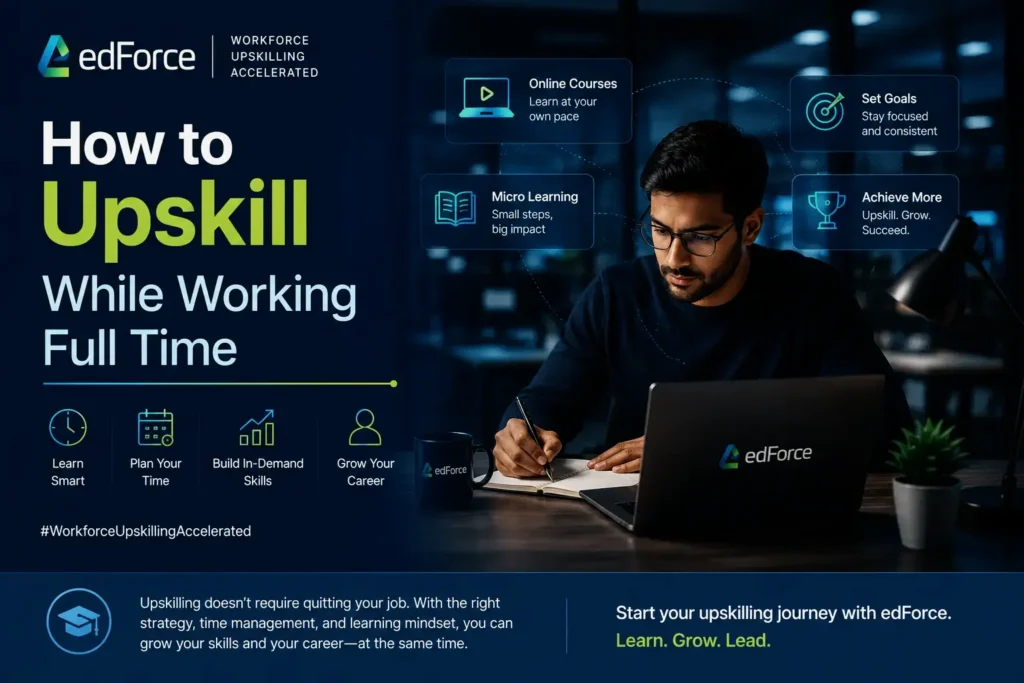
Many professionals are not willing to learn. There is never enough time. Meetings, deadlines, email, project updates and unexpected requests are all part of a typical workday. Learning something new can feel like an extra task by the end of the day. Many people put off upgrading their skills. After the project is completed, the next release or when work becomes less hectic, they tell themselves that they will start working after this. Sadly, the perfect moment rarely comes. Technology continues to advance. AI is now part of the everyday workplace. Cloud platforms are changing. Cybersecurity needs are evolving. Every few months, new tools are released. The fastest growing people aren’t necessarily the ones with the most time. They are the ones who continue to learn, even when busy. It is possible to upgrade your skills while still working full-time. It is not necessary to spend hours studying every day. It is important to integrate learning into your daily routine, rather than treating it as an extra project. No more waiting for extra time The myth that learning requires large blocks of uninterrupted space is a common one. Most working professionals will never enjoy this luxury. You may have to wait months if you are waiting until you schedule is completely free. Think about learning in the same way that you would think about healthy eating or exercise. Consistent, small efforts usually produce better results than intense bursts. Over a period of months, even thirty minutes of focused work per day can make a significant difference. Finding more time is not the challenge. The use of existing time is more intentional. Learn skills that will help you solve today’s problems A common mistake is to choose courses based on popularity. Ask yourself one question before enrolling in a program. Will this skill be used in the next few months by me? Motivation becomes easier if you answer yes. Cloud training, for example, will feel immediately relevant if your business is moving towards cloud platforms. Learning prompt engineering or Generative AI can be beneficial almost immediately if AI tools become part of your everyday work. When you can use new knowledge within a week of learning it, you will find that you are able to learn more quickly. Focus on one skill instead of five Many professionals start out with enthusiasm. Students can enroll in AI courses. They add cloud certification. Cybersecurity is a must. Then data analytics. They stop learning after a few days because they are overwhelmed. It is better to develop one skill at a given time. Learn the basics. Use what you have learned. Continue to the next area. Initially, progress may seem slower but usually it becomes more sustainable. Learning is not a sprint, but a marathon. Learn on the Job Many successful professionals have a habit of combining learning and work. They combine both. Imagine you’re learning Azure. Volunteer to do a simple cloud-related job. Use AI tools to summarize or organize documents and meeting notes if you’re studying AI. Automate a task that takes you several minutes each day if you’re learning Python. When theory and real work are combined, the fastest learning occurs. Your practice environment becomes your projects. Create a weekly learning routine Consistency is more important than intensity. It is not necessary to study each evening. You need a realistic schedule. This might look something like: Weekdays, 30 minutes before starting work A weekend learning event that focuses on one specific topic Reviewing notes during short breaks Practice new skills whenever possible on real tasks Routines eliminate the daily question of “Should you study today?” “ Learning becomes a part of the week. Do not chase every new technology The technology is constantly changing. Each week, it seems, there is a brand new AI model or framework. It is impossible to know everything. Build strong foundations instead. Understanding cloud architecture, for example, is more important than memorizing all the new cloud services. It is better to learn AI basics than jump from one AI application to another. Professionals who have solid foundations are more likely to adapt quickly when new technologies emerge. Qualifications open doors, skills build careers Professional certifications are still valuable. These courses help to demonstrate commitment, and they provide structured learning pathways. Employers are increasingly looking beyond certificates. Hiring managers are looking for people who have the ability to solve problems. When two candidates have the same certifications, the candidate who can demonstrate how they used those skills on a real-life project will often stand out. When you finish a course ask yourself the following questions: “How can I apply this knowledge to my work?” This question transforms learning into experience. The Trends Worth Paying Attention to The value placed on the learning abilities themselves is a noticeable change. Technology stacks change. The job roles of employees are changing. AI is reshaping the way work is done. Employers are increasingly looking for professionals with the ability to adapt quickly, rather than those with experience in a single technology. It seems more and more likely that continual learning will be a key career skill, rather than merely an advantage. People who update their knowledge annually are likely to be valuable no matter how technology changes. The Right Structure Makes Learning Easier Some professionals find that self-learning is a good option. Other people benefit from a structured path of learning, live mentoring and hands-on labs. It is important to have a practical understanding of technologies like AI, Red Hat, NVIDIA and cybersecurity as well as data engineering. A well-designed program can help reduce confusion, increase confidence and keep learners motivated until they achieve their goals. Grow Your Career without Pressing Pause Many professionals feel they must choose between their career and their current responsibilities. Both can occur simultaneously. Most successful professionals don’t take long breaks to learn. They instead integrate learning into their daily routine. edForce.co training programs are created with the working professional in mind. Learners can build
How NVIDIA GPUs Are Used in AI Training and Inference
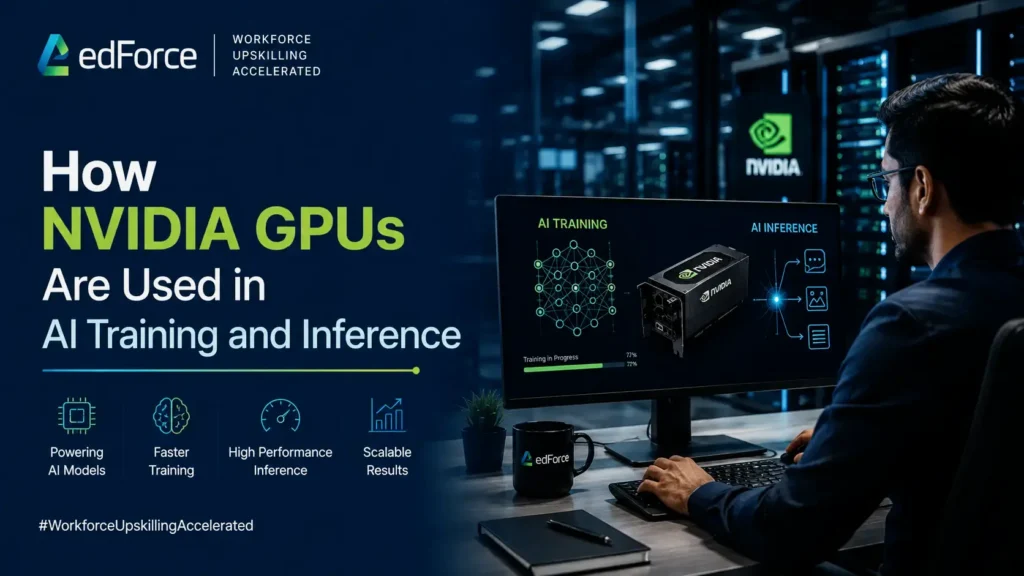
Several years ago, the main reason for buying faster hardware was to improve performance. Today’s topic is making AI practical. Each enterprise is looking for AI that can respond quickly, scale smoothly, and deliver reliable results. Behind the scenes, whether it’s an internal chatbot or AI assistant for employees, recommendation engines, or Agentic AI applications, there is one thing that makes it all possible. The GPU is a graphics processing unit. NVIDIA is known for its powerful graphics cards. But in the AI industry NVIDIA GPUs play a larger role. They are used to power some of the largest AI models in the world, as well as supporting enterprise AI infrastructure and helping organizations create applications that millions of users use every day. Many professionals are still unsure of what GPUs do. Why are they important? Why do companies invest in NVIDIA? Understanding the answers will help you understand why GPU-accelerated computing is one of the fastest growing skill areas in AI. AI Needs more than powerful software Most AI conversations begin with models when businesses embark on their AI journey. Should we use the Large Language Model for our linguistics? What AI platform should be chosen? How accurate is this model? They are good questions, but overlook an important part of the equation. Even the most intelligent AI models need computing power to process information, learn and generate responses. Imagine this: A model of AI is like an experienced employee. The GPU is the workspace which allows an employee to work efficiently. Even excellent AI models can become slower, more costly to operate and harder to scale if they lack enough computing power. The fact that AI and infrastructure are increasingly seen as being two sides of a single strategy is why many enterprises view them this way. What does AI training actually mean? It is important to know what AI training is before comparing it with inference. The AI model is trained by analyzing huge amounts of data. The model analyses millions of examples or even billions, identifies patterns and improves its prediction. It gradually becomes more accurate. This process is extremely computationally intensive. Imagine having one employee read all the books in a large collection. It would take many years. Imagine thousands of employees sharing their knowledge and experiences from reading books. This is similar to the way GPUs can accelerate AI training. They perform thousands of simultaneous calculations instead of one after the other. Modern AI training is made possible by parallel processing. NVIDIA GPUs are effective for AI training The traditional processor is designed to perform a wide range of computing tasks. GPUs are built differently. They excel in performing thousands of simultaneous operations of the same type. AI training is heavily dependent on this capability. All of these applications, including computer vision systems and recommendation engines, require millions upon millions of calculations per second. NVIDIA GPUs manage this workload. It is for this reason that they are the first choice of organizations developing enterprise AI solutions. Training advanced AI models without GPU acceleration would be much slower and more expensive. What is AI Inference? After a model of AI has completed learning, it moves on to the next stage known as inference. Inference is the moment that people begin to use the model. As an example: A worker asks a question to an AI assistant. A customer uploads an analysis document. AI provides medical insights to a doctor A recommendation engine suggests products. The model no longer learns. The application of what has been learned. Although it may seem easier than training, this stage has its own challenges. Businesses expect AI systems that respond almost immediately. Customers are rarely willing to wait for several seconds between interactions. Fast inference is just as important for accurate training as it is to have a fast response. Why inference is just as important as training Some people believe that AI training is difficult and that inference happens automatically. In fact, companies often spend more effort thinking about inference. Why? Inference is a problem for business. Customer experience is negatively affected if an AI-powered system for customer support takes too long. Productivity drops if an AI assistant delays answering questions during meetings. Scaling an AI application that cannot handle thousands users at once is difficult. NVIDIA GPUs can help overcome these challenges because they provide fast and efficient inference performance, while simultaneously supporting a large number of requests. AI applications are responsive to demand even if it grows. NVIDIA GPUs in Enterprises: Where are they used today? GPU-accelerated computing is not limited to the research laboratories. NVIDIA AI Training are used in a wide range of industries to support AI. Some of the most common enterprise applications are: Generate AI assistants Retrieval-Augmented Generation systems (RAGs) Workflows for Agentic AI Computer vision solutions Fraud detection Medical Imaging Financial Analysis Manufacturing Automation Intelligent customer support All these uses cases are connected by speed. AI systems are a must for organizations that want to process information efficiently without compromising accuracy. GPU acceleration is most valuable in this area. GPU Skills are Increasingly Valuable A new trend in hiring is emerging. AI is no longer the only thing that companies are looking for. Also, they are looking for AI professionals. AI adoption is growing and businesses need to hire employees who can understand it. GPU-accelerated computing NVIDIA AI Platforms AI deployment Model optimization AI Performance Tuning Enterprise AI infrastructure It is a great opportunity for those professionals who want to develop their NVIDIA AI capabilities. A prediction is becoming more and more realistic. In the coming years, AI infrastructure may be as important as AI talent. Building Enterprise AI Teams AI is not just about technology. People do. Many organizations have already access to powerful AI platforms, cloud-based tools, and GPU infrastructure. It is often the workforce that makes the difference. Can teams use AI effectively? Is they optimize their inference performance? Can they manage enterprise AI environments Can they scale
Claude AI vs ChatGPT: Which Is Better for Enterprises?
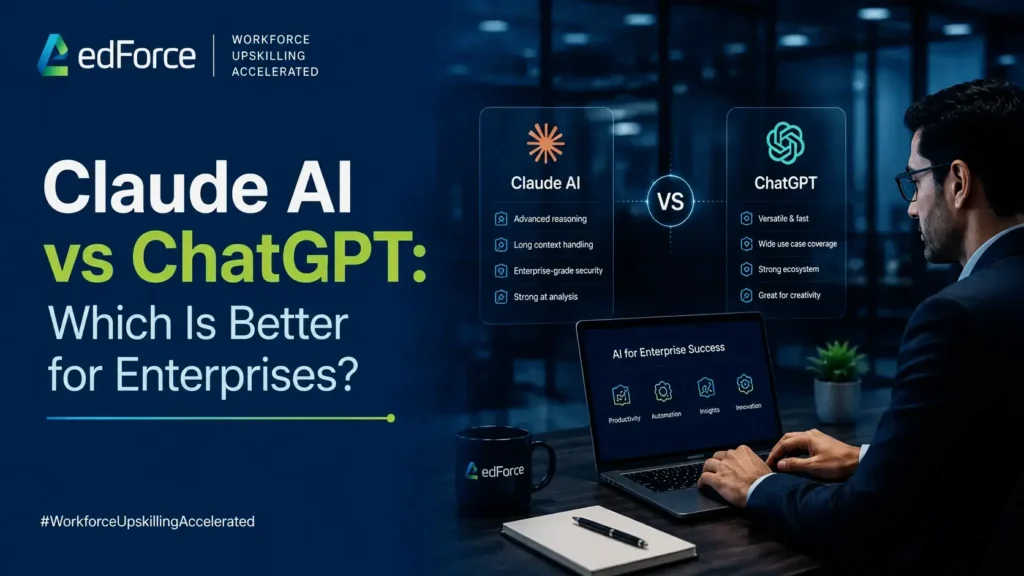
The decision to choose an AI platform is no longer a technical one, but a decision of business. A year or two back, many companies were debating whether AI was even worth it. This discussion is largely over. The question today is different. Which AI platforms will provide the greatest value to our team? In almost all enterprise conversations, two names are used: ChatGPT and ClaudeAI . Both are very powerful. Both are improving rapidly. Both can be used to help employees handle information and work more quickly. They aren’t exactly the same. Most businesses compare features only. Enterprises should instead compare , which is how each platform fits with their people, business processes and goals. It is rare that the best decision comes down to picking a winner. It’s about selecting the right tool to do the work that your team does every day. Understanding the business need is important before comparing tools Many organizations are exhibiting a similar pattern. Teams spend many weeks comparing AI models, but they only spend a few moments discussing how their employees will use them. This approach is usually a recipe for disappointment. The first question you should never ask is “Which AI system is better?” “ The correct wording is: “What business problem do we want to solve?” A legal department has different requirements than a customer service team. A software engineering team is different from an HR team. Marketing teams need different skills than finance teams. When the business goal is clearly defined, selecting the best AI platform becomes easier. Where Claude AI performs well Claude AI is a popular tool for enterprises who work with a lot of written material. It is used by many professionals to summarize documents, understand context and organize ideas. It is particularly useful in activities like: Reviewing contracts and policies Summarizing reports Documentation Knowledge management Business Research Long-form Writing Enterprise communication Claude AI training is especially useful for employees who spend a lot of time reading and processing information. It encourages well-structured and thoughtful outputs. This can be a great tool for organizations that deal with knowledge-intensive tasks. It will improve productivity and consistency. What ChatGPT brings to the table ChatGPT is gaining popularity because of its versatility. It can be used for a variety of tasks in the business world, including writing content, brainstorming ideas, data analysis and workflow automation. ChatGPT is used by many enterprises for: Software development support Marketing content Customer Communication Business Analysis Learn more about Learning Assistance Workflow Automation Problem-solving creativity The wide ecosystem and constant feature development makes it appealing to organizations that are looking for flexibility in multiple departments. ChatGPT is used by many companies to communicate across non-technical and technical teams. It is often the way teams work that makes a bigger difference. Comparing features only tells part of the story. The most important differences are often found in the employee workflows. Many organizations spend a lot of time on documents, policies and research. Other rely heavily upon coding, automation and rapid experimentation. The AI platform can produce different business values depending on its environment. This is why companies should compare AI to workflows rather than marketing. A tool with more features, but a lower adoption rate, will typically deliver better results. Productivity is more dependent on skills than the platform Many businesses fail to consider this. Platforms are only one part of the equation. The same AI tool can produce different results when used by two employees. You will receive clear and useful responses. Other struggles have inconsistent results. It is rare that the difference comes from technology. The user is the one who must understand how to use AI, assess responses and correctly apply information. The importance of workforce capabilities is growing as AI adoption does. Investing in AI without employee training can often lead to inconsistent business results for organizations. Should enterprises choose one platform? Not necessarily. In 2026, many organizations will be moving away from using only one AI platform. Diverse departments benefit from different tools. As an example: Some HR teams prefer to use a single platform for communication and documentation. The developer can choose another to receive technical assistance. Business analysts can combine AI tools based on the project. The hybrid approach allows companies to utilize each platform in the areas where they add value, rather than forcing all teams into the same workflow. This flexible model will likely become more popular in the coming years. What should enterprises focus on first? Organizations should ask themselves a few questions before deciding whether to use Claude AI or ChatGPT. What business processes take up the most time of employees? What teams deal with large amounts of data? What can AI do to improve quality, rather than just speed? How can employees use AI to their advantage? What policies will encourage responsible AI use? These questions can have a bigger impact on AI success that the actual platform choice. The technology can never stop evolving. Long-term value is created by strong business processes and highly skilled employees. The Next Enterprise AI Challenge AI is already changing the conversation. Businesses today compare Claude AI with ChatGPT. Tomorrow they are likely to compare AI agents, enterprise AI workflows, and autonomous systems. It is therefore more important to learn how to use AI than a particular AI platform. Employees who are familiar with the concepts of prompt design, workflow, critical evaluation and AI usage will be able to adapt better as new technologies emerge. Adaptability may become one of most important workplace skills in the next five to ten years. Building Enterprise AI skills with edForce The journey begins with choosing an AI platform. Employees who are confident in applying AI to their work will bring real business value. edForce.co enterprise AI training focuses primarily on practical business applications. This includes Claude AI and ChatGPT. It also covers responsible AI practices as well as emerging technologies like Agentic AI. It is more important to build
What Is Agentic AI? A Beginner’s Guide for Enterprises
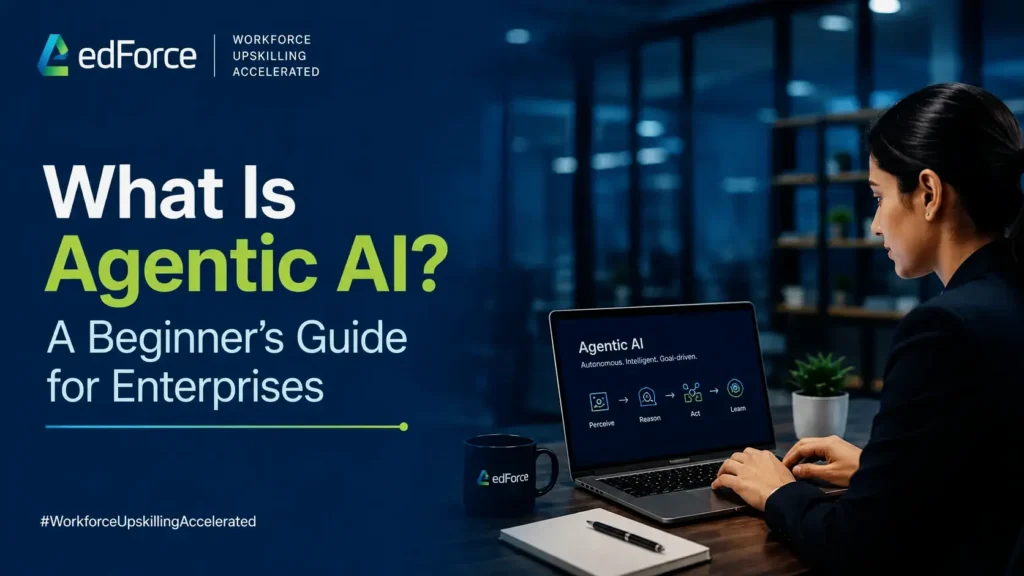
Most workplace discussions about AI used to revolve around one question: Can AI help employees work quicker? “ This question is changing. The business leaders now ask for something more. Can AI do some of the work while employees concentrate on more valuable tasks? “ Agentic AI is one of the most popular topics in enterprise tech because it reflects this shift. Agentic AI, unlike traditional AI tools, is designed to plan and reason. It can make decisions within boundaries that are defined, as well as complete multiple steps in order to reach a goal. It does not replace humans, but can help reduce repetitive tasks and improve team efficiency. This is the next step in AI adoption for many organizations. Understanding Agentic AI, however, is easier than successfully implementing it. Before investing in AI agents for business, employees must understand the technology, how it will fit into operations and what role humans are still going to play. Let’s begin with the basics. What is Agentic AI? Agentic AI is a term used to describe AI systems which can work towards a specific goal instead of waiting on one instruction at a given time. AI traditional usually follows a very simple pattern. A person asks a question. AI can provide a solution. Conversation stops until next request. Agentic AI is different. It can be used to break down a large task into smaller tasks, gather information from multiple sources, evaluate potential actions and complete certain parts of a workflow before requesting human approval. Consider the difference between asking for directions and planning a trip. One gives information. The other is helpful in achieving the goal. Agentic AI is especially useful for businesses that deal with repetitive processes, a large amount of information and complex decisions. Why are enterprises talking about agentic AI? Not every technology trend is a game changer for business. Agentic AI training has attracted attention due to its potential to improve business workflows rather than just individual tasks. Consider creating a team of customer service representatives. A traditional AI assistant could draft a response to a client’s question. A AI agent can go further, by retrieving previous conversations, identifying the issue of the customer, suggesting a solution, preparing the response, and contacting the relevant department, if necessary. While the employee reviews the results, much of the routine tasks are performed automatically. It allows teams to spend less time collecting data and more time focusing on solving problems. This is why businesses are starting to view Agentic AI more as a productivity tool than just another AI application. What is the difference between agentic AI and generative AI? Many people confuse agentic AI with generative AI, but these two terms solve very different problems. Generative AI is a technology that focuses on the creation of content. You can use it to write emails, create reports, summarise documents, create images or answer questions. Agentic AI is focused on completing workflows. It is a combination of reasoning, planning and decision-making as well as task execution that helps achieve a specific business goal. This is a simple way to tell the difference between them: Generative AI creates. Agentic AI coordinates, acts and is Both technologies will be used by most enterprises, rather than one or the other. What businesses can use agentic AI for? Agentic AI’s popularity is largely due to its ability to support multiple departments, rather than a single team. Some common enterprise use cases include: Automated customer service workflow IT service desk support Onboarding HR processes Internal Knowledge Management Sales assistance Project coordination Business Reporting Document processing It is flexible, because it focuses more on the business process than on individual tasks. Each organization has repetitive processes that eat up valuable employee time. Agentic AI is designed to streamline many of these activities. Why employee training is important A common misconception is that technology is all a business needs. Technology alone is rarely enough to create a successful transformation. It is important that employees understand the decisions made by AI, when they need human oversight, and how best to work with these systems. Often, organisations adopt policies in a non-coordinated manner without proper training. Some teams are too reliant on AI. Some people avoid it entirely. Both approaches are not long-term beneficial. Many enterprises invest in Agentic AI Training prior to introducing AI agents into their critical business operations. Adoption is much easier when employees are aware of the strengths and weaknesses of the technology. What skills should businesses start building? The skills that organizations require are changing as AI agents become more prevalent. AI is no longer limited to AI tools. It is also important to know how AI can be integrated into existing business processes. The following are some of the most important skills: Understanding AI agents, workflows and AI agents Design and task planning in advance Workflow automation concepts AI Governance and Responsible Usage Evaluation of outputs and critical thinking Collaboration between AI and humans It is interesting to note that these skills are not just technical. Understanding how AI agents improve the day-today work of managers, analysts, business leaders, and operations teams will be beneficial to them. Many companies are beginning to notice a shift A new trend has emerged across all industries. Not all organizations investing in AI will necessarily make the biggest progress. These professionals are the ones who help employees to adapt to new working methods. The technology can be deployed fairly quickly. Changes in habits, workflows and decision-making take much longer. The workforce readiness factor is one of the most important success factors for enterprise AI adoption. Early preparation of employees usually results in smoother implementations and better long-term outcomes. What could the future look like? Agentic AI is still in its early stages, but the direction it is taking is becoming more clear. In the coming years, AI agents will likely become more than just standalone tools. They’ll be part of business operations. AI agents can be used by employees in the same manner as they use
Why Agentic AI Training Is the Next Big Enterprise Skill and How edForce Delivers It
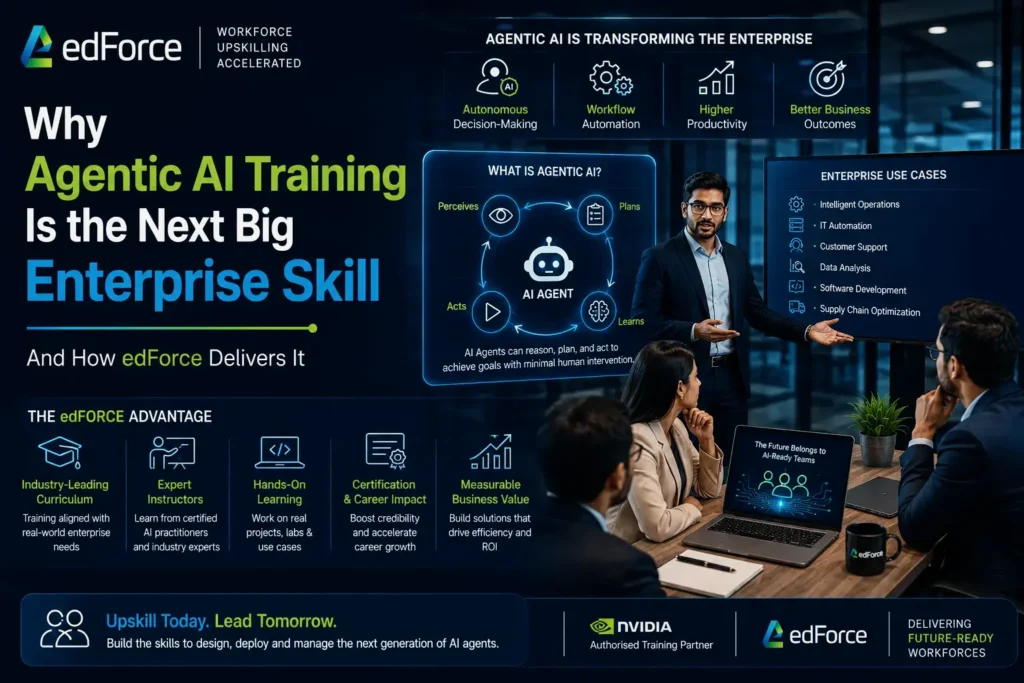
Over the past two years, most AI conversations within organizations have focused on content creation. Teams learned how to write emails faster. Marketing departments experimented with AI-generated content. Employees used AI to summarize reports, organize information, and improve productivity. This phase helped businesses understand what AI can do. The next phase is about understanding what AI can do on its own. That is where Agentic AI is beginning to change the conversation. Unlike traditional AI tools that rely on prompts and commands, Agentic AI systems can take actions, manage workflows, make decisions within defined boundaries, and interact with other systems to complete tasks. For many organizations, this represents a much bigger shift than Generative AI. The reason is simple. Generative AI helps employees work faster. Agentic AI has the potential to change how work gets done. The opportunity is exciting, but it also creates a challenge. Most organizations are not struggling to access Agentic AI technology. They are struggling to find people who understand how to use it effectively. That is why Agentic AI training is quickly becoming one of the most important enterprise skills in 2026. The Skills Gap Is Already Starting to Appear Every major technology shift creates a learning gap. Cloud computing created one. Cybersecurity created one. Data analytics created one. Agentic AI is creating another. Many professionals already understand AI at a high level. They know how chatbots work. They have used Generative AI tools. They understand concepts such as prompting and automation. However, Agentic AI introduces a different level of complexity. Organizations need people who understand: AI agents Workflow orchestration Decision-making systems Multi-agent environments Human-AI collaboration Governance and oversight These are not the skills most organizations developed during the first phase of AI adoption. As a result, demand is growing faster than workforce readiness. Why Agentic AI Is Different From Traditional Automation One common mistake organizations make is treating Agentic AI as just another automation tool. Traditional automation follows predefined rules. If a specific event occurs, the system performs a predefined action. Agentic AI works differently. It can evaluate situations, determine next steps, gather information, interact with systems, and adapt to changing conditions. That flexibility is what makes it powerful. It is also what makes workforce training so important. Employees need to understand not only how these systems work, but also when human oversight is required. Without that understanding, organizations risk creating confusion instead of efficiency. Why Business Leaders Are Paying Attention Attend any enterprise strategy discussion today and you will notice a shift. Last year, many leaders were discussing AI adoption. This year, many are discussing AI execution. The focus is moving beyond experimentation. Organizations want answers to questions such as: How can AI improve operational efficiency? Where can AI reduce manual effort? Which workflows can be safely automated? How should teams collaborate with AI agents? This is creating demand for professionals who understand both technology and business operations. Interestingly, many organizations are realizing that technical knowledge alone is not enough. They need employees who understand processes, workflow design, compliance, governance, and decision-making. Agentic AI sits at the intersection of all these areas. The Next High-Value Skill May Not Be Coding An interesting trend is beginning to emerge across industries. For years, technical skills were viewed as the primary requirement for working with advanced technologies. Agentic AI is starting to change that perception. Technical expertise remains important. However, organizations are increasingly looking for professionals who can design workflows, evaluate outcomes, manage AI-assisted processes, and oversee decision-making systems. In many situations, understanding business processes can be just as valuable as writing code. That is one reason Agentic AI is attracting attention from operations teams, analysts, project managers, business leaders, and technical professionals alike. Why Companies Cannot Wait Too Long Many organizations are taking a wait-and-see approach to Agentic AI. That strategy may prove risky. Not because Agentic AI will replace entire teams overnight. But because early adopters are already building experience. Just as organizations that invested early in cloud capabilities gained advantages later, companies that start developing Agentic AI skills today may be better positioned as adoption accelerates. One prediction appears increasingly realistic. In a few years, organizations may stop asking whether they need Agentic AI skills and start asking why they waited so long to build them. The workforce gap could grow much faster than training programs can keep up. What Effective Agentic AI Training Looks Like A common misconception is that Agentic AI training should focus only on tools. Tools will continue to evolve. Platforms will change. New frameworks will emerge. The most valuable training focuses on concepts and practical application. Employees need to understand: How AI agents work Where they create business value How workflows evolve How accountability is maintained How humans and AI collaborate effectively When professionals understand these fundamentals, they can adapt more easily as technology changes. That creates long-term capability rather than short-term familiarity. How edForce Delivers Agentic AI Training At edForce, the focus is not simply on explaining what Agentic AI is. The goal is to help organizations understand how Agentic AI can be applied in real business environments. Training is designed around practical implementation rather than theoretical discussion. Teams explore: AI agent architectures Enterprise use cases Workflow automation AI governance Agentic AI frameworks Real-world business applications The objective is to help employees move beyond experimentation and build the skills needed to support real implementation projects. This becomes increasingly valuable as organizations move beyond Generative AI pilots and toward more advanced AI ecosystems. Building the Workforce for the Next AI Era Many organizations believe AI will play a much larger role in business operations over the next decade. The only uncertainty is how quickly work itself will change. Some roles will evolve. New responsibilities will emerge. Workflows will become increasingly automated. The organizations that adapt fastest will not necessarily be the ones with the newest technology. They will often be the ones with the most prepared people. That is why workforce readiness is becoming a critical part
edForce Claude AI Training: Use Cases, Benefits, and Learning Paths
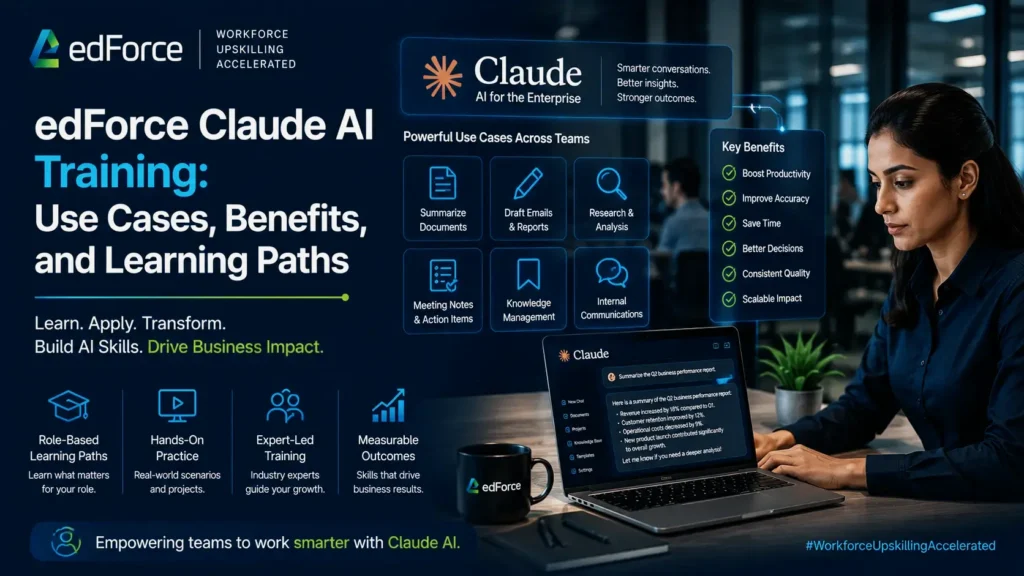
Many companies have already experimented with AI. Employees use AI tools to write emails, create reports, develop content, organize information, and simplify everyday tasks. On the surface, AI adoption appears successful. However, a different picture often emerges when you look more closely. Some employees use AI confidently and achieve excellent results. Others use the same tools but struggle to generate useful outcomes. Teams work differently, processes become inconsistent, and managers begin asking a familiar question: “We are using AI tools, so why aren’t we getting the results we expected?” This is becoming a common challenge across industries. The problem is usually not the AI platform itself. It is the gap between having access to AI and knowing how to use it effectively in real business situations. This is exactly why Claude AI training is becoming increasingly important for organizations in 2026. Companies are no longer looking for employees who simply know AI exists. They want teams that can use AI to improve communication, streamline workflows, manage information more effectively, and support better decision-making. Why Claude AI Is Getting Attention in Enterprises Most workplace tools generate more information. Claude AI is gaining attention because it helps employees make sense of that information. Think about how much time teams spend every week: Reading documents Preparing reports Reviewing proposals Organizing knowledge Responding to emails Creating internal communications These tasks are important, but they consume a significant portion of the workday. Claude AI helps reduce that burden. Its value goes beyond generating text. It helps employees understand, process, and organize large amounts of information more efficiently. That makes it useful across a wide range of business functions. The Real Challenge Is Not Learning the Tool One common mistake organizations make is assuming AI adoption is simply a software training issue. Employees learn which buttons to click. They attend a workshop. They receive access. The training ends. But that rarely changes behavior. The real challenge is helping employees understand how AI fits into their daily responsibilities. For example, a marketing team may use Claude AI very differently from an HR team. A project manager has different needs than a business analyst. Without role-specific guidance, employees often fall into two groups. Some use AI for everything. Others barely use it at all. Neither approach delivers consistent business value. This is why workforce training is becoming just as important as AI access itself. Where Businesses Are Using Claude AI Today Another reason Claude AI is becoming popular is its ability to support work across multiple departments. In many organizations, teams use it for communication, research, documentation, and information-heavy tasks. Common enterprise use cases include: Summarizing long documents and reports Writing business communications Creating meeting notes and action items Research and analysis support Building internal knowledge resources Improving documentation workflows Assisting with training content development What makes these use cases valuable is that they improve work employees are already doing every day. Claude AI does not always create entirely new ways of working. It often improves existing processes. That makes adoption easier for many teams. The Biggest Benefit Is Better Decision-Making Most AI discussions focus on productivity. Productivity is important, but many organizations are discovering another benefit that receives less attention. Better information often leads to better decisions. Employees frequently spend hours searching for information, reviewing documents, and trying to understand complex situations before taking action. Claude AI helps shorten that process. When employees can access information faster, understand it more clearly, and organize it more effectively, decision-making often improves as well. This is particularly valuable for managers, team leaders, and professionals working in information-intensive environments. Why AI Skills Are Becoming Career Skills A few years ago, AI knowledge was viewed as a specialist skill. That is changing rapidly. Today, employers increasingly expect professionals across different roles to understand how AI can support their work. The expectation is not that everyone becomes an AI expert. The goal is to make employees comfortable working alongside AI systems. This shift resembles what happened when cloud technology became mainstream. Cloud skills were once limited to technical teams. Today, cloud awareness exists across many business functions. AI appears to be following the same path. Professionals who develop practical AI skills now may be better positioned as workplace expectations continue to evolve. What an Effective Learning Path Looks Like One reason some AI training programs fail is that they try to teach everything at once. Employees leave with a lot of information but very little confidence. The most effective learning paths are usually progressive. Stage 1: Understanding the Technology The first stage focuses on understanding how Claude AI works and where it fits within business workflows. Stage 2: Practical Application The second stage focuses on real-world use. Employees learn how to apply AI to role-specific tasks and daily responsibilities. Stage 3: Optimization and Consistency The final stage focuses on improving quality, maintaining consistency, and integrating AI into larger workflows. This approach often delivers stronger long-term results because employees can apply new knowledge immediately instead of trying to remember everything at once. A Trend Many Organizations Are Beginning to Notice An interesting trend is emerging in enterprise environments. The gap between high-performing employees and average performers is no longer based solely on technical skills. Increasingly, it comes down to how quickly people can adapt to new technologies. AI tools continue to evolve. New platforms will emerge. Workflows will change. The people who adapt the fastest may become some of the most valuable employees within an organization. That is why AI training should not be viewed only as a technology initiative. It is also a workforce development initiative. Organizations that build strong learning cultures often adapt to technological change faster than those that focus only on technology. Why Enterprises Are Investing in Structured AI Training Many organizations began with informal AI adoption. Employees experimented independently and learned through trial and error. That approach worked in the early stages. As AI becomes more deeply integrated into business operations, organizations need greater consistency. Leadership teams are
How Can You Determine the ROI of IT Training for Corporate Employees? (With an Easy Formula
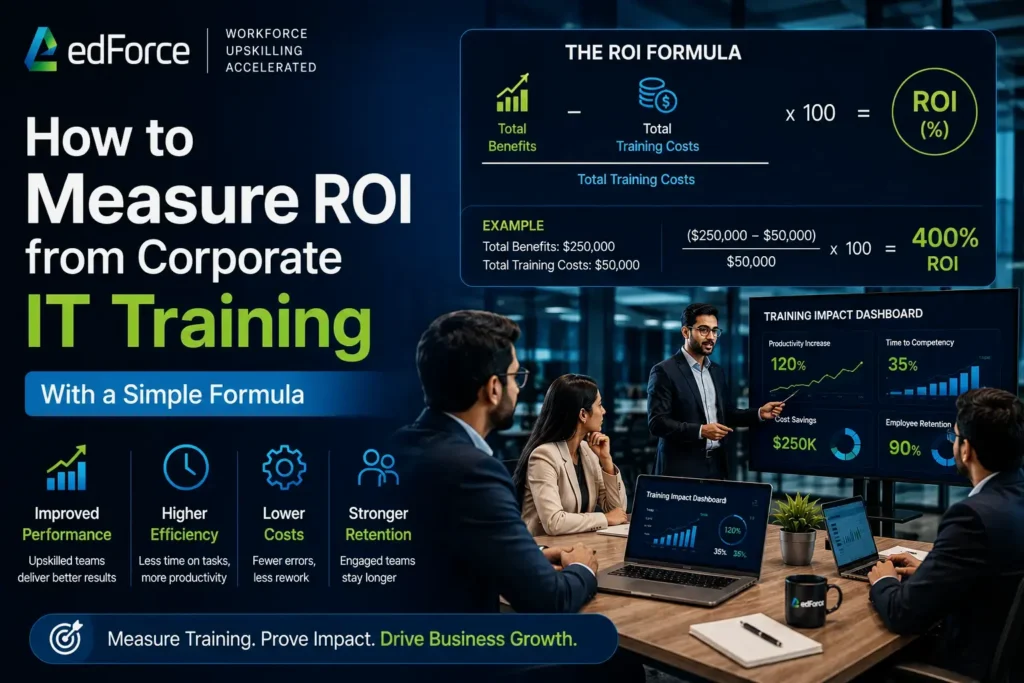
One of the biggest mistakes companies make when it comes to corporate training is treating it as a cost rather than an investment. When a business invests in new software, management expects measurable results. If a company spends on marketing, sales, or infrastructure, performance is carefully tracked. Training often gets different treatment. Many organizations spend thousands or even millions of rupees on employee development programs, yet very few can answer one simple question: “What business value are we actually getting from this training?” This is becoming an even bigger issue in 2026 as training budgets continue to grow. Technology is evolving rapidly, new skills are constantly emerging, and companies are investing heavily in areas such as AI, cloud computing, cybersecurity, Red Hat, NVIDIA, and data technologies. Leadership teams increasingly need to justify these investments. The good news is that training ROI is not as difficult to measure as many organizations think. The real challenge is that most companies track learning activities rather than business outcomes. The Wrong Way to Measure Training Success Many organizations focus on numbers that look impressive in reports but reveal very little about actual business impact. For example: Number of employees trained Course completion rates Certification counts Training hours completed Workshop attendance These metrics can be useful, but they do not answer the question executives care about most: Did the training improve business performance? An employee may complete a certification but never apply the knowledge. Another employee may attend fewer sessions but use new skills to improve project quality, reduce costs, or solve operational challenges. Only one of those examples creates measurable business value. That is why organizations need to move beyond learning metrics and focus on performance metrics. Why Measuring ROI Has Become More Important A few years ago, many organizations viewed training as a long-term investment that was difficult to measure. Today’s leadership teams expect greater visibility. The reason is simple. Technology skills directly affect business outcomes. A well-trained cloud team can reduce infrastructure costs. An AI-enabled workforce can improve productivity. Cybersecurity training can reduce business risk. DevOps training can speed up deployment cycles. These improvements directly influence revenue, efficiency, customer satisfaction, and operational performance. Training is no longer separate from business strategy. It has become a critical part of it. A Simple Formula for Training ROI Many companies overcomplicate ROI calculations. The basic formula is straightforward: Training ROI (%) = [(Business Benefit – Training Cost) / Training Cost] × 100 Let’s look at a simple example. Suppose a company spends ₹10,00,000 on cloud training for its infrastructure team. After the training: Cloud costs decrease by ₹8,00,000 per year Productivity improvements save another ₹7,00,000 per year Total Benefit = ₹15,00,000 Applying the formula: ROI = [(15,00,000 – 10,00,000) / 10,00,000] × 100 ROI = 50% In this example, the company achieved a 50% return on its training investment. The formula is simple. The challenge is identifying the right benefits to measure. What Business Benefits Should You Track? This is where many organizations struggle. Training rarely creates value in just one area. Instead of focusing on a single metric, companies should track multiple business outcomes. Depending on the training program, improvements may include: Faster project delivery Lower operational costs Higher productivity Improved employee retention Reduced support tickets Better compliance performance Faster deployment cycles Fewer security incidents Improved customer satisfaction Not every benefit will apply to every training program. The goal is to identify outcomes that are directly connected to the skills being developed. The Hidden ROI Many Companies Ignore An important area often overlooked is internal capability building. When organizations lack critical skills, they usually solve the problem in one of three ways: Hiring external talent Bringing in consultants Delaying projects All three options can be expensive. A skilled internal workforce reduces dependence on external resources. This benefit often does not appear in training reports, but it can create significant long-term value. For example, a company with strong internal AI expertise may avoid hiring expensive consultants for every new AI initiative. Over time, those savings can become substantial. Why Certifications Alone Are Not Enough Many organizations still measure training success through certification counts. While certifications have value, they should not be the ultimate goal. The real goal is application. A cloud certification matters because it helps improve cloud operations. A cybersecurity certification matters because it strengthens security practices. An AI certification matters because it supports innovation and business outcomes. When organizations focus only on certifications, they risk missing the bigger picture. The best training programs create measurable performance improvements, not just certificates. The Best Time to Measure ROI Another common mistake is measuring ROI too early. Learning takes time to translate into business results. An employee may complete training today but not apply those skills until the next project begins. That is why many organizations measure training impact in phases. 30 Days Knowledge acquisition Course completion Certification progress 90 Days Skill application Workflow improvements Productivity gains 6–12 Months Business outcomes Cost savings Operational improvements Long-term impact This approach provides a more realistic view of training effectiveness. A Prediction for the Future of Corporate Training Over the next few years, training budgets will likely face greater scrutiny. Organizations will continue investing in AI, cloud computing, cybersecurity, automation, and other emerging technologies. At the same time, leadership teams will increasingly demand proof that training investments generate business value. As a result, companies may begin evaluating learning programs the same way they evaluate technology investments. The question will no longer be: “How many employees completed the training?” Instead, it will be: “What business outcomes improved because of the training?” That shift is already happening. How Leading Organizations Measure Training Success The most successful companies do not treat training as an HR initiative alone. They connect learning directly to business goals. Before launching a program, they identify: The skills being developed The business problem being solved The performance metrics that matter The expected outcomes This creates a clear link between workforce development and business performance. When learning aligns