

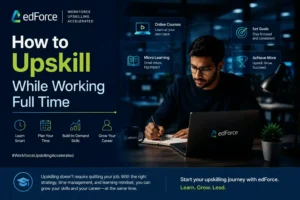
Many professionals are not willing to learn. There is never enough time.
Meetings, deadlines, email, project updates and unexpected requests are all part of a typical workday. Learning something new can feel like an extra task by the end of the day.
Many people put off upgrading their skills.
After the project is completed, the next release or when work becomes less hectic, they tell themselves that they will start working after this.
Sadly, the perfect moment rarely comes.
Technology continues to advance. AI is now part of the everyday workplace. Cloud platforms are changing. Cybersecurity needs are evolving. Every few months, new tools are released.
The fastest growing people aren’t necessarily the ones with the most time. They are the ones who continue to learn, even when busy.
It is possible to upgrade your skills while still working full-time. It is not necessary to spend hours studying every day. It is important to integrate learning into your daily routine, rather than treating it as an extra project.
No more waiting for extra time
The myth that learning requires large blocks of uninterrupted space is a common one.
Most working professionals will never enjoy this luxury.
You may have to wait months if you are waiting until you schedule is completely free.
Think about learning in the same way that you would think about healthy eating or exercise.
Consistent, small efforts usually produce better results than intense bursts.
Over a period of months, even thirty minutes of focused work per day can make a significant difference.
Finding more time is not the challenge.
The use of existing time is more intentional.
Learn skills that will help you solve today’s problems
A common mistake is to choose courses based on popularity.
Ask yourself one question before enrolling in a program.
Will this skill be used in the next few months by me?
Motivation becomes easier if you answer yes.
Cloud training, for example, will feel immediately relevant if your business is moving towards cloud platforms.
Learning prompt engineering or Generative AI can be beneficial almost immediately if AI tools become part of your everyday work.
When you can use new knowledge within a week of learning it, you will find that you are able to learn more quickly.
Focus on one skill instead of five
Many professionals start out with enthusiasm.
Students can enroll in AI courses.
They add cloud certification.
Cybersecurity is a must.
Then data analytics.
They stop learning after a few days because they are overwhelmed.
It is better to develop one skill at a given time.
Learn the basics.
Use what you have learned.
Continue to the next area.
Initially, progress may seem slower but usually it becomes more sustainable.
Learning is not a sprint, but a marathon.
Learn on the Job
Many successful professionals have a habit of combining learning and work.
They combine both.
Imagine you’re learning Azure.
Volunteer to do a simple cloud-related job.
Use AI tools to summarize or organize documents and meeting notes if you’re studying AI.
Automate a task that takes you several minutes each day if you’re learning Python.
When theory and real work are combined, the fastest learning occurs.
Your practice environment becomes your projects.
Create a weekly learning routine
Consistency is more important than intensity.
It is not necessary to study each evening.
You need a realistic schedule.
This might look something like:
- Weekdays, 30 minutes before starting work
- A weekend learning event that focuses on one specific topic
- Reviewing notes during short breaks
- Practice new skills whenever possible on real tasks
Routines eliminate the daily question of “Should you study today?” “
Learning becomes a part of the week.
Do not chase every new technology
The technology is constantly changing.
Each week, it seems, there is a brand new AI model or framework.
It is impossible to know everything.
Build strong foundations instead.
Understanding cloud architecture, for example, is more important than memorizing all the new cloud services.
It is better to learn AI basics than jump from one AI application to another.
Professionals who have solid foundations are more likely to adapt quickly when new technologies emerge.
Qualifications open doors, skills build careers
Professional certifications are still valuable.
These courses help to demonstrate commitment, and they provide structured learning pathways.
Employers are increasingly looking beyond certificates.
Hiring managers are looking for people who have the ability to solve problems.
When two candidates have the same certifications, the candidate who can demonstrate how they used those skills on a real-life project will often stand out.
When you finish a course ask yourself the following questions:
“How can I apply this knowledge to my work?”
This question transforms learning into experience.
The Trends Worth Paying Attention to
The value placed on the learning abilities themselves is a noticeable change.
Technology stacks change.
The job roles of employees are changing.
AI is reshaping the way work is done.
Employers are increasingly looking for professionals with the ability to adapt quickly, rather than those with experience in a single technology.
It seems more and more likely that continual learning will be a key career skill, rather than merely an advantage.
People who update their knowledge annually are likely to be valuable no matter how technology changes.
The Right Structure Makes Learning Easier
Some professionals find that self-learning is a good option.
Other people benefit from a structured path of learning, live mentoring and hands-on labs.
It is important to have a practical understanding of technologies like AI, Red Hat, NVIDIA and cybersecurity as well as data engineering.
A well-designed program can help reduce confusion, increase confidence and keep learners motivated until they achieve their goals.
Grow Your Career without Pressing Pause
Many professionals feel they must choose between their career and their current responsibilities.
Both can occur simultaneously.
Most successful professionals don’t take long breaks to learn.
They instead integrate learning into their daily routine.
edForce.co training programs are created with the working professional in mind. Learners can build the skills they need while maintaining their full-time career with live instructor-led sessions and practical labs. They can also prepare for certifications through flexible learning paths. No matter if you are exploring AI, cloud-computing, NVIDIA or Red Hat, cybersecurity or emerging technologies, we focus on learning around your work and not interrupting it.
Final Thoughts
It is not necessary to find the perfect circumstances for you to upskill workforce while working full-time.
Consistency is key.
As technology continues to evolve, new opportunities will be available for those who are willing and able to learn.
It is not necessary to learn everything in just a few weeks.
Keep moving forward.
A small investment today in education can lead to career opportunities lasting for many years.
Continuous learning is one of the best investments you can ever make for yourself, especially in an environment where skills are outdated more quickly than before.