


One of the biggest mistakes companies make when it comes to corporate training is treating it as a cost rather than an investment.
When a business invests in new software, management expects measurable results. If a company spends on marketing, sales, or infrastructure, performance is carefully tracked.
Training often gets different treatment.
Many organizations spend thousands or even millions of rupees on employee development programs, yet very few can answer one simple question:
“What business value are we actually getting from this training?”
This is becoming an even bigger issue in 2026 as training budgets continue to grow. Technology is evolving rapidly, new skills are constantly emerging, and companies are investing heavily in areas such as AI, cloud computing, cybersecurity, Red Hat, NVIDIA, and data technologies.
Leadership teams increasingly need to justify these investments.
The good news is that training ROI is not as difficult to measure as many organizations think.
The real challenge is that most companies track learning activities rather than business outcomes.
The Wrong Way to Measure Training Success
Many organizations focus on numbers that look impressive in reports but reveal very little about actual business impact.
For example:
- Number of employees trained
- Course completion rates
- Certification counts
- Training hours completed
- Workshop attendance
These metrics can be useful, but they do not answer the question executives care about most:
Did the training improve business performance?
An employee may complete a certification but never apply the knowledge.
Another employee may attend fewer sessions but use new skills to improve project quality, reduce costs, or solve operational challenges.
Only one of those examples creates measurable business value.
That is why organizations need to move beyond learning metrics and focus on performance metrics.
Why Measuring ROI Has Become More Important
A few years ago, many organizations viewed training as a long-term investment that was difficult to measure.
Today’s leadership teams expect greater visibility.
The reason is simple.
Technology skills directly affect business outcomes.
A well-trained cloud team can reduce infrastructure costs.
An AI-enabled workforce can improve productivity.
Cybersecurity training can reduce business risk.
DevOps training can speed up deployment cycles.
These improvements directly influence revenue, efficiency, customer satisfaction, and operational performance.
Training is no longer separate from business strategy.
It has become a critical part of it.
A Simple Formula for Training ROI
Many companies overcomplicate ROI calculations.
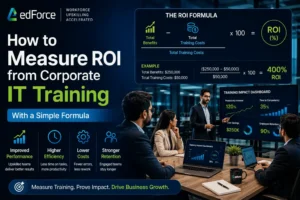
The basic formula is straightforward:
Training ROI (%) = [(Business Benefit – Training Cost) / Training Cost] × 100
Let’s look at a simple example.
Suppose a company spends ₹10,00,000 on cloud training for its infrastructure team.
After the training:
- Cloud costs decrease by ₹8,00,000 per year
- Productivity improvements save another ₹7,00,000 per year
Total Benefit = ₹15,00,000
Applying the formula:
ROI = [(15,00,000 – 10,00,000) / 10,00,000] × 100
ROI = 50%
In this example, the company achieved a 50% return on its training investment.
The formula is simple.
The challenge is identifying the right benefits to measure.
What Business Benefits Should You Track?
This is where many organizations struggle.
Training rarely creates value in just one area.
Instead of focusing on a single metric, companies should track multiple business outcomes.
Depending on the training program, improvements may include:
- Faster project delivery
- Lower operational costs
- Higher productivity
- Improved employee retention
- Reduced support tickets
- Better compliance performance
- Faster deployment cycles
- Fewer security incidents
- Improved customer satisfaction
Not every benefit will apply to every training program.
The goal is to identify outcomes that are directly connected to the skills being developed.
The Hidden ROI Many Companies Ignore
An important area often overlooked is internal capability building.
When organizations lack critical skills, they usually solve the problem in one of three ways:
- Hiring external talent
- Bringing in consultants
- Delaying projects
All three options can be expensive.
A skilled internal workforce reduces dependence on external resources.
This benefit often does not appear in training reports, but it can create significant long-term value.
For example, a company with strong internal AI expertise may avoid hiring expensive consultants for every new AI initiative.
Over time, those savings can become substantial.
Why Certifications Alone Are Not Enough
Many organizations still measure training success through certification counts.
While certifications have value, they should not be the ultimate goal.
The real goal is application.
A cloud certification matters because it helps improve cloud operations.
A cybersecurity certification matters because it strengthens security practices.
An AI certification matters because it supports innovation and business outcomes.
When organizations focus only on certifications, they risk missing the bigger picture.
The best training programs create measurable performance improvements, not just certificates.
The Best Time to Measure ROI
Another common mistake is measuring ROI too early.
Learning takes time to translate into business results.
An employee may complete training today but not apply those skills until the next project begins.
That is why many organizations measure training impact in phases.
30 Days
- Knowledge acquisition
- Course completion
- Certification progress
90 Days
- Skill application
- Workflow improvements
- Productivity gains
6–12 Months
- Business outcomes
- Cost savings
- Operational improvements
- Long-term impact
This approach provides a more realistic view of training effectiveness.
A Prediction for the Future of Corporate Training
Over the next few years, training budgets will likely face greater scrutiny.
Organizations will continue investing in AI, cloud computing, cybersecurity, automation, and other emerging technologies.
At the same time, leadership teams will increasingly demand proof that training investments generate business value.
As a result, companies may begin evaluating learning programs the same way they evaluate technology investments.
The question will no longer be:
“How many employees completed the training?”
Instead, it will be:
“What business outcomes improved because of the training?”
That shift is already happening.
How Leading Organizations Measure Training Success
The most successful companies do not treat training as an HR initiative alone.
They connect learning directly to business goals.
Before launching a program, they identify:
- The skills being developed
- The business problem being solved
- The performance metrics that matter
- The expected outcomes
This creates a clear link between workforce development and business performance.
When learning aligns with business priorities, ROI becomes much easier to demonstrate.
How edForce Helps Organizations Track Training Impact
At edForce.co, enterprise training programs are designed with business outcomes in mind.
Whether organizations are building capabilities in AI, cloud computing, NVIDIA, Red Hat, cybersecurity, data technologies, or other emerging skills, the focus goes beyond course completion.
The objective is to help companies develop workforce capabilities that improve productivity, innovation, operational efficiency, and long-term business growth.
Because successful training should not just improve employee knowledge. It should improve business results.
Final Thoughts
Measuring the ROI of corporate training does not require complex formulas or massive reporting systems.
It starts with asking the right questions.
Instead of measuring how much learning took place, measure what changed because of that learning.
When organizations connect training to business outcomes, workforce development becomes easier to justify, easier to improve, and far more valuable.
In 2026, the companies that succeed with training may not be the ones that spend the most. They will be the ones that measure the right things.