


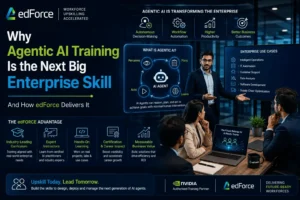
Over the past two years, most AI conversations within organizations have focused on content creation.
Teams learned how to write emails faster. Marketing departments experimented with AI-generated content. Employees used AI to summarize reports, organize information, and improve productivity.
This phase helped businesses understand what AI can do. The next phase is about understanding what AI can do on its own.
That is where Agentic AI is beginning to change the conversation. Unlike traditional AI tools that rely on prompts and commands, Agentic AI systems can take actions, manage workflows, make decisions within defined boundaries, and interact with other systems to complete tasks.
For many organizations, this represents a much bigger shift than Generative AI.
The reason is simple.
Generative AI helps employees work faster. Agentic AI has the potential to change how work gets done.
The opportunity is exciting, but it also creates a challenge. Most organizations are not struggling to access Agentic AI technology. They are struggling to find people who understand how to use it effectively.
That is why Agentic AI training is quickly becoming one of the most important enterprise skills in 2026.
The Skills Gap Is Already Starting to Appear
Every major technology shift creates a learning gap.
- Cloud computing created one.
- Cybersecurity created one.
- Data analytics created one.
- Agentic AI is creating another.
Many professionals already understand AI at a high level. They know how chatbots work. They have used Generative AI tools. They understand concepts such as prompting and automation.
However, Agentic AI introduces a different level of complexity.
Organizations need people who understand:
- AI agents
- Workflow orchestration
- Decision-making systems
- Multi-agent environments
- Human-AI collaboration
- Governance and oversight
These are not the skills most organizations developed during the first phase of AI adoption. As a result, demand is growing faster than workforce readiness.
Why Agentic AI Is Different From Traditional Automation
One common mistake organizations make is treating Agentic AI as just another automation tool.
Traditional automation follows predefined rules. If a specific event occurs, the system performs a predefined action.
Agentic AI works differently.
It can evaluate situations, determine next steps, gather information, interact with systems, and adapt to changing conditions.
That flexibility is what makes it powerful. It is also what makes workforce training so important. Employees need to understand not only how these systems work, but also when human oversight is required.
Without that understanding, organizations risk creating confusion instead of efficiency.
Why Business Leaders Are Paying Attention
Attend any enterprise strategy discussion today and you will notice a shift. Last year, many leaders were discussing AI adoption.
This year, many are discussing AI execution. The focus is moving beyond experimentation.
Organizations want answers to questions such as:
- How can AI improve operational efficiency?
- Where can AI reduce manual effort?
- Which workflows can be safely automated?
- How should teams collaborate with AI agents?
This is creating demand for professionals who understand both technology and business operations. Interestingly, many organizations are realizing that technical knowledge alone is not enough.
They need employees who understand processes, workflow design, compliance, governance, and decision-making. Agentic AI sits at the intersection of all these areas.
The Next High-Value Skill May Not Be Coding
An interesting trend is beginning to emerge across industries.
For years, technical skills were viewed as the primary requirement for working with advanced technologies.
Agentic AI is starting to change that perception.
Technical expertise remains important.
However, organizations are increasingly looking for professionals who can design workflows, evaluate outcomes, manage AI-assisted processes, and oversee decision-making systems.
In many situations, understanding business processes can be just as valuable as writing code.
That is one reason Agentic AI is attracting attention from operations teams, analysts, project managers, business leaders, and technical professionals alike.
Why Companies Cannot Wait Too Long
Many organizations are taking a wait-and-see approach to Agentic AI. That strategy may prove risky.
Not because Agentic AI will replace entire teams overnight. But because early adopters are already building experience.
Just as organizations that invested early in cloud capabilities gained advantages later, companies that start developing Agentic AI skills today may be better positioned as adoption accelerates.
One prediction appears increasingly realistic.
In a few years, organizations may stop asking whether they need Agentic AI skills and start asking why they waited so long to build them.
The workforce gap could grow much faster than training programs can keep up.
What Effective Agentic AI Training Looks Like
A common misconception is that Agentic AI training should focus only on tools.
Tools will continue to evolve. Platforms will change.
New frameworks will emerge. The most valuable training focuses on concepts and practical application.
Employees need to understand:
- How AI agents work
- Where they create business value
- How workflows evolve
- How accountability is maintained
- How humans and AI collaborate effectively
When professionals understand these fundamentals, they can adapt more easily as technology changes.
That creates long-term capability rather than short-term familiarity.
How edForce Delivers Agentic AI Training
At edForce, the focus is not simply on explaining what Agentic AI is. The goal is to help organizations understand how Agentic AI can be applied in real business environments.
Training is designed around practical implementation rather than theoretical discussion.
Teams explore:
- AI agent architectures
- Enterprise use cases
- Workflow automation
- AI governance
- Agentic AI frameworks
- Real-world business applications
The objective is to help employees move beyond experimentation and build the skills needed to support real implementation projects.
This becomes increasingly valuable as organizations move beyond Generative AI pilots and toward more advanced AI ecosystems.
Building the Workforce for the Next AI Era
Many organizations believe AI will play a much larger role in business operations over the next decade.
The only uncertainty is how quickly work itself will change. Some roles will evolve.
New responsibilities will emerge. Workflows will become increasingly automated. The organizations that adapt fastest will not necessarily be the ones with the newest technology.
They will often be the ones with the most prepared people. That is why workforce readiness is becoming a critical part of enterprise AI strategy.
At edForce.co, Agentic AI training programs focus on practical learning, enterprise use cases, workflow design, AI governance, and implementation readiness to help organizations build teams that can work effectively in the next generation of AI-powered environments.
Final Thoughts
Agentic AI is moving the conversation beyond content creation and into workflow execution. That shift changes the capabilities organizations need from their workforce.
Businesses no longer need employees who simply understand AI tools. They need professionals who understand how AI agents interact with systems, processes, and business operations.
Demand for these skills is already growing. Organizations that begin building Agentic AI capabilities today will likely be better positioned for the future.
Because the next phase of AI adoption will not be defined by access to technology. It will be defined by how well people understand how to use it.