


The majority of companies are not struggling today because employees don’t want to learn. The real issue is that corporate training is still disconnected from actual job roles and workplace requirements.
Employees may attend training sessions, earn certifications, and complete learning modules, but when it comes to applying those skills in real projects, many still feel limited. Managers notice low adoption rates. Teams often return to old workflows, and productivity improvements remain smaller than expected.
This is why enterprises are becoming more selective when choosing a corporate training company.
Businesses are no longer interested in training that only looks good in reports. They want programs that improve daily operations, help employees adapt faster, and build long-term workforce capability.
This shift is changing how enterprises approach upskilling in 2026.
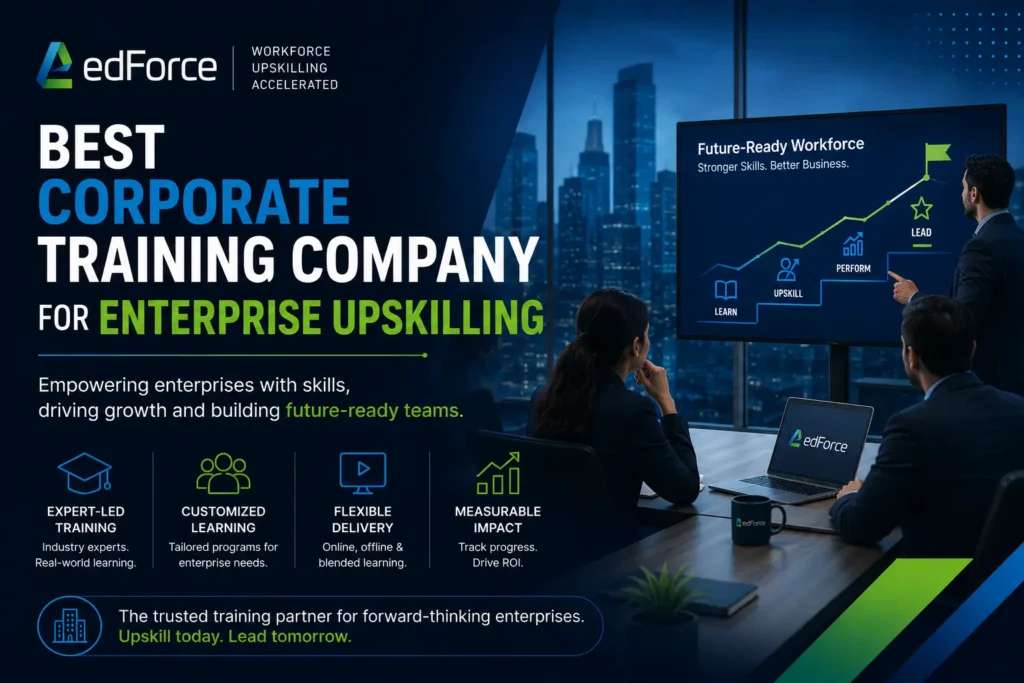
edForce is not just another course provider. The focus is on helping organizations build practical workforce skills that employees can confidently apply in real business environments.
Why Upskilling Enterprises Has Become a Business Priority
A few years ago, corporate training was often treated as a supporting function. Today, it directly impacts business growth, productivity, and technology adoption.
The reason is simple:
Technology is evolving much faster than traditional education systems.
Companies are rapidly adopting AI, cloud technologies, automation platforms, cybersecurity systems, and new digital workflows. However, many employees still rely on outdated processes because organizational learning systems struggle to keep pace.
This creates a growing gap between:
- Business goals
- Employee capabilities
- Technology adoption
- Operational execution
Enterprise upskilling is no longer optional. It has become part of a long-term business strategy.
What Makes a Good Corporate Training Company?
Most training providers focus heavily on certifications and course catalogs. But today, enterprises need much more than access to content.
A strong corporate training company should help organizations:
- Improve workforce capability
- Close skill gaps
- Support digital transformation
- Improve operational productivity
- Create role-based learning pathways
- Align training goals with business objectives
The difference becomes visible when learning improves real workflows instead of staying limited to training dashboards.
One major mistake companies make is selecting training vendors only based on brand recognition or the number of available courses. The best enterprise training partners understand how employees learn and apply skills in the workplace.
Why Traditional Corporate Training Often Fails
Many businesses face a common but overlooked problem: employees complete training programs but rarely change their work habits afterward.
There are several reasons for this:
Sometimes the learning is too theoretical. In other cases, the training becomes outdated before employees finish it. Often, the content has little connection to actual job responsibilities.
The result is predictable:
- Low engagement
- Poor retention
- Weak implementation
- Minimal business impact
Employees do not need more random information. They need training designed around real workflows and real workplace challenges.
Modern enterprise upskilling is becoming more practical and role-focused.
Enterprise Training Needs Practical Learning, Not Just Content
Online training is useful for explaining concepts, but it often fails to prepare employees for real-world situations.
This is becoming a major challenge in areas such as:
- AI adoption
- Cloud computing
- Cybersecurity
- Automation
- DevOps
- Data and analytics
Employees may understand the terminology but still struggle with implementation.
edForce training programs focus on real-world business use cases instead of disconnected theory. Learning is designed to help professionals apply skills in real enterprise environments through guided sessions, hands-on learning, and workflow-based models.
This improves team confidence, increases retention, and speeds up skill adoption.
The Biggest Workforce Shift Is Happening Now
In 2026, companies will no longer hire only for current skills. Businesses are increasingly hiring and training employees for adaptability.
Why?
Because technology changes too quickly. Employees who can adapt to new workflows and learn emerging systems are becoming far more valuable.
Organizations are changing the way they approach workforce development. Modern enterprise training now focuses on:
- Applying learning in real situations
- Workflow adaptation
- Practical implementation
- Role-based capability development
- Continuous upskilling
This represents a major shift in corporate learning programs.
Why Enterprises Are Looking for Long-Term Training Partners
Many organizations are moving away from one-time training models.
The reason is practicality.
Upskilling has become an ongoing process and is now part of continuous workforce development.
Today, businesses need partners who can support:
- Technology changes
- Evolving workflows
- Enterprise scaling
- AI adoption
- Cloud transformation
- Technical workforce readiness
That is why companies increasingly prefer corporate training firms that understand enterprise challenges instead of relying on generic learning modules.
The strongest partnerships are formed when learning aligns with operational goals.
How Enterprise Upskilling Impacts Business Performance
Many businesses underestimate how strongly workforce capability affects overall performance.
Skill gaps often lead to:
- Slower execution
- Workflow inefficiencies
- Dependency on external support
- Reduced innovation
- Poor technology adoption
Strong upskilling programs help organizations:
- Improve productivity
- Increase internal capability
- Adapt faster to technological changes
- Reduce operational delays
- Improve employee confidence
- Strengthen long-term workforce readiness
Enterprise learning is now becoming a core part of business growth strategy, not just HR planning.
What Businesses Should Consider Before Selecting a Training Partner
The largest course library does not always mean the best corporate training provider.
Businesses should focus on:
- Practical implementation capability
- Industry relevance
- Enterprise-focused learning models
- Hands-on training
- Instructor expertise
- Workflow-based learning
- Scalability for teams
- Alignment with business goals
Training providers should understand not only the technology itself, but also the operational challenges businesses face while adopting new systems.
That difference matters more than marketing claims.
Why Companies Choose edForce Enterprise Training
edForce enterprise training primarily focuses on developing practical skills that match modern workforce challenges. The programs are designed to improve real team capabilities rather than provide generic learning experiences.
The training focuses on:
- Enterprise-focused learning pathways
- Hands-on implementation
- Practical business use cases
- Role-specific upskilling
- Instructor-led learning
- Workflow-oriented training
This helps employees adapt more effectively in a rapidly changing business environment.
Final Thoughts
Corporate learning is no longer just about completing courses. It is about helping employees apply skills effectively in real workplace situations.
That is the biggest difference modern businesses are looking for today.
Companies want training that improves execution, supports transformation, and helps teams adapt faster to new technologies and workflows.
The best corporate trainer is not the one offering the most courses. It is the company that helps organizations build practical, long-term workplace capability while creating measurable business impact.
FAQ‘s
Ans: Enterprise upskilling is a way to improve productivity and adapt quickly to new technologies, as well as reduce skills gaps and enhance long-term workforce capabilities.
Ans: edForce focuses more on learning through practical workflows than just theoretical content. The training is intended to help employees use skills in real-world business situations.
Ans: Corporate training that is effective improves efficiency, encourages digital transformation, boosts employee confidence and allows teams to adopt new technologies more quickly.
Ans: Most training programs are either too theoretical, out-of-date, or unconnected to actual job duties, which results in low engagement and poor execution.
Ans: Enterprise upskilling can be a great benefit to industries adopting AI and cloud computing.