


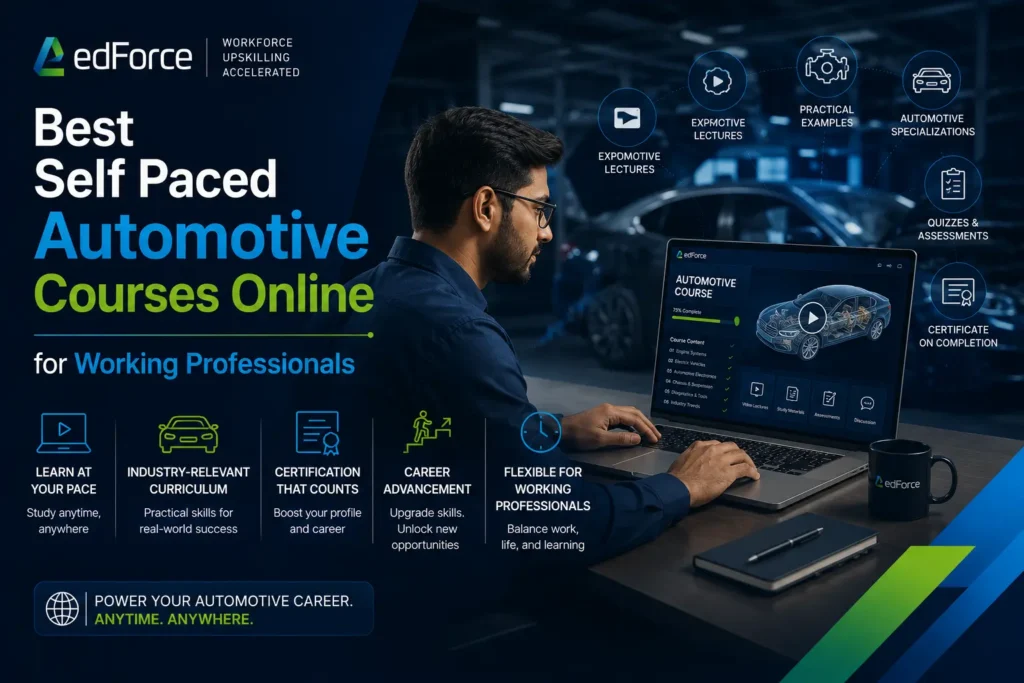
The automotive industry is evolving faster than most professionals anticipated. Today’s vehicles are not just mechanical systems. Today’s automotive environments combine electronic, diagnostics and software systems with automation, EV technology and smart manufacturing processes.
Many professionals realize that their old skills are not enough to remain competitive.
Most professionals are unable to leave their job in order to enroll in full-time classroom courses. Most people already have to manage their busy schedules and responsibilities, including project deadlines, shifting work, and operational duties. Self-paced automotive courses will be more popular online in 2026.
There is also another reason for this growth.
Professionals of today are not satisfied with certificates. They are looking for practical skills to improve their job prospects, adapt to changes in the industry, and grow their career.
This is a new approach to automotive education.
Why working professionals prefer self-paced learning
Modern work environments are not always conducive to traditional training models.
There are many professionals who work in:
- Rotating shifts
- Long operating hours
- Field-based roles
- Project-driven schedules
- Weekend responsibilities
It is difficult to maintain fixed classroom programs on a regular basis.
Auto courses that are self-paced offer learners greater flexibility, as they can develop their skills without disrupting their current work obligations.
Flexibility alone isn’t the greatest advantage.
Learning at a rate that is appropriate to your actual understanding, rather than rushing through training topics in order to complete the schedule, will be more beneficial.
When professionals can practice, review, and apply their learning in real-world situations, they are better able to understand the technical concepts.
The Automotive Industry is Facing a Skills Shift
The automotive industry is experiencing rapid changes in job roles. In the past, most automotive jobs were centered around mechanical systems.
Companies today are increasingly looking for professionals who can:
- Diagnostics
- Electric Vehicle Systems
- Automotive electronics
- Automation Technologies
- Manufacturing software
- Quality systems
- Modern repair technologies
The shift in the industry creates new job opportunities but also skill gaps.
Now, many experienced professionals face a new challenge. Although they are familiar with automotive operations, they must update their technical knowledge in order to keep up with the latest systems.
Online automotive courses are important for both beginners and experienced professionals.
Why practical automotive learning is more important than theory
Many technical courses are good at explaining concepts, but they don’t prepare students for the real world.
It is a problem that becomes more serious in the automotive industry, where employees are often faced with:
- Troubleshooting Issues
- Diagnostic systems
- Repair workflows
- Operational deadlines
- Equipment handling
- Problem-solving techniques
The theory alone is not enough to build confidence.
When training is practical and connected to the real work environment, it helps working professionals learn more quickly.
The best auto courses are not just about delivering information. They also focuses on:
- Applications of Practical Mathematics
- Real-world workflows
- Industry scenarios
- Hands-on understanding
- Operational Thinking
Professionals will remember skills better if they can see where and how they are used.
Automotive Careers are Increasingly Technology-Driven
The increasing importance of technology in the automotive industry is another reason why the growth in automotive learning has been rapid.
Modern vehicles are now:
- Electronic control systems
- Advanced Diagnostics
- Software Integration
- Sensor Technology
- Electric Vehicle Platforms
- Connected systems
Automotive professionals will need to be more technical-adaptable and mechanically literate.
Employers no longer hire only those with traditional repair skills. Employers are now looking for professionals who have the confidence to work with new systems and technologies.
It is for this reason that professionals who invest in upskilling themselves today will have better career prospects over the long term.
Why self-paced courses are good for career growth
Control is something that many professionals who are working appreciate when it comes to self-paced learning.
You can:
- After-hours learning
- Revisiting difficult topics
- Progression is made gradually
- Balance your learning and responsibilities
- Focus on specific skills
This can reduce the learning pressure, and improve retention.
Many traditional classrooms are rushed to meet schedules. Automotive learning can be self-paced to allow professionals to gain understanding more easily and consistently.
This is important for technical learning.
The best automotive courses focus on industry-relevant skills
Some automotive courses are not as valuable as others. Many programs are outdated and still heavily reliant on older technology, while the modern workplace increasingly requires updated technical knowledge.
Today’s best automotive training programs focus on:
- Electric Vehicles
- Diagnostics
- Manufacturing systems
- You can also find out more about the Automated Vehicles by clicking here.
- Automotive electronics
- Maintenance Technologies
- Quality processes
- Service operations
The career benefits of courses that are aligned to real industry demands such like edForce can be much greater.
Why Employees Upskill Instead of Switching Industries
In 2026, many automotive professionals will choose to upgrade their skills instead of changing careers.
In the past, workers often quit industries because technology changed too fast. More professionals today choose to adapt and update their skills instead of leaving the industry.
The automotive industry is changing.
Modern automotive environments include:
- EV servicing
- Smart Manufacturing
- Diagnostics
- Support for technical support
- Automated systems
- Quality management
Professionals who constantly improve their skills are more likely to adapt quickly to changing roles.
Learn Flexibility is a Major ADVANTAGE
Consistency is a hidden benefit of self-paced learning.
Most working professionals who stop learning do not do so because they lack motivation but because it is difficult to balance work and family responsibilities with traditional training models.
Online automotive courses are a great way to relieve some of the pressure.
The learner can build skills without changing routines.
This creates more long-term learning habits than short-term, high-pressure programs.
Why Businesses Value Continuous Learning
Today, employers are increasingly looking for employees who can improve their skills on their own.
The automotive and manufacturing industries are not immune to the constant changes in technology.
Actively learning professionals:
- Adaptation faster
- Handle new systems better
- Increase operational confidence
- Support workflow changes more effectively
Continuous upskilling has become highly valued in many technical industries.
The automotive training programs at are geared towards practical workplace learning and the development of industry-relevant skills. This allows working professionals to improve their technical capabilities while still balancing other responsibilities.
What professionals should look for before choosing a course
The longest course does not necessarily mean the best.
Professionals should concentrate on:
- Relevance
- Topics updated in the industry
- Applications in the real world
- Flexible Learning Structure
- Career focused skill development
- Modern automotive technologies
When a course improves the actual capabilities of the student, it is more valuable than merely adding another certificate.
Final Thoughts
Professionals who are willing to learn more about the automotive industry will be better able to keep up with technology changes.
Online self-paced automotive courses are popular because they allow working professionals to develop practical skills while maintaining their careers. They also allow students to gradually adapt to new automotive technologies and workplace demands.
Career growth in 2026 will be more dependent on adaptability, learning, and confidence with modern systems than on knowledge that is fixed.