


How to Upskill 100+ Employees Without Disrupting Delivery Timelines
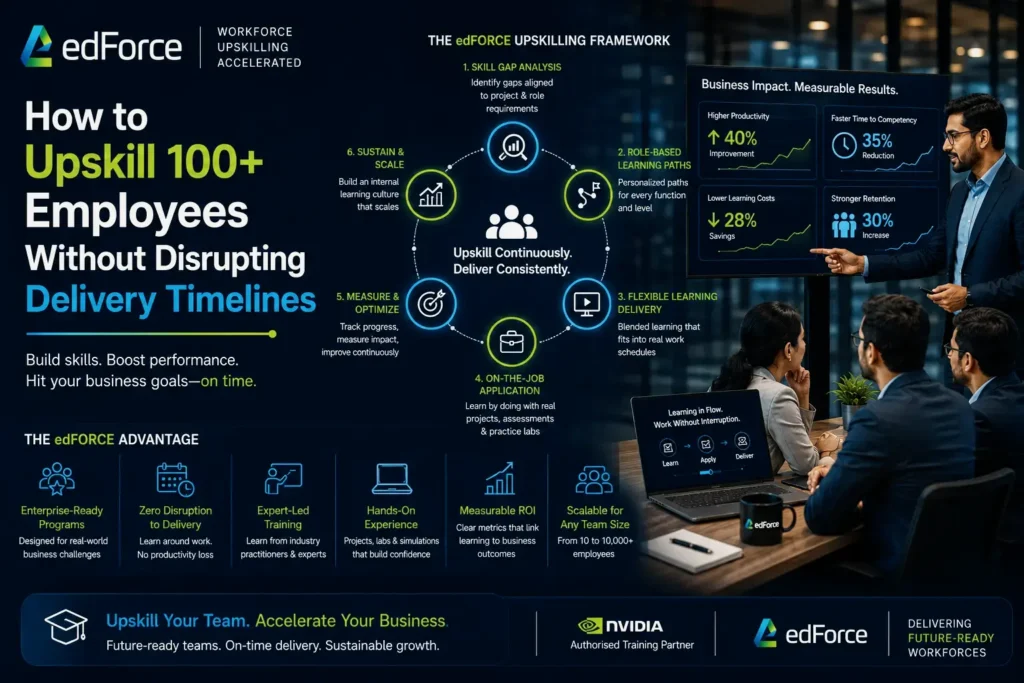
Every company agrees that upskilling is important. The challenge begins when training moves from strategy to execution. Leaders want employees to learn new technologies. Managers want stronger capabilities across teams. Employees want opportunities to grow and advance. At the same time, projects still need to be delivered. Customers still expect deadlines to be met. Business goals do not pause simply because a training program has started. This creates one of the biggest challenges enterprises face today: How do you upskill hundreds of employees without affecting productivity, project timelines, and customer commitments? The answer is not simply “more training“ Many large-scale learning initiatives struggle because organizations treat training as a separate activity instead of integrating it into the way people work. The companies seeing the best results in 2026 are taking a different approach. They are building workforce upskill programs that support business operations rather than compete with them. The Biggest Mistake Enterprises Make Many organizations still follow an outdated model. A training program is announced. Employees are expected to attend long learning sessions. Project managers suddenly lose access to key team members. Deadlines become harder to manage. Eventually, learning starts feeling like an obligation rather than an opportunity. The issue is not the training itself. The issue is the assumption that learning and delivery must happen separately. Modern enterprises cannot afford to choose between skill development and execution. They need both at the same time. That is why workforce development strategies are evolving rapidly. Why Traditional Training Models Struggle at Scale Training ten employees is manageable. Training one hundred employees is a completely different challenge. The complexity increases because every team works differently. Some employees are involved in critical projects. Others support customers. Some work remotely, while others manage daily delivery responsibilities. When organizations apply the same learning model to everyone, participation drops and outcomes become inconsistent. This is one reason many enterprise training programs deliver weaker results than expected. The learning content may be valuable, but the delivery model often does not reflect workplace realities. The Best Learning Programs Work Around Business Priorities A common pattern appears among the most successful organizations. They do not stop work for learning. They build learning into work. Instead of asking employees to step away from their responsibilities for long periods, they create structured learning pathways that fit into existing schedules. Teams continue delivering while gradually building new capabilities. This creates less disruption and stronger adoption. Employees are far more likely to engage with learning when it feels manageable rather than overwhelming. Why Role-Based Learning Matters Not every employee needs the same skills. This sounds obvious, yet many organizations still run training programs that treat everyone the same. A cloud engineer has very different learning needs than a project manager. A data analyst requires different capabilities than a customer support professional. When learning paths are role-based, employees immediately see how new knowledge connects to their day-to-day responsibilities. This improves engagement and increases the chances that learning will be applied in real-world situations. Role-based training also helps organizations focus on what matters most instead of trying to teach everything to everyone. Learning Should Support Business Goals One reason some training programs fail is because employees do not clearly understand why they are learning something. When learning feels disconnected from business objectives, participation becomes passive. The most successful workforce development programs answer simple questions: Why do we need to learn this? How will it help the projects we work on? How will it improve performance? How will it support future business growth? When employees can see the connection between learning and business outcomes, motivation naturally increases. This becomes especially important when training large groups across multiple teams. Why Managers Play a Bigger Role Than Most Companies Realize Many organizations focus heavily on learners but overlook managers. This is a mistake. Managers often determine whether training succeeds or fails. Employees look to their managers to understand priorities. If learning is treated as less important than project work, participation declines. If managers actively support workforce development, employees are far more likely to engage. Many successful enterprise learning initiatives involve managers from the beginning instead of treating training as an HR-only responsibility. When leadership, managers, and employees align around the same goals, learning becomes part of the company culture rather than a separate activity. The Rise of Continuous Learning In the past, many organizations viewed training as something that happened once or twice a year. That approach is becoming less effective. Technology evolves too quickly. AI continues to advance. Cloud platforms keep expanding. New tools and technologies enter the workplace every day. As a result, many companies are moving toward continuous learning models. Instead of large training events, employees build skills gradually throughout the year. This approach often improves retention while reducing business disruption. It also helps employees stay current as technology continues to evolve. A Prediction Enterprises Should Pay Attention To Over the next few years, companies may compete less on technology and more on workforce adaptability. Many organizations will have access to similar tools. Many will use the same platforms. What will differentiate high-performing companies is how quickly employees learn and apply new skills. The ability to learn could become a major competitive advantage. Organizations that can upskill hundreds of employees efficiently are likely to adapt faster than those that rely mainly on external hiring. That shift is already underway. What Successful Large-Scale Upskilling Looks Like Organizations that achieve the strongest results typically follow a few common principles. They: Align learning with business objectives Create role-based learning pathways Involve managers early Measure outcomes, not just attendance Integrate learning into existing workflows Most importantly, they recognize that workforce development is not separate from business performance. It directly influences business performance. When employees learn faster and adapt more effectively, organizations become more agile, productive, and resilient. How edForce Helps Enterprises Upskill at Scale At edForce.co, enterprise training programs are built around a simple reality: business cannot stop while training takes place. Whether organizations are developing skills in
Why Agentic AI Training Is the Next Big Enterprise Skill and How edForce Delivers It
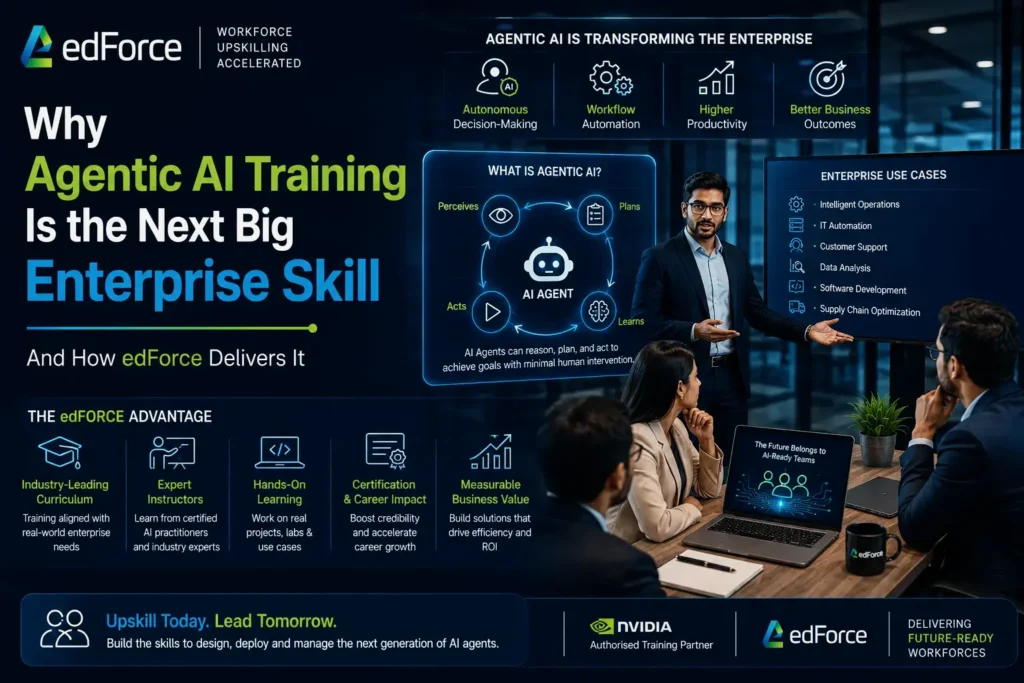
Over the past two years, most AI conversations within organizations have focused on content creation. Teams learned how to write emails faster. Marketing departments experimented with AI-generated content. Employees used AI to summarize reports, organize information, and improve productivity. This phase helped businesses understand what AI can do. The next phase is about understanding what AI can do on its own. That is where Agentic AI is beginning to change the conversation. Unlike traditional AI tools that rely on prompts and commands, Agentic AI systems can take actions, manage workflows, make decisions within defined boundaries, and interact with other systems to complete tasks. For many organizations, this represents a much bigger shift than Generative AI. The reason is simple. Generative AI helps employees work faster. Agentic AI has the potential to change how work gets done. The opportunity is exciting, but it also creates a challenge. Most organizations are not struggling to access Agentic AI technology. They are struggling to find people who understand how to use it effectively. That is why Agentic AI training is quickly becoming one of the most important enterprise skills in 2026. The Skills Gap Is Already Starting to Appear Every major technology shift creates a learning gap. Cloud computing created one. Cybersecurity created one. Data analytics created one. Agentic AI is creating another. Many professionals already understand AI at a high level. They know how chatbots work. They have used Generative AI tools. They understand concepts such as prompting and automation. However, Agentic AI introduces a different level of complexity. Organizations need people who understand: AI agents Workflow orchestration Decision-making systems Multi-agent environments Human-AI collaboration Governance and oversight These are not the skills most organizations developed during the first phase of AI adoption. As a result, demand is growing faster than workforce readiness. Why Agentic AI Is Different From Traditional Automation One common mistake organizations make is treating Agentic AI as just another automation tool. Traditional automation follows predefined rules. If a specific event occurs, the system performs a predefined action. Agentic AI works differently. It can evaluate situations, determine next steps, gather information, interact with systems, and adapt to changing conditions. That flexibility is what makes it powerful. It is also what makes workforce training so important. Employees need to understand not only how these systems work, but also when human oversight is required. Without that understanding, organizations risk creating confusion instead of efficiency. Why Business Leaders Are Paying Attention Attend any enterprise strategy discussion today and you will notice a shift. Last year, many leaders were discussing AI adoption. This year, many are discussing AI execution. The focus is moving beyond experimentation. Organizations want answers to questions such as: How can AI improve operational efficiency? Where can AI reduce manual effort? Which workflows can be safely automated? How should teams collaborate with AI agents? This is creating demand for professionals who understand both technology and business operations. Interestingly, many organizations are realizing that technical knowledge alone is not enough. They need employees who understand processes, workflow design, compliance, governance, and decision-making. Agentic AI sits at the intersection of all these areas. The Next High-Value Skill May Not Be Coding An interesting trend is beginning to emerge across industries. For years, technical skills were viewed as the primary requirement for working with advanced technologies. Agentic AI is starting to change that perception. Technical expertise remains important. However, organizations are increasingly looking for professionals who can design workflows, evaluate outcomes, manage AI-assisted processes, and oversee decision-making systems. In many situations, understanding business processes can be just as valuable as writing code. That is one reason Agentic AI is attracting attention from operations teams, analysts, project managers, business leaders, and technical professionals alike. Why Companies Cannot Wait Too Long Many organizations are taking a wait-and-see approach to Agentic AI. That strategy may prove risky. Not because Agentic AI will replace entire teams overnight. But because early adopters are already building experience. Just as organizations that invested early in cloud capabilities gained advantages later, companies that start developing Agentic AI skills today may be better positioned as adoption accelerates. One prediction appears increasingly realistic. In a few years, organizations may stop asking whether they need Agentic AI skills and start asking why they waited so long to build them. The workforce gap could grow much faster than training programs can keep up. What Effective Agentic AI Training Looks Like A common misconception is that Agentic AI training should focus only on tools. Tools will continue to evolve. Platforms will change. New frameworks will emerge. The most valuable training focuses on concepts and practical application. Employees need to understand: How AI agents work Where they create business value How workflows evolve How accountability is maintained How humans and AI collaborate effectively When professionals understand these fundamentals, they can adapt more easily as technology changes. That creates long-term capability rather than short-term familiarity. How edForce Delivers Agentic AI Training At edForce, the focus is not simply on explaining what Agentic AI is. The goal is to help organizations understand how Agentic AI can be applied in real business environments. Training is designed around practical implementation rather than theoretical discussion. Teams explore: AI agent architectures Enterprise use cases Workflow automation AI governance Agentic AI frameworks Real-world business applications The objective is to help employees move beyond experimentation and build the skills needed to support real implementation projects. This becomes increasingly valuable as organizations move beyond Generative AI pilots and toward more advanced AI ecosystems. Building the Workforce for the Next AI Era Many organizations believe AI will play a much larger role in business operations over the next decade. The only uncertainty is how quickly work itself will change. Some roles will evolve. New responsibilities will emerge. Workflows will become increasingly automated. The organizations that adapt fastest will not necessarily be the ones with the newest technology. They will often be the ones with the most prepared people. That is why workforce readiness is becoming a critical part
How Online Automotive Courses Help Professionals Stay Industry-Ready
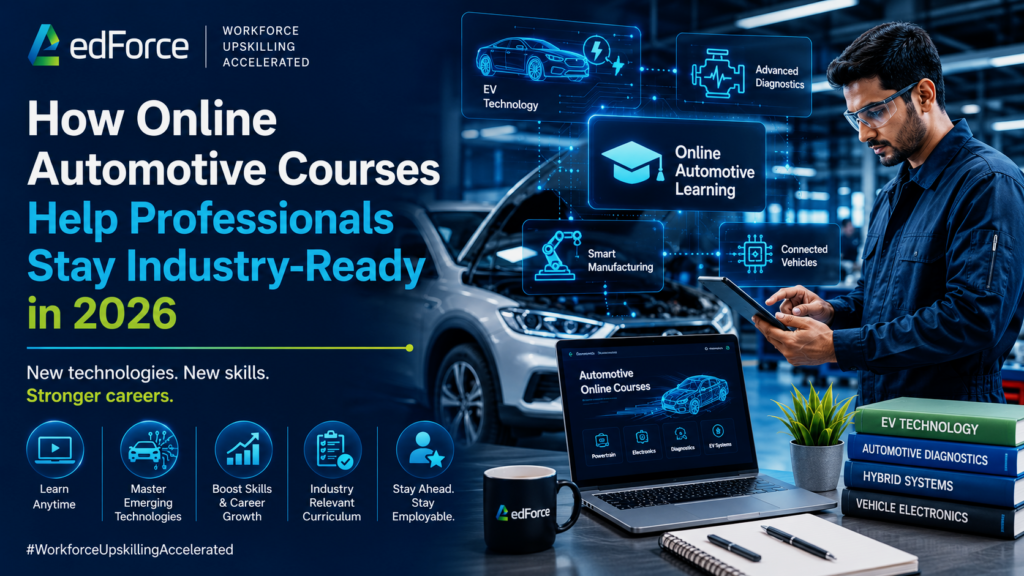
The automotive industry is evolving faster than many experts expected. In the past, experience alone was often enough to build a successful career in the automotive sector. Professionals could spend years working with the same equipment, following the same processes, and using familiar technologies while continuing to grow in their careers. That is becoming less common today. Modern vehicles now include advanced electronic systems, software, sensors, diagnostics, connected technologies, and electric vehicle components. At the same time, manufacturing facilities are becoming more sophisticated, service centers are becoming more technology-driven, and employers expect engineers and technicians to adapt to new technologies much faster than before. This creates a challenge for many working professionals. The issue is not whether skills are important. The question is whether our current skills will still be relevant three or four years from now. This is why online automotive training is becoming increasingly important for career growth in the automotive industry. The Industry Is Evolving Faster Than Traditional Learning Models One of the biggest changes happening in the automotive sector is the speed of technological advancement. In the past, major industry changes often took years to become widespread. Today, new technologies can influence hiring requirements within months. Electric vehicles are a good example. A technician who was highly skilled in traditional automotive systems may now find employers looking for knowledge of battery systems, EV maintenance, electronic diagnostics, and safety procedures. The same trend is visible in manufacturing environments. Modern automotive facilities increasingly rely on automation, data systems, predictive maintenance, and efficient production processes. For professionals in the industry, waiting until their skills become outdated is a risky approach. Online learning allows employees to stay ahead of industry changes instead of reacting to them later. Experience Still Matters, But It Is No Longer Enough Many professionals bring years or even decades of industry experience. That experience remains extremely valuable. However, employers today are increasingly looking for a combination of experience and adaptability. A common trend across the industry is that organizations prefer employees who can quickly learn new technologies. The automotive industry is one where technology is constantly changing, and businesses need professionals who can evolve alongside it. Career growth increasingly depends on continuous learning. Professionals who regularly update their skills are often better positioned to: Move into higher-paying roles Take on greater technical responsibilities Transition into leadership positions Work with emerging technologies The goal is not to replace existing experience. It is to build upon it with new capabilities. Online Learning Fits the Reality of Modern Work One reason online automotive courses are becoming more popular is flexibility. Many working professionals cannot pause their careers to attend full-time training programs. They have jobs, project deadlines, family commitments, and other responsibilities. Traditional classroom-based learning can be difficult to manage. Online learning helps solve part of this challenge by allowing professionals to learn at their own pace while continuing to work. This may sound like a small advantage, but it can make a significant difference. Most employees understand the importance of upgrading their skills. The challenge is finding enough time to do it. Flexible learning makes continuous development more practical. The Skills Employers Want Are Changing Another major trend in the automotive industry is that employers are looking beyond traditional mechanical skills. Technical knowledge remains important, but many modern roles now require expertise in: Diagnostics Electronic systems Software integration Automation awareness Data interpretation Problem-solving The strongest candidates are often those who understand how these areas connect. For example, diagnosing an issue in a modern vehicle may require more than mechanical expertise. It may involve understanding sensors, software alerts, electronic systems, and communication between vehicle components. Many professionals are using online courses to broaden their knowledge rather than limiting themselves to a single area of expertise. The Biggest Risk Is Falling Behind Quietly One issue that is not discussed often enough is how skill gaps gradually develop. Most professionals do not suddenly wake up one day and realize they are behind. The process happens slowly. New technologies begin changing workplace requirements. A new diagnostic tool becomes standard. A new production system is introduced. Over time, professionals who do not update their skills may become less comfortable with modern workflows. This is where continuous learning creates value. It helps professionals stay current before skill gaps become career obstacles. Industry Readiness Is Becoming a Career Advantage Being industry-ready today means more than having technical knowledge. It means understanding where the industry is heading. Many automotive organizations are preparing for: Expanding EV adoption Connected vehicle technologies Smarter manufacturing systems Greater automation Digital service environments Professionals who recognize these shifts are often better positioned to take advantage of future opportunities. One prediction that appears increasingly likely is that automotive careers will become far more technology-focused over the next five years. Employees who prepare early may have greater flexibility than those who wait until change becomes unavoidable. Why Practical Learning Matters More Than Certificates Certificates can demonstrate a commitment to learning. However, employers are increasingly focused on practical skills. They want professionals who can apply new knowledge in real-world situations. This is why the most effective online automotive courses focus on understanding, application, and problem-solving rather than memorization. Professionals gain the most value when learning is connected to real workplace situations. This builds confidence, which is often more valuable than knowledge alone. Learning Has Become Part of Career Growth Ten years ago, many people viewed training as something that happened before a career began. That mindset is changing. In today’s automotive industry, learning has become part of the job itself. Professionals who continue building their expertise tend to become more adaptable as technology evolves. They often feel more confident taking on new responsibilities and are better prepared for future opportunities. The goal is not to master everything. The objective is to remain adaptable. That may be one of the most valuable career skills of all. At edForce.co, automotive training programs focus on practical industry skills, emerging technologies, and workforce readiness, helping professionals develop capabilities
Why NVIDIA Skills Are Becoming Critical for AI Careers
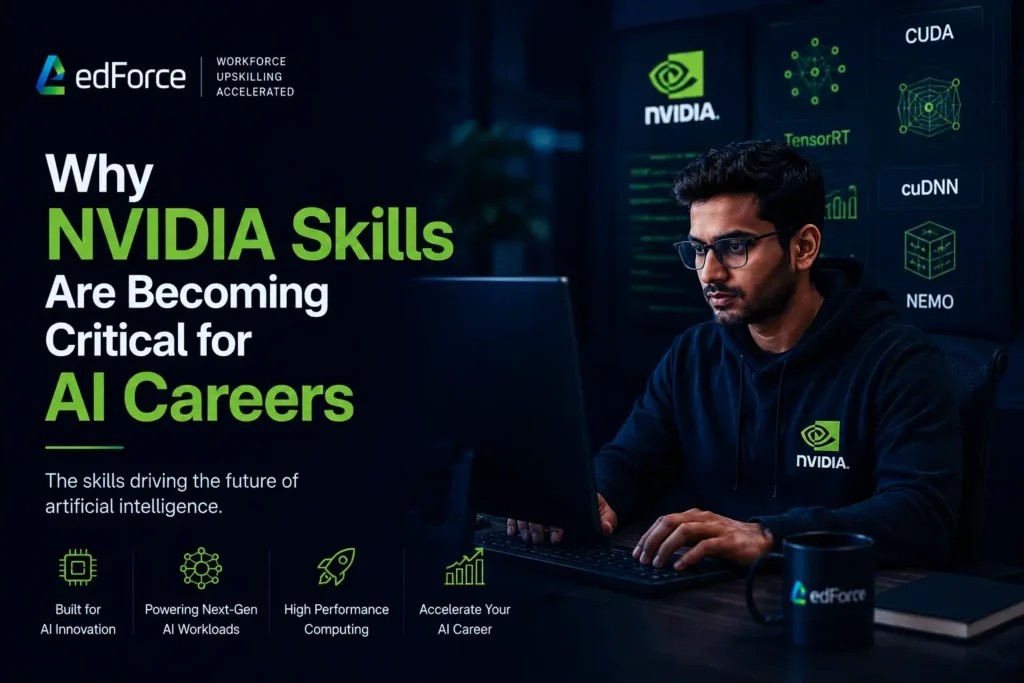
Many professionals are unaware that AI systems depend heavily on computing infrastructure. People often focus only on AI models, tools, or prompts. But when enterprises build AI environments, they are equally focused on the infrastructure powering those systems. By 2026, NVIDIA-related AI skills are becoming essential for AI careers. The demand for AI professionals is growing as businesses invest heavily in: And this is no longer limited to advanced research teams. AI infrastructure is becoming an important enterprise skill. AI Growth Is Increasing the Demand for GPU Expertise A few years ago, AI was mostly focused on algorithms and data science concepts. Today, businesses are running much larger AI workloads. Organizations now work with: The computing power needed to run these environments is massive. Traditional CPU-based systems often struggle to handle modern AI workloads, especially when enterprises scale AI operations across large environments. This is where NVIDIA technologies become highly valuable. GPU-accelerated computing allows AI systems to process large amounts of data much faster, helping enterprises scale AI more efficiently. Why Enterprises Need More Than AI Theory Many professionals understand AI concepts but not the infrastructure behind them. This creates a challenge for businesses. Enterprises increasingly need teams that understand: Enterprise AI projects are becoming much more complex. AI is no longer limited to experimentation. Businesses now need professionals who can support AI implementation in real operational environments. NVIDIA Skills Are Becoming Valuable Across Multiple Roles Earlier, GPU computing was mainly associated with engineers and research environments. That is changing quickly. Today, NVIDIA-related skills are valuable for: Modern AI systems increasingly connect software workflows with infrastructure performance. Businesses now need professionals who understand both sides. The AI Industry Is Facing an Infrastructure Skill Gap One hidden challenge many companies face today is infrastructure dependency. Organizations invest heavily in: But many internal teams still lack the practical skills needed to manage and optimize these environments effectively. This often creates: AI growth requires more than software. It also requires strong workforce capability. That is one reason NVIDIA AI and GPU-focused training programs are growing rapidly. Why Practical NVIDIA Skills Matter More Than Surface-Level AI Knowledge A large part of online AI education still focuses mainly on: But enterprise AI environments involve much more complex operational challenges. Teams often deal with: This is where practical NVIDIA skills become highly valuable. Professionals who understand accelerated computing environments deeply are often much better prepared to support enterprise AI systems than those with only surface-level AI knowledge. AI Careers Are Becoming More Infrastructure-Oriented One major shift happening in 2026 is that AI careers are becoming more infrastructure-focused. Employers increasingly value professionals who understand: AI systems are becoming more complex and computationally intensive. Businesses need employees who can help AI systems run efficiently in real operational environments. NVIDIA Skills Support Long-Term Career Growth NVIDIA expertise connects with many future-focused industries. GPU-accelerated computing now supports: Because accelerated computing is expanding across industries, professionals with these skills often gain stronger long-term career flexibility. NVIDIA-related expertise is becoming valuable far beyond traditional AI engineering roles. Why Businesses Invest in AI Infrastructure Training Many companies now realize they cannot scale AI successfully without stronger technical capability. Earlier, businesses often depended heavily on outside consultants and vendors for AI infrastructure support. Today, organizations increasingly want in-house teams that can: That is why workforce development around NVIDIA accelerated computing and enterprise AI learning is becoming more important. The Real Difference Between Learning AI and Building AI Systems Many professionals eventually realize that using AI tools is very different from supporting AI systems. Real enterprise AI environments involve: Professionals with NVIDIA Training and GPU computing expertise usually understand these deeper operational realities much better. This practical understanding is becoming increasingly important for enterprise AI careers. Why Continuous Learning Matters in AI Infrastructure AI technologies continue evolving very quickly. GPU architectures, AI frameworks, infrastructure systems, and optimization methods keep changing every year. Businesses increasingly look for professionals who can: Today, the strongest AI professionals are often those who combine: At edForce, NVIDIA AI and GPU-accelerated computing training programs focus on hands-on learning, enterprise AI workflows, and practical implementation. This helps professionals build real-world AI capability instead of only theoretical understanding. Final Thoughts NVIDIA-related skills are becoming critical for AI careers because modern AI systems depend heavily on accelerated computing infrastructure. As AI adoption continues to grow, companies increasingly need professionals who understand not only AI concepts, but also the systems powering them. By 2026, AI careers will no longer depend only on software expertise. Understanding how to support, optimize, and scale real AI infrastructure will become equally important.
Is Red Hat Linux Certification Worth It in 2026? A Practical Guide

If you ask this question today, you are asking the right thing. Because in 2026, not every certification is worth your time or money.Some certificates look good on paper but do not change your career. Others actually build skills that companies pay for.Red Hat Linux certification falls into the second category — but only if you understand where it fits. What Makes Red Hat Certification Different After working with hiring teams and tech professionals, one thing is clear. Not all certifications are trusted equally. Red Hat stands out for a simple reason. It is hands-on, not theory-based. You do not pass by remembering answers. You pass by solving real problems on a live system.That is why companies trust it more and edforce.co is a trusted partner partner who provides best training. It shows you can actually work, not just study. Is There Real Demand in 2026? Yes, and it is not slowing down.Linux is still the base of: Cloud systemsDevOps setupsServers and enterprise systems Most cloud platforms like AWS and Azure depend heavily on Linux systems, which keeps demand strong for professionals with real Linux skills.Red Hat Enterprise Linux is widely used in companies, which increases demand for certified professionals. This is not a short trend. It is a long-term need. Salary and Career Impact Let’s talk practical value. In India, RHCSA-certified professionals can earn around ₹4 LPA to ₹10 LPA based on experienceMid-level roles can go up to ₹8–12 LPA or moreGlobally, salaries often cross $100K for experienced professionals It also opens roles like: Linux System AdministratorDevOps EngineerCloud EngineerSite Reliability Engineer These are not basic roles. These are core system roles. Where It Helps and Where It Does Not This is where most people get confused.Red Hat certification is strong, but only in the right situation. It is worth it if: You want a career in Linux, DevOps, or CloudYou are targeting backend or system rolesYou are serious about hands-on work It is NOT worth it if: You want quick job placement without skillsYou are in non-technical roles like marketingYou think certification alone will get you hired Even in developer communities, this is clear. Certification helps, but without real practice, it does not guarantee a job. The Real Advantage Most People Miss From experience, the biggest value is not the certificate itself.It is how you learn while preparing. You gain: Strong command-line skillsBetter system understandingProblem-solving skills under pressure These are the skills companies look for but often do not find.That is why Red Hat certifications are called a gold standard in Linux. Cost vs Return Let’s be clear. It is not cheap. Exam cost is around $400–$500Training can cost more based on how you prepare But the return is clear.Many professionals recover the cost through better salary or new opportunities. So the real question is not cost.It is whether you will use the skill. Practical Opinion Based on Hiring Trends If you are serious about a tech career, especially in cloud or DevOps, Red Hat certification is still one of the best choices in 2026. But here is the truth: The certificate alone will not change your careerThe skills you build while preparing will That is the real difference. Final Words Red Hat Linux certification is worth it in 2026, but not for everyone. It is useful for people who: Want strong technical skillsAre ready to practice regularlyAre aiming for cloud or system roles It is not useful for those looking for shortcuts. In simple words, this certification does not give you a job.It gives you the ability to do the job well.And in today’s market, that is what really matters.
The Silent Skill Crisis No One Is Talking About in 2026
At first glance, it appears great.Team members are working good. Projects are in motion. Training programs are in operation. Innovative technologies are being used across departments. However, underneath this growth there is a smaller issue becoming more apparent.A problem which isn’t apparent immediately in reports, but slows down performance, speed and decision making. A silent crisis in skill. It’s not because people aren’t taking classes. The reason is that the skills being taught do not keep up with how the workplace is evolving. The Gap Is Not Visible, But It Is Real In contrast to traditional shortages of skills, this issue is not about talent shortages. Companies aren’t struggling to recruit. The employees aren’t completely untrained. The issue is a bit more subtle.People are using outdated methods in today’s contexts. They are utilizing new methods that rely on outdated thinking. They’re accomplishing tasks but not at the pace needed for today’s pace. The gap lies between the requirements of the job currently and what the worker can do in actual. The gap is growing in a quiet way. Technology Is Moving Faster Than Capability In 2026, the majority of organizations have already made investments into digitalization. Artificial Intelligence tools have been integrated. Cloud systems are working. Automation is an integral part of workflows. But it is not the same thing as being able. The employees may have access to advanced tools, but do not have the knowledge to utilize them effectively. They are aware of the features, but not how to use them. They adhere to procedures, but don’t make them more efficient. This results in a situation where technology is not being utilized and the expected benefits never fully manifest. Training Exists, But It Is Not Solving the Problem Many companies are not delaying the importance of learning. In reality, the training investment are at a higher level than ever before. The programs are regularly running. Content is available in a wide range. But the gap in skills continues. Why? Since a lot of the learning process is still at the surface. It’s about the awareness of oneself, not on mastery. It is finished, however, it is not incorporated. It is then delivered however it is not reinforced. The result is a familiarity with no real ability. Managers Are Seeing It, But Not Naming It In many companies, the managers are aware of the problem.The work takes longer than anticipated. It is more difficult to make decisions without support. Teams depend heavily on the performance of a handful of top performers. These signals are typically considered to be problems with performance, not as skill gaps. The issue isn’t effort. It’s the misalignment of capability. In addition, since it isn’t well-defined, it is not properly addressed. The Cost Is Slow, But Significant This crisis that is silent does not result in an immediate failure. Instead, it leads to the appearance of gradual inefficiency. Slowing down of project implementation. Innovation reduces. Errors are slightly higher. The dependence on key people increases. Over time, this can get worse. The organizations may not be aware right away, but they are operating in a way that is not up to their potential. The Shift Toward Skill Visibility Future-oriented companies are beginning to tackle this. They are challenging the assumptions of their predecessors and gaining a clear view into the capabilities of workforce. They are mapping their skills as well as identifying areas of need and aligning their development to real business requirements. This requires a change from content-driven learning to skills-based plan of work. Certain organizations collaborate with partners such as edforce.co to develop system of structured development that focuses on measuring capacity, not just delivery. This method brings clarity to the previously unnoticed. The Real Risk Is Ignoring It The greatest challenge of the silent crisis is that it’s simple to overlook. There is no immediate break. No clear failure point. There is a an ongoing decrease in efficiency and competition. However, in a highly-speedy context, even small gaps can result in major disadvantages in the course of time. Businesses that realize this in the early stages have an advantage. They are more likely to be able to catch ahead. Final Thoughts The skill shortage in 2026 isn’t a loud one. It is not a sudden disruption. It is built quietly, within teams processes, every day work. Employees are learning but often not in the proper way. Training is occurring, but it’s not always leading to capacity. The companies that will succeed will be those that dig at the bigger picture. They will look beyond completion metrics, and focus on a real alignment of skill. Since the greatest risk present isn’t a lack of ability. It is an unbalanced capability that is hidden behind the activity.
Companies Are Spending More on Training but Seeing Less Impact, Why?
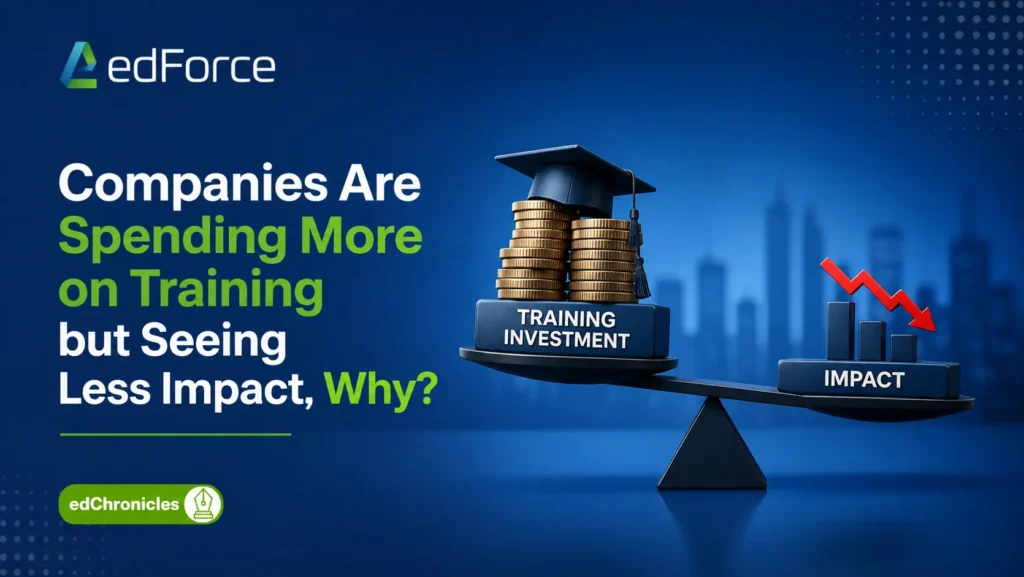
Budgets for training are growing rapidly. The learning platforms are getting better. More content is available than ever before. Yet many organizations are facing an unpleasant real-world. Despite the increased expenditure into corporate education, its actual effect on performance is a bit sporadic. Enterprises are not hesitant to invest in education. They’re trying to transform learning into quantifiable capabilities. More Training Does Not Mean Better Outcomes One of the most common misconceptions about enterprise education is more education is always a guarantee for better results. It’s not. In many organisations learning has become quantity driven. More classes and better sessions. More sessions completed. In dashboards, it appears like progress. In teams, few happens. Learning is viewed as a process, not as a system of performance. The Disconnect Between Learning and Work This is where the most impact is missed. Training often happens in isolation. Participants attend training sessions, learn concepts, only to return to the same environment where those concepts aren’t repeated or are not required. There was no application. No follow-up. No accountability. The knowledge is lost. If learning is not integrated in everyday work it is merely in the realm of theory. Learning that is theoretical does not enhance business results. Completion Metrics Are Misleading Leaders Many companies still rely on numbers of completed tasks to determine their success. It is simple to follow. It is simple to track. But it’s also a bit misleading. Completion simply tells you that employees were present or completed something. It doesn’t tell you: This can create a false perception of efficiency. The company is evaluating the activity, not the impact. Generic Training in a Role Specific World The work has become extremely specific. A single team could require different abilities according to projects, tools or even business goals. However, training is typically provided in a standard style. Similar content. Similar structure. Same expectations. This decreases the importance. Employees are disengaged when they don’t discern how training is linked to their work. If the relevance of training decreases retention and the application decrease along with it. Lack of Manager Involvement One of the most neglected areas is at the manager at the manager level. Managers are in charge of the setting where learning happens. If they’re not involved in the learning process, it is not tied to performance. In high-impact organizations Managers: In the absence of this element, the best planned training fails to produce outcomes. No Real Time Feedback or Reinforcement Learning without feedback is not complete. Employees must know if they’re using their skills in the right way. They require guidance while they are learning, not just weeks later. In many organizations feedback is often delayed or not available. This can slow down the process of the process of improvement and reduces retention. Continuous feedback helps transform learning to progress. If it isn’t there, the process of learning is in uncertainty. The Missing Link: Skill Based Thinking The fundamental issue is straightforward yet crucial. Training is mostly focussed on content. High impact companies are moving to more skill-based models. Instead of asking “What should we teach?” They instead ask“What capability do we need to build?“ This alters everything. Learning becomes organized. The outcomes are obvious. The progress is measurable. Companies that make this change begin to see real returns. Numerous companies are working with partners such as edforce.co to create learning systems that link the development of skills directly to the performance of their business, rather than only delivering training courses. What High Impact Organizations Do Differently The most important thing is that they view learning as an important job function and not as a support task. Final Thoughts The issue isn’t the fact that companies spend too much money on training. The issue is that a lot of this spending isn’t turning into capacity. As long as learning is not tied to actual work, reinforced by feedback, and evaluated through the performance of learners, impact is likely to be insignificant. Enterprises that can close this gap do not only improve the quality of training. They will create more powerful, faster and more flexible teams. In the current competitive environment it is the most important competitive advantage and upgrading skills.
How Companies Can Improve Knowledge Retention in Training
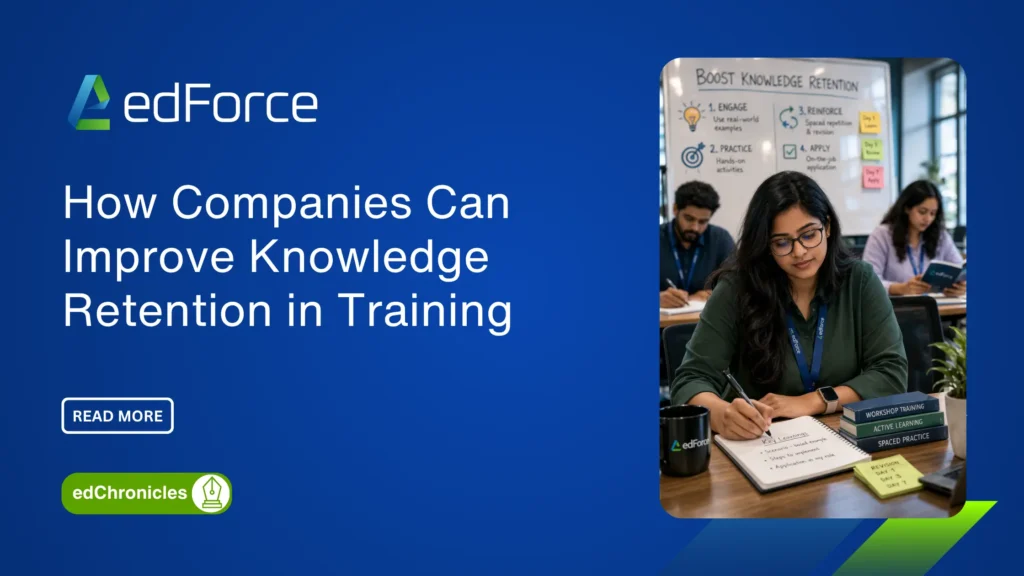
Training is easy to provide to employess. It is much more difficult to attain. Many organizations have well-organized programs, but a significant portion of the information employees are taught is lost in a matter of days. The issue isn’t exertion. It’s method. If knowledge is not stored, it is not utilized. And if it’s not utilized, it is of no value for business. Enhancing retention is not just about the addition of more content. It’s about changing the way learning is created, presented and strengthened. Make Learning Immediately Relevant People are able to remember what is meaningful. When training directly connects to the daily tasks retention increases naturally. Employees pay more attention. They become more involved. They are more likely to remember the information they have learned since they can see how it fits. Generic content fades quickly. Learning that is contextualized lasts longer. Break Content Into Smaller, Focused Segments The long sessions can be a drain on the mind. When a lot of information is presented simultaneously, very little is absorbed. The brain requires some time for processing, absorbing and connect concepts. Modules that are shorter and have clear focus points are better. They allow students to reflect and comprehend. Clarity helps improve memory. Encourage Active Participation Listening isn’t learning. The retention rate increases when employees are engaged in the content. Discussion of scenarios, asking questions as well as solving problems and sharing ideas all help to improve understanding. The more engaged learners are more engaged, more likely they will be to keep their memories in mind. Sessions that are passive may seem efficient. They seldom have long-term effect. Reinforce Learning Through Practice Training helps you develop skills. Without application, learning fades quickly. If employees are given the chance to put what they’ve learned into practice even in small ways retention is improved dramatically. Real-world scenarios, simulations and follow-up exercises can help integrate knowledge into daily work. Learning is an integral part of our lives Not just memory. Use Repetition the Right Way Repetition can be powerful, but only if done properly. Repetition of the same information does not assist. It should be provided in a variety of styles. Refreshers, discussions and actual examples increase recall but without making learning feel tedious. The process of extending learning helps to improve retention. It helps concepts be able to settle and reconnect. Provide Timely Feedback Feedback strengthens understanding. If employees get immediate feedback about what they’re doing correctly or incorrectly they can adjust their behavior more quickly. This helps reinforce the correct method and avoids wrong habits from occurring. In the absence of feedback, how we learn is in uncertainty. When feedback is provided, learning becomes more clear and stable. Create a Learning Environment That Continues After Training Retention doesn’t happen in one session. It develops over time. Companies that encourage continuous learning experience see greater outcomes. Managers play an important role in this. Inspiring students to apply of questions, and linking training to actual work helps keep learning going. Many companies are developing structured learning systems using partners such as edforce.co so that information is not only imparted, but is also retained and used. Final Thoughts Retention of knowledge is the reason that gives training its worth. Without it, even the most effective software can’t produce results. Learning becomes an effective driver of performance. Companies that are focused on relevancy to engagement, practice and reinforcement can create the best learning experience that can last and have a real impact. In the end, it’s not about how many employees are taught in a single session. It’s about how many they retain and apply when it’s important.
What Happens When Training Is Not Applied on the Job
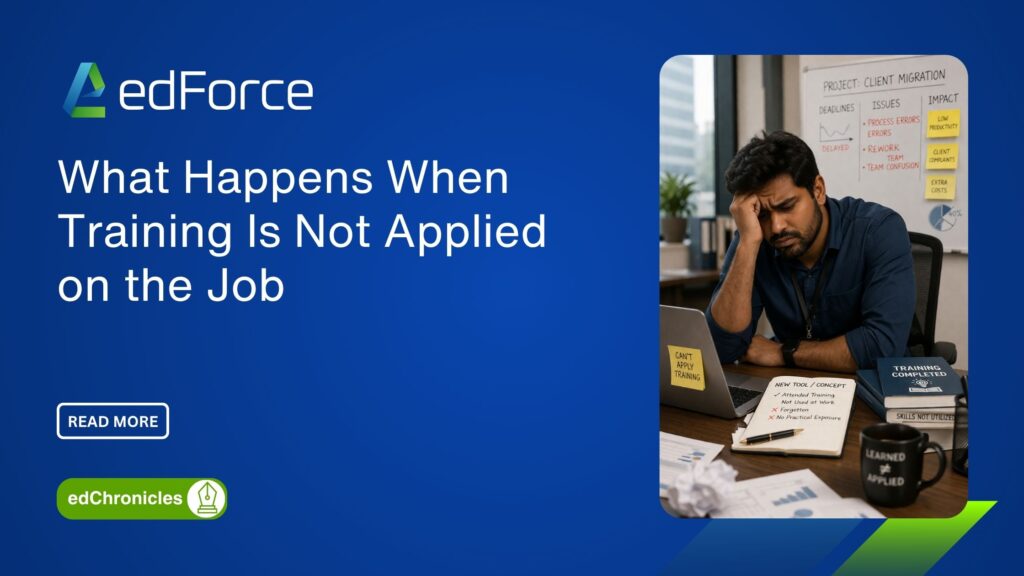
The majority of companies invest heavily in training. Programs are designed. The sessions are taught. Employees are required to attend and complete the course. Then comes the main problem. What actually changes at work? In most instances the answer is not always. That’s the point where the problem really is afoot. Since training that isn’t utilized isn’t just ineffective. It’s a cost with no return. Learning Stays Theoretical, Not Practical If training isn’t used and is not applied, it remains as a matter of knowledge. Employees might be able to grasp concepts in the class. They might even do quite well during assessments. But if they don’t have a practical application in the workplace this knowledge quickly fades away. The ability to learn is developed through practice rather than exposure. Without practice learning, it is not a capability. Performance Does Not Improve The goal of all corporate training is to improve performance. More productive. Fewer errors. Faster execution. Stronger decision making. If training isn’t applied and implemented, no results are realized. Teams continue to function exactly the same way as before. This causes a gap between the learning investment and business outcomes. Employees Lose Interest in Learning Professionals are pragmatic. They are interested in learning and how it can help them to do their work better. If training is not connected to working, employees begin thinking of it as an exercise in formality. It’s a task to be completed but not something you can use. Over time, engagement drops. The participation becomes less active. Learning culture weakens. Managers Stop Trusting Training Programs Managers are expecting the training of their teams to make them better equipped. If they do not experience an improvement that is visible, their the confidence they have in their learning program decreases. Training can feel like something to do rather than an answer. This will impact the future learning projects. The support is cut. Budgets become more difficult to justify. Time and Budget Are Wasted Training is a commitment. Not just in cash but also in time. Employees take time off from their work. Teams alter their the schedules. The allocation of resources is done. If the learning process isn’t applied the effort will be of little use. The business has to pay twice. One time for training and a second time to cover any missed improvements. Skill Gaps Continue to Grow One of the greatest dangers of not applying training is that skills gaps remain unsolved. In the abstract, workers appear well-trained. In reality, the capability of employees does not grow. This can lead to hidden weaknesses within the business. In time, these gaps impact productivity, innovation and even competitiveness. Why Application Fails in the First Place In most cases the problem isn’t with the learner. It’s with the system they are surrounded by. Training may not be aligned with the actual job requirements. Managers might not encourage the process of learning. There might be no follow-up with feedback, and there may be no opportunities to try out. If there is no connection between work and learning the application becomes difficult. The organizations that fill this gap concentrate on learning through practical experience and real-time feedback and a structured follow-up. Many companies are now working with other companies like edforce.co to create programs that make sure that learning is applied and not only given. Final Thoughts Training is only valuable by changing the way people behave. If the participants don’t implement what they learned, then training becomes a rote exercise. It could look effective on paper but isn’t in practice. Organisations seeking to have a real impact should go beyond just delivery. They should focus on reinforcement, application, and performance. Since, in the end learning is not measurable by the content of instruction. The measure is the way it is being used.
From Campus to Corporate: How edForce.co prepares the next generation talent

The workplace is changing more quickly than ever before. The mere possession of a degree is no longer sufficient. Employers are looking for graduates with the ability to think, adapt and perform right from the start. Students are looking for jobs that provide growth, stability and purpose. edForce.co meets these needs by preparing the next generation of talent for corporate success. The future demands more than academic knowledge Technology will affect every type of job in the future. Cloud platforms, data-driven decision making, cybersecurity and automation are now essentials in all industries. The World Economic Forum estimates that more than 60% of students today will be working in roles which do not yet exist. It is important to focus on adaptability and not memorization when learning. edForce helps students prepare for the future by developing skills that will grow with them. How edForce Prepares Students for the Workplace From Day 1 edForce is a program that has been designed to meet the needs of today’s workplace. They practice them. Students practice concepts. Professionals face real tools, environments, and challenges every day. This practical exposure eliminates fear, builds confidence and clarifies workplace roles. Students should be prepared to participate in the workplace, and not just watch. Confused Career Pathways? Clear Career Direction is the Answer After graduation, many students feel lost. They are aware that they studied technology but they don’t know where they belong. edForce offers structured career paths based not only on subjects, but also roles. Clarity helps students to make better career decisions earlier. Learn to Grow with the Future The technology will continue to develop. edForce is a program that supports continuous learning. The students build a solid foundation which allows them to quickly learn new tools in the future. This mentality prepares them for not only their first job but also for their long-term career growth. LinkedIn says that professionals who continue to learn are three times more likely than others to progress in their career. Building Confidence along with Skills Confidence is a key factor in achieving career success. edForce focuses primarily on developing confidence through practice feedback and mentoring. Students are taught how to communicate effectively, present ideas in groups, and work as a team. They can perform better at interviews and on the job. Confidence is the key to turning knowledge into action. Creating Stronger Placement Outcomes for Institutions Colleges and Universities want to improve their placement results. edForce is a service that helps educational institutions to improve their employability by aligning the learning with industry demands. Institutions can benefit from: The institution’s reputation and the future of students are strengthened. Why Businesses prefer edForce-trained talent Professionals who can quickly deliver value are in high demand by businesses. The edForce-trained talent requires less training and can adapt faster to project needs. It reduces the training costs and increases productivity. Candidates who are familiar with the real world of work will be trusted by employers. Real Success Stories with a Future-Focused Focus Final Year Engineering StudentBecause I had worked on real scenarios, I felt confident when I walked into interviews. It was a natural transition to move from college into corporate. HR Manager Technology FirmThe candidates trained by edForce demonstrated a better level of understanding and preparedness. They required less time to adapt. College Placement HeadWe help our students become more confident and focused. Prepare Talent for Careers and Not Just Jobs Careers can change. Careers continue. edForce equips students with skills relevant to all roles and industries. These skills help students to grow, change roles and become leaders in the future. The future belongs to confident and skilled talent Those who prepare for the future will be rewarded. Students who invest today in the right skills will be leaders tomorrow. The institutions that provide industry-aligned learning will be distinguished. Those who hire talent that is ready to work will be able to move more quickly. edForce combines all three. Next Gen Talent: Are you ready? Whether you’re a student seeking a solid start, a school aiming to improve placements or a company looking for future-ready professionals, edForce can be your learning partner. Begin your campus-to-corporate journey today with edForce.co and create a better future.