


Top Industries Using NVIDIA AI Training in 2026
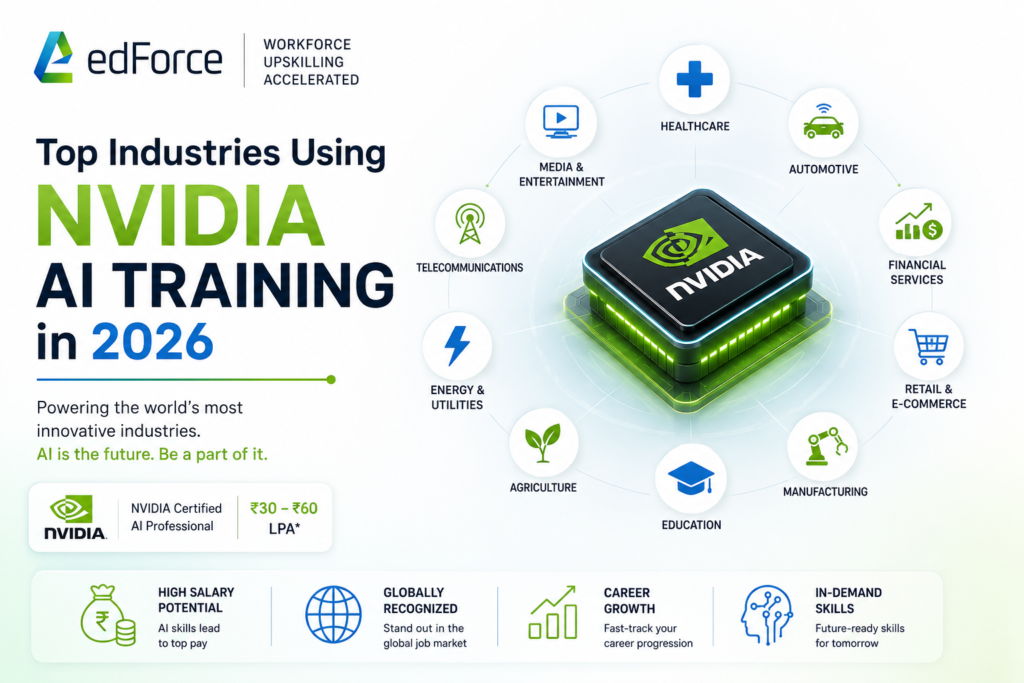
Every Company claims to be “doing AI”. But ask a different one. Which departments actually receive AI training budgets? Answers are surprising consistent. AI is not the first place companies invest. Companies invest where bad decisions can be costly, when downtime can cost millions of dollars, when regulations are strict or when every second saved is measurable. This shift is why NVIDIA AI Training has evolved from a technical conversation to a boardroom discussion. Few years ago, AI researchers were largely responsible for learning CUDA or GPU optimization. By 2026, this audience will be much larger. AI is a topic that affects everyone. Manufacturing engineers, cloud architect, software developers and medical imaging specialists are among those who work on AI projects. Demand is not driven by hype. Business transformation is driving the demand. Manufacturing Doesn’t Buy AI. It’s about buying predictability. The failure of machines in most factories does not cause a loss of money. Unexpected failures can cost them money. Unplanned shutdowns can affect production schedules and supplier commitments. They also impact inventory planning, timelines for delivery, customer confidence, and the ability to plan deliveries. AI can help you save more money than preventing a few hours downtime. This is why manufacturers invest heavily in digital twins powered by NVIDIA, predictive maintenance, robotics, industrial vision systems and NVIDIA. The technology isn’t what makes the change interesting. The training of production engineers is increasing in tandem with the software development teams, as the people who know the machines must also understand the AI models that monitor them. Future manufacturing engineers will not only troubleshoot machinery. Before making decisions, they’ll analyze AI recommendations. Healthcare wants faster answers, not automated doctors The biggest myth about AI in healthcare is that hospitals want to replace clinicians. They’re not. The majority of healthcare organizations focus on something simpler. Reduce the time it takes to collect medical information before making confident clinical choices. Data volumes are huge in medical imaging, pathology, genomics and clinical documentation. AI can help specialists review information faster but only if the infrastructure is optimized to handle enterprise-scale workloads. This is why hospitals, healthcare technology providers, and research institutions invest in professionals who are knowledgeable about accelerated computing, as well as responsible AI deployment. Even a small improvement in accuracy can have a significant impact on patient outcomes. Banks measure success in milliseconds Waiting two seconds is not a big deal for most businesses. These seconds can be a source of operational risk for financial institutions that process millions of transactions each day. NVIDIA’s AI infrastructure is used by banks to improve fraud detection, anti-money laundering, customer verification and optimize algorithmic trading environments. It’s interesting to see how the hiring process has evolved. Five years ago, the banks were primarily looking for data scientists. They’re looking for software developers, cloud engineers and infrastructure specialists that understand enterprise AI workloads in production environments. Demand is now multidisciplinary and less role-specific. Automotive Companies Are Becoming Software Companies You’ll notice that there are far fewer discussions about engines in a modern engineering center. Teams instead discuss simulation environments, autonomous decision systems, perception models, and edge computing. AI is now heavily used by vehicle manufacturers during design, testing and manufacturing operations, as well as post-sale. Before they ever hit the public roads, autonomous driving systems complete millions of driving simulations. For these simulations to be run efficiently, engineers and powerful infrastructure are required. NVIDIA AI training has become increasingly important for automotive organizations even if they do not have dedicated AI departments. Retail has quietly become an AI Industry AI is a hidden technology that most shoppers don’t even notice. Customers can easily find the products they need, get relevant suggestions, and enjoy faster delivery. Retailers are solving complex problems behind these experiences. Demand forecasting. Automated warehouses are a great way to save time and money. Supply chain optimization. Computer vision. Pricing intelligence. These AI experiments are no longer isolated. These capabilities are becoming essential to business. Retail organizations need more professionals who can integrate AI with operations, logistics, and the customer experience, rather than treating AI as an isolated technology project. The Telecommunications Industry is Training AI before Customers Notice Network failures are rarely the result of catastrophic events. They often start out as small performance anomalies which gradually affect the customer experience. AI is used by telecom providers to detect signals before they are detected by traditional monitoring systems. Network operations teams become more proactive, rather than reacting to service quality issues. This transformation requires engineers with a solid understanding of both the networking fundamentals as well as accelerated AI infrastructure. This is another example of traditional roles in technology evolving, rather than disappearing. The Energy Industry Solves Different AI Problems Energy organizations, unlike consumer technology companies often manage infrastructure that spans thousands of kilometers. Pipelines. Wind farms. Solar plants. Power grids. It is impossible for inspection teams to physically inspect every asset each day. AI is made possible by drones, computer vision and predictive analytics. NVIDIA’s computing power supports infrastructure monitoring and large-scale analysis of images. This allows engineers to concentrate their attention on the areas with the highest risk. The goal is not to replace field workers. This helps them make the best decisions. The Challenges Technology Companies Facing are Different The question of whether AI should be adopted by technology companies is not asked. The question is how soon they can integrate AI into all their products. Intelligent assistants are embedded in software. Cloud providers are expanding AI-based services. Enterprise AI is being developed by consulting firms. SaaS firms are redesigning their products around intelligent automation. Many technology companies have found that it is easier to buy GPUs than find engineers who can use them properly. This growing skills gap is why technical upskilling became a strategic initiative instead of a HR initiative. The real competition is no longer between industries This is a trend that’s often overlooked. Healthcare and manufacturing are not in competition. Retail doesn’t compete with
Top Claude AI Skills Employees Need in 2026
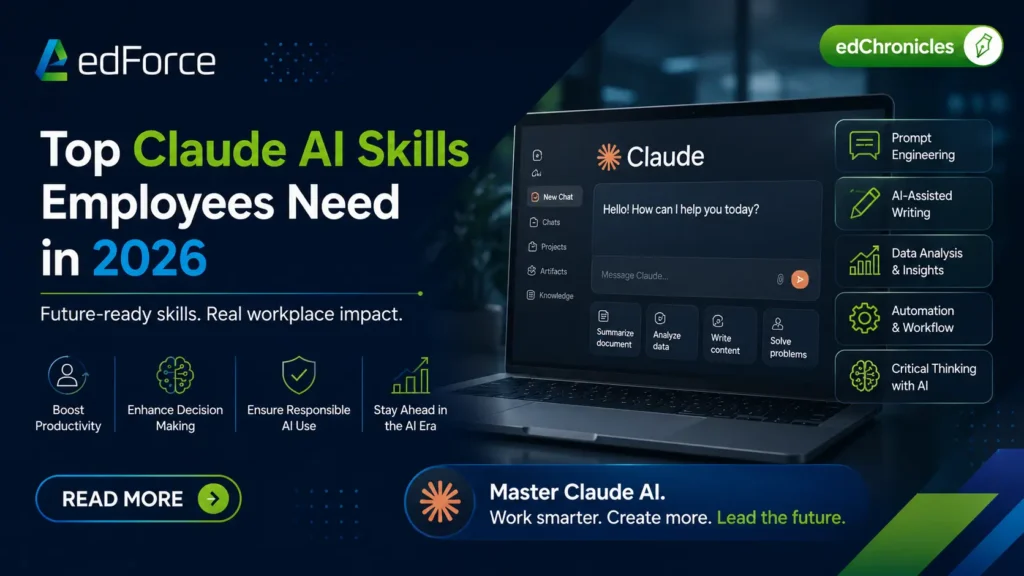
In the year prior, many employees were still asking if AI could affect their work. In 2026, the conversation has completely changed. The focus now shifts to a different area. The companies are no longer asking whether employees should use AI. They are now asking whether employees are aware of how to use it effectively. Tools such as Claude AI are becoming part of the daily work of departments. The teams are using these tools to research and content production, workflow support document analysis, report-writing, and internal communications. However, being able to access AI tools does not suffice. The workers who add the most worth are those who are able to use AI successfully, not in a casual way. Writing Better Prompts Is Becoming a Real Workplace Skill One of the most commonly held misconceptions regarding AI instruments is that they function perfectly by themselves. They aren’t. Quality of the output is heavily dependent on how employees interact in a system. This is the reason prompt writing is fast growing to be one of the essential useful AI abilities. Employees who have the ability to: generally, you will get more effective results using tools such as Claude. It is no longer a technical ability. It’s now a business capability across all the different roles. Employees Need to Learn How to Verify AI Output Another problem that businesses are experiencing is the overreliance on AI-generated response. Claude AI can save time however, employees will still require judgement. Employees with a strong work ethic are able to: This balance is becoming increasingly crucial in professional settings. The firms that reap the most benefits from AI aren’t replacing human thinking by AI. They combine AI efficiency with the human capacity to make decisions. Context Handling Is Becoming More Valuable One reason why many businesses are moving to Claude AI is because it handles large conversations and longer-form context better than previous AI tools. However, employees must be aware of managing this context effectively. In terms of practicality it refers to: People who are aware of this can perform better using AI systems. AI-Assisted Communication Is Growing Fast One area that is rapidly changing within businesses is communication. Employees are currently making use of AI instruments to But businesses do not require automated communications. They are still looking for clarity precision, accuracy, and professional judgement. This is the reason employees who are able to utilize Claude AI, while maintaining the human touch and understanding of business are increasing in value. Critical Thinking Matters More Than Ever In a way, AI is accelerating the importance of human brains. Many employees believe that AI eliminates the necessity to think critically. However, the reverse is taking place. As AI-generated content becomes more and more popular companies are increasingly looking to hire employees who are able to: AI can generate answers quickly. Whether those answers are logical is the domain of a human. Workflow Understanding Is More Important Than Tool Knowledge One thing that many professionals do wrong is not focusing on acquiring the tool itself. The companies are more concerned with how employees can enhance their workflows with the help of AI. This includes: The workers who comprehend workflow improvement typically create greater value than those who only know AI features. Why Enterprises Are Investing in Claude AI Training As AI adoption increases, a lot of organisations are beginning to realize that unstructured AI use can cause inconsistencies. Some employees use AI effectively. Other employees do not use it at all or apply it improperly. Many companies are spending money on structured AI capacity development and tools like claude Training via Learning partners such as edforce.co specifically for teams who work using AI-based generative AI tools such as enterprise workflows, corporate workflows, as well as AI-based productivity tools. The aim isn’t just AI access. The aim is to be practical AI ability. The Biggest Shift Happening in Workplaces The main shift isn’t the fact that AI instruments are replacing workers. The result is that workers who are able to effectively use AI are far more productive than employees who don’t. The gap in productivity is growing rapidly. In many organizations this is already happening: This is the reason AI abilities are no longer considered to be optional job-related abilities. Final Thoughts By 2026 Claude AI abilities aren’t only about learning to understand the functions of a machine. They’re about learning to be more efficient in AI-powered environments. People who can manage AI effectively, check outputs, consider the implications, and improve workflows will be in an edge in the modern workplaces. The future of work isn’t just human as well as AI jobs.It is humans and AI working in tandem to achieve success.
Best Online Automotive Courses to Build Job-Ready Skills in 2026
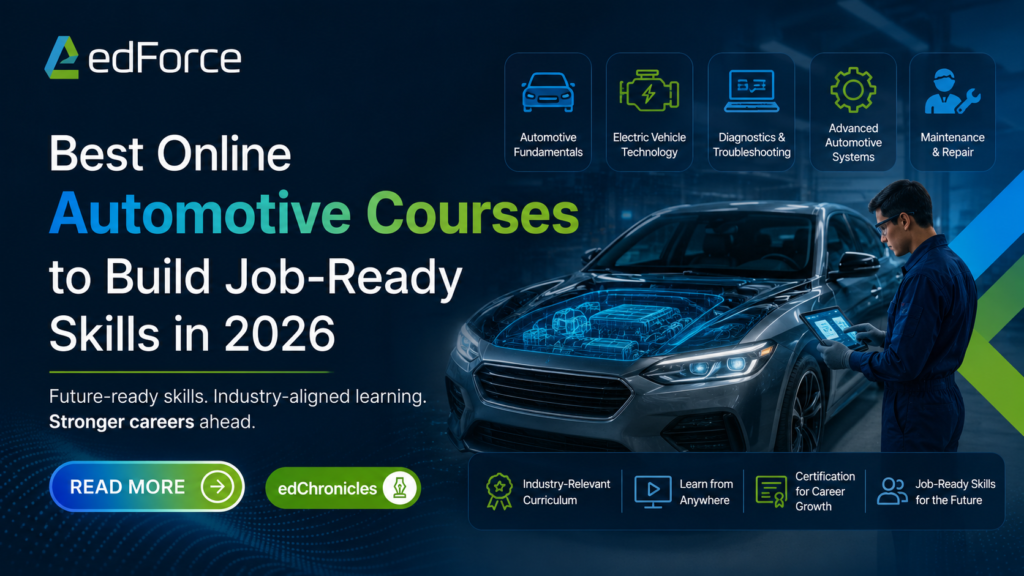
The auto industry is not like before. It is no longer only about repairs and engines. In 2026, cars are getting smarter, more electric, and more computer-based. This change has also changed what “job-ready” means. Companies today are not looking for people who only know basic theory. They want professionals who can handle diagnostics, electronic systems, design tools, and real problems. That is why choosing the right online automotive course is more important than ever. What Makes an Automotive Course Worth It Before looking at options, it is important to know what matters. A good course is not just one that teaches concepts. It should help you: Understand how real car systems workUse tools like simulation, CAD, or diagnosticsLearn new technologies like electric vehiclesBuild skills you can use in real jobs Courses that only focus on theory and not practice will not help much. Best Online Automotive Course Platforms Instead of random courses, here are some useful and relevant options based on how the industry is changing. 1. Coursera Automotive Courses Platforms like Coursera offer structured courses from universities that focus on automotive basics, design, and industry concepts. You learn topics like mechanics, vehicle systems, and engineering. Best for: Engineering students and beginnersLearning basic automotive conceptsStrong base with certification 2. edX Automotive and EV Courses edX offers courses focused on modern trends like electric vehicles, engine systems, and system design. This is where you move from basic learning to future-ready skills. Best for: Learning EV and hybrid vehiclesEngineers moving to advanced rolesUnderstanding system-level design 3. Udemy Practical Automotive Courses Udemy is more practical and beginner-friendly. Courses like repair, diagnostics, and electrical systems help you understand how cars work. These are not heavy theory courses. They focus on real use. Best for: Beginners with no experienceHands-on repair and maintenance skillsQuick learning 4. Alison Free Automotive Courses If budget is a concern, Alison offers free courses on automotive systems, engines, and basics. These are short but useful for starting. Best for: Free learningBasic understandingQuick certification 5. Autodata and Technician Training Platforms Platforms like Autodata offer industry-focused training with many modules for repair, diagnostics, and advanced systems. This type of learning matches real workshop work. Best for: Working professionalsMechanics improving skillsReal-world repair and diagnostics 6. EV and Automotive Design Courses Courses focused on EV, CAD tools, and simulation are becoming important. Learning tools like MATLAB or SolidWorks helps in future roles. Best for: Advanced learners and engineersEV industry jobsDesign and development roles How to Choose the Right Course After seeing many learners, one mistake is common. People choose courses based on popularity, not need. A simple way to decide: If you want to be a mechanic, focus on repair and diagnosticsIf you want engineering or design roles, choose CAD, EV, or system coursesIf you are starting, begin with basics and then move to advanced Do not try to learn everything at once. It wastes time. Where Most Learners Go Wrong This is important. Many students complete many courses but still do not get jobs. The reason is simple. They do not practice. Just completing a course does not make you job-ready. What matters is: Practice what you learnWork on real problemsUnderstand how systems work, not just theory Even the best course will not help without practice. Practical Advice If you want to build a career in the automotive field in 2026, focus on two things: First, learn the basics properlySecond, move fast into practical and future skills like diagnostics and EV systems The industry is changing fast. People who adapt early will grow faster. edForce.co is the best company who provides best training for automotive firld and its cetification is valid in many companies. Final Thoughts The best online automotive course is not the one with the most content. It is the one that helps you do real work with confidence. In 2026, job-ready means: You understand systemsYou can find problemsYou can use modern toolsYou can adapt to new technology Choose courses that build these skills, and your career will move in the right direction.
How Enterprises Train Employees Across Different Time Zones
As companies expand internationally the challenge of globalization becomes inevitable. Teams are no longer confined to one place, or even the same time zone. A course of instruction that works for one area might be difficult or impossible for an entirely different region. However, the goal remains the same. Learning should be consistent, enjoyable and efficient throughout the entire workforce. Businesses that thrive in this context don’t depend on one approach. They develop learning systems that are flexible and structure with real time connectivity. Moving Beyond One Time Training Sessions Traditional training was designed to be used by teams that co-located. A fixed schedule. The shared space. A single delivery. The model is broken in a global setting. Companies are now designing courses that aren’t only limited to one time. Instead, they develop learning experiences which allow employees to participate in a variety of ways and without loosing consistency. This ensures that learning is easily accessible and not limited by location. Combining Live and Flexible Learning Live sessions are still important. They provide dialogue, interaction, and clarity. However, in teams with global reach there are many people who cannot be able to attend the same event simultaneously. This is the reason why businesses offer live training and the ability to access training in a variety of ways. Sessions are usually held in multiple time slots or aided by recordings and resources for follow-up. Employees are able to revisit the content as they need to, which can improve comprehension. This combination of real-time and flexible learning allows for more flexible training. Designing for Clarity Across Cultures The training across different time zones isn’t solely about timing. It’s also about communication. Teams have diverse professional and cultural backgrounds. The design of learning must be simple, clear and well-organized to allow everyone to learn easily. Case studies, examples and explanations should be appropriate across all regions. If the content feels familiar to the audience, it increases engagement regardless of the location. Strong Facilitation Keeps Global Learners Engaged In virtual environments, attention can drop quickly. This can be even more difficult when people are interacting at different times during the day. Enterprises invest in skilled trainers who are able to maintain their the energy of their students, promote participation and be able to adapt to a variety of audiences. Interactive elements like discussions polls, discussions, and actual scenarios keep students engaged even when they are in remote settings. Using Technology to Connect Distributed Teams Technology plays an important role in global education. Learning platforms, tools for collaboration, and virtual classrooms let employees to network with each other, exchange ideas, and collaborate regardless of distance. Additionally the tools aid in maintaining continuity. Every student receives the same level of instruction, regardless of where they are located. Continuous Support Beyond the Session In international organizations the learning process cannot stop at the time of session’s end. Employees might require clarification in the future because of time differences. Enterprises can help with discussions forums, follow-ups as well as access to the trainer or mentor. This support continues to ensure that learning is always active and easily accessible. Many companies also collaborate with formal learning partners such as edforce.co to develop scalable training systems that ensure high-quality across different regions and time zones. Final Thoughts Training in different time zones isn’t only a logistical issue. It’s also a design problem. Businesses that succeed are focused on clarity, flexibility, and engagement. They develop systems in which learning isn’t linked to a date, but is integrated into the processes teams use. As global teams continue increase, the capability to provide consistent and efficient education across different time zones is going to be an essential element of the planning for the development of workers.
What to Expect After Completing an edForce.co Training Program Real Results

It is a major decision to complete a professional program. The real question for many IT professionals, and even enterprises, is not whether they complete the course. What happens next? This guide will help you understand what to expect from edForce.co’s training programs in terms of career development, confidence and skills. Immediate Confidence in Skill After Training Confidence is one of the first things professionals notice when they complete an edForce program. Practical exposure is the only way to gain confidence, not theory. The learners work with real scenarios, labs and use cases that are aligned to business. They understand why they are doing things, not just what to do. A PwC study on the workforce found that employees who received hands-on skill training felt 40 percent more confident in applying new skills to their jobs. Confidence directly affects performance. IT Job Readyness: A Better Fit for IT Roles edForce.co is designed to meet the needs of industry. The learners are not only certified, but also job-ready. The course prepares professionals for roles like Cloud engineer DevOps professional Data and AI specialist Enterprise I consultant Many students report that they are better prepared for interviews because they are able to clearly describe real-world problem solving. This practical clarity is highly valued by hiring managers. Faster career growth and role transitions Career advancement is one of the most important outcomes following an edForce program. It could be a change in role, a promotion or a shift to a technology field that is in high demand. LinkedIn’s workplace report shows professionals who consistently upskill are promoted 25 percent faster than their peers who don’t. Structured learning paths in edForce help professionals transition from junior or support roles to specialist and leadership roles. Salary Impact Measurable It is more than just knowledge. It directly impacts earning potential. According to industry data, IT professionals who are certified and have received training earn between 20 and 45 percent more in average, depending on their skill level. After completing the edForce program, many learners qualify for higher-paying roles in cloud, advanced engineering, and security domains. Training is a long-term investment, not a one-time expense. Employers Value Experienced Employees with Practical Skills The emphasis on hands-on experience is a key feature of edForce. This practical learning bridges the gap between workplace expectations and training. Employers prefer professionals with skills that can be demonstrated, rather than certificates. Improvement in Performance of Current Roles Not everyone switches jobs right after training. Professionals often apply their newly acquired skills in their current organizations. It leads to faster project completion, better teamwork, and improved problem-solving. According to McKinsey, employees who have updated their digital skills increase productivity by more than 20 percent. This impact is quickly noticed by organizations. Experiences from edForce learners Ravi Mehta Senior System EngineerI completed my cloud training and began contributing to migration projects in the workplace. In a few months, I received more responsibility from my leadership. Sneha, a Cybersecurity AnalystExplains how hands-on labs have helped her to understand threats and real responses. Now I can handle security tasks with confidence. Kunal Verma DevOps engineerThe edForce course helped me to move from manual processes into automated workflows. My role became strategic and not repetitive. Long Term Career Clarity edForce provides more than immediate results. It also gives direction. The learner understands which skills to develop next, how technology connects, and where they can take their career in the coming years. Clarity reduces confusion, which can lead to career stagnation. Professionals who have a clear plan for growth are more motivated and successful in the long run. What makes edForce outcomes different? edForce.co is focused on This ensures learning is translated into real outcomes and not just course completion. Get Ready for Real Career Results The journey does not end when you complete a training program at edForce.co. This is just the beginning. The right training is essential if you want to improve your skills, increase your opportunities and grow professionally. Discover edForce’s training programs and start your journey to a rewarding career today. The skills you develop now will determine your future role.