


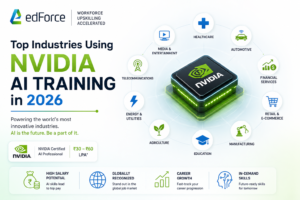
Every Company claims to be “doing AI”.
But ask a different one.
Which departments actually receive AI training budgets?
Answers are surprising consistent.
AI is not the first place companies invest. Companies invest where bad decisions can be costly, when downtime can cost millions of dollars, when regulations are strict or when every second saved is measurable.
This shift is why NVIDIA AI Training has evolved from a technical conversation to a boardroom discussion.
Few years ago, AI researchers were largely responsible for learning CUDA or GPU optimization. By 2026, this audience will be much larger. AI is a topic that affects everyone. Manufacturing engineers, cloud architect, software developers and medical imaging specialists are among those who work on AI projects.
Demand is not driven by hype. Business transformation is driving the demand.
Manufacturing Doesn’t Buy AI. It’s about buying predictability.
The failure of machines in most factories does not cause a loss of money.
Unexpected failures can cost them money.
Unplanned shutdowns can affect production schedules and supplier commitments. They also impact inventory planning, timelines for delivery, customer confidence, and the ability to plan deliveries. AI can help you save more money than preventing a few hours downtime.
This is why manufacturers invest heavily in digital twins powered by NVIDIA, predictive maintenance, robotics, industrial vision systems and NVIDIA.
The technology isn’t what makes the change interesting.
The training of production engineers is increasing in tandem with the software development teams, as the people who know the machines must also understand the AI models that monitor them.
Future manufacturing engineers will not only troubleshoot machinery. Before making decisions, they’ll analyze AI recommendations.
Healthcare wants faster answers, not automated doctors
The biggest myth about AI in healthcare is that hospitals want to replace clinicians.
They’re not.
The majority of healthcare organizations focus on something simpler.
Reduce the time it takes to collect medical information before making confident clinical choices.
Data volumes are huge in medical imaging, pathology, genomics and clinical documentation. AI can help specialists review information faster but only if the infrastructure is optimized to handle enterprise-scale workloads.
This is why hospitals, healthcare technology providers, and research institutions invest in professionals who are knowledgeable about accelerated computing, as well as responsible AI deployment.
Even a small improvement in accuracy can have a significant impact on patient outcomes.
Banks measure success in milliseconds
Waiting two seconds is not a big deal for most businesses.
These seconds can be a source of operational risk for financial institutions that process millions of transactions each day.
NVIDIA’s AI infrastructure is used by banks to improve fraud detection, anti-money laundering, customer verification and optimize algorithmic trading environments.
It’s interesting to see how the hiring process has evolved.
Five years ago, the banks were primarily looking for data scientists.
They’re looking for software developers, cloud engineers and infrastructure specialists that understand enterprise AI workloads in production environments.
Demand is now multidisciplinary and less role-specific.
Automotive Companies Are Becoming Software Companies
You’ll notice that there are far fewer discussions about engines in a modern engineering center.
Teams instead discuss simulation environments, autonomous decision systems, perception models, and edge computing.
AI is now heavily used by vehicle manufacturers during design, testing and manufacturing operations, as well as post-sale.
Before they ever hit the public roads, autonomous driving systems complete millions of driving simulations. For these simulations to be run efficiently, engineers and powerful infrastructure are required.
NVIDIA AI training has become increasingly important for automotive organizations even if they do not have dedicated AI departments.
Retail has quietly become an AI Industry
AI is a hidden technology that most shoppers don’t even notice.
Customers can easily find the products they need, get relevant suggestions, and enjoy faster delivery.
Retailers are solving complex problems behind these experiences.
Demand forecasting.
Automated warehouses are a great way to save time and money.
Supply chain optimization.
Computer vision.
Pricing intelligence.
These AI experiments are no longer isolated.
These capabilities are becoming essential to business.
Retail organizations need more professionals who can integrate AI with operations, logistics, and the customer experience, rather than treating AI as an isolated technology project.
The Telecommunications Industry is Training AI before Customers Notice
Network failures are rarely the result of catastrophic events.
They often start out as small performance anomalies which gradually affect the customer experience.
AI is used by telecom providers to detect signals before they are detected by traditional monitoring systems.
Network operations teams become more proactive, rather than reacting to service quality issues.
This transformation requires engineers with a solid understanding of both the networking fundamentals as well as accelerated AI infrastructure.
This is another example of traditional roles in technology evolving, rather than disappearing.
The Energy Industry Solves Different AI Problems
Energy organizations, unlike consumer technology companies often manage infrastructure that spans thousands of kilometers.
Pipelines.
Wind farms.
Solar plants.
Power grids.
It is impossible for inspection teams to physically inspect every asset each day.
AI is made possible by drones, computer vision and predictive analytics.
NVIDIA’s computing power supports infrastructure monitoring and large-scale analysis of images. This allows engineers to concentrate their attention on the areas with the highest risk.
The goal is not to replace field workers.
This helps them make the best decisions.
The Challenges Technology Companies Facing are Different
The question of whether AI should be adopted by technology companies is not asked.
The question is how soon they can integrate AI into all their products.
Intelligent assistants are embedded in software.
Cloud providers are expanding AI-based services.
Enterprise AI is being developed by consulting firms.
SaaS firms are redesigning their products around intelligent automation.
Many technology companies have found that it is easier to buy GPUs than find engineers who can use them properly.
This growing skills gap is why technical upskilling became a strategic initiative instead of a HR initiative.
The real competition is no longer between industries
This is a trend that’s often overlooked.
Healthcare and manufacturing are not in competition.
Retail doesn’t compete with banking
All of them are competing for the same AI talent.
Cloud architects with accelerated computing knowledge are in high demand across all industries.
Software engineers with AI expertise are in high demand across all industries.
Infrastructure teams that can support enterprise-scale AI are a must for every industry.
The competition makes workforce capability the most important differentiator in enterprise AI adoption.
Organizations who develop their own talent will move much faster than those that rely solely on external hiring.
NVIDIA Training Is Becoming Role-Based
Enterprise learning programs are undergoing a noticeable change.
No longer do companies request generic AI workshops.
They ask more specific questions.
“Can our DevOps engineers deploy AI workloads? “
Can our cloud architects optimize GPU architecture? “
will our software developers create RAG applications?” “
Can our platform team support Agentic AI?” “
Conversations have shifted away from AI concepts and towards solving operational issues.
Structured enterprise learning is far more valuable for certification preparation than isolated training. Learning partners like edForce.co help organizations build role-based NVIDIA AI paths that combine accelerated computation, Generative AI and Agentic AI with cloud infrastructure, enterprise deployment practices, and RAG. This is because AI projects in the real world rarely depend on just one skill.
NVIDIA AI Training: The bigger story
One pattern is evident across all industries.
The companies that invest the most in NVIDIA AI are not necessarily those with the biggest technology budgets.
It’s the one where any improvement in speed or accuracy, operational resilience, or operational efficiency directly impacts business performance.
By 2026, NVIDIA AI will no longer be limited to GPUs.
It is about preparing architects, engineers, and leaders in technology to build systems businesses can trust.
Companies that are successful won’t just have more AI infrastructure.
There will be more people in the company who understand how to convert that infrastructure into tangible business results.