


In the year prior, many employees were still asking if AI could affect their work. In 2026, the conversation has completely changed.
The focus now shifts to a different area.
The companies are no longer asking whether employees should use AI. They are now asking whether employees are aware of how to use it effectively.
Tools such as Claude AI are becoming part of the daily work of departments. The teams are using these tools to research and content production, workflow support document analysis, report-writing, and internal communications. However, being able to access AI tools does not suffice.
The workers who add the most worth are those who are able to use AI successfully, not in a casual way.
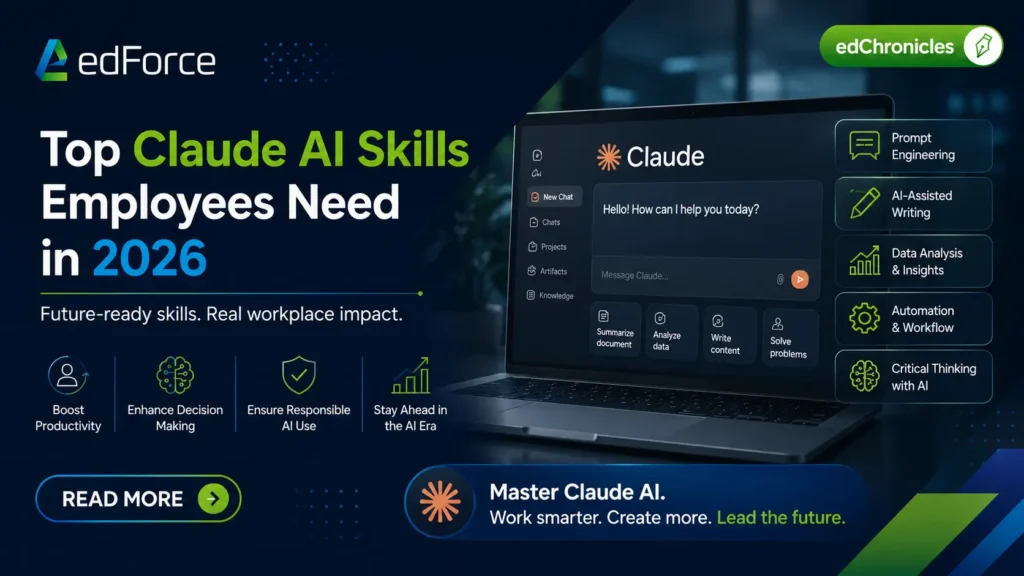
Writing Better Prompts Is Becoming a Real Workplace Skill
One of the most commonly held misconceptions regarding AI instruments is that they function perfectly by themselves.
They aren’t.
Quality of the output is heavily dependent on how employees interact in a system. This is the reason prompt writing is fast growing to be one of the essential useful AI abilities.
Employees who have the ability to:
- ask clear questions
- structure instructions properly
- They can provide context
- Improve outputs by enhancing them intelligently
generally, you will get more effective results using tools such as Claude.
It is no longer a technical ability. It’s now a business capability across all the different roles.
Employees Need to Learn How to Verify AI Output
Another problem that businesses are experiencing is the overreliance on AI-generated response.
Claude AI can save time however, employees will still require judgement.
Employees with a strong work ethic are able to:
- Take note of responses
- Recognize weak or inaccurate information
- Improve drafts prior to using the drafts
- Use human brains instead of blindly copying
This balance is becoming increasingly crucial in professional settings.
The firms that reap the most benefits from AI aren’t replacing human thinking by AI. They combine AI efficiency with the human capacity to make decisions.
Context Handling Is Becoming More Valuable
One reason why many businesses are moving to Claude AI is because it handles large conversations and longer-form context better than previous AI tools.
However, employees must be aware of managing this context effectively.
In terms of practicality it refers to:
- organizing information clearly
- Giving AI the correct background
- ensuring the sameness throughout the tasks
- using structured communications
People who are aware of this can perform better using AI systems.
AI-Assisted Communication Is Growing Fast
One area that is rapidly changing within businesses is communication.
Employees are currently making use of AI instruments to
- Draft emails
- summarize meetings
- Create reports
- Prepare internal documents
- simplify technical information
But businesses do not require automated communications. They are still looking for clarity precision, accuracy, and professional judgement.
This is the reason employees who are able to utilize Claude AI, while maintaining the human touch and understanding of business are increasing in value.
Critical Thinking Matters More Than Ever
In a way, AI is accelerating the importance of human brains.
Many employees believe that AI eliminates the necessity to think critically. However, the reverse is taking place.
As AI-generated content becomes more and more popular companies are increasingly looking to hire employees who are able to:
- question outputs
- spots with gaps
- make decisions
- link information to goals of the business
AI can generate answers quickly. Whether those answers are logical is the domain of a human.
Workflow Understanding Is More Important Than Tool Knowledge
One thing that many professionals do wrong is not focusing on acquiring the tool itself.
The companies are more concerned with how employees can enhance their workflows with the help of AI.
This includes:
- reducing repetitive work
- speed, without compromising quality
- organizing information better
- Facilitating collaboration across teams
The workers who comprehend workflow improvement typically create greater value than those who only know AI features.
Why Enterprises Are Investing in Claude AI Training
As AI adoption increases, a lot of organisations are beginning to realize that unstructured AI use can cause inconsistencies.
Some employees use AI effectively. Other employees do not use it at all or apply it improperly.
Many companies are spending money on structured AI capacity development and tools like claude Training via Learning partners such as edforce.co specifically for teams who work using AI-based generative AI tools such as enterprise workflows, corporate workflows, as well as AI-based productivity tools.
The aim isn’t just AI access. The aim is to be practical AI ability.
The Biggest Shift Happening in Workplaces
The main shift isn’t the fact that AI instruments are replacing workers.
The result is that workers who are able to effectively use AI are far more productive than employees who don’t.
The gap in productivity is growing rapidly.
In many organizations this is already happening:
- Performance
- efficiency
- decision-making
- speed of execution
This is the reason AI abilities are no longer considered to be optional job-related abilities.
Final Thoughts
By 2026 Claude AI abilities aren’t only about learning to understand the functions of a machine. They’re about learning to be more efficient in AI-powered environments.
People who can manage AI effectively, check outputs, consider the implications, and improve workflows will be in an edge in the modern workplaces.
The future of work isn’t just human as well as AI jobs.
It is humans and AI working in tandem to achieve success.