


What Is Agentic AI? A Beginner’s Guide for Enterprises
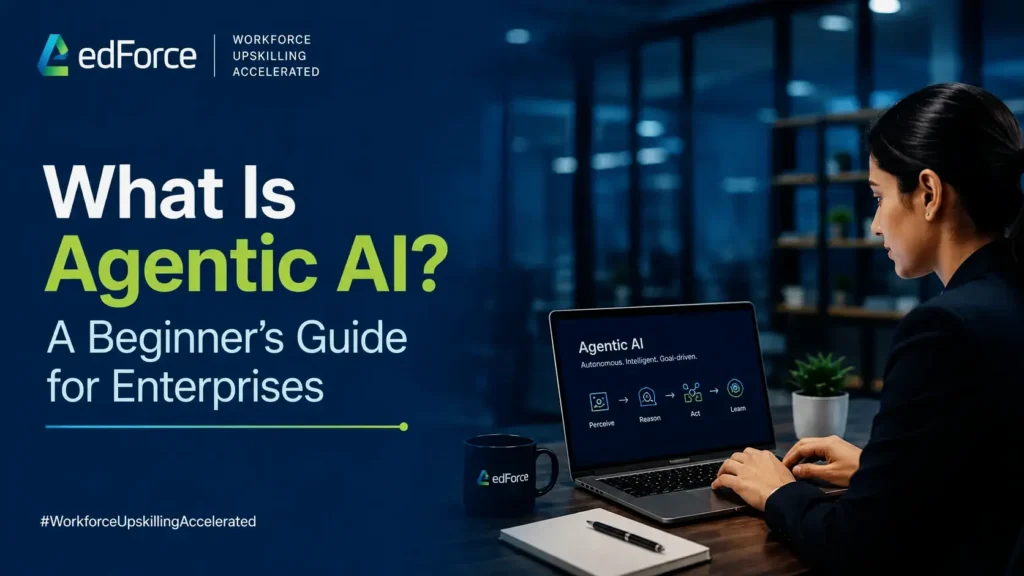
Most workplace discussions about AI used to revolve around one question: Can AI help employees work quicker? “ This question is changing. The business leaders now ask for something more. Can AI do some of the work while employees concentrate on more valuable tasks? “ Agentic AI is one of the most popular topics in enterprise tech because it reflects this shift. Agentic AI, unlike traditional AI tools, is designed to plan and reason. It can make decisions within boundaries that are defined, as well as complete multiple steps in order to reach a goal. It does not replace humans, but can help reduce repetitive tasks and improve team efficiency. This is the next step in AI adoption for many organizations. Understanding Agentic AI, however, is easier than successfully implementing it. Before investing in AI agents for business, employees must understand the technology, how it will fit into operations and what role humans are still going to play. Let’s begin with the basics. What is Agentic AI? Agentic AI is a term used to describe AI systems which can work towards a specific goal instead of waiting on one instruction at a given time. AI traditional usually follows a very simple pattern. A person asks a question. AI can provide a solution. Conversation stops until next request. Agentic AI is different. It can be used to break down a large task into smaller tasks, gather information from multiple sources, evaluate potential actions and complete certain parts of a workflow before requesting human approval. Consider the difference between asking for directions and planning a trip. One gives information. The other is helpful in achieving the goal. Agentic AI is especially useful for businesses that deal with repetitive processes, a large amount of information and complex decisions. Why are enterprises talking about agentic AI? Not every technology trend is a game changer for business. Agentic AI training has attracted attention due to its potential to improve business workflows rather than just individual tasks. Consider creating a team of customer service representatives. A traditional AI assistant could draft a response to a client’s question. A AI agent can go further, by retrieving previous conversations, identifying the issue of the customer, suggesting a solution, preparing the response, and contacting the relevant department, if necessary. While the employee reviews the results, much of the routine tasks are performed automatically. It allows teams to spend less time collecting data and more time focusing on solving problems. This is why businesses are starting to view Agentic AI more as a productivity tool than just another AI application. What is the difference between agentic AI and generative AI? Many people confuse agentic AI with generative AI, but these two terms solve very different problems. Generative AI is a technology that focuses on the creation of content. You can use it to write emails, create reports, summarise documents, create images or answer questions. Agentic AI is focused on completing workflows. It is a combination of reasoning, planning and decision-making as well as task execution that helps achieve a specific business goal. This is a simple way to tell the difference between them: Generative AI creates. Agentic AI coordinates, acts and is Both technologies will be used by most enterprises, rather than one or the other. What businesses can use agentic AI for? Agentic AI’s popularity is largely due to its ability to support multiple departments, rather than a single team. Some common enterprise use cases include: Automated customer service workflow IT service desk support Onboarding HR processes Internal Knowledge Management Sales assistance Project coordination Business Reporting Document processing It is flexible, because it focuses more on the business process than on individual tasks. Each organization has repetitive processes that eat up valuable employee time. Agentic AI is designed to streamline many of these activities. Why employee training is important A common misconception is that technology is all a business needs. Technology alone is rarely enough to create a successful transformation. It is important that employees understand the decisions made by AI, when they need human oversight, and how best to work with these systems. Often, organisations adopt policies in a non-coordinated manner without proper training. Some teams are too reliant on AI. Some people avoid it entirely. Both approaches are not long-term beneficial. Many enterprises invest in Agentic AI Training prior to introducing AI agents into their critical business operations. Adoption is much easier when employees are aware of the strengths and weaknesses of the technology. What skills should businesses start building? The skills that organizations require are changing as AI agents become more prevalent. AI is no longer limited to AI tools. It is also important to know how AI can be integrated into existing business processes. The following are some of the most important skills: Understanding AI agents, workflows and AI agents Design and task planning in advance Workflow automation concepts AI Governance and Responsible Usage Evaluation of outputs and critical thinking Collaboration between AI and humans It is interesting to note that these skills are not just technical. Understanding how AI agents improve the day-today work of managers, analysts, business leaders, and operations teams will be beneficial to them. Many companies are beginning to notice a shift A new trend has emerged across all industries. Not all organizations investing in AI will necessarily make the biggest progress. These professionals are the ones who help employees to adapt to new working methods. The technology can be deployed fairly quickly. Changes in habits, workflows and decision-making take much longer. The workforce readiness factor is one of the most important success factors for enterprise AI adoption. Early preparation of employees usually results in smoother implementations and better long-term outcomes. What could the future look like? Agentic AI is still in its early stages, but the direction it is taking is becoming more clear. In the coming years, AI agents will likely become more than just standalone tools. They’ll be part of business operations. AI agents can be used by employees in the same manner as they use
Why Agentic AI Training Is the Next Big Enterprise Skill and How edForce Delivers It
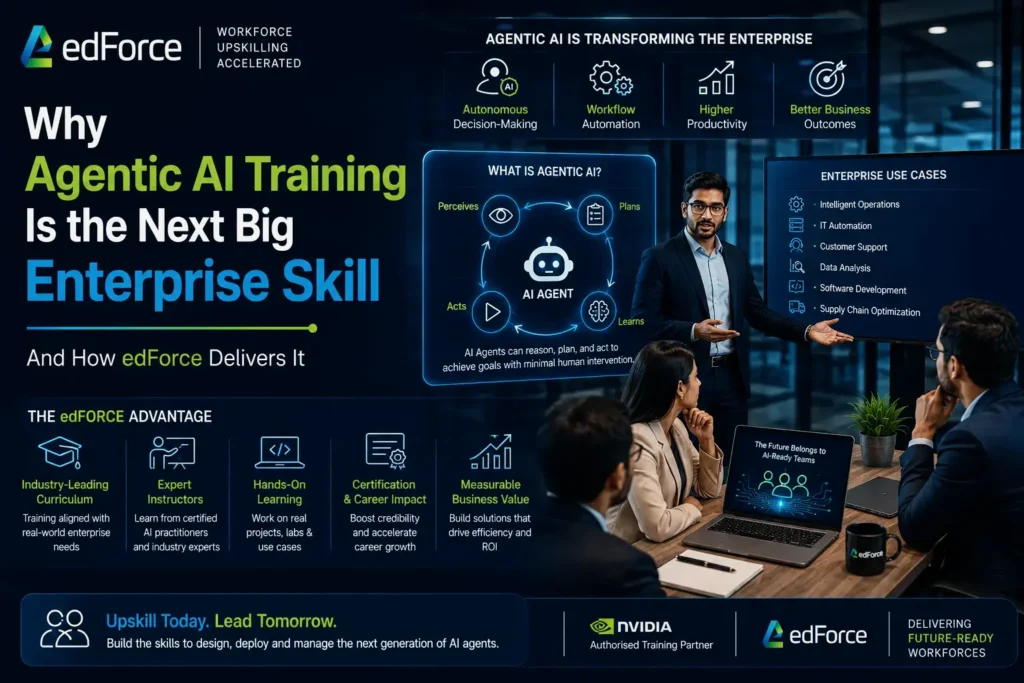
Over the past two years, most AI conversations within organizations have focused on content creation. Teams learned how to write emails faster. Marketing departments experimented with AI-generated content. Employees used AI to summarize reports, organize information, and improve productivity. This phase helped businesses understand what AI can do. The next phase is about understanding what AI can do on its own. That is where Agentic AI is beginning to change the conversation. Unlike traditional AI tools that rely on prompts and commands, Agentic AI systems can take actions, manage workflows, make decisions within defined boundaries, and interact with other systems to complete tasks. For many organizations, this represents a much bigger shift than Generative AI. The reason is simple. Generative AI helps employees work faster. Agentic AI has the potential to change how work gets done. The opportunity is exciting, but it also creates a challenge. Most organizations are not struggling to access Agentic AI technology. They are struggling to find people who understand how to use it effectively. That is why Agentic AI training is quickly becoming one of the most important enterprise skills in 2026. The Skills Gap Is Already Starting to Appear Every major technology shift creates a learning gap. Cloud computing created one. Cybersecurity created one. Data analytics created one. Agentic AI is creating another. Many professionals already understand AI at a high level. They know how chatbots work. They have used Generative AI tools. They understand concepts such as prompting and automation. However, Agentic AI introduces a different level of complexity. Organizations need people who understand: AI agents Workflow orchestration Decision-making systems Multi-agent environments Human-AI collaboration Governance and oversight These are not the skills most organizations developed during the first phase of AI adoption. As a result, demand is growing faster than workforce readiness. Why Agentic AI Is Different From Traditional Automation One common mistake organizations make is treating Agentic AI as just another automation tool. Traditional automation follows predefined rules. If a specific event occurs, the system performs a predefined action. Agentic AI works differently. It can evaluate situations, determine next steps, gather information, interact with systems, and adapt to changing conditions. That flexibility is what makes it powerful. It is also what makes workforce training so important. Employees need to understand not only how these systems work, but also when human oversight is required. Without that understanding, organizations risk creating confusion instead of efficiency. Why Business Leaders Are Paying Attention Attend any enterprise strategy discussion today and you will notice a shift. Last year, many leaders were discussing AI adoption. This year, many are discussing AI execution. The focus is moving beyond experimentation. Organizations want answers to questions such as: How can AI improve operational efficiency? Where can AI reduce manual effort? Which workflows can be safely automated? How should teams collaborate with AI agents? This is creating demand for professionals who understand both technology and business operations. Interestingly, many organizations are realizing that technical knowledge alone is not enough. They need employees who understand processes, workflow design, compliance, governance, and decision-making. Agentic AI sits at the intersection of all these areas. The Next High-Value Skill May Not Be Coding An interesting trend is beginning to emerge across industries. For years, technical skills were viewed as the primary requirement for working with advanced technologies. Agentic AI is starting to change that perception. Technical expertise remains important. However, organizations are increasingly looking for professionals who can design workflows, evaluate outcomes, manage AI-assisted processes, and oversee decision-making systems. In many situations, understanding business processes can be just as valuable as writing code. That is one reason Agentic AI is attracting attention from operations teams, analysts, project managers, business leaders, and technical professionals alike. Why Companies Cannot Wait Too Long Many organizations are taking a wait-and-see approach to Agentic AI. That strategy may prove risky. Not because Agentic AI will replace entire teams overnight. But because early adopters are already building experience. Just as organizations that invested early in cloud capabilities gained advantages later, companies that start developing Agentic AI skills today may be better positioned as adoption accelerates. One prediction appears increasingly realistic. In a few years, organizations may stop asking whether they need Agentic AI skills and start asking why they waited so long to build them. The workforce gap could grow much faster than training programs can keep up. What Effective Agentic AI Training Looks Like A common misconception is that Agentic AI training should focus only on tools. Tools will continue to evolve. Platforms will change. New frameworks will emerge. The most valuable training focuses on concepts and practical application. Employees need to understand: How AI agents work Where they create business value How workflows evolve How accountability is maintained How humans and AI collaborate effectively When professionals understand these fundamentals, they can adapt more easily as technology changes. That creates long-term capability rather than short-term familiarity. How edForce Delivers Agentic AI Training At edForce, the focus is not simply on explaining what Agentic AI is. The goal is to help organizations understand how Agentic AI can be applied in real business environments. Training is designed around practical implementation rather than theoretical discussion. Teams explore: AI agent architectures Enterprise use cases Workflow automation AI governance Agentic AI frameworks Real-world business applications The objective is to help employees move beyond experimentation and build the skills needed to support real implementation projects. This becomes increasingly valuable as organizations move beyond Generative AI pilots and toward more advanced AI ecosystems. Building the Workforce for the Next AI Era Many organizations believe AI will play a much larger role in business operations over the next decade. The only uncertainty is how quickly work itself will change. Some roles will evolve. New responsibilities will emerge. Workflows will become increasingly automated. The organizations that adapt fastest will not necessarily be the ones with the newest technology. They will often be the ones with the most prepared people. That is why workforce readiness is becoming a critical part
Agentic AI vs Generative AI: What Enterprises Should Train Teams On in 2026
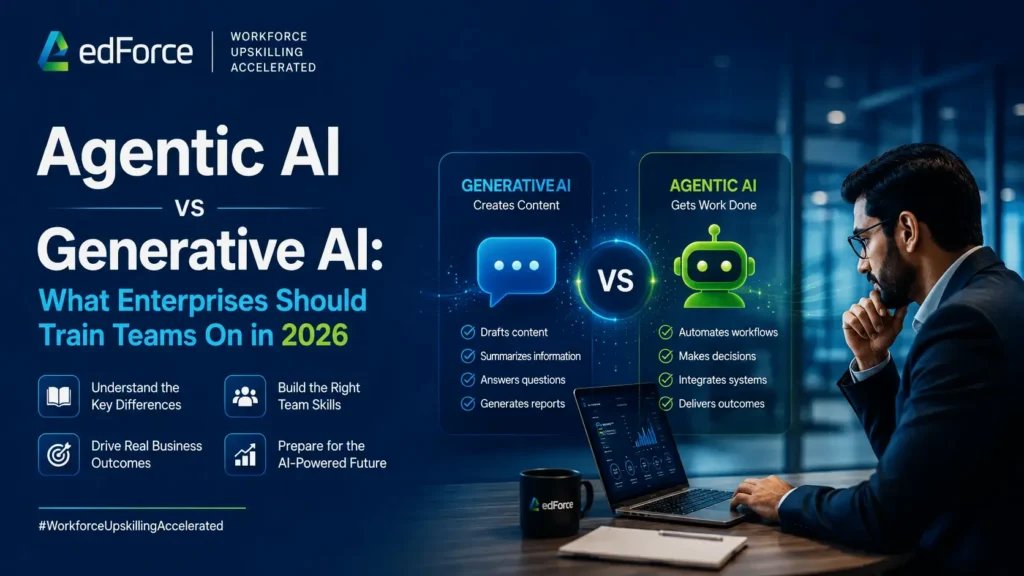
In the past two years, the majority of discussions in the workplace on AI have been focused on AI tools that produce documents, create emails, summarize information, generate reports, or respond to questions. Employees became accustomed to chat-based AI systems, and companies eagerly explored productivity improvements. The conversation is now evolving. Many companies are wondering if the next stage of AI isn’t solely about creating content, but also about finishing work. This is where Agentic AI enters the picture. Many business leaders are being introduced to terms such as Generative AI, Agentic AI, AI agents, or self-contained workflows. The problem is that these terms are often used as if they’re all the same thing. They’re not. Understanding the distinction is important since it directly affects workforce education choices. Many businesses are already planning Agentic AI initiatives while their employees are still learning to utilize Generative AI effectively. This gap could be one of the major issues facing workers in 2026. The First Wave Was About Content Creation Generative AI has changed the way individuals interact with information. How Teams Started Using Generative AI Teams began using AI to: Draft emails Summarize documents Create content Research and support Create systems for storing information Generate reports For many companies, this was their first experience with AI within routine work processes. The value was evident. Employees can complete information-based tasks faster and spend less time on repetitive work. However, something very interesting occurred. The most significant productivity improvements did not come from employees who simply used AI tools. These gains came from employees who learned to integrate these tools into their routine processes. This is crucial because it’s being repeated through Agentic AI. Agentic AI Is About Action, Not Just Output Generative AI primarily helps employees create information. Agentic AI was designed to act. What AI Agents Can Do Instead of producing reports and waiting for users to decide what to do next, an AI agent can: Collect details Analyze information Trigger workflows Communicate with systems Perform multiple tasks at once This is a significant difference. Generative AI aids work. Agentic AI participates in work. Many companies are excited about its potential. It is also the reason workforce readiness is becoming more crucial. Many Companies Are Asking the Wrong Question A common question in boardrooms today is: “Should we train employees on Generative AI or Agentic AI?” A better question is: “Which skills will employees need as AI becomes more autonomous?” Since, in the real world, businesses require both. Generative AI and Agentic AI solve different problems. One helps employees work faster. The other changes how work gets done. Businesses that view these technologies as rivals could overlook the larger opportunity. What Should Enterprises Train Teams On First? The most common error organizations make is chasing the latest technology without establishing foundational capabilities. The Foundation Still Matters Many companies are eager to explore Agentic AI, but some teams are still struggling with: Prompt quality Output verification Responsible AI usage Workflow integration Information management Without these fundamentals, Agentic AI adoption can become chaotic. Employees need to understand how AI integrates into workflows before they can effectively manage systems that make decisions or perform tasks on their own. For many companies, Generative AI literacy remains the primary step. Not because it is more important, but because it provides the foundation for everything that follows. The Real Skill Gap Is Not Technical The majority of discussions on AI are focused on technology. The most difficult challenge is often behavior. Skills Employees Need to Develop Many people are just beginning to learn: When to trust AI When to question AI outputs How to review details How to ensure accountability How to work with automated systems These abilities become more essential as organizations shift toward Agentic AI. One prediction that is becoming more likely is that future AI education programs will spend less time teaching tools and more time teaching decision-making. As AI systems become smarter, human judgment becomes more important, not less. Why Workforce Training Will Change Traditional corporate training usually focuses on teaching employees how to operate a platform. AI is different. Future Workforce Capabilities Today’s employees must understand: Workflow redesign AI supervision Operational accountability Exception handling Governance practices These are not purely technical capabilities. They are business capabilities. This is why many organizations are realizing that AI readiness can no longer remain only within IT departments. Management teams, operations teams, HR managers, project teams, and other business functions require an understanding of how AI can affect the way work is done. The Enterprises Seeing Success Are Taking a Different Approach Some companies still view AI implementation as a software rollout. Others describe it as a workplace transformation initiative. The second group is typically seeing better results. Why Transformation Beats Technology Alone Because technology adoption is usually more straightforward than changing behavior. Most employees can master a new tool quickly. Changing how people make decisions, collaborate, review work, and manage workflows often takes longer. The companies that are planning effectively for Agentic AI are usually the ones investing in workforce capabilities before large-scale deployment. What Skills Will Matter Most in 2026? Interestingly, the most valuable AI skills in 2026 may not be the ones people expect. The Skills That Will Define Future Teams Businesses are increasingly seeking employees who can: Redesign workflows Critically evaluate AI outputs Manage AI-assisted processes Work with automated systems Maintain quality and accountability These capabilities apply to employees using either Generative AI or Agentic AI. The next workforce advantage may belong to those who can combine AI efficiency with strong human judgment. Why Agentic AI Training Cannot Wait Too Long Though many organizations are still building Generative AI capabilities, waiting too long to prepare for Agentic AI could create its own challenges. Preparing for Autonomous Workflows As autonomous systems become more common, workers will need to understand: How AI agents function When human supervision is required How workflow ownership changes How accountability is managed The businesses that begin building this understanding
Why Companies Are Investing in Agentic AI Training
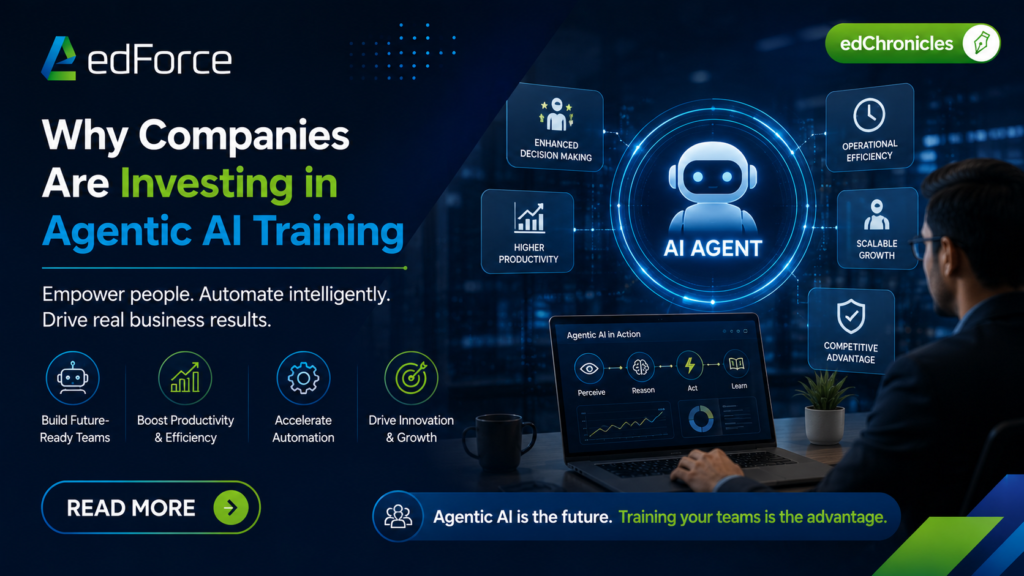
In the past few years, most companies have been using AI mainly as a support tool. Employees used AI to ask questions, create documents, generate content, or automate small tasks. Now, the conversation is changing. In 2026, businesses are moving toward something bigger. AI systems are becoming capable of making decisions, managing workflows, handling tasks within limits, and completing actions with less human involvement. This is why Agentic AI is becoming one of the most talked about technologies in enterprises. While businesses are investing heavily in AI systems, they are also realizing something important. Technology alone is not enough. Employees also need to understand how to use these systems properly. This is exactly why Agentic AI training is growing rapidly across companies. What Is Agentic AI in Simple Terms? Agentic AI refers to AI systems that can complete tasks on their own instead of only responding to instructions. Unlike traditional AI tools that wait for commands, Agentic AI systems can: In simple terms, the AI behaves more like an active digital assistant rather than just a chatbot. This is changing how businesses use AI completely. Why Businesses Are Taking It Seriously Many companies are already seeing the limitations of basic AI usage. Employees may save time using content generation or automation, but businesses still face challenges such as: Agentic AI is attracting attention because it can help reduce these operational bottlenecks. For example, businesses are exploring AI systems that can: This moves AI from support toward execution. The Real Reason Training Matters Many businesses are becoming more practical in their approach. Companies understand that advanced AI systems can create confusion if employees do not understand: Without proper training, AI adoption often becomes inconsistent. Some teams become too dependent on AI, while others avoid using it completely. Neither approach works well in business environments. Training helps create balance. Employees Need a Different Mindset for Agentic AI One major change happening today is that employees are no longer expected to only use software tools. They are increasingly expected to: This requires a very different skill set compared to traditional software usage. Employees need to understand how AI decisions affect: This is one reason businesses are investing heavily in structured AI capability building instead of casual experimentation. Why Enterprises Cannot Treat Agentic AI Casually From what many organizations are experiencing, Agentic AI creates both opportunities and risks. The benefits are clear: However, businesses also worry about: That is why companies are becoming more careful about workforce readiness. Organizations successfully implementing Agentic AI are not only using tools. They are also preparing employees to work with these systems effectively. Team Training Is Becoming More Important Than Individual Learning Another major shift is happening inside enterprises. AI adoption is no longer limited to small technical teams. Agentic AI affects operations teams, support staff, managers, analysts, and business workflows across departments. Because of this, companies are investing more in team based AI learning instead of focusing only on individual training. Many organizations are now working with enterprise learning partners like edforce.co to help teams build practical understanding of AI workflows, automation systems, and responsible AI usage in real business environments. The goal is not only AI awareness.It is operational readiness. What Companies Actually Want From Employees A clear trend is now visible in hiring and workforce development. Businesses are not expecting every employee to become an AI engineer. However, they do need employees who can: These are quickly becoming valuable workplace skills. My Practical View The companies gaining the most value from AI today are not the ones rushing to automate everything immediately. They are the ones preparing their teams properly before scaling AI adoption. Preparation matters because Agentic AI changes how employees work inside organizations. Employees who understand these systems will become far more valuable in the coming years. Businesses already understand this. Final Thoughts Companies are investing in Agentic AI training because the future of work is moving from basic AI assistance toward AI supported execution. As AI systems become more autonomous, businesses need employees who can guide, monitor, and work with these systems responsibly.The real challenge is no longer getting access to AI tools.It is building teams that understand how to use them effectively in real business environments