


Best Corporate Training Company for Enterprise Upskilling
The majority of companies are not struggling today because employees don’t want to learn. The real issue is that corporate training is still disconnected from actual job roles and workplace requirements. Employees may attend training sessions, earn certifications, and complete learning modules, but when it comes to applying those skills in real projects, many still feel limited. Managers notice low adoption rates. Teams often return to old workflows, and productivity improvements remain smaller than expected. This is why enterprises are becoming more selective when choosing a corporate training company. Businesses are no longer interested in training that only looks good in reports. They want programs that improve daily operations, help employees adapt faster, and build long-term workforce capability. This shift is changing how enterprises approach upskilling in 2026. edForce is not just another course provider. The focus is on helping organizations build practical workforce skills that employees can confidently apply in real business environments. Why Upskilling Enterprises Has Become a Business Priority A few years ago, corporate training was often treated as a supporting function. Today, it directly impacts business growth, productivity, and technology adoption. The reason is simple: Technology is evolving much faster than traditional education systems. Companies are rapidly adopting AI, cloud technologies, automation platforms, cybersecurity systems, and new digital workflows. However, many employees still rely on outdated processes because organizational learning systems struggle to keep pace. This creates a growing gap between: Enterprise upskilling is no longer optional. It has become part of a long-term business strategy. What Makes a Good Corporate Training Company? Most training providers focus heavily on certifications and course catalogs. But today, enterprises need much more than access to content. A strong corporate training company should help organizations: The difference becomes visible when learning improves real workflows instead of staying limited to training dashboards. One major mistake companies make is selecting training vendors only based on brand recognition or the number of available courses. The best enterprise training partners understand how employees learn and apply skills in the workplace. Why Traditional Corporate Training Often Fails Many businesses face a common but overlooked problem: employees complete training programs but rarely change their work habits afterward. There are several reasons for this: Sometimes the learning is too theoretical. In other cases, the training becomes outdated before employees finish it. Often, the content has little connection to actual job responsibilities. The result is predictable: Employees do not need more random information. They need training designed around real workflows and real workplace challenges. Modern enterprise upskilling is becoming more practical and role-focused. Enterprise Training Needs Practical Learning, Not Just Content Online training is useful for explaining concepts, but it often fails to prepare employees for real-world situations. This is becoming a major challenge in areas such as: Employees may understand the terminology but still struggle with implementation. edForce training programs focus on real-world business use cases instead of disconnected theory. Learning is designed to help professionals apply skills in real enterprise environments through guided sessions, hands-on learning, and workflow-based models. This improves team confidence, increases retention, and speeds up skill adoption. The Biggest Workforce Shift Is Happening Now In 2026, companies will no longer hire only for current skills. Businesses are increasingly hiring and training employees for adaptability. Why? Because technology changes too quickly. Employees who can adapt to new workflows and learn emerging systems are becoming far more valuable. Organizations are changing the way they approach workforce development. Modern enterprise training now focuses on: This represents a major shift in corporate learning programs. Why Enterprises Are Looking for Long-Term Training Partners Many organizations are moving away from one-time training models. The reason is practicality. Upskilling has become an ongoing process and is now part of continuous workforce development. Today, businesses need partners who can support: That is why companies increasingly prefer corporate training firms that understand enterprise challenges instead of relying on generic learning modules. The strongest partnerships are formed when learning aligns with operational goals. How Enterprise Upskilling Impacts Business Performance Many businesses underestimate how strongly workforce capability affects overall performance. Skill gaps often lead to: Strong upskilling programs help organizations: Enterprise learning is now becoming a core part of business growth strategy, not just HR planning. What Businesses Should Consider Before Selecting a Training Partner The largest course library does not always mean the best corporate training provider. Businesses should focus on: Training providers should understand not only the technology itself, but also the operational challenges businesses face while adopting new systems. That difference matters more than marketing claims. Why Companies Choose edForce Enterprise Training edForce enterprise training primarily focuses on developing practical skills that match modern workforce challenges. The programs are designed to improve real team capabilities rather than provide generic learning experiences. The training focuses on: This helps employees adapt more effectively in a rapidly changing business environment. Final Thoughts Corporate learning is no longer just about completing courses. It is about helping employees apply skills effectively in real workplace situations. That is the biggest difference modern businesses are looking for today. Companies want training that improves execution, supports transformation, and helps teams adapt faster to new technologies and workflows. The best corporate trainer is not the one offering the most courses. It is the company that helps organizations build practical, long-term workplace capability while creating measurable business impact. FAQ‘s
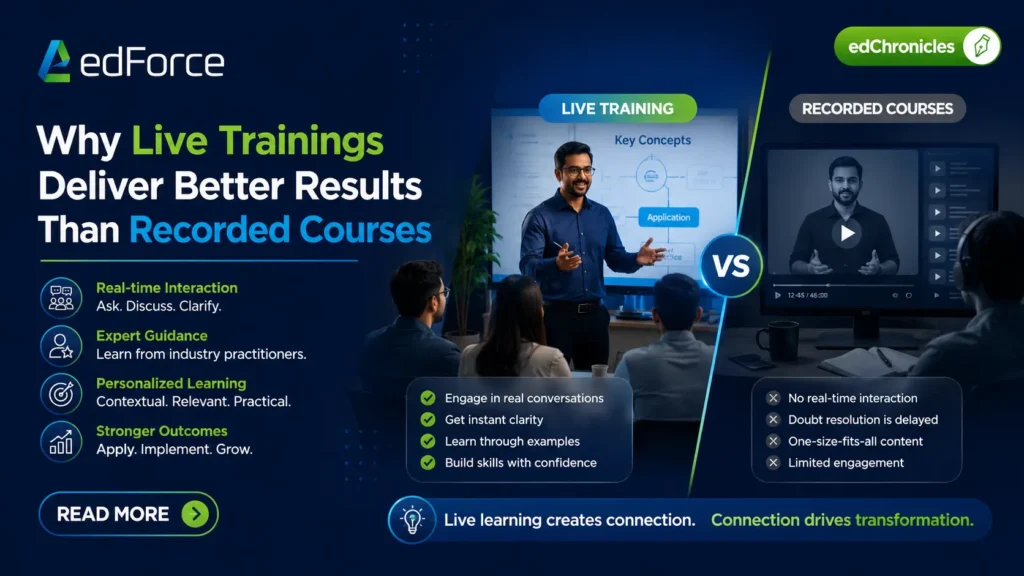
Why Live Trainings Deliver Better Results Than Recorded Courses
In every firm I’ve worked in or observed closely I have observed the same pattern. A select group of employees is consistently moving ahead in the same direction, while other employees who have similar qualifications remain at the same level. It’s tempting to label”talent” this “talent,” but after many years of watching the way teams function this explanation doesn’t work. The distinction is more practical. It is all about the way people conduct themselves at work everyday, and especially when there is no one looking closely. It is not about who has more knowledge. It’s about who makes use of their knowledge in the correct way in the right way, at the right moment. Growth Is Driven by Application, Not Learning Volume A lot of employees today are continuously learning. They take classes, complete courses, and are constantly up to date. In writing, they appear robust. However, there’s a noticeable gap that I’ve repeatedly observed. The lack of application in learning creates confidence, not capabilities. People who progress faster in their careers have a different approach to one thing. They integrate the knowledge they have gained into their work right away. Even if they’re unsure about something, they will try. They experiment with concepts, refine them and then improve them through actions. The habit will grow with time. It’s not about how much you’ve learned. It’s how fast you transform your learning to output. Ownership Is the First Real Signal of Growth Managers do not promote talent. They encourage reliability. In many teams, the employees with the highest growth aren’t the ones who wait for clarity. The ones that are fastest-growing ahead. There are certain behaviors that are consistent: This builds trust. When trust is established the growth will naturally follow. Feedback Is Used, Not Defended Feedback is among the least understood aspects of growth. Some employees take note of feedback, but don’t take action based on the information. Others are resistant to it completely. Both types slow down progress. The employees who increase their productivity take feedback in a different way. They view it as an feedback for improvement and not as a form of judgment. Practically speaking: This leads to a loop of constant improvements, and that’s what businesses value. They Focus on Solving, Not Just Doing It is an unnoticeable, but significant distinction between employees who finish their work and those who are growing. Focused on task, employees try to complete the work given to them.Growth-focused employees seek to understand the reason of the task. In time, this leads to drastically different results. There are many fast-growing employees: It is also where they begin being noticed without trying too to be too. Skill Building Is Intentional, Not Random One of the most common mistakes I have seen is a lack of focus on learning. Employees tend to spend their time learning techniques that are intriguing but do not serve their job. People who are growing faster are more discerning. They pay their attention to: They then work on the specific areas. The same is true for organizations that are transforming. Many are now constructing system of learning that is structured and based on roles typically with partners such as edforce.co for employees to are focused on specific competencies that directly impact their performance. Consistency Beats Intensity Every Time Growth is not a thing that happens in a flash. It is a pattern that occurs. Certain employees are extremely hard-working for brief periods, only to they slow down. Some employees maintain a steady rate of progress. Second group goes ahead. There are three things you will be able to see: After an entire year, the change is evident. My Perspective After Working With Teams If I needed to simplify the situation by experience, growth can be described as a set of actions that are practical: None of these requires extraordinary skills. Together, they can create remarkable advancement. Final Thoughts The notion that success is dependent mostly on talent is a common however it can be is a bit misleading. It lets people explain stagnation and not question their strategy. In reality, the biggest changes in growth are caused by everyday choices. What someone does and how they react, and how they grow. It is also the reason that some employees progress faster. It is not because they are more skilled or skilled, but because they are more focused on how they progress.