

How Can You Determine the ROI of IT Training for Corporate Employees? (With an Easy Formula
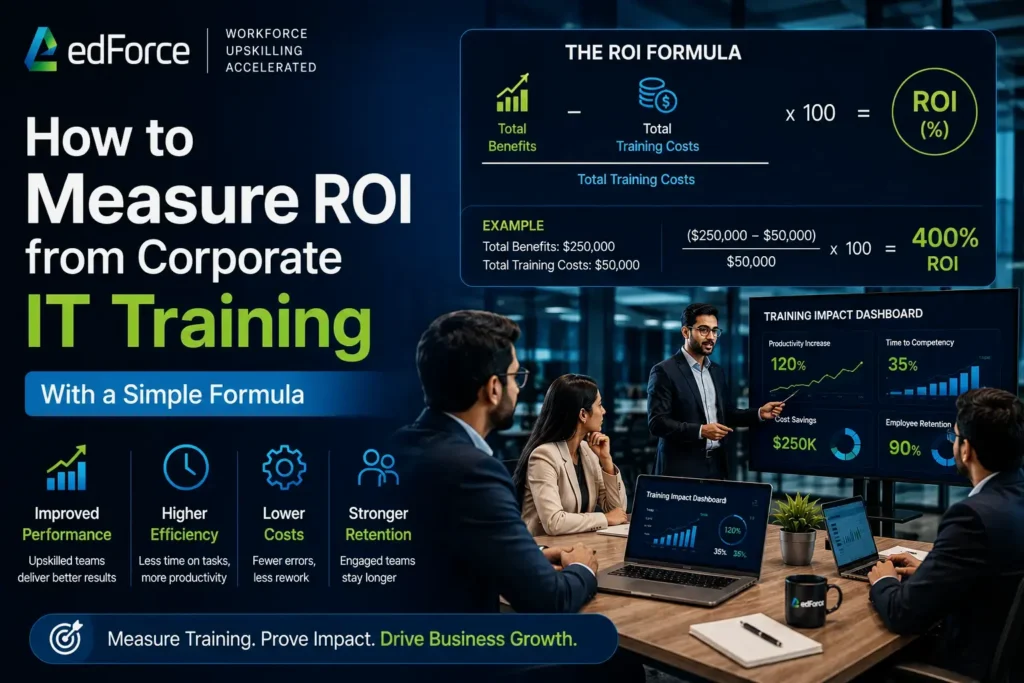
One of the biggest mistakes companies make when it comes to corporate training is treating it as a cost rather than an investment. When a business invests in new software, management expects measurable results. If a company spends on marketing, sales, or infrastructure, performance is carefully tracked. Training often gets different treatment. Many organizations spend thousands or even millions of rupees on employee development programs, yet very few can answer one simple question: “What business value are we actually getting from this training?” This is becoming an even bigger issue in 2026 as training budgets continue to grow. Technology is evolving rapidly, new skills are constantly emerging, and companies are investing heavily in areas such as AI, cloud computing, cybersecurity, Red Hat, NVIDIA, and data technologies. Leadership teams increasingly need to justify these investments. The good news is that training ROI is not as difficult to measure as many organizations think. The real challenge is that most companies track learning activities rather than business outcomes. The Wrong Way to Measure Training Success Many organizations focus on numbers that look impressive in reports but reveal very little about actual business impact. For example: Number of employees trained Course completion rates Certification counts Training hours completed Workshop attendance These metrics can be useful, but they do not answer the question executives care about most: Did the training improve business performance? An employee may complete a certification but never apply the knowledge. Another employee may attend fewer sessions but use new skills to improve project quality, reduce costs, or solve operational challenges. Only one of those examples creates measurable business value. That is why organizations need to move beyond learning metrics and focus on performance metrics. Why Measuring ROI Has Become More Important A few years ago, many organizations viewed training as a long-term investment that was difficult to measure. Today’s leadership teams expect greater visibility. The reason is simple. Technology skills directly affect business outcomes. A well-trained cloud team can reduce infrastructure costs. An AI-enabled workforce can improve productivity. Cybersecurity training can reduce business risk. DevOps training can speed up deployment cycles. These improvements directly influence revenue, efficiency, customer satisfaction, and operational performance. Training is no longer separate from business strategy. It has become a critical part of it. A Simple Formula for Training ROI Many companies overcomplicate ROI calculations. The basic formula is straightforward: Training ROI (%) = [(Business Benefit – Training Cost) / Training Cost] × 100 Let’s look at a simple example. Suppose a company spends ₹10,00,000 on cloud training for its infrastructure team. After the training: Cloud costs decrease by ₹8,00,000 per year Productivity improvements save another ₹7,00,000 per year Total Benefit = ₹15,00,000 Applying the formula: ROI = [(15,00,000 – 10,00,000) / 10,00,000] × 100 ROI = 50% In this example, the company achieved a 50% return on its training investment. The formula is simple. The challenge is identifying the right benefits to measure. What Business Benefits Should You Track? This is where many organizations struggle. Training rarely creates value in just one area. Instead of focusing on a single metric, companies should track multiple business outcomes. Depending on the training program, improvements may include: Faster project delivery Lower operational costs Higher productivity Improved employee retention Reduced support tickets Better compliance performance Faster deployment cycles Fewer security incidents Improved customer satisfaction Not every benefit will apply to every training program. The goal is to identify outcomes that are directly connected to the skills being developed. The Hidden ROI Many Companies Ignore An important area often overlooked is internal capability building. When organizations lack critical skills, they usually solve the problem in one of three ways: Hiring external talent Bringing in consultants Delaying projects All three options can be expensive. A skilled internal workforce reduces dependence on external resources. This benefit often does not appear in training reports, but it can create significant long-term value. For example, a company with strong internal AI expertise may avoid hiring expensive consultants for every new AI initiative. Over time, those savings can become substantial. Why Certifications Alone Are Not Enough Many organizations still measure training success through certification counts. While certifications have value, they should not be the ultimate goal. The real goal is application. A cloud certification matters because it helps improve cloud operations. A cybersecurity certification matters because it strengthens security practices. An AI certification matters because it supports innovation and business outcomes. When organizations focus only on certifications, they risk missing the bigger picture. The best training programs create measurable performance improvements, not just certificates. The Best Time to Measure ROI Another common mistake is measuring ROI too early. Learning takes time to translate into business results. An employee may complete training today but not apply those skills until the next project begins. That is why many organizations measure training impact in phases. 30 Days Knowledge acquisition Course completion Certification progress 90 Days Skill application Workflow improvements Productivity gains 6–12 Months Business outcomes Cost savings Operational improvements Long-term impact This approach provides a more realistic view of training effectiveness. A Prediction for the Future of Corporate Training Over the next few years, training budgets will likely face greater scrutiny. Organizations will continue investing in AI, cloud computing, cybersecurity, automation, and other emerging technologies. At the same time, leadership teams will increasingly demand proof that training investments generate business value. As a result, companies may begin evaluating learning programs the same way they evaluate technology investments. The question will no longer be: “How many employees completed the training?” Instead, it will be: “What business outcomes improved because of the training?” That shift is already happening. How Leading Organizations Measure Training Success The most successful companies do not treat training as an HR initiative alone. They connect learning directly to business goals. Before launching a program, they identify: The skills being developed The business problem being solved The performance metrics that matter The expected outcomes This creates a clear link between workforce development and business performance. When learning aligns
Why Corporate Training Is Changing Rapidly in 2026
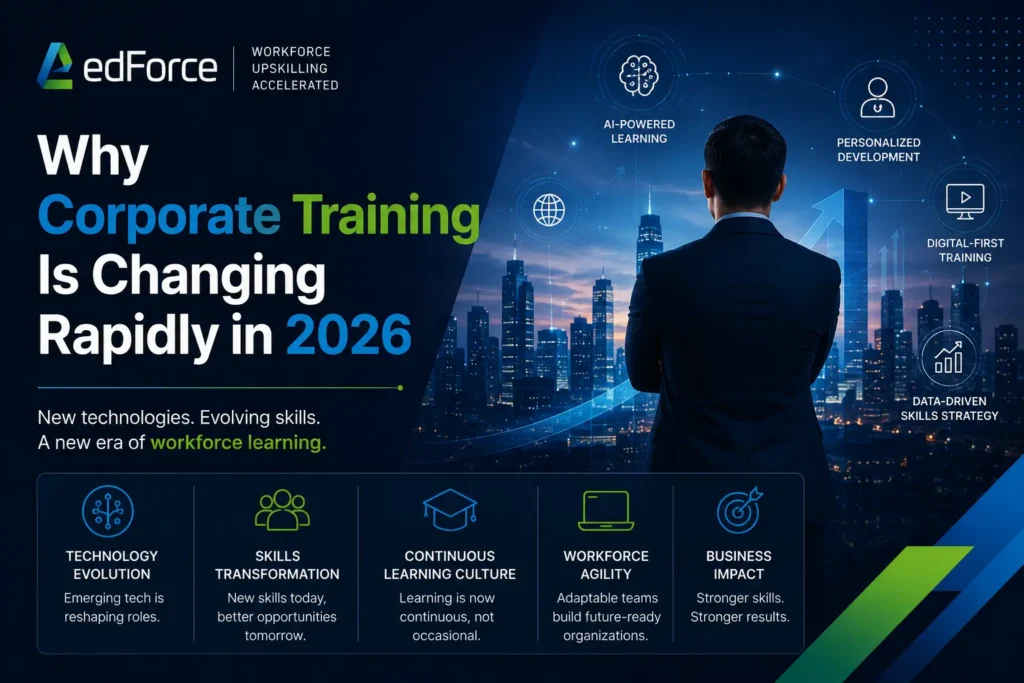
Corporate training has gone through one of the biggest workplace changes in recent years. Earlier, companies mainly focused on learning programs, certifications, and attendance tracking. Today, businesses are asking a different question. Does the training improve employee performance? This single shift is changing the corporate learning industry. Employees in many organizations already have access to thousands of courses, learning platforms, and certification programs. Even then, many companies still struggle with skill gaps, slow technology adoption, and teams being unable to apply learning in real projects. Information is no longer the problem. The real challenge is helping employees adapt quickly to new tools, workflows, and business expectations. Corporate training is changing rapidly in 2026. The Workplace Is Evolving Faster Than Traditional Learning One major reason behind this shift is the speed of workplace change. Today, teams work in environments shaped by: Many traditional learning systems were built for slower business environments. Employees could learn one skill and use it for years without major changes. That model no longer works. Today, technology changes quickly, workflows constantly evolve, and employees must adapt continuously. Learning systems now need to keep up with real business operations instead of remaining separate from them. This is why many organizations are rethinking workforce training. Employers Care More About Skill Application Than Course Completion A few years ago, businesses measured training success using: But those metrics alone are no longer enough. Many employees complete training programs successfully but still struggle to apply the learning. Managers often notice that employees understand concepts during training but face difficulty using them in real workflows. This has created an important realization for enterprises. Training creates value only when employees feel confident applying skills at work. Because of this, businesses now focus more on: This shift away from passive learning models is driving more practical and experience-based training approaches. Information Overload Is Becoming a Workplace Problem Another reason corporate training is changing is because employees already deal with too much information every day. Most professionals work with: When training becomes another disconnected stream of information, engagement drops quickly. Employees no longer want repetitive or overly theoretical learning that feels unrelated to their work. They want learning that helps solve real workplace problems. Modern workforce development is becoming more workflow-focused and role-based. Businesses now understand that employees learn better when training directly connects with their daily responsibilities. AI Is Changing Corporate Learning Expectations Artificial intelligence is also changing corporate learning faster than most companies expected. Earlier, much of workplace training focused on memorizing processes and manually understanding systems. Today, AI tools can automate many repetitive tasks. Because of this, businesses increasingly want employees who can: This represents a major shift in learning priorities. Employers no longer want employees who only “know information.” They want employees who can adapt confidently inside fast-changing environments. This requires a very different learning approach. Practical Learning Is Becoming More Important The demand for practical training is growing strongly in 2026. Many companies now realize that theory alone does not prepare employees for real operational situations. In real workplaces, teams deal with: Employees need more than conceptual understanding. They need confidence handling real situations. That is why businesses increasingly prefer: Employees build stronger confidence and retention when they actively apply skills instead of passively consuming information. Enterprise Upskilling Is Becoming Continuous Upskilling is no longer a one-time activity. In many industries, skills become outdated much faster than before. Companies can no longer depend only on occasional training sessions. To stay competitive, organizations are building continuous learning cultures where employees regularly improve skills alongside changing technologies. This is especially visible in areas like: Companies that adapt the fastest are usually the ones treating workforce learning as a business function instead of a one-time HR task. Employees Want Learning That Supports Career Growth Modern employees are also becoming more selective about training. People no longer want courses only to collect certificates. Employees want learning that: This is pushing organizations to rethink how training programs are designed. Employees become more engaged when they clearly understand: Corporate learning is becoming more employee-focused instead of only compliance-driven. Why Companies Are Choosing More Flexible Training Models Traditional learning systems are often rigid and difficult to scale. Modern businesses need learning systems that support: That is why companies are moving toward flexible learning models that combine: At edForce, enterprise training programs are designed around modern workforce and operational needs. The focus is on helping teams build skills that improve real business performance instead of simply completing training modules. The Real Reason Corporate Training Is Evolving Corporate training is changing because businesses now understand that workforce capability directly affects business performance. Skill gaps no longer impact only HR reports. They now affect: Strong learning systems are becoming a major business advantage. That is why training is becoming more connected to real business strategy instead of functioning only as a support activity. Final Thoughts In 2026, corporate training is no longer only about teaching information. It is about helping employees adapt quickly, apply skills confidently, and work effectively inside changing business environments.
Best Corporate Training Company for Enterprise Upskilling
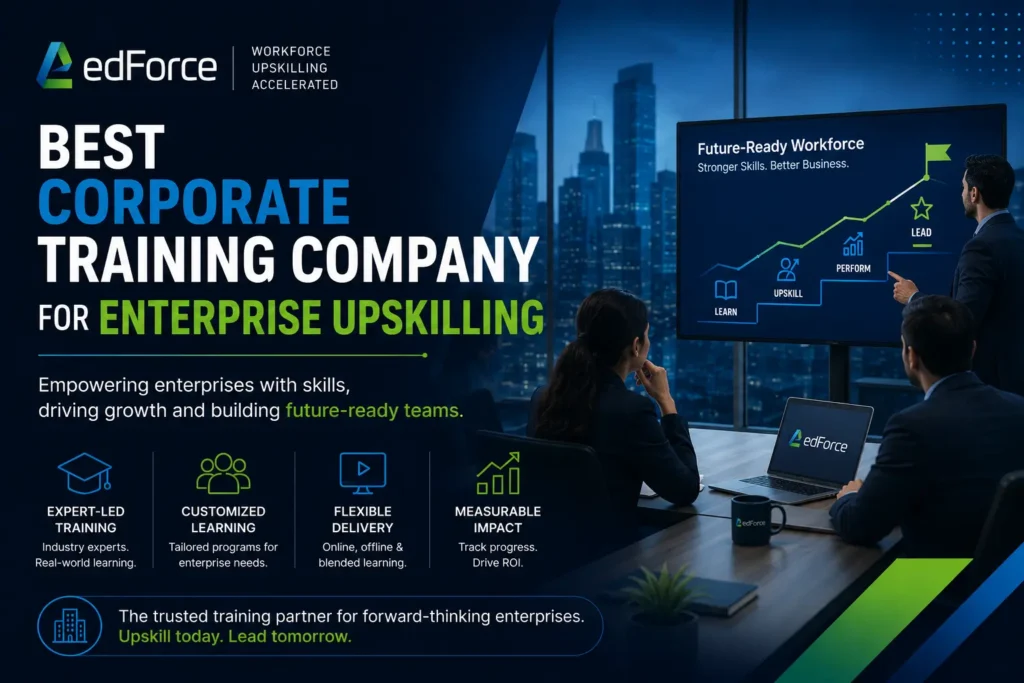
The majority of companies are not struggling today because employees don’t want to learn. The real issue is that corporate training is still disconnected from actual job roles and workplace requirements. Employees may attend training sessions, earn certifications, and complete learning modules, but when it comes to applying those skills in real projects, many still feel limited. Managers notice low adoption rates. Teams often return to old workflows, and productivity improvements remain smaller than expected. This is why enterprises are becoming more selective when choosing a corporate training company. Businesses are no longer interested in training that only looks good in reports. They want programs that improve daily operations, help employees adapt faster, and build long-term workforce capability. This shift is changing how enterprises approach upskilling in 2026. edForce is not just another course provider. The focus is on helping organizations build practical workforce skills that employees can confidently apply in real business environments. Why Upskilling Enterprises Has Become a Business Priority A few years ago, corporate training was often treated as a supporting function. Today, it directly impacts business growth, productivity, and technology adoption. The reason is simple: Technology is evolving much faster than traditional education systems. Companies are rapidly adopting AI, cloud technologies, automation platforms, cybersecurity systems, and new digital workflows. However, many employees still rely on outdated processes because organizational learning systems struggle to keep pace. This creates a growing gap between: Enterprise upskilling is no longer optional. It has become part of a long-term business strategy. What Makes a Good Corporate Training Company? Most training providers focus heavily on certifications and course catalogs. But today, enterprises need much more than access to content. A strong corporate training company should help organizations: The difference becomes visible when learning improves real workflows instead of staying limited to training dashboards. One major mistake companies make is selecting training vendors only based on brand recognition or the number of available courses. The best enterprise training partners understand how employees learn and apply skills in the workplace. Why Traditional Corporate Training Often Fails Many businesses face a common but overlooked problem: employees complete training programs but rarely change their work habits afterward. There are several reasons for this: Sometimes the learning is too theoretical. In other cases, the training becomes outdated before employees finish it. Often, the content has little connection to actual job responsibilities. The result is predictable: Employees do not need more random information. They need training designed around real workflows and real workplace challenges. Modern enterprise upskilling is becoming more practical and role-focused. Enterprise Training Needs Practical Learning, Not Just Content Online training is useful for explaining concepts, but it often fails to prepare employees for real-world situations. This is becoming a major challenge in areas such as: Employees may understand the terminology but still struggle with implementation. edForce training programs focus on real-world business use cases instead of disconnected theory. Learning is designed to help professionals apply skills in real enterprise environments through guided sessions, hands-on learning, and workflow-based models. This improves team confidence, increases retention, and speeds up skill adoption. The Biggest Workforce Shift Is Happening Now In 2026, companies will no longer hire only for current skills. Businesses are increasingly hiring and training employees for adaptability. Why? Because technology changes too quickly. Employees who can adapt to new workflows and learn emerging systems are becoming far more valuable. Organizations are changing the way they approach workforce development. Modern enterprise training now focuses on: This represents a major shift in corporate learning programs. Why Enterprises Are Looking for Long-Term Training Partners Many organizations are moving away from one-time training models. The reason is practicality. Upskilling has become an ongoing process and is now part of continuous workforce development. Today, businesses need partners who can support: That is why companies increasingly prefer corporate training firms that understand enterprise challenges instead of relying on generic learning modules. The strongest partnerships are formed when learning aligns with operational goals. How Enterprise Upskilling Impacts Business Performance Many businesses underestimate how strongly workforce capability affects overall performance. Skill gaps often lead to: Strong upskilling programs help organizations: Enterprise learning is now becoming a core part of business growth strategy, not just HR planning. What Businesses Should Consider Before Selecting a Training Partner The largest course library does not always mean the best corporate training provider. Businesses should focus on: Training providers should understand not only the technology itself, but also the operational challenges businesses face while adopting new systems. That difference matters more than marketing claims. Why Companies Choose edForce Enterprise Training edForce enterprise training primarily focuses on developing practical skills that match modern workforce challenges. The programs are designed to improve real team capabilities rather than provide generic learning experiences. The training focuses on: This helps employees adapt more effectively in a rapidly changing business environment. Final Thoughts Corporate learning is no longer just about completing courses. It is about helping employees apply skills effectively in real workplace situations. That is the biggest difference modern businesses are looking for today. Companies want training that improves execution, supports transformation, and helps teams adapt faster to new technologies and workflows. The best corporate trainer is not the one offering the most courses. It is the company that helps organizations build practical, long-term workplace capability while creating measurable business impact. FAQ‘s
What Growing Companies Look for in Corporate Training Partners
As companies grow, learning requirements change quickly. Teams are created, new roles arise, expand, and the skills that worked in the past may not be sufficient. In a growing company, corporate training is no longer just about separate programs. It’s all about choosing the best trainer that can help support long-term expansion. Nowadays, businesses go beyond platform and catalogs. They are looking for partners who can understand their needs, work according to their needs and produce tangible outcomes. Strategic Alignment With Business Growth Training partners in the business are expected by companies that are growing to know where their business will go in the future, not only where they are today. They seek partners that: The training that’s not linked to business strategies quickly becomes obsolete and ineffective. Flexibility and Customization Growing roles bring diversity to roles, levels of skill and team structure. A one-size-fits all approach to training isn’t effective. Companies appreciate partners who: Flexibility allows training to remain relevant even as the company grows. Strong Trainer Expertise and Industry Experience Companies that are growing will seek out those who can provide competent trainers who have real-world knowledge. They are looking for: The quality of the trainer directly affects the level of engagement, confidence, as well as the performance results. Measurable Outcomes and ROI Focus Teams of leaders are increasingly asking: What impact is training having? Companies are looking for partners who: The success of training is measured by outcomes, not attendance. Ability to Scale Without Losing Quality As teams expand the training needs to be adapted without becoming generic or being diluted. The companies that are growing look for partners who are able to: Scalability is essential to maintain learning outcomes during the rapid growth. Ongoing Support, Not One-Time Programs The training process isn’t just a one-time annual event, but rather an ongoing process. Companies prefer partners who offer: Partner organizations like edforce.co are valued when they can combine organized programs with continuous support and flexibility. Cultural Fit and Learning Mindset Beyond their capabilities, companies search for partners that align with their values. This includes: A good fit with the culture ensures more efficient collaboration and better acceptance. Final Thoughts For companies that are growing, selecting a partner for corporate training is a wise choice. They seek out partners who can provide: A good partner doesn’t only offer training; they also help to build a workforce that is ready for the next phase of expansion.
The Rise of Microlearning and Its Impact on Corporate Teams

Have you tried to sit through a 3-hour training session following a long day at work? Many corporate professionals will admit that it’s difficult to remain focused. The workload is heavier, the schedules are tighter and attention spans shorter. Microlearning is the preferred way of learning at work. We’ll look at the impact of microlearning on corporate learning, and how your team could benefit more than you thought. What is Microlearning exactly? The idea of microlearning is simple. Learning is delivered as small, focused chunks, rather than long training programs. Each segment takes just a few moments. The micro units include Each unit focuses on a single topic. There is nothing extra. There’s nothing confusing. Imagine being able to learn a new tool as you wait for the meeting to begin or brushing up your compliance rules while on your commute. Microlearning is powerful. Are you looking to modernize the learning methods of your team without losing productivity hours? You might find exactly what you’re looking for. Why Microlearning is Growing so Fast Microlearning is not a trend that corporate teams have adopted by chance. This shift is driven by a number of workplace trends. Recent data shows The numbers are a good reflection of what we feel in the office. Long sessions drain your energy. Short sessions are more manageable. What Microlearning Means for Corporate Teams This is an example of how microlearning can improve performance within organizations. Impact Area What Microlearning Can Do for You Results for Teams Knowledge Retention Learning is easier when you learn one concept at atime Faster application and better recall Productivity Small breaks are used by learners to learn. Reduced time off from work Engaged in a variety of ways Enjoyable interactive and short formats Increased completion rates of courses Skill Development Quick lessons help fill in skill gaps. Faster adaptability Training Costs The content creation process is now shorter and easier Lower overall budgets Improved Knowledge Retention You forget the information quickly from long presentations. This is solved by microlearning, which keeps lessons short and simple. Employees who learn one concept at time are more likely to remember it and put it into action immediately. You can also see our Example of a Good Way to StartSales executives who learn one technique of negotiation per day will remember and use it better than those who attend a four-hour workshop once a yearly. Improved Productivity and Time-Management Finding time to learn is a major challenge for many people. Microlearning is a great way to fit learning into a busy schedule without feeling stressed. Microlearning allows employees to review something or take a short lesson in between tasks. It is a great way to keep productivity high and reduce the need for long training sessions. Strengthening Engagement and Motivation Micro-lessons that are interactive feel fun and light. They are less intimidating and more enjoyable. This results in higher completion rates as well as a stronger culture of learning. You can also see our Example of a Good Way to StartTech support teams that use daily troubleshooting scenarios of five minutes each are more sharp than those who attend quarterly training. Continued Upskilling in Modern Workplaces Modern workplaces are constantly evolving. Microlearning allows employees to grow all year round instead of waiting until annual training cycles. Many companies use platforms such as edForce.co for structured microlearning programs, which are accessible on any device. This allows for quick and consistent upskilling. How microlearning can help corporate leaders Leaders struggle to understand and track their progress. Clear analytics on microlearning platforms can help. Managers can It makes it easier to make decisions about leadership and is more data-driven. Why Microlearning is needed in industries that are undergoing rapid change Almost every month, industries like retail, healthcare, customer service, and finance undergo changes. New software, tools and regulations are constantly appearing. Microlearning allows employees the opportunity to upgrade their skills without stopping their workflow. Continual small lessons help teams stay confident and ready. You can also see our Example of a Good Way to StartThe team that receives weekly micro-alerts of five minutes each are far more alert to threats than the teams who rely on annual workshops. Future of Microlearning within the Next 3 to5 Years AI-driven personalization is expected to accelerate the growth of microlearning. By 2028, reports suggest that nearly 60% of workplace learning will be delivered in bite-sized formats, supported by intelligent recommendations (Gartner 2024). The AI is likely to be a surprise Teams that begin microlearning now will be better prepared for the digital transformations ahead. How to make microlearning even more effective Key Takeaways
How edForce.co Personalizes Employee Learning Using Data and AI

You may have sat through an extensive training and wondered “why am I learning that?” You’re not the only one who has felt this way. Many corporate and IT professionals share the same sentiment. The workplace of today is fast-paced. Roles evolve. Tools evolve. Deadlines shorten. Employees simply do not have the time to attend generic training, which teaches all but what they need. Personalized employee learning is essential. It allows employees to learn faster, remain motivated and develop their skills where they are needed. We’ll look at the ways in which data, AI and smarter tools are changing learning, and how edForce.co is using them to create relevant, personalized learning experiences for modern teams. Why personalization is more important than ever Have you noticed that music apps suggest songs you like? How about shopping apps that show you items that are similar to your style? The same principle applies to personalized learning. The traditional training is the same for everyone. People learn in different ways. Some people prefer short videos. Some prefer microlearning in short bursts, while others prefer real-life examples. Engagement drops when learning isn’t matched to the individual. Recent studies show: Are you planning to create a culture of learning that works? Start with personalization. Data and AI shape personalized employee learning Data and AI quietly monitor learning behavior, performance and preferences. They then create a learning pathway that almost feels custom-made. Here’s a quick breakdown. 1. Skill Gap Identification AI analyzes performance data, job requirements, and assessments to identify missing skills.The system can pinpoint exactly what the employee needs. Example:You may have promoted someone to a new position and only realized after three months that they were lacking a critical skill. AI can help prevent this. 2. Adaptive Learning Pathways The pace of learning is set by the individual.AI automatically adjusts the difficulty level based on progress. Learners who are fast learners will move ahead.Other people receive extra support. 3. Behavior Based Content Suggestions Some people prefer bite sized content. Some people learn better by doing.AI is able to detect this and will always recommend the correct format. Microlearning is a powerful tool. Lessons that are focused and short help busy professionals to learn without consuming their time. 4. Real-Time Performance Feedback Learners can get instant feedback instead of waiting for days to receive manual reviews.Instant feedback allows them to learn from their mistakes and improve faster. 5. Predictive Learning Analytics AI analyzes job trends to predict future skills needs.It keeps them future-ready and helps to prevent skill gaps from appearing. Future InsightIn the next three to four years, over 60 percent of all jobs will require digital hybrid skills, such as workflow automation and cloud knowledge (World Economic Forum 2025). All learning platforms will most likely include predictive learning. Table: AI and Data Improve Employee Learning Features Benefit Impact on Learners Skills gap analysis Targeted skill discovery The importance of training Adaptive pathways Content and pace can be customized Improved engagement and faster results Behavioural insights Formats of content that are preferred Increased completion rates Real-time feedback Corrections made immediately Stronger skill mastery Predictive Analytics Future ready skill building Career growth that is stronger How edForce.co Provides Personalized Professional Learning edForce.co builds training programs that are tailored to the individual using a combination of AI and data analytics. Platform studies: It then recommends the best mix of courses and microlearning modules. It is a guided learning journey that grows along with the student.Professionals can get content that is easy to understand.Businesses get quantifiable results without wasting budgets or time. A simple example:Imagine a project leader who is struggling with data dashboards. Rather than enrolling them into a generic analytics course that is long and boring, edforce.co provides short, targeted lessons focusing on the tools they use. This results in faster improvement and less frustration. Why this works so well for busy professionals Tips for Organizations Ready to Personalise Education The Future of Learning Employee learning is expected in the future to grow. Start now to build stronger teams, reduce skill gaps and stay competitive. Are you prepared to discover a better way to develop talent? Key Takeaways
Hybrid Learning Models That Improve Training Engagement

Have you ever attended a long session of training and felt exhausted within the first half hour? The majority of professionals have. The pace of work is accelerating, attention spans have shrunk, and schedules tighten. Hybrid learning is a game changer. It provides your teams with the structure they require without taking them away from their real work. We’ll look at the hybrid learning models that are changing how modern workers engage in training. What is Hybrid Learning? Hybrid education combines two worlds.Learners can access online sessions at any time.They can interact with peers and instructors in person. This flexible training model combines virtual convenience and the human connection found in the classroom. This results in a learning process that is natural, easy to understand, and practical. Imagine this: Online, you can learn the basics in a quiet home morning. You can then join a workshop to practice the same skills under guidance. This balance makes learning more interesting and efficient. Why hybrid learning is important for professionals today Are you looking to improve the skills of your team without disrupting their work? Hybrid learning allows you to do just that. Deloitte’s 2024 report states that employees who have more flexibility are 57 per cent more likely to attend training. Hybrid models allow for this freedom. The learner can move at their own pace and still get the benefit of live explanations. Do you want to create training programs that engage people? Hybrid learning is a great way to learn. This leads to improved attention and better skill retention. Key Benefits of hybrid learning models Benefit Explanation Results Flexibility Choose your preferred format and time for learning Attendance increases and fatigue decreases Personalization People learn at their own pace More confidence and better understanding Real time collaboration Live sessions promote teamwork and discussion Better engagement and recall Practical Application Combining online theory with in-person practice Job readiness and faster skill adoption Scalability Work for large and small organizations Cost efficiency and easy management How hybrid models improve training engagement 1. Participants Increase Online modules eliminate barriers such as travel, time constraints, and conflicting meetings. You may have missed a class because of back-to-back meetings. This problem is solved by hybrid learning. Online lessons can be completed before offline discussions. 2. Learners can be engaged in a variety of ways to learn Hybrid programs combine quizzes, breakout sessions, group activities, and feedback in real time. The learners aren’t just passively listening. The learners are actually doing it. According to a study by LinkedIn Learning, interactive training increases engagement by 43 percent. 3. Burnout is reduced and focus improves Online lessons that are shorter and workshops in person that are more focused can help prevent overload. Microlearning is preferred by most corporate teams because it fits into their schedule. Microlearning has been found to improve knowledge retention by 20 to 25% in companies that use it (ATD 2023). 4. Strengthening Skill Application Hybrid learning combines theory and action. Online learning helps learners to first grasp the concept. Later, in person, they practice it with real-life scenarios. This helps the knowledge to stick. 5. Clear Tracking Support Track digital platform’s It allows trainers to support their learners at the appropriate time. Employees are guided rather than pressured. Hybrid Learning: Why companies are choosing it Modern workplaces are dynamic and distributed. Many people work in different cities, time zones and continents. This environment is ideal for hybrid learning. McKinsey’s 2023 report found that nine out of 10 companies plan to increase their digital learning investments in the next five years. Hybrid models help organizations Many training providers offer hybrid programs. For example, edForce.co offers structured corporate learning solutions that combine online modules with in-person workshops to achieve high engagement and measurable results. Hybrid learning: Practical ways to boost engagement Tips to Show Support and Care for Learners What will the next 3 to 5 years look like? As remote work and digital technologies continue to develop, hybrid learning will grow rapidly. AI-based personalization is likely to become a standard, suggesting tailored content for every learner. As attention spans decrease and workloads increase, microlearning will become more popular. Hybrid training will help companies prepare for future talent requirements and skill transitions. Key Takeaways In the next few years, we will see an increase in AI-driven learning and personalization.
The Critical Skill Gap India Enterprises Face and How edforce is Closing It

Have you noticed how rapidly workplace technology is changing today? Next month, your team will have mastered a new tool. This is something that many corporate and IT professionals experience every day. This constant shift is the reason India faces a growing skill gap and is a major business problem. Here is the good news. It is a real problem, but it can be solved. We’ll look at the causes, how they impact your organization, and how platforms such as edForce.co help companies overcome this gap. Understanding the Skill Gap In India The gap between employers’ needs and employee knowledge is called the skill gap. This gap is increasing in India because the job roles are changing faster than learning systems. In a recent report, NASSCOM2023 discovered that over 70% of Indian employees felt underprepared for digital roles in the future. In the meantime, 82 per cent of companies anticipate that tech skills will change significantly by 2027. (World Economic Forum 2020). Are you building a workforce that is future-ready? Understanding what causes this skills gap is the first thing to do. What is the cause of the skill gap? Here’s a simple look at what drives the Indian gap. Key Factor What it Contributes to the Skill Gap Rapid technological adoption New tools and digital systems are causing employees to fall behind. Access to training updates is limited Many teams still rely on outdated training programs Demand for digital roles on the rise There are not enough professionals to fill the new digital jobs Hands-on learning is not available The majority of employees only learn the theory and not real-world practice Business models are constantly changing The skills needed today are very different than five years ago The issues are prevalent in almost all industries, including manufacturing, IT, telecom, finance and health care. Indian Enterprises: The Impact is Growing Do you need reasons to take the skills gap seriously? Its real business impact is listed below. A Deloitte 2024 study found that 40 percent of Indian companies cite a lack of talent as the biggest obstacle to their growth. This problem cannot be solved by hiring alone. Retraining and upskilling are now essential strategies for business. How edForce.co is closing the skill gap in India Modern businesses need more than generic training. They need business-aligned, structured training that has a real impact. A platform such as edForce.co can play a key role in this. Take a look and see how it can help. Enterprise Focused Learning The majority of learning tools include courses. Enterprises need more. They need an educational plan that supports their business goals. edForce offers: Employees do not simply learn skills. The skills they need for tomorrow’s job are taught. Hands-on and Outcome-Driven Training Have you ever been to a training that was great on paper but didn’t change anything at work? This is what causes India’s skills gap. Learning does not stick without hands-on practice. edForce is able to solve this problem through: Employees gain confidence by practicing real-life workplace scenarios. Data-Driven Workforce Insights Clarity is essential for leaders. Leaders need clarity. edForce helps organisations with analytics Instead of guesswork, enterprises can now have a data-driven roadmap. Building a Culture for Continuous Learning Have you noticed how quickly teams fall behind when they stop acquiring new skills? The skill gaps are widening because many companies don’t have a culture that encourages continuous learning. edForce can help build this culture by enabling consistent and structured growth at all levels. Companies grow faster when employees are regularly trained. Why Closing the Skill Gap Matters for Indian Enterprises Take a look at the benefits that companies get when they bridge their skill gap. Business Benefit How Upskilling Contributes High productivity Teams are more productive and make fewer errors Better customer experience Employees deliver accurate, timely outcomes Reduced hiring costs Companies rely less on external recruiting Stronger innovation Teams come up with new and innovative ideas Future-ready workforce Employees remain relevant when changing jobs McKinsey’s 2023 report states that companies who invest in continual upskilling can see a 30 percent increase in productivity within 2 years. What the next 3-5 years may look like India’s skills gap will likely widen, before shrinking. By 2027 the country could face a shortage in digitally-skilled workers of more than 3 million (WEF, 2023). Digital transformation will accelerate in all sectors. If enterprises want to remain competitive in the future, they must invest today in upskilling that is structured, practical and aligned with their future. How to reduce the skill gap in your business Here are some practical and simple steps. The skills gap is real but manageable. India’s businesses can create a future-ready workforce with the right strategy and learning partners. Key Takeaways
Why Most Corporate Training Fails and How edForce Solves It
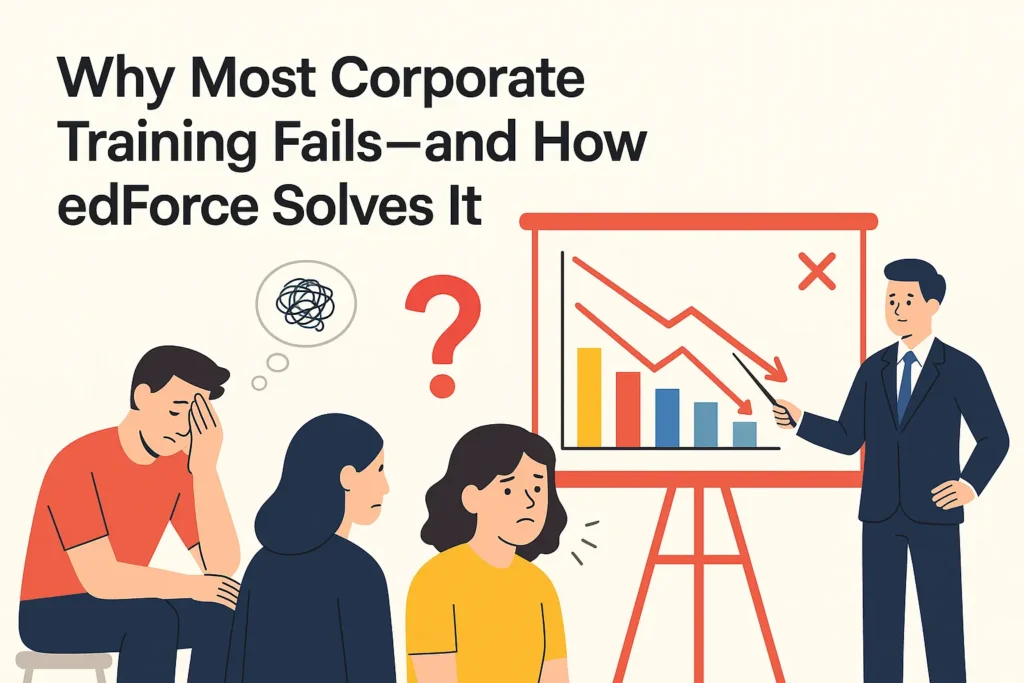
Corporate training is a vital part of ensuring that companies stay competitive and upskill their employees.If we examine closely, however, the majority of corporate training programs do not deliver the results expected. Skills do not improve as expected, employees forget the lessons they have learned, and ROI is often unclear. Why does it happen? How can organisations fix this?Take a look. There are many reasons why corporate training fails. 1. One size fits all approachMany companies still use generic training programs, which are not tailored for different job roles. What may work for a marketer might not be the best thing for someone who works in cybersecurity. Employees lose interest when training is not tailored to their needs. 2. Continuous learning is lackingLearning is not an event that happens once. Most companies still treat training as a once-a-year activity or merely a one week workshop. Real retention is affected by a lack of follow-up. Employees forget what they learned today. 3. No connection to real-world WorkThe training will become theoretical if learners are unable to apply it directly to their everyday tasks. Employees must be able to relate to real-life scenarios, use cases and practical examples. 4. Limited engagementCorporate training can often feel like a lecture. Less interaction is present and there’s more passive listening. Unengaging sessions can be mentally draining for professionals who already have busy schedules. 5. Measurement of results is not accurateMost companies do not track the impact of training on performance. It is difficult to know what works without data. In the end, programs of training continue to be implemented without any improvement. edForce Solves These Challenges edForce’s approach to corporate training is different, with a focus on outcomes, individualization and continuous engagement. edForce offers solutions that are: Are you worried about the low impact of training on your team? edforce.co is a leader in this area because it ensures that learning transforms performance. Why working professionals prefer edForce Do you want training that actually works? Most organizations don’t need more training. Most organizations need better-designed, more effective training.Relevant, practical, trackable and engaging training. edForce is a company that helps businesses upgrade their workforce capability in a way which has measurable impacts.Learning stick is easier with this tool. How to improve corporate training? Before beginning any training, define clear learning objectives. When learning is relevant, meaningful, and engaging, it becomes more meaningful.Edforce’s corporate training aligns with business goals, so it’s worth looking into if you want to get the most out of your training.
How to Choose the Right Corporate Training Provider?

Corporate training is more than just giving people new skills. It’s about preparing your team for the future, helping them work better, and making your business stronger. Done right, it improves performance, keeps employees happy, and supports your company’s growth. In fact, a report from LinkedIn says 89% of Learning & Development professionals believe that building employee skills now is the key to future success. But there’s a big question: how do you choose the right Corporate training provider? There are so many out there, and they all say they’re the best. So, how do you find one that actually works for your business? Let’s find out what really matters and how edForce, a trusted Workforce Upskilling Accelerator, might be the perfect fit. 1. Know Your Business Goals Before you even start looking at training providers, question or ask yourself one simple question: What do we want to achieve with training? Knowing your goals will help you choose training that actually makes a difference. At edForce, we help companies match training with their business needs. Whether it’s onboarding, upskilling, or certification, our programs are designed to solve real problems. 2. Choose the Right Learning Format Not every team learns the same way. That’s why it’s important to choose training that suits your people and your workplace. Different teams learn differently. That is why it is important to select training that is aligned with your people and your workplace. Here are some training options: At edForce, we offer all of these. Plus, we use modern tools like CloudLabs, Gamification, Microlearning, and more to make learning fun and engaging. 3. Check Their Credibility You don’t want to trust your team’s development to just anyone. Always check if the training provider is officially recognized and works with respected industry bodies. This shows three things: edForce is an Authorized Training Partner (ATP) of major global companies like AWS, Microsoft, Cisco, Red Hat, and many others. That means your team gets high-quality training that’s respected around the world. 4. Ask: Can They Customize the Training? A big problem with many training programs is that they’re too general. They use the same examples and case studies for everyone, no matter the industry or role. But your business is unique and your training should be too. That’s why edForce offers fully customized training content. We include: This kind of personalized training makes learning easier and more relevant. And when training feels real, people remember it and use it. 5. Look for Certification and Clear Results Training is an investment, and you should be able to see clear results. Look for programs that offer industry-recognized certifications like AWS, Microsoft, PMP, Google Cloud, and more. These certificates help boost employee confidence and show real progress. Also, make sure you can measure success. A good training provider should offer: At edForce, we believe training should always lead to real, measurable change. That’s why we include impact tracking in every program. 6. Think About the Future Your company will grow. Your industry will change. You’ll need new skills to keep up like cloud technology, AI tools, cybersecurity, and more. So, ask yourself: Can this corporate training partner grow with us? edForce isn’t just a training vendor. We’re a long-term upskilling partner. Whether you’re a startup or a global business, we help you build training programs that evolve with your needs. Why edForce Is the Right Partner for Your Corporate Training Needs? With many years of experience in corporate learning and workforce transformation, here’s what sets edForce apart: Whether you need help with Fresh Hire Onboarding, Lateral Training, Certifications, CloudLabs, or Hire-Train-Deploy (HTD) programs, we’re here to help your team grow faster and smarter. Final Thoughts Your people are your biggest asset. Don’t waste their time or your budget on training that doesn’t stick. Choose an offer for Corporate training that listens to your objectives, customizes the experience, provides genuine certifications, and delivers measurable results. If that sounds like the type of partner you are looking for, let’s connect! Frequently Asked Questions (FAQs)