

Claude AI vs ChatGPT: Which Is Better for Enterprises?

The decision to choose an AI platform is no longer a technical one, but a decision of business. A year or two back, many companies were debating whether AI was even worth it. This discussion is largely over. The question today is different. Which AI platforms will provide the greatest value to our team? In almost all enterprise conversations, two names are used: ChatGPT and ClaudeAI . Both are very powerful. Both are improving rapidly. Both can be used to help employees handle information and work more quickly. They aren’t exactly the same. Most businesses compare features only. Enterprises should instead compare , which is how each platform fits with their people, business processes and goals. It is rare that the best decision comes down to picking a winner. It’s about selecting the right tool to do the work that your team does every day. Understanding the business need is important before comparing tools Many organizations are exhibiting a similar pattern. Teams spend many weeks comparing AI models, but they only spend a few moments discussing how their employees will use them. This approach is usually a recipe for disappointment. The first question you should never ask is “Which AI system is better?” “ The correct wording is: “What business problem do we want to solve?” A legal department has different requirements than a customer service team. A software engineering team is different from an HR team. Marketing teams need different skills than finance teams. When the business goal is clearly defined, selecting the best AI platform becomes easier. Where Claude AI performs well Claude AI is a popular tool for enterprises who work with a lot of written material. It is used by many professionals to summarize documents, understand context and organize ideas. It is particularly useful in activities like: Reviewing contracts and policies Summarizing reports Documentation Knowledge management Business Research Long-form Writing Enterprise communication Claude AI training is especially useful for employees who spend a lot of time reading and processing information. It encourages well-structured and thoughtful outputs. This can be a great tool for organizations that deal with knowledge-intensive tasks. It will improve productivity and consistency. What ChatGPT brings to the table ChatGPT is gaining popularity because of its versatility. It can be used for a variety of tasks in the business world, including writing content, brainstorming ideas, data analysis and workflow automation. ChatGPT is used by many enterprises for: Software development support Marketing content Customer Communication Business Analysis Learn more about Learning Assistance Workflow Automation Problem-solving creativity The wide ecosystem and constant feature development makes it appealing to organizations that are looking for flexibility in multiple departments. ChatGPT is used by many companies to communicate across non-technical and technical teams. It is often the way teams work that makes a bigger difference. Comparing features only tells part of the story. The most important differences are often found in the employee workflows. Many organizations spend a lot of time on documents, policies and research. Other rely heavily upon coding, automation and rapid experimentation. The AI platform can produce different business values depending on its environment. This is why companies should compare AI to workflows rather than marketing. A tool with more features, but a lower adoption rate, will typically deliver better results. Productivity is more dependent on skills than the platform Many businesses fail to consider this. Platforms are only one part of the equation. The same AI tool can produce different results when used by two employees. You will receive clear and useful responses. Other struggles have inconsistent results. It is rare that the difference comes from technology. The user is the one who must understand how to use AI, assess responses and correctly apply information. The importance of workforce capabilities is growing as AI adoption does. Investing in AI without employee training can often lead to inconsistent business results for organizations. Should enterprises choose one platform? Not necessarily. In 2026, many organizations will be moving away from using only one AI platform. Diverse departments benefit from different tools. As an example: Some HR teams prefer to use a single platform for communication and documentation. The developer can choose another to receive technical assistance. Business analysts can combine AI tools based on the project. The hybrid approach allows companies to utilize each platform in the areas where they add value, rather than forcing all teams into the same workflow. This flexible model will likely become more popular in the coming years. What should enterprises focus on first? Organizations should ask themselves a few questions before deciding whether to use Claude AI or ChatGPT. What business processes take up the most time of employees? What teams deal with large amounts of data? What can AI do to improve quality, rather than just speed? How can employees use AI to their advantage? What policies will encourage responsible AI use? These questions can have a bigger impact on AI success that the actual platform choice. The technology can never stop evolving. Long-term value is created by strong business processes and highly skilled employees. The Next Enterprise AI Challenge AI is already changing the conversation. Businesses today compare Claude AI with ChatGPT. Tomorrow they are likely to compare AI agents, enterprise AI workflows, and autonomous systems. It is therefore more important to learn how to use AI than a particular AI platform. Employees who are familiar with the concepts of prompt design, workflow, critical evaluation and AI usage will be able to adapt better as new technologies emerge. Adaptability may become one of most important workplace skills in the next five to ten years. Building Enterprise AI skills with edForce The journey begins with choosing an AI platform. Employees who are confident in applying AI to their work will bring real business value. edForce.co enterprise AI training focuses primarily on practical business applications. This includes Claude AI and ChatGPT. It also covers responsible AI practices as well as emerging technologies like Agentic AI. It is more important to build
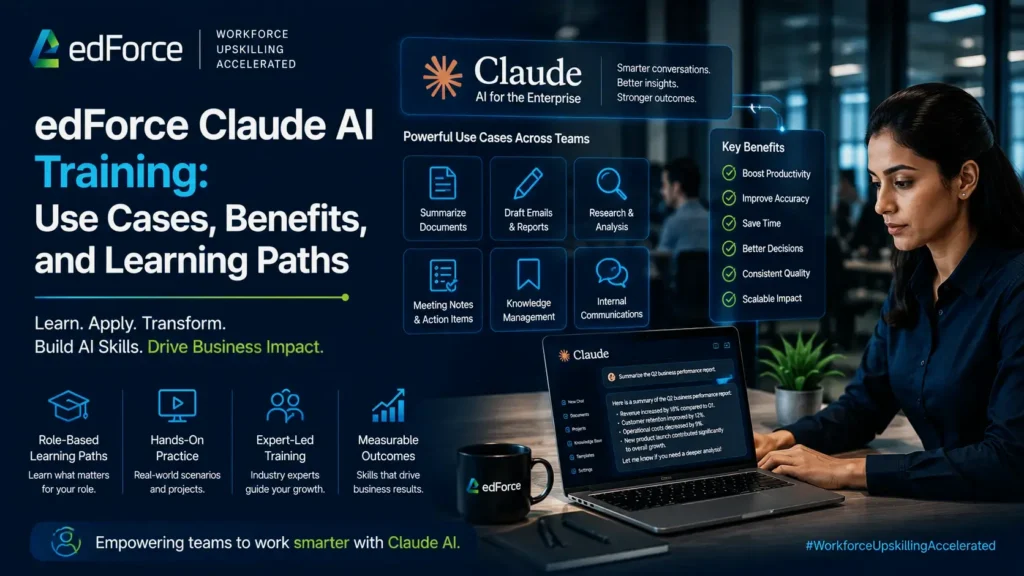
edForce Claude AI Training: Use Cases, Benefits, and Learning Paths
Many companies have already experimented with AI. Employees use AI tools to write emails, create reports, develop content, organize information, and simplify everyday tasks. On the surface, AI adoption appears successful. However, a different picture often emerges when you look more closely. Some employees use AI confidently and achieve excellent results. Others use the same tools but struggle to generate useful outcomes. Teams work differently, processes become inconsistent, and managers begin asking a familiar question: “We are using AI tools, so why aren’t we getting the results we expected?” This is becoming a common challenge across industries. The problem is usually not the AI platform itself. It is the gap between having access to AI and knowing how to use it effectively in real business situations. This is exactly why Claude AI training is becoming increasingly important for organizations in 2026. Companies are no longer looking for employees who simply know AI exists. They want teams that can use AI to improve communication, streamline workflows, manage information more effectively, and support better decision-making. Why Claude AI Is Getting Attention in Enterprises Most workplace tools generate more information. Claude AI is gaining attention because it helps employees make sense of that information. Think about how much time teams spend every week: Reading documents Preparing reports Reviewing proposals Organizing knowledge Responding to emails Creating internal communications These tasks are important, but they consume a significant portion of the workday. Claude AI helps reduce that burden. Its value goes beyond generating text. It helps employees understand, process, and organize large amounts of information more efficiently. That makes it useful across a wide range of business functions. The Real Challenge Is Not Learning the Tool One common mistake organizations make is assuming AI adoption is simply a software training issue. Employees learn which buttons to click. They attend a workshop. They receive access. The training ends. But that rarely changes behavior. The real challenge is helping employees understand how AI fits into their daily responsibilities. For example, a marketing team may use Claude AI very differently from an HR team. A project manager has different needs than a business analyst. Without role-specific guidance, employees often fall into two groups. Some use AI for everything. Others barely use it at all. Neither approach delivers consistent business value. This is why workforce training is becoming just as important as AI access itself. Where Businesses Are Using Claude AI Today Another reason Claude AI is becoming popular is its ability to support work across multiple departments. In many organizations, teams use it for communication, research, documentation, and information-heavy tasks. Common enterprise use cases include: Summarizing long documents and reports Writing business communications Creating meeting notes and action items Research and analysis support Building internal knowledge resources Improving documentation workflows Assisting with training content development What makes these use cases valuable is that they improve work employees are already doing every day. Claude AI does not always create entirely new ways of working. It often improves existing processes. That makes adoption easier for many teams. The Biggest Benefit Is Better Decision-Making Most AI discussions focus on productivity. Productivity is important, but many organizations are discovering another benefit that receives less attention. Better information often leads to better decisions. Employees frequently spend hours searching for information, reviewing documents, and trying to understand complex situations before taking action. Claude AI helps shorten that process. When employees can access information faster, understand it more clearly, and organize it more effectively, decision-making often improves as well. This is particularly valuable for managers, team leaders, and professionals working in information-intensive environments. Why AI Skills Are Becoming Career Skills A few years ago, AI knowledge was viewed as a specialist skill. That is changing rapidly. Today, employers increasingly expect professionals across different roles to understand how AI can support their work. The expectation is not that everyone becomes an AI expert. The goal is to make employees comfortable working alongside AI systems. This shift resembles what happened when cloud technology became mainstream. Cloud skills were once limited to technical teams. Today, cloud awareness exists across many business functions. AI appears to be following the same path. Professionals who develop practical AI skills now may be better positioned as workplace expectations continue to evolve. What an Effective Learning Path Looks Like One reason some AI training programs fail is that they try to teach everything at once. Employees leave with a lot of information but very little confidence. The most effective learning paths are usually progressive. Stage 1: Understanding the Technology The first stage focuses on understanding how Claude AI works and where it fits within business workflows. Stage 2: Practical Application The second stage focuses on real-world use. Employees learn how to apply AI to role-specific tasks and daily responsibilities. Stage 3: Optimization and Consistency The final stage focuses on improving quality, maintaining consistency, and integrating AI into larger workflows. This approach often delivers stronger long-term results because employees can apply new knowledge immediately instead of trying to remember everything at once. A Trend Many Organizations Are Beginning to Notice An interesting trend is emerging in enterprise environments. The gap between high-performing employees and average performers is no longer based solely on technical skills. Increasingly, it comes down to how quickly people can adapt to new technologies. AI tools continue to evolve. New platforms will emerge. Workflows will change. The people who adapt the fastest may become some of the most valuable employees within an organization. That is why AI training should not be viewed only as a technology initiative. It is also a workforce development initiative. Organizations that build strong learning cultures often adapt to technological change faster than those that focus only on technology. Why Enterprises Are Investing in Structured AI Training Many organizations began with informal AI adoption. Employees experimented independently and learned through trial and error. That approach worked in the early stages. As AI becomes more deeply integrated into business operations, organizations need greater consistency. Leadership teams are
Why Claude AI Adoption Requires Workforce Training

AI is being used in many companies, but actual AI usage inside most organizations still feels inconsistent. One team may use AI daily and save hours of work. Another team may barely use it because employees do not know how to use it properly. Some professionals get excellent results from AI systems, while others struggle to get useful outputs. This is making large-scale AI adoption difficult for businesses. Access to AI is no longer the problem. Most companies already have powerful AI platforms. The real challenge is helping employees understand how to use AI in real business workflows. That is why Claude AI adoption requires proper workforce training. Without structured learning, AI can create confusion, fragmented workflows, and inconsistent outputs across teams. AI Tools Alone Will Not Increase Productivity Many organizations believed employees would automatically learn how to use AI during the early stages of AI adoption. But this rarely happens. Most professionals quickly understand the basics of AI usage. However, enterprise environments require much more than basic usage. Employees need to understand: Without training, employees often use AI randomly instead of strategically. This creates uneven productivity across departments. Why Claude AI Is Different in Enterprise Environments Claude AI is increasingly being used in businesses because it handles structured communication, long-context understanding, documentation workflows, and detailed information processing very effectively. It can support: These use cases require employees to think differently about how they interact with AI systems. Employees need to understand: That is why workforce training becomes important when adopting Claude AI. Most Employees Still Do Not Know How AI Fits Into Daily Work One common challenge businesses face today is that employees understand AI conceptually but struggle with practical implementation. They know AI can be useful, but they are unsure: This uncertainty slows adoption. Many companies notice that employees complete AI training but still hesitate to use AI in daily work because the training feels disconnected from real business situations. That is why practical AI training matters more than basic AI awareness sessions. Workforce Training Helps Standardize AI Usage AI is not a uniform tool. Some employees use vague instructions. Others use detailed prompts. Some carefully review outputs, while others rely too heavily on AI-generated responses. Over time, this creates inconsistency across teams. Businesses then face problems such as: Structured Claude AI training helps organizations create more consistent AI workflows across departments. Employees learn: This improves both productivity and workflow reliability. AI Adoption Is More About Workflow Change Than Technology Many companies still treat AI adoption as only a technology project. In reality, AI adoption is mostly a workforce challenge. The biggest challenge is not installing AI tools. The real challenge is helping teams change how they work. Employees need to develop: This transition requires proper guidance. Without support, businesses often face: That is why many companies now invest in enterprise AI training instead of relying only on software deployment. Why Practical AI Training Matters More Than Generic AI Courses Many online AI courses explain AI concepts in a general way, but employees often struggle to apply AI inside real business operations. Real workplace environments involve: These situations require practical learning. The best Claude AI training programs focus on: This helps employees feel more confident using AI in real operational environments. Companies Need AI-Literate Teams, Not Just AI Tools In 2026, businesses are realizing that AI success depends heavily on workforce capability. The same AI platform can produce very different results for two companies depending on: Companies that see the strongest AI productivity improvements are usually the ones investing in both workforce training and technology adoption. This is quickly becoming a major competitive advantage. Why Employees Need Confidence When Using AI Lack of confidence is one of the hidden barriers to AI adoption. Employees often worry about: Without proper guidance, employees may either avoid AI completely or depend on it too much. Both situations create problems. Training helps employees understand: This makes AI adoption more effective and reliable inside organizations. Enterprise AI Adoption Requires Long-Term Learning Businesses are also realizing that AI training cannot be treated as a one-time workshop. AI systems evolve quickly. Workflows continuously change. Teams constantly discover new use cases and operational challenges. This means enterprise AI learning has become a continuous workforce development process instead of a one-time training activity. At edForce, Claude AI training focuses on real business use cases, workflow-based learning, and practical enterprise implementation. This helps organizations build stronger internal AI capability instead of simply introducing AI tools. Final Thoughts Successful AI adoption depends heavily on workforce training because AI implementation is more about people and workflows than just software. Businesses need employees who can confidently, consistently, and responsibly use AI in real operational environments. The companies gaining the most value from AI are not simply the ones adopting tools faster.