


Why AI Assistants Are Becoming Part of Everyday Enterprise Work
A Few Years Ago, Using an AI Assistant at Work Felt Like an Experiment Someone might ask it to rewrite an email, summarise a long document, or suggest ideas for a presentation. The result was interesting, but the actual work still happened somewhere else. That relationship is changing. In 2026, AI assistants are increasingly becoming part of the normal working day. They’re showing up inside development environments, productivity platforms, customer service systems, business applications, and internal knowledge tools. Employees aren’t always opening a separate AI website anymore – in many cases, AI is simply becoming part of the software they already use. That shift matters because it changes the question enterprises need to ask. It’s no longer just “Should our employees use AI?“ It’s becoming “How should AI assist our employees while they work?“ AI Is Moving Closer to the Work The most useful AI assistant may not be the one with the most impressive demo. It may be the one that shows up at exactly the right moment. A developer gets help while writing code. A sales employee gets a summary before a customer meeting. An analyst can ask questions about a business document instead of reading every page manually. A support employee receives suggested responses while handling a customer issue. The common thread is context. AI becomes genuinely useful when it understands enough about the task to offer relevant assistance – without forcing the employee to constantly switch between applications. This is one reason enterprise AI adoption is moving from experimentation toward integration. Employees Don’t Want Another Tool to Manage There’s a practical reason AI assistants are gaining traction. Employees already juggle dozens of applications. Adding another standalone platform means another login, another interface, another process, and another place where information needs to be copied over. An assistant built into an existing workflow feels different. If a developer gets coding assistance inside their development environment, there’s far less disruption. If a sales professional can summarise customer information within the system they already use, the benefit is immediately clear. The future of workplace AI may be less about telling employees to “go use AI” and more about bringing AI into the places where work already happens. The First Productivity Gains Are Often Small Not every AI use case needs to transform an entire department. Some of the most useful improvements are refreshingly ordinary. An employee might spend 20 minutes turning meeting notes into action items – AI can cut that down to a few minutes. A manager might spend an hour summarising several reports before a meeting – an assistant can produce a first draft the manager simply reviews. A developer might spend time searching documentation or explaining repetitive code – AI can handle the first pass. Individually, these savings can look small. Across hundreds or thousands of employees, they add up to something significant. This is exactly why enterprises need to be careful about how they measure AI productivity. The value often doesn’t show up as one dramatic cost reduction — it emerges through hundreds of small improvements repeated daily. AI Assistants Are Not Replacing Human Judgement The word “assistant” is useful because it describes the role fairly accurately. An assistant can prepare, organise, suggest, summarise, and accelerate. The employee still decides. For important business decisions, AI output still needs to be checked against reliable information, and employees need to recognise when a response might be incomplete or unsuitable. This matters even more when AI is handling sensitive information. A solid enterprise AI strategy needs both capability and clear boundaries. Employees should know what they’re allowed to ask an assistant to do, what information they can share with it, and when human approval is required. The Nature of Work Is Changing Too There’s another effect that gets less attention. When AI takes on some of the smaller tasks surrounding a job, employees often end up spending more time on the parts of their role that genuinely require judgement. Take a software engineer: if AI handles repetitive code, documentation, debugging suggestions, and test generation, the engineer can spend more time thinking about architecture and system behaviour. A sales professional may spend less time preparing information and more time actually speaking with customers. An analyst may spend less time formatting data and more time interpreting what it actually means. This isn’t just about doing the same work faster. It can genuinely change where employees direct their attention. AI Assistants Are Becoming More Context-Aware Early AI assistants relied almost entirely on what the user typed into a prompt. Enterprise systems are moving toward something different. An assistant can now potentially draw on information already available within the user’s authorised environment — documents, project details, customer records, code, internal knowledge, or business processes. That opens up far more useful interactions. Instead of asking: “Summarise this document.” an employee might ask: “What changed from the previous version, and what do I need to act on?” That second question requires real context. As enterprise AI becomes more connected to business systems, context is likely to become one of the biggest differentiators between basic AI usage and genuinely useful AI assistance. This Is Where AI Skills Become Important Giving an employee an AI assistant doesn’t automatically teach them how to work with it. Employees need to understand how to provide useful context, evaluate responses, protect sensitive information, and recognise when the system needs human direction. They also need to understand where the technology’s limits lie. A professional who knows how to question an AI response can extract far more value from the same tool than someone who accepts every answer at face value. This is why AI literacy is increasingly a workplace capability, not just a technical skill. Enterprises Will Need Different AI Skills for Different Roles A common mistake is treating AI training as a single subject for everyone. It isn’t. A developer may need AI-assisted coding and application-development skills. A cloud engineer may need to understand AI infrastructure and deployment. A business
The Difference Between Using AI and Actually Working With AI
There’s a Big Difference Between Using an AI Tool and Actually Knowing How to Use AI AI can be used to create presentations, write emails, summarise reports, or even explain difficult topics. This is a useful first layer — but there’s more to it than that. AI is more than just a tool. Knowing what AI is and what it does, knowing how to use its output to improve business processes, and knowing how to verify that output are all part of genuinely working with AI. In 2026, this distinction matters more than ever, because AI has evolved from a personal productivity tool into a system woven into everyday business operations. The Easy Part of AI Is Using It Most professionals can learn the basics of AI assistants quite quickly: Ask a question Re-read the answer Change a few things Apply the result This may be enough for simple tasks. Imagine an employee who uses AI to create a report for a client. The tool produces a polished response, but some of the figures are outdated. The employee accepts it anyway because it sounds convincing. The AI wasn’t at fault. It was a lack of process. This is where the difference between using AI and working with AI becomes clear. What Does It Actually Mean to Work With AI? AI is best used as part of a broader workflow, not as a standalone application. Professionals working seriously with AI tend to ask questions like: What information does the system actually need? What tasks should AI perform? Where is human approval still required? How should the output be checked for accuracy? Can the process be safely repeated? What happens if AI gets it wrong? These questions go well beyond writing a good prompt. They require data awareness, process design, evaluation skills, and domain knowledge. AI skills, in other words, have become more than knowing how to operate a chatbot. AI Literacy Is Becoming a Core Workplace Skill In the past, many office roles depended on knowing how to use spreadsheets. Basic AI literacy today is similar. Employees are increasingly expected to understand what AI is capable of, where it excels, and where human judgment is still necessary. HR professionals might use AI to organise candidate information. Finance teams might use it to spot patterns across large documents. A software team might use it to explain or generate code. The tool itself changes depending on the department. But the underlying skill stays the same: using AI effectively and responsibly. Prompting Is Useful – But It’s Not the Whole Skill Prompt engineering was the first AI skill to gain widespread attention, because better instructions tend to produce better results. Enterprise AI training use, however, is moving beyond simple prompting. A good AI user knows how to provide context. A strong AI practitioner also knows where that context should come from, what shape it should take, and how to evaluate the results it produces. Take a customer service team as an example. The common approach is asking AI to “write a reply to this client.” A stronger approach gives AI access to relevant information – approved product data, customer history, company policy, and response guidelines. The second approach is far closer to how AI will actually be used across businesses going forward. Knowing What Not to Automate through AI This may become one of the most important AI skills in the coming years. It’s tempting to automate everything that can be automated. But AI isn’t the right answer for every problem. Even when AI can produce a quick answer, decisions involving legal responsibility, sensitive employee information, financial risk, or customer safety may still require human review. The strongest AI professionals understand these boundaries clearly. They don’t ask, “Can AI do this?” They ask, “Should AI do this — and under what conditions?” That’s a far more useful question for any enterprise to be asking. Working With AI Requires Verification AI can produce a response in seconds. That doesn’t mean the response is correct. Professionals who work well with AI develop the habit of checking important outputs against reliable sources, and learning to recognise when something looks off — rather than assuming fluent writing means accurate reasoning. This shifts workplace behaviour in a meaningful way. Employees are no longer just producing and reviewing their own work. In many workflows, they’re now reviewing machine-generated work before it reaches another employee, a customer, or a business system. That takes judgment. And judgment isn’t something you can automate with another prompt. From AI Tools to AI Workflows The next wave of enterprise AI adoption will likely involve fewer isolated experiments and more integrated workflows. Picture a process where AI summarises customer conversations, identifies next steps, drafts a proposal, updates internal records, and flags where human approval is needed. The salesperson is still involved. But their role has shifted. Instead of manually completing each step, they now supervise an automated workflow — letting AI handle repetitive tasks while they focus on relationships, decisions, and exceptions. Agentic AI is likely to expand this shift significantly. Rather than simply responding to individual requests, AI will increasingly complete sequences of tasks within defined parameters. Why Businesses Need a Different Kind of AI Training A short introduction is enough to teach employees how to use an AI tool. But enterprise training needs to answer a different question: Can this technology genuinely help our teams work better? That requires training built around real business scenarios. A software engineer may need AI-assisted development skills. A cloud engineer may need familiarity with AI infrastructure. A data team may need to work directly with AI models and pipelines. Business teams may need skills in AI-assisted analysis and workflow automation. The right training path depends on the employee’s role. A generic AI course simply can’t close every skill gap. The Future AI Employee May Not Look Like an “AI Specialist” This shift is worth paying attention to. AI skills won’t be limited to people with “AI” in
How to Upskill While Working Full Time

Many professionals are not willing to learn. There is never enough time. Meetings, deadlines, email, project updates and unexpected requests are all part of a typical workday. Learning something new can feel like an extra task by the end of the day. Many people put off upgrading their skills. After the project is completed, the next release or when work becomes less hectic, they tell themselves that they will start working after this. Sadly, the perfect moment rarely comes. Technology continues to advance. AI is now part of the everyday workplace. Cloud platforms are changing. Cybersecurity needs are evolving. Every few months, new tools are released. The fastest growing people aren’t necessarily the ones with the most time. They are the ones who continue to learn, even when busy. It is possible to upgrade your skills while still working full-time. It is not necessary to spend hours studying every day. It is important to integrate learning into your daily routine, rather than treating it as an extra project. No more waiting for extra time The myth that learning requires large blocks of uninterrupted space is a common one. Most working professionals will never enjoy this luxury. You may have to wait months if you are waiting until you schedule is completely free. Think about learning in the same way that you would think about healthy eating or exercise. Consistent, small efforts usually produce better results than intense bursts. Over a period of months, even thirty minutes of focused work per day can make a significant difference. Finding more time is not the challenge. The use of existing time is more intentional. Learn skills that will help you solve today’s problems A common mistake is to choose courses based on popularity. Ask yourself one question before enrolling in a program. Will this skill be used in the next few months by me? Motivation becomes easier if you answer yes. Cloud training, for example, will feel immediately relevant if your business is moving towards cloud platforms. Learning prompt engineering or Generative AI can be beneficial almost immediately if AI tools become part of your everyday work. When you can use new knowledge within a week of learning it, you will find that you are able to learn more quickly. Focus on one skill instead of five Many professionals start out with enthusiasm. Students can enroll in AI courses. They add cloud certification. Cybersecurity is a must. Then data analytics. They stop learning after a few days because they are overwhelmed. It is better to develop one skill at a given time. Learn the basics. Use what you have learned. Continue to the next area. Initially, progress may seem slower but usually it becomes more sustainable. Learning is not a sprint, but a marathon. Learn on the Job Many successful professionals have a habit of combining learning and work. They combine both. Imagine you’re learning Azure. Volunteer to do a simple cloud-related job. Use AI tools to summarize or organize documents and meeting notes if you’re studying AI. Automate a task that takes you several minutes each day if you’re learning Python. When theory and real work are combined, the fastest learning occurs. Your practice environment becomes your projects. Create a weekly learning routine Consistency is more important than intensity. It is not necessary to study each evening. You need a realistic schedule. This might look something like: Weekdays, 30 minutes before starting work A weekend learning event that focuses on one specific topic Reviewing notes during short breaks Practice new skills whenever possible on real tasks Routines eliminate the daily question of “Should you study today?” “ Learning becomes a part of the week. Do not chase every new technology The technology is constantly changing. Each week, it seems, there is a brand new AI model or framework. It is impossible to know everything. Build strong foundations instead. Understanding cloud architecture, for example, is more important than memorizing all the new cloud services. It is better to learn AI basics than jump from one AI application to another. Professionals who have solid foundations are more likely to adapt quickly when new technologies emerge. Qualifications open doors, skills build careers Professional certifications are still valuable. These courses help to demonstrate commitment, and they provide structured learning pathways. Employers are increasingly looking beyond certificates. Hiring managers are looking for people who have the ability to solve problems. When two candidates have the same certifications, the candidate who can demonstrate how they used those skills on a real-life project will often stand out. When you finish a course ask yourself the following questions: “How can I apply this knowledge to my work?” This question transforms learning into experience. The Trends Worth Paying Attention to The value placed on the learning abilities themselves is a noticeable change. Technology stacks change. The job roles of employees are changing. AI is reshaping the way work is done. Employers are increasingly looking for professionals with the ability to adapt quickly, rather than those with experience in a single technology. It seems more and more likely that continual learning will be a key career skill, rather than merely an advantage. People who update their knowledge annually are likely to be valuable no matter how technology changes. The Right Structure Makes Learning Easier Some professionals find that self-learning is a good option. Other people benefit from a structured path of learning, live mentoring and hands-on labs. It is important to have a practical understanding of technologies like AI, Red Hat, NVIDIA and cybersecurity as well as data engineering. A well-designed program can help reduce confusion, increase confidence and keep learners motivated until they achieve their goals. Grow Your Career without Pressing Pause Many professionals feel they must choose between their career and their current responsibilities. Both can occur simultaneously. Most successful professionals don’t take long breaks to learn. They instead integrate learning into their daily routine. edForce.co training programs are created with the working professional in mind. Learners can build
How NVIDIA GPUs Are Used in AI Training and Inference
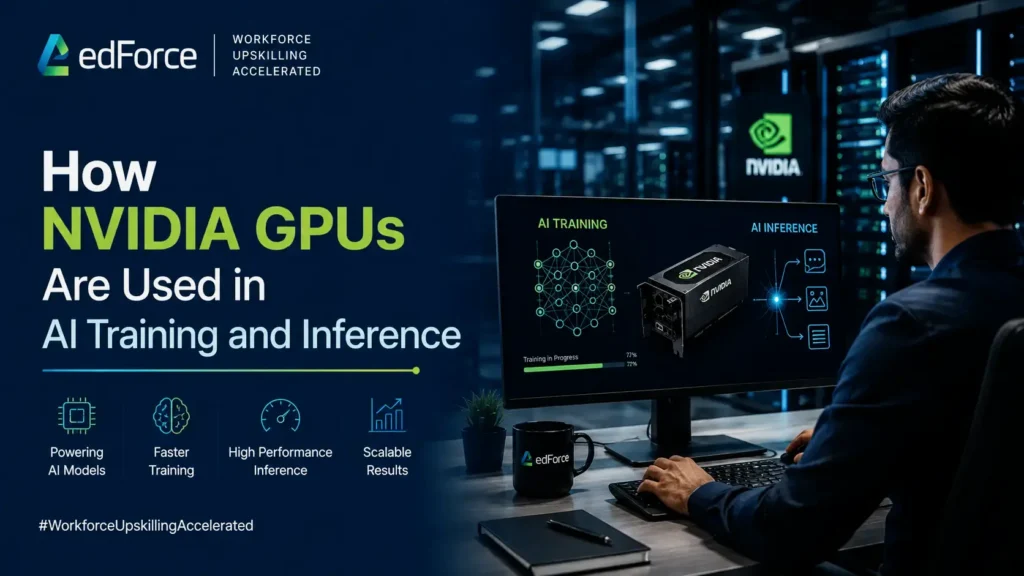
Several years ago, the main reason for buying faster hardware was to improve performance. Today’s topic is making AI practical. Each enterprise is looking for AI that can respond quickly, scale smoothly, and deliver reliable results. Behind the scenes, whether it’s an internal chatbot or AI assistant for employees, recommendation engines, or Agentic AI applications, there is one thing that makes it all possible. The GPU is a graphics processing unit. NVIDIA is known for its powerful graphics cards. But in the AI industry NVIDIA GPUs play a larger role. They are used to power some of the largest AI models in the world, as well as supporting enterprise AI infrastructure and helping organizations create applications that millions of users use every day. Many professionals are still unsure of what GPUs do. Why are they important? Why do companies invest in NVIDIA? Understanding the answers will help you understand why GPU-accelerated computing is one of the fastest growing skill areas in AI. AI Needs more than powerful software Most AI conversations begin with models when businesses embark on their AI journey. Should we use the Large Language Model for our linguistics? What AI platform should be chosen? How accurate is this model? They are good questions, but overlook an important part of the equation. Even the most intelligent AI models need computing power to process information, learn and generate responses. Imagine this: A model of AI is like an experienced employee. The GPU is the workspace which allows an employee to work efficiently. Even excellent AI models can become slower, more costly to operate and harder to scale if they lack enough computing power. The fact that AI and infrastructure are increasingly seen as being two sides of a single strategy is why many enterprises view them this way. What does AI training actually mean? It is important to know what AI training is before comparing it with inference. The AI model is trained by analyzing huge amounts of data. The model analyses millions of examples or even billions, identifies patterns and improves its prediction. It gradually becomes more accurate. This process is extremely computationally intensive. Imagine having one employee read all the books in a large collection. It would take many years. Imagine thousands of employees sharing their knowledge and experiences from reading books. This is similar to the way GPUs can accelerate AI training. They perform thousands of simultaneous calculations instead of one after the other. Modern AI training is made possible by parallel processing. NVIDIA GPUs are effective for AI training The traditional processor is designed to perform a wide range of computing tasks. GPUs are built differently. They excel in performing thousands of simultaneous operations of the same type. AI training is heavily dependent on this capability. All of these applications, including computer vision systems and recommendation engines, require millions upon millions of calculations per second. NVIDIA GPUs manage this workload. It is for this reason that they are the first choice of organizations developing enterprise AI solutions. Training advanced AI models without GPU acceleration would be much slower and more expensive. What is AI Inference? After a model of AI has completed learning, it moves on to the next stage known as inference. Inference is the moment that people begin to use the model. As an example: A worker asks a question to an AI assistant. A customer uploads an analysis document. AI provides medical insights to a doctor A recommendation engine suggests products. The model no longer learns. The application of what has been learned. Although it may seem easier than training, this stage has its own challenges. Businesses expect AI systems that respond almost immediately. Customers are rarely willing to wait for several seconds between interactions. Fast inference is just as important for accurate training as it is to have a fast response. Why inference is just as important as training Some people believe that AI training is difficult and that inference happens automatically. In fact, companies often spend more effort thinking about inference. Why? Inference is a problem for business. Customer experience is negatively affected if an AI-powered system for customer support takes too long. Productivity drops if an AI assistant delays answering questions during meetings. Scaling an AI application that cannot handle thousands users at once is difficult. NVIDIA GPUs can help overcome these challenges because they provide fast and efficient inference performance, while simultaneously supporting a large number of requests. AI applications are responsive to demand even if it grows. NVIDIA GPUs in Enterprises: Where are they used today? GPU-accelerated computing is not limited to the research laboratories. NVIDIA AI Training are used in a wide range of industries to support AI. Some of the most common enterprise applications are: Generate AI assistants Retrieval-Augmented Generation systems (RAGs) Workflows for Agentic AI Computer vision solutions Fraud detection Medical Imaging Financial Analysis Manufacturing Automation Intelligent customer support All these uses cases are connected by speed. AI systems are a must for organizations that want to process information efficiently without compromising accuracy. GPU acceleration is most valuable in this area. GPU Skills are Increasingly Valuable A new trend in hiring is emerging. AI is no longer the only thing that companies are looking for. Also, they are looking for AI professionals. AI adoption is growing and businesses need to hire employees who can understand it. GPU-accelerated computing NVIDIA AI Platforms AI deployment Model optimization AI Performance Tuning Enterprise AI infrastructure It is a great opportunity for those professionals who want to develop their NVIDIA AI capabilities. A prediction is becoming more and more realistic. In the coming years, AI infrastructure may be as important as AI talent. Building Enterprise AI Teams AI is not just about technology. People do. Many organizations have already access to powerful AI platforms, cloud-based tools, and GPU infrastructure. It is often the workforce that makes the difference. Can teams use AI effectively? Is they optimize their inference performance? Can they manage enterprise AI environments Can they scale
The ROI of Red Hat OpenShift Training for Enterprise Teams in 2026
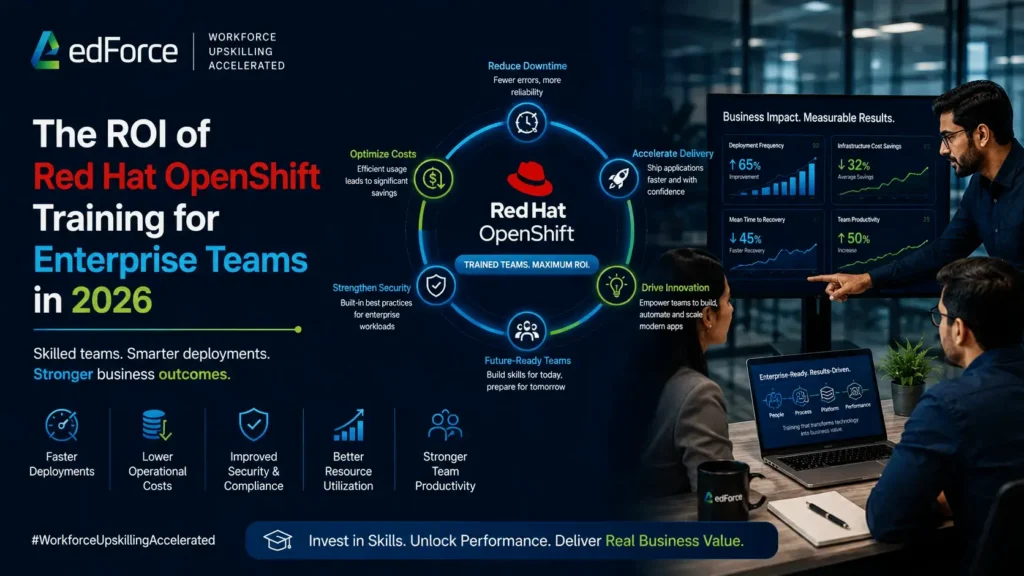
Many IT decisions in the enterprise seem straightforward at first. A business adopts Kubernetes. Teams begin moving applications into containers. Cloud infrastructure becomes more important. Leaders want faster deployments and greater scalability. Then reality sets in. The technology may be available, but the teams are not always ready for it. This is one reason many OpenShift projects move more slowly than expected. The problem is not usually the platform itself. In many cases, organizations underestimate how much workforce readiness affects performance. By 2026, most enterprises already understand the value of cloud-native technology. The conversation has changed. Companies are no longer asking whether containers matter. They want to know how quickly teams can use them effectively. That is where Red Hat training becomes important. The ROI is not just about learning a platform. It is about helping teams work more efficiently, reducing operational errors, and supporting modern application environments with confidence. Why OpenShift Projects Often Slow Down Many organizations invest heavily in infrastructure but underestimate the learning curve that comes with it. A common scenario looks like this: The platform is successfully deployed. Technical teams complete the installation. Leadership expects faster development cycles. However, developers continue using older workflows. Operations teams struggle with new deployment models. Security teams need time to adapt to container-based environments. As a result, technology adoption progresses more slowly than expected. What appears to be a platform problem is often a skills problem. This trend is becoming more common as organizations adopt Kubernetes, cloud-native architectures, and modern DevOps practices. The Real ROI of OpenShift Training When organizations discuss training ROI, the conversation usually begins with cost. How much will the training cost? How many employees need to be trained? How long will it take? These questions matter, but they often miss the bigger picture. The real value comes from reducing the inefficiencies that slow projects down. For example, trained teams tend to spend less time: Troubleshooting avoidable issues Correcting deployment mistakes Managing inconsistent environments Resolving configuration errors Teams also become more comfortable working with containers and cloud-native applications. That confidence matters. Many enterprise projects struggle not because employees lack capability, but because they lack familiarity with modern operating models. Training helps close that gap faster. Why Enterprises Are Looking Beyond Certifications In the past, certifications were often enough to demonstrate capability. Today, organizations are becoming more practical. Certifications still matter, but companies increasingly focus on implementation skills. Can teams deploy applications efficiently? if They manage container environments effectively? Can they support business-critical workloads without creating operational bottlenecks? These are the questions leadership teams are asking. This is why the most effective OpenShift training programs focus on practical application rather than theory alone. Employees need to understand how the platform fits into day-to-day operations, not just how it works in a lab environment. How Long Does OpenShift Training Take? One common mistake organizations make is assuming every employee needs the same training path. In reality, timelines vary depending on roles and responsibilities. A developer learning OpenShift will require a different learning path than an infrastructure engineer or DevOps specialist. In most organizations, learning happens in stages rather than all at once. Stage 1: Foundation The first stage usually focuses on building a strong understanding of how OpenShift fits into modern cloud-native environments and how containerized applications are managed. Stage 2: Practical Application The next stage focuses on applying concepts to real projects, workflows, and operational processes. Stage 3: Advanced Operations The final stage often includes automation, security practices, optimization, and modern platform management. Organizations that train in phases typically see better adoption because employees can apply knowledge gradually instead of trying to absorb everything at once. The Team Structure That Works Best One trend becoming increasingly visible across enterprises is that OpenShift success does not depend on a single team. In the past, technology initiatives were often managed by one department. Modern cloud-native environments are different. Successful OpenShift environments usually require collaboration across multiple teams. Developers focus on application delivery. Operations teams focus on reliability and performance. Security teams focus on governance and compliance. Platform engineers maintain infrastructure consistency. Leadership teams ensure alignment with business goals. When these groups work in isolation, adoption becomes more difficult. When they share a common understanding of the platform, implementation becomes much smoother. This is one reason organizations increasingly train cross-functional teams instead of focusing only on infrastructure specialists. The Hidden Cost of Delayed Upskilling One factor many organizations overlook is the cost of waiting. When new platforms are introduced without workforce preparation, projects may still move forward, but progress is usually slower than expected. Employees spend more time searching for answers. Teams become dependent on a small number of experts. Knowledge remains concentrated instead of being shared across the organization. Over time, this creates operational risk. Surprisingly, many enterprise technology delays can be traced back to capability gaps rather than technology limitations. That is why many organizations now include training as part of deployment planning instead of treating it as an afterthought. OpenShift Skills Are Becoming More Valuable The broader market is evolving rapidly. Cloud-native technologies continue expanding across industries. Organizations are investing heavily in containers, automation, DevOps, and hybrid cloud environments. As a result, professionals with OpenShift expertise are becoming increasingly valuable. However, the most sought-after professionals are usually not those who only understand the platform. Organizations need people who understand: Cloud-native operations Automation workflows Container management Enterprise security requirements Modern application delivery OpenShift sits at the center of many of these capabilities. That is why OpenShift training often delivers value far beyond a single platform. A Trend Enterprises Should Pay Attention To One prediction is becoming increasingly likely over the next few years. The gap between organizations that adopt cloud technologies and those that successfully use them will continue to grow. Technology is becoming easier to acquire. Workforce capability is becoming harder to develop. The competitive advantage may come less from access to advanced platforms and more from having teams that know how to use those platforms effectively.
Agentic AI vs Generative AI: What Enterprises Should Train Teams On in 2026
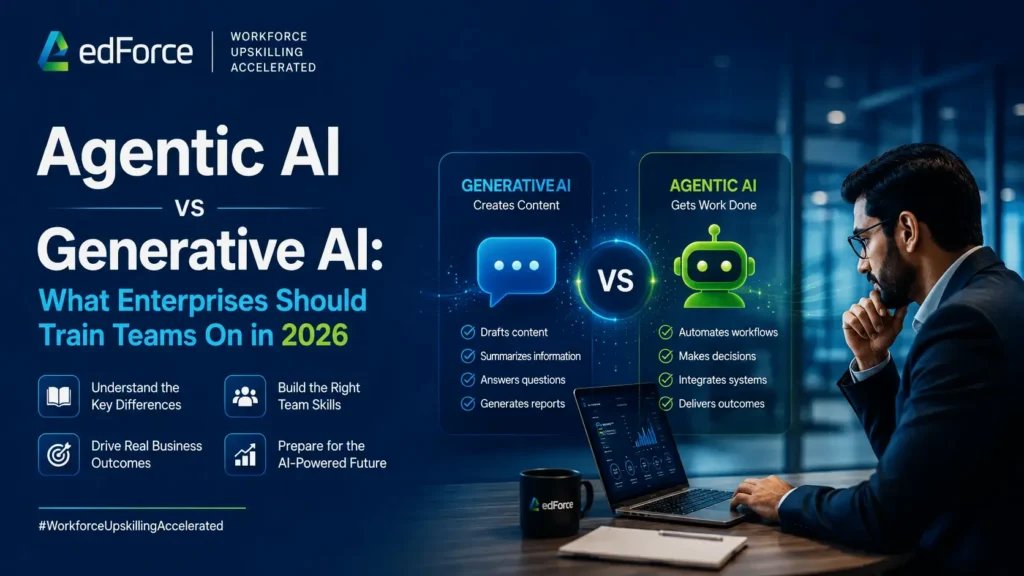
In the past two years, the majority of discussions in the workplace on AI have been focused on AI tools that produce documents, create emails, summarize information, generate reports, or respond to questions. Employees became accustomed to chat-based AI systems, and companies eagerly explored productivity improvements. The conversation is now evolving. Many companies are wondering if the next stage of AI isn’t solely about creating content, but also about finishing work. This is where Agentic AI enters the picture. Many business leaders are being introduced to terms such as Generative AI, Agentic AI, AI agents, or self-contained workflows. The problem is that these terms are often used as if they’re all the same thing. They’re not. Understanding the distinction is important since it directly affects workforce education choices. Many businesses are already planning Agentic AI initiatives while their employees are still learning to utilize Generative AI effectively. This gap could be one of the major issues facing workers in 2026. The First Wave Was About Content Creation Generative AI has changed the way individuals interact with information. How Teams Started Using Generative AI Teams began using AI to: Draft emails Summarize documents Create content Research and support Create systems for storing information Generate reports For many companies, this was their first experience with AI within routine work processes. The value was evident. Employees can complete information-based tasks faster and spend less time on repetitive work. However, something very interesting occurred. The most significant productivity improvements did not come from employees who simply used AI tools. These gains came from employees who learned to integrate these tools into their routine processes. This is crucial because it’s being repeated through Agentic AI. Agentic AI Is About Action, Not Just Output Generative AI primarily helps employees create information. Agentic AI was designed to act. What AI Agents Can Do Instead of producing reports and waiting for users to decide what to do next, an AI agent can: Collect details Analyze information Trigger workflows Communicate with systems Perform multiple tasks at once This is a significant difference. Generative AI aids work. Agentic AI participates in work. Many companies are excited about its potential. It is also the reason workforce readiness is becoming more crucial. Many Companies Are Asking the Wrong Question A common question in boardrooms today is: “Should we train employees on Generative AI or Agentic AI?” A better question is: “Which skills will employees need as AI becomes more autonomous?” Since, in the real world, businesses require both. Generative AI and Agentic AI solve different problems. One helps employees work faster. The other changes how work gets done. Businesses that view these technologies as rivals could overlook the larger opportunity. What Should Enterprises Train Teams On First? The most common error organizations make is chasing the latest technology without establishing foundational capabilities. The Foundation Still Matters Many companies are eager to explore Agentic AI, but some teams are still struggling with: Prompt quality Output verification Responsible AI usage Workflow integration Information management Without these fundamentals, Agentic AI adoption can become chaotic. Employees need to understand how AI integrates into workflows before they can effectively manage systems that make decisions or perform tasks on their own. For many companies, Generative AI literacy remains the primary step. Not because it is more important, but because it provides the foundation for everything that follows. The Real Skill Gap Is Not Technical The majority of discussions on AI are focused on technology. The most difficult challenge is often behavior. Skills Employees Need to Develop Many people are just beginning to learn: When to trust AI When to question AI outputs How to review details How to ensure accountability How to work with automated systems These abilities become more essential as organizations shift toward Agentic AI. One prediction that is becoming more likely is that future AI education programs will spend less time teaching tools and more time teaching decision-making. As AI systems become smarter, human judgment becomes more important, not less. Why Workforce Training Will Change Traditional corporate training usually focuses on teaching employees how to operate a platform. AI is different. Future Workforce Capabilities Today’s employees must understand: Workflow redesign AI supervision Operational accountability Exception handling Governance practices These are not purely technical capabilities. They are business capabilities. This is why many organizations are realizing that AI readiness can no longer remain only within IT departments. Management teams, operations teams, HR managers, project teams, and other business functions require an understanding of how AI can affect the way work is done. The Enterprises Seeing Success Are Taking a Different Approach Some companies still view AI implementation as a software rollout. Others describe it as a workplace transformation initiative. The second group is typically seeing better results. Why Transformation Beats Technology Alone Because technology adoption is usually more straightforward than changing behavior. Most employees can master a new tool quickly. Changing how people make decisions, collaborate, review work, and manage workflows often takes longer. The companies that are planning effectively for Agentic AI are usually the ones investing in workforce capabilities before large-scale deployment. What Skills Will Matter Most in 2026? Interestingly, the most valuable AI skills in 2026 may not be the ones people expect. The Skills That Will Define Future Teams Businesses are increasingly seeking employees who can: Redesign workflows Critically evaluate AI outputs Manage AI-assisted processes Work with automated systems Maintain quality and accountability These capabilities apply to employees using either Generative AI or Agentic AI. The next workforce advantage may belong to those who can combine AI efficiency with strong human judgment. Why Agentic AI Training Cannot Wait Too Long Though many organizations are still building Generative AI capabilities, waiting too long to prepare for Agentic AI could create its own challenges. Preparing for Autonomous Workflows As autonomous systems become more common, workers will need to understand: How AI agents function When human supervision is required How workflow ownership changes How accountability is managed The businesses that begin building this understanding
What Enterprises Actually Expect From AI Skilled Employees
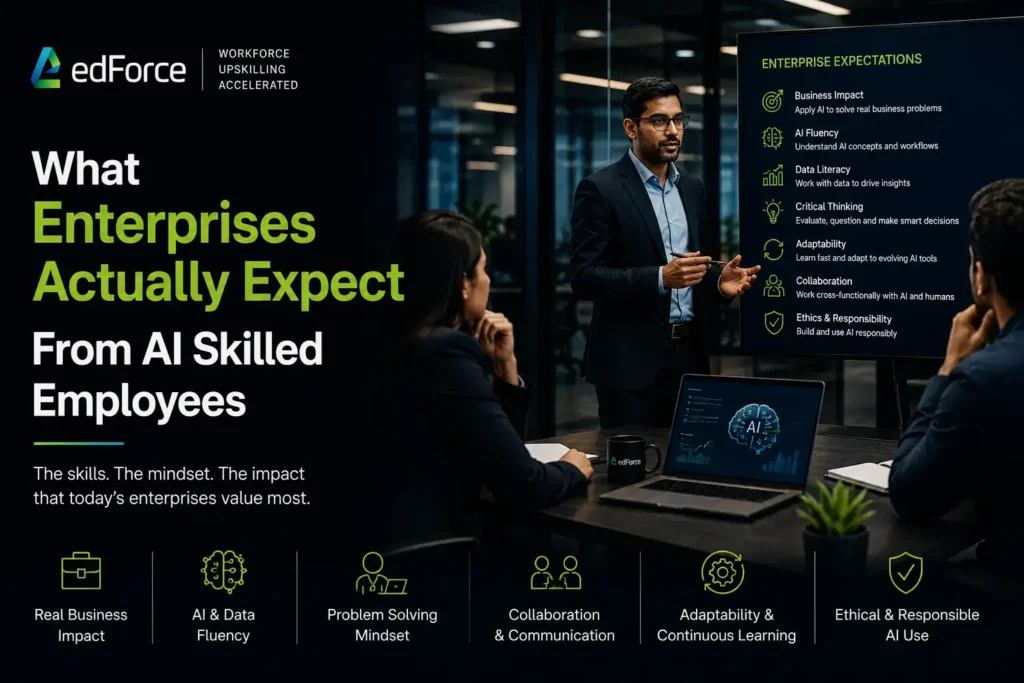
Many professionals believe that “AI skills” simply means knowing how to use AI software. But workplace expectations are changing. Companies are no longer impressed just because employees can create content with AI or write prompts. Businesses now want professionals who can use AI in real operational environments in a responsible and workflow-focused way. This shift is becoming much bigger in 2026. The conversation around AI skills is moving beyond: “Can employees use AI?” toward: “Can employees improve business performance using AI?” This difference is important. Enterprises Do Not Want Random AI Usage One major problem companies face after adopting AI is inconsistency. Some employees use AI in ways that improve productivity. Others use AI in ways that create confusion, poor results, or workflow disruptions. This creates uneven work quality across teams. Without structure, AI can create operational problems instead of efficiency. That is why employers increasingly expect employees to understand: These skills are far more valuable than basic AI experiments. Practical Thinking Is the Most Valuable AI Skill Many online discussions still focus heavily on prompts and AI tools. But in enterprises, the most valuable employees are the ones who think strategically. Professionals who understand business operations are in high demand. This includes understanding: AI becomes useful only when employees can apply it effectively in these areas. For example, employers value employees who can: This is very different from using AI casually. Businesses Expect Employees to Work With AI, Not Depend on It Enterprise environments are moving away from blind dependence on AI. Many organizations are becoming more careful about how employees rely on AI-generated outputs. Companies increasingly expect AI-skilled professionals to: This is especially important in: Businesses are not looking for uncontrolled automation. They want balanced and responsible AI usage. AI Skills Are Becoming Important Across Every Department Earlier, AI skills were mostly associated with technical teams. That is changing rapidly. Today, AI is becoming important across departments such as: Why? Because modern work has become highly information-driven. Employees now spend large amounts of time: AI can simplify many of these tasks, but only when employees know how to use it properly. That is why businesses now see AI skills as more than just technical knowledge. Businesses Value Adaptability More Than Tool Expertise Hiring priorities are changing. Companies are becoming less focused on mastery of a single AI tool and more focused on adaptability. Businesses understand that AI platforms will continue evolving quickly. New systems, models, and workflows will keep appearing. Because of this, employers increasingly prefer professionals who can: Developing the right mindset is becoming more important than memorizing AI features. The strongest AI-skilled employees are usually the ones who can adapt their work style as technology changes. Workflow Understanding Matters More Than Prompt Writing Many professionals still think AI expertise is mainly about writing prompts. But enterprises are increasingly focused on workflow integration. Anyone can use AI tools to generate output. The bigger challenge is understanding: Many businesses still struggle in these areas. Employees may know AI tools, but team workflows often remain inconsistent. This is one reason businesses are investing more in workforce AI training instead of only providing access to tools. Why AI Communication Skills Matter Clear communication has become an increasingly valuable skill. AI-assisted work requires: The way employees communicate with AI systems directly affects output quality. Businesses increasingly value professionals who can: Interestingly, AI is making strong communication skills even more valuable. Businesses Expect Employees to Improve Productivity Responsibly Many companies adopted AI expecting instant productivity improvements. Now businesses realize productivity improvements are not automatic. Employees need to understand: This requires more than technical curiosity. It requires operational maturity. That is why enterprises increasingly value practical AI literacy over surface-level AI awareness. Why Workforce AI Training Is Becoming More Important Businesses now understand that successful AI adoption depends heavily on workforce capability. Without proper training: That is why enterprises are investing more in structured AI workforce development programs. At edForce, enterprise AI training focuses not only on AI tools, but also on responsible usage, workflow understanding, and operational learning. This helps teams apply AI effectively in real business environments instead of treating AI as a separate tool. Real Skill Is What Enterprises Actually Need In the end, employers are not simply looking for employees who “know AI.” They want professionals who can: This combination of AI knowledge and practical thinking is far more valuable. Final Thoughts Employer expectations for AI-skilled professionals are changing quickly. Businesses are no longer interested in isolated AI knowledge or random AI experimentation. They want professionals who can integrate AI into real workflows and improve operational efficiency. In 2026, strong AI capability will be less about casually using tools and more about helping organizations work faster, smarter, and more consistently.
Why Companies Are Investing in Agentic AI Training
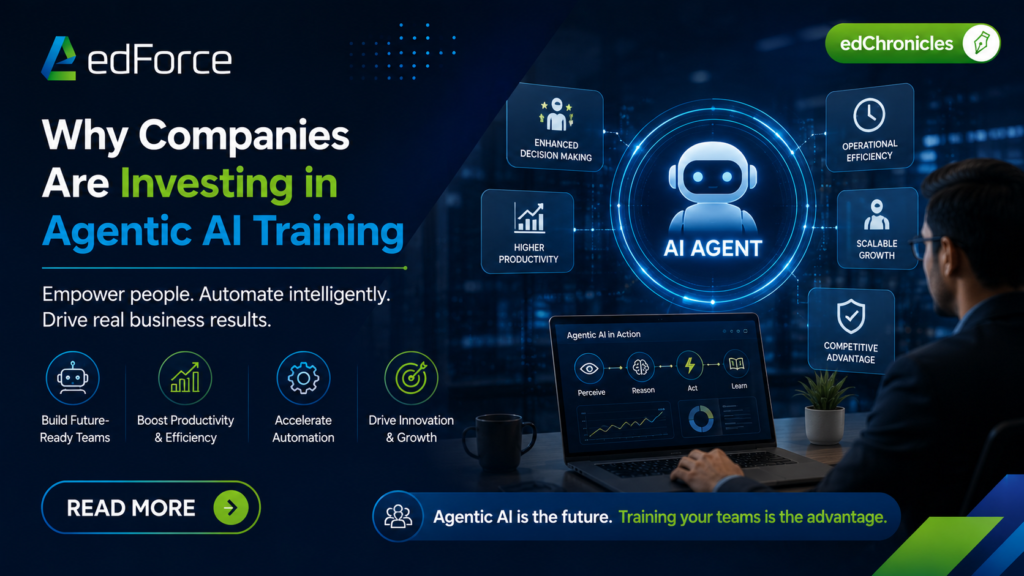
In the past few years, most companies have been using AI mainly as a support tool. Employees used AI to ask questions, create documents, generate content, or automate small tasks. Now, the conversation is changing. In 2026, businesses are moving toward something bigger. AI systems are becoming capable of making decisions, managing workflows, handling tasks within limits, and completing actions with less human involvement. This is why Agentic AI is becoming one of the most talked about technologies in enterprises. While businesses are investing heavily in AI systems, they are also realizing something important. Technology alone is not enough. Employees also need to understand how to use these systems properly. This is exactly why Agentic AI training is growing rapidly across companies. What Is Agentic AI in Simple Terms? Agentic AI refers to AI systems that can complete tasks on their own instead of only responding to instructions. Unlike traditional AI tools that wait for commands, Agentic AI systems can: In simple terms, the AI behaves more like an active digital assistant rather than just a chatbot. This is changing how businesses use AI completely. Why Businesses Are Taking It Seriously Many companies are already seeing the limitations of basic AI usage. Employees may save time using content generation or automation, but businesses still face challenges such as: Agentic AI is attracting attention because it can help reduce these operational bottlenecks. For example, businesses are exploring AI systems that can: This moves AI from support toward execution. The Real Reason Training Matters Many businesses are becoming more practical in their approach. Companies understand that advanced AI systems can create confusion if employees do not understand: Without proper training, AI adoption often becomes inconsistent. Some teams become too dependent on AI, while others avoid using it completely. Neither approach works well in business environments. Training helps create balance. Employees Need a Different Mindset for Agentic AI One major change happening today is that employees are no longer expected to only use software tools. They are increasingly expected to: This requires a very different skill set compared to traditional software usage. Employees need to understand how AI decisions affect: This is one reason businesses are investing heavily in structured AI capability building instead of casual experimentation. Why Enterprises Cannot Treat Agentic AI Casually From what many organizations are experiencing, Agentic AI creates both opportunities and risks. The benefits are clear: However, businesses also worry about: That is why companies are becoming more careful about workforce readiness. Organizations successfully implementing Agentic AI are not only using tools. They are also preparing employees to work with these systems effectively. Team Training Is Becoming More Important Than Individual Learning Another major shift is happening inside enterprises. AI adoption is no longer limited to small technical teams. Agentic AI affects operations teams, support staff, managers, analysts, and business workflows across departments. Because of this, companies are investing more in team based AI learning instead of focusing only on individual training. Many organizations are now working with enterprise learning partners like edforce.co to help teams build practical understanding of AI workflows, automation systems, and responsible AI usage in real business environments. The goal is not only AI awareness.It is operational readiness. What Companies Actually Want From Employees A clear trend is now visible in hiring and workforce development. Businesses are not expecting every employee to become an AI engineer. However, they do need employees who can: These are quickly becoming valuable workplace skills. My Practical View The companies gaining the most value from AI today are not the ones rushing to automate everything immediately. They are the ones preparing their teams properly before scaling AI adoption. Preparation matters because Agentic AI changes how employees work inside organizations. Employees who understand these systems will become far more valuable in the coming years. Businesses already understand this. Final Thoughts Companies are investing in Agentic AI training because the future of work is moving from basic AI assistance toward AI supported execution. As AI systems become more autonomous, businesses need employees who can guide, monitor, and work with these systems responsibly.The real challenge is no longer getting access to AI tools.It is building teams that understand how to use them effectively in real business environments