


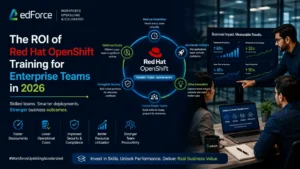
Many IT decisions in the enterprise seem straightforward at first. A business adopts Kubernetes. Teams begin moving applications into containers. Cloud infrastructure becomes more important. Leaders want faster deployments and greater scalability.
Then reality sets in.
The technology may be available, but the teams are not always ready for it.
This is one reason many OpenShift projects move more slowly than expected. The problem is not usually the platform itself. In many cases, organizations underestimate how much workforce readiness affects performance.
By 2026, most enterprises already understand the value of cloud-native technology. The conversation has changed. Companies are no longer asking whether containers matter.
They want to know how quickly teams can use them effectively. That is where Red Hat training becomes important.
The ROI is not just about learning a platform. It is about helping teams work more efficiently, reducing operational errors, and supporting modern application environments with confidence.
Why OpenShift Projects Often Slow Down
Many organizations invest heavily in infrastructure but underestimate the learning curve that comes with it.
A common scenario looks like this:
The platform is successfully deployed.
Technical teams complete the installation.
Leadership expects faster development cycles.
However, developers continue using older workflows.
Operations teams struggle with new deployment models.
Security teams need time to adapt to container-based environments.
As a result, technology adoption progresses more slowly than expected.
What appears to be a platform problem is often a skills problem.
This trend is becoming more common as organizations adopt Kubernetes, cloud-native architectures, and modern DevOps practices.
The Real ROI of OpenShift Training
When organizations discuss training ROI, the conversation usually begins with cost.
How much will the training cost?
How many employees need to be trained?
How long will it take?
These questions matter, but they often miss the bigger picture.
The real value comes from reducing the inefficiencies that slow projects down.
For example, trained teams tend to spend less time:
- Troubleshooting avoidable issues
- Correcting deployment mistakes
- Managing inconsistent environments
- Resolving configuration errors
Teams also become more comfortable working with containers and cloud-native applications.
That confidence matters.
Many enterprise projects struggle not because employees lack capability, but because they lack familiarity with modern operating models.
Training helps close that gap faster.
Why Enterprises Are Looking Beyond Certifications
In the past, certifications were often enough to demonstrate capability.
Today, organizations are becoming more practical.
Certifications still matter, but companies increasingly focus on implementation skills.
- Can teams deploy applications efficiently?
- if They manage container environments effectively?
- Can they support business-critical workloads without creating operational bottlenecks?
These are the questions leadership teams are asking.
This is why the most effective OpenShift training programs focus on practical application rather than theory alone.
Employees need to understand how the platform fits into day-to-day operations, not just how it works in a lab environment.
How Long Does OpenShift Training Take?
One common mistake organizations make is assuming every employee needs the same training path.
In reality, timelines vary depending on roles and responsibilities.
A developer learning OpenShift will require a different learning path than an infrastructure engineer or DevOps specialist.
In most organizations, learning happens in stages rather than all at once.
Stage 1: Foundation
The first stage usually focuses on building a strong understanding of how OpenShift fits into modern cloud-native environments and how containerized applications are managed.
Stage 2: Practical Application
The next stage focuses on applying concepts to real projects, workflows, and operational processes.
Stage 3: Advanced Operations
The final stage often includes automation, security practices, optimization, and modern platform management.
Organizations that train in phases typically see better adoption because employees can apply knowledge gradually instead of trying to absorb everything at once.
The Team Structure That Works Best
One trend becoming increasingly visible across enterprises is that OpenShift success does not depend on a single team.
In the past, technology initiatives were often managed by one department.
Modern cloud-native environments are different.
Successful OpenShift environments usually require collaboration across multiple teams.
- Developers focus on application delivery.
- Operations teams focus on reliability and performance.
- Security teams focus on governance and compliance.
- Platform engineers maintain infrastructure consistency.
- Leadership teams ensure alignment with business goals.
When these groups work in isolation, adoption becomes more difficult.
When they share a common understanding of the platform, implementation becomes much smoother.
This is one reason organizations increasingly train cross-functional teams instead of focusing only on infrastructure specialists.
The Hidden Cost of Delayed Upskilling
One factor many organizations overlook is the cost of waiting.
When new platforms are introduced without workforce preparation, projects may still move forward, but progress is usually slower than expected.
Employees spend more time searching for answers.
Teams become dependent on a small number of experts.
Knowledge remains concentrated instead of being shared across the organization.
Over time, this creates operational risk.
Surprisingly, many enterprise technology delays can be traced back to capability gaps rather than technology limitations.
That is why many organizations now include training as part of deployment planning instead of treating it as an afterthought.
OpenShift Skills Are Becoming More Valuable
The broader market is evolving rapidly.
Cloud-native technologies continue expanding across industries. Organizations are investing heavily in containers, automation, DevOps, and hybrid cloud environments.
As a result, professionals with OpenShift expertise are becoming increasingly valuable.
However, the most sought-after professionals are usually not those who only understand the platform.
Organizations need people who understand:
- Cloud-native operations
- Automation workflows
- Container management
- Enterprise security requirements
- Modern application delivery
OpenShift sits at the center of many of these capabilities.
That is why OpenShift training often delivers value far beyond a single platform.
A Trend Enterprises Should Pay Attention To
One prediction is becoming increasingly likely over the next few years.
The gap between organizations that adopt cloud technologies and those that successfully use them will continue to grow.
Technology is becoming easier to acquire.
Workforce capability is becoming harder to develop.
The competitive advantage may come less from access to advanced platforms and more from having teams that know how to use those platforms effectively.
Organizations that invest in workforce development early are often better positioned when new technologies emerge.
Those that wait usually spend more time catching up.
Building an OpenShift-Ready Workforce
The most successful enterprise training strategies focus on long-term capability rather than short-term certification goals.
Employees need exposure to real-world scenarios and opportunities to apply new skills in operational environments.
At edForce.co, Red Hat OpenShift training programs are designed to help organizations build cloud-native capabilities across development, operations, and platform teams. The goal is not simply to pass an exam. It is to help organizations build teams that can support modern applications with confidence and consistency.
Final Thoughts
Red Hat OpenShift training is often viewed as a technology investment. In reality, it is a business investment.
The ROI comes from faster adoption, stronger operational consistency, reduced dependency on a small group of experts, and greater confidence across teams.
As organizations continue expanding cloud-native initiatives, the companies that succeed may not be those with the most advanced technology.
They will be the ones with teams that are prepared to use those platforms effectively.
In 2026, that distinction will be more important than ever.