


From the Charkha to AI: Why India’s Next Chapter of Self-Reliance Will Be Built on Capability

Back to Blogs Page A Few Years Ago, Using an AI Assistant at Work Felt Like an Experiment Someone might ask it to rewrite an email, summarise a long document, or suggest ideas for a presentation. The result was interesting, but the actual work still happened somewhere else. That relationship is changing. In 2026, AI assistants are increasingly becoming part of the normal working day. They’re showing up inside development environments, productivity platforms, customer service systems, business applications, and internal knowledge tools. Employees aren’t always opening a separate AI website anymore – in many cases, AI is simply becoming part of the software they already use. That shift matters because it changes the question enterprises need to ask. It’s no longer just “Should our employees use AI?“ It’s becoming “How should AI assist our employees while they work?“ AI Is Moving Closer to the Work The most useful AI assistant may not be the one with the most impressive demo. It may be the one that shows up at exactly the right moment. A developer gets help while writing code. A sales employee gets a summary before a customer meeting. An analyst can ask questions about a business document instead of reading every page manually. A support employee receives suggested responses while handling a customer issue. The common thread is context. AI becomes genuinely useful when it understands enough about the task to offer relevant assistance – without forcing the employee to constantly switch between applications. This is one reason enterprise AI adoption is moving from experimentation toward integration. Employees Don’t Want Another Tool to Manage There’s a practical reason AI assistants are gaining traction. Employees already juggle dozens of applications. Adding another standalone platform means another login, another interface, another process, and another place where information needs to be copied over. An assistant built into an existing workflow feels different. If a developer gets coding assistance inside their development environment, there’s far less disruption. If a sales professional can summarise customer information within the system they already use, the benefit is immediately clear. The future of workplace AI may be less about telling employees to “go use AI” and more about bringing AI into the places where work already happens. The First Productivity Gains Are Often Small Not every AI use case needs to transform an entire department. Some of the most useful improvements are refreshingly ordinary. An employee might spend 20 minutes turning meeting notes into action items – AI can cut that down to a few minutes. A manager might spend an hour summarising several reports before a meeting – an assistant can produce a first draft the manager simply reviews. A developer might spend time searching documentation or explaining repetitive code – AI can handle the first pass. Individually, these savings can look small. Across hundreds or thousands of employees, they add up to something significant. This is exactly why enterprises need to be careful about how they measure AI productivity. The value often doesn’t show up as one dramatic cost reduction — it emerges through hundreds of small improvements repeated daily. AI Assistants Are Not Replacing Human Judgement The word “assistant” is useful because it describes the role fairly accurately. An assistant can prepare, organise, suggest, summarise, and accelerate. The employee still decides. For important business decisions, AI output still needs to be checked against reliable information, and employees need to recognise when a response might be incomplete or unsuitable. This matters even more when AI is handling sensitive information. A solid enterprise AI strategy needs both capability and clear boundaries. Employees should know what they’re allowed to ask an assistant to do, what information they can share with it, and when human approval is required. The Nature of Work Is Changing Too There’s another effect that gets less attention. When AI takes on some of the smaller tasks surrounding a job, employees often end up spending more time on the parts of their role that genuinely require judgement. Take a software engineer: if AI handles repetitive code, documentation, debugging suggestions, and test generation, the engineer can spend more time thinking about architecture and system behaviour. A sales professional may spend less time preparing information and more time actually speaking with customers. An analyst may spend less time formatting data and more time interpreting what it actually means. This isn’t just about doing the same work faster. It can genuinely change where employees direct their attention. AI Assistants Are Becoming More Context-Aware Early AI assistants relied almost entirely on what the user typed into a prompt. Enterprise systems are moving toward something different. An assistant can now potentially draw on information already available within the user’s authorised environment — documents, project details, customer records, code, internal knowledge, or business processes. That opens up far more useful interactions. Instead of asking: “Summarise this document.” an employee might ask: “What changed from the previous version, and what do I need to act on?” That second question requires real context. As enterprise AI becomes more connected to business systems, context is likely to become one of the biggest differentiators between basic AI usage and genuinely useful AI assistance. This Is Where AI Skills Become Important Giving an employee an AI assistant doesn’t automatically teach them how to work with it. Employees need to understand how to provide useful context, evaluate responses, protect sensitive information, and recognise when the system needs human direction. They also need to understand where the technology’s limits lie. A professional who knows how to question an AI response can extract far more value from the same tool than someone who accepts every answer at face value. This is why AI literacy is increasingly a workplace capability, not just a technical skill. Enterprises Will Need Different AI Skills for Different Roles A common mistake is treating AI training as a single subject for everyone. It isn’t. A developer may need AI-assisted coding and application-development skills. A cloud engineer may need to understand AI infrastructure
Best Agentic AI Training Providers in India for Enterprises
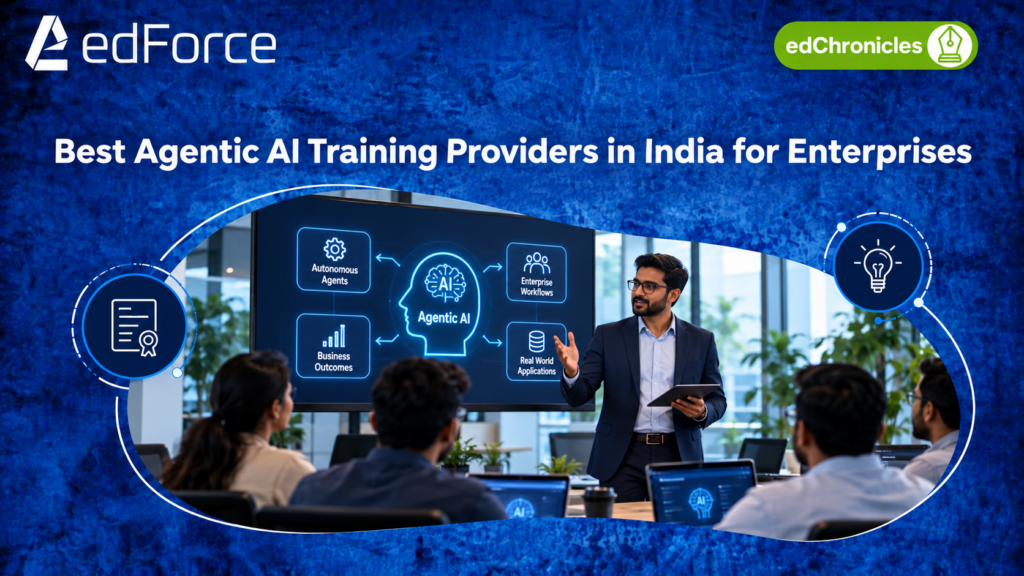
Agentic AI is moving out of the experimentation phase and into real commercial workflows. Enterprises are looking to agents for software development, research, customer service, data analysis, IT operations, internal knowledge management and workflow automation. But simply giving employees access to AI technologies is not the same as teaching them to work with AI agents. Employees have to know how agents work, where they can be employed, how to oversee them, how to evaluate their output and what hazards they present. For companies, this transforms the choice of a training provider into a workforce capabilities decision, not merely a course purchase. Here are 10 Agentic AI training providers and programs in India that organizations should consider for employee upskilling in 2026. 1. IIT Madras Pravartak IIT Madras Pravartak runs programs in Agentic AI engineering and corporate processes and strategy. The benefit for organizations is the separation of technical and business capacity. Not every employee needs to create an AI agent from start. Some employees do need to know how to use agents inside their workflows, while technical teams may need more advanced engineering abilities. Suitable for: Enterprises interested in organized programs with technical and business oriented Agentic AI learning. 2. edForce.co The edForce.co training on Agentic AI is particularly pertinent for businesses that are seeking to upskill their employees. Its enterprise learning model include role focused training, evaluations and hands on CloudLabs. This allows employees to go beyond passively viewing demonstrations and actively practice technical skills in organized contexts. For technical staff, Agentic AI training can be combined with fields such as Generative AI, cloud, AI infrastructure and certification paths. edForce also partners with NVIDIA as a training partner to enable organizations to combine Agentic AI learning with the AI certification ecosystem of NVIDIA. The major plus for company L&D teams is the opportunity to structure training according employee roles and existing skill levels, instead of offering every employee the identical AI course. Best for: Enterprises looking for unique employee upskilling, hands-on laboratories, exams and role based AI learning. 3. IIT Delhi The Executive Certificate in Agentic Artificial Intelligence Systems by IIT Delhi is focused on advancing from the basics of AI to deployment. The curriculum covers topics including LLMs, autonomous agents, multi agent systems, RAG, AI governance and enterprise knowledge systems. For organizations, this type of education can be important for personnel who already have some technical background and need to grasp how Agentic Artificial Intelligence systems can proceed toward production. Ideal for: Technical staff, architects and engineering experts looking for advanced Agentic AI training. 4. AI Guru AI Guru offers business AI training including Generative AI, Agentic AI, AI Engineering and AI Governance. The enterprise strategy means organizations can tailor learning around diverse groups of employees. This is significant since an HR staffer, a software developer, and a technology manager would not need the same level of Agentic AI. Therefore a tailored training can concentrate on awareness for business teams and more advanced implementation skills for technical teams. Best fit: Enterprises that want to provide tailored training to their technical and business workforce. 5. The Ikigai School of AI Ikigai School of AI focuses on creating organizational AI competence, not a separate course on AI learning. Its enterprise programs include AI awareness, role based capability development and building internal AI capabilities. It consists of agentic workflows and hands-on assignments. This strategy might be effective for organizations where the goal is not just to teach individuals, but to develop internal teams who can find and implement AI use cases. Ideal for: Enterprises developing internal AI capability and AI Centers of Excellence. 6. Jigar Joshi Jigar Joshi conducts instructor-led Agentic AI programs with a heavy technical focus. The curriculum covers agent architecture, tools, APIs, security, observability, multi model systems and production monitoring. This makes the curriculum more relevant to the employees who are involved in software engineering and AI implementation than general AI awareness for workforce. It’s ideal for: IT services organizations, developers and engineering teams implementing Agentic AI applications. 7. Ai LearnX Innovations At Ai LearnX we offer corporate tech training in Generative AI, Agentic AI and AI engineering. Its corporate model comprises customized programs and instructor led delivery making it fit for organizations that require training offered across employee groups rather than individual enrollments. Customization is key for L&D teams as employee capacity levels might vary widely within one organization. Best suited for: Enterprises seeking customized instructor guided AI training. 8. CraftVoy CraftVoy offers customized business technology training in Generative AI, Agentic AI, and AI engineering. Training can be customized to a technical team’s technological stack and needs. This can be especially valuable when personnel are required to work with Agentic AI in existing development environments rather than learning the technology in a vacuum. Best for: Engineering and development teams who want hands on, technology specific training. 9. IIM Bangalore IIM Bangalore’s enterprise learning offering is a different ball game. Its executive education programs have included enterprise AI preparation, covering LLMs, RAG, AI agents, governance and organizational capabilities. This type of curriculum is more important for managers, technology leaders and senior employees responsible for AI adoption, rather than for employees who need to construct agents themselves. Who should attend Senior managers, business leaders and technology leaders participating in AI strategy. 10. NASSCOM FutureSkills Program NASSCOM FutureSkills is relevant for organizations looking to set up wider technology workforce development. It’s ecosystem includes nascent emerging technology skills and might be considered when a company is seeking to combine Agentic AI training with broader digital and technology upskilling. Before choosing a particular course, enterprises should consider unique program, trainer’s experience, practical components and employee learning outcomes. Best for: Large-scale workforce development and enterprise IT upskilling programs. What Should Enterprises Expect from Employee Agentic AI Training? The worst mistake is picking a program solely because it says “Agentic AI” on it. Enterprise program should be relevant to what employees do. A good program should have some of the following capabilities: Employee
Why Every Enterprise Will Need an “AI Skills Audit” by 2027
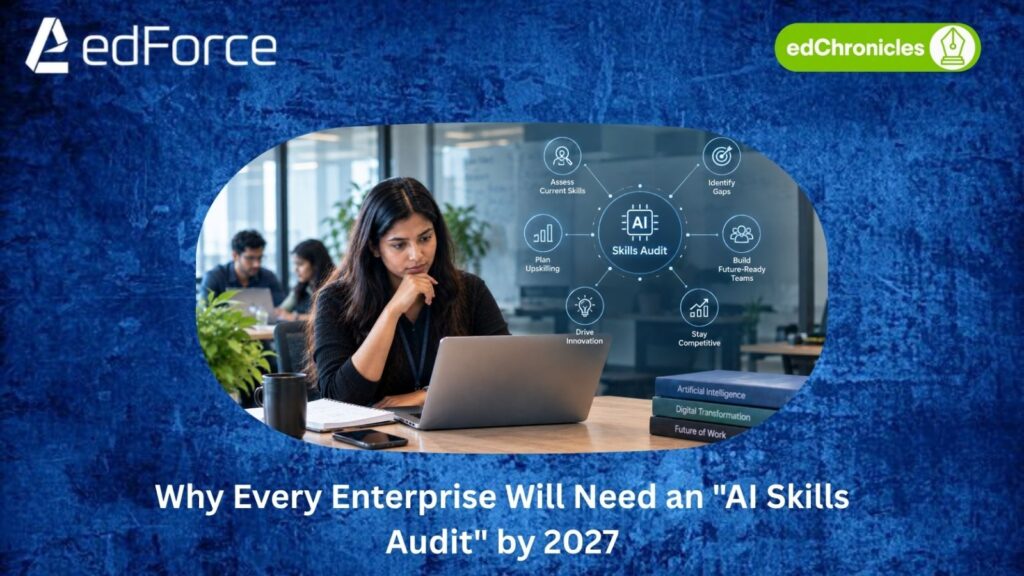
Most companies already have an idea of where they want to use in AI. Much less know whether their workers have the abilities to use it safely, efficiently, and at scale. By 2027, that will matter more. The use of AI is moving beyond experiments with chatbots and productivity aids. Employees are adopting AI for research, coding, analysis, content, customer service, decision support, and, increasingly, agent based processes. Meanwhile the abilities required to use these systems effectively are developing rapidly. The World Economic Forum says that 63% of companies now list skills deficiencies as a major impediment to transforming their businesses, and 77% anticipate to upskill or reskill their staff in response to AI by 2030. That’s why an AI skills audit is expected to become a regular part of company labor planning. What is a Skills Audit for AI? An AI skills audit is a formal evaluation of the AI skills an organization currently possesses, against the skills they will need or to check the Skill Gap report of their company. This is not just a test of how good employees are at using ChatGPT or Copilot. A good audit considers numerous layers: Skills area What the organization should check AI literacy Understanding of AI capabilities, limitations and responsible use Use of AI tools Ability to employ sanctioned AI tools well Prompting Ability to provide clear instructions and enhance outputs Critical evaluation Ability to evaluate correctness, bias, reliability Data skills Ability to understand data dangers and to work with data AI Technical Skills Development, Integration, Deployment and Supervision Privacy, security, compliance and responsible AI AI management Human talents Critical thinking, Judgment, Communication, Decision making The thing is that not all employees require the same amount of AI capacity. A financial analyst, a software engineer, an HR manager and a cloud architect might all be using AI but the skills they will require will be very different. Why Same-Training-for-Everyone Won’t Work One of the simplest mistakes an organization can make is to develop a one-size-fits-all AI training program for the whole workforce. Sounds efficient. Usually it isn’t. A developer might need abilities like APIs, integrating models, evaluating them and developing applications for AI. Sometimes a sales professional is good at research and content creation and customer analysis. An manager might need to comprehend AI dangers, workflow reform and how to evaluate AI helped judgments. Some Companies report on AI capabilities in India also depicts a similar development from AI informed employees and AI users to AI integrators, AI builders and AI experts. An audit gives you a sense of where each individual or function falls on that competency range. The AI Skills Gap Is Turning Into an Enterprise Problem The question is not any more if organizations can hire AI expertise. Enterprises require thousands of workers who can work effectively with AI. So leadership is faced with a tricky question: Are employees genuinely gaining the skills to turn access to AI into commercial value? One method to answer this is with an AI skills audit. What should an enterprise audit really measure? A useful audit shouldn’t just question if staff have received AI training. Activity metric Training completion Capability is measured as an outcome. For example, an enterprise could evaluate if employees can: Choosing the proper AI technology for a commercial task Effective directions to write and improve Identify incorrect or falsified outputs Safeguard private corporate data Verify AI-generated analysis Explain when human review is needed Automate suitable aspects of a workflow Know the limits of standard artificial intelligence systems Work responsibly with AI agents Apply particular AI talents for real business tasks in roles This gives a far better image than a certificate or attendance slip. Audit Must Connect Skills to Actual Work The best way to go is to begin by establishing roles and workflows, not technology. Think of an organisation’s finance team. It is not the question: “Is the finance group aware of generative AI?” A better question to ask is: “Which finance workflows could be enhanced with AI, and what skills would employees need to use it securely? This could encompass financial research, report writing, document analysis, forecasting support and retrieval of internal knowledge. The same approach can be implemented in IT, HR, legal, marketing, customer support, operations and engineering. This shifts the conversation from AI training to labor capacity. AI Skills Are Going To Keep Evolving The other reason why audits will be significant is that the life span of AI skills is short. According to the World Economic Forum, roughly 40% of skills needed on the job are likely to change by 2030. The technology itself is likewise advancing rapidly. Employees who have so far been taught in basic prompting may soon have to interact with AI agents, automated workflows, multimodal systems and organization specific AI platforms. Microsoft’s 2026 Work Trend Index characterizes this change as AI and agents doing more of the execution, and people increasingly leading work, making decisions and owning outcomes. That implies an AI skills assessment shouldn’t be considered as a once a year HR task. It should be part of ongoing workforce planning. From Skills Audit to Skills Roadmap – The audit is only as good as what follows thereafter. A useful enterprise roadmap might classify three groups: Prepared: Employees already possess the capabilities required for their present AI enabled role. Developing: Employees have a rudimentary knowledge of AI, but they require systematic training and experience. Priority gap: Employees don’t have skills that are growing vital to their role or business function. The organization can then link each group with a learning route. That may be AI literacy for one person, prompt and process training for another, cloud and AI infrastructure training for an IT team, or advanced AI engineering certification for specialist technical jobs. Structured enterprise programs or trainings by well known corporate training provider such as edForce.co can aid this kind of role focused workforce upskilling strategy. The Real Reason for an AI Skills Audit An
Palo Alto Certifications Explained: A Career Roadmap for 2026

If you are searching for a Palo Alto Networks certification in 2026, there is one mistake worth avoiding before you start studying: following an old PCNSE or PCNSA roadmap. The Palo Alto Networks certification programme has changed. The current framework is organised around job roles and security functions, with four levels: Foundational, Professional, Specialist and Architect. The main tracks cover Network Security, Security Operations and Cloud Security. That change matters because the right certification now depends less on the product you want to learn and more on the work you want to perform. The Old Palo Alto Certification Roadmap Is No Longer the Current One For years, professionals commonly looked at certifications such as PCCET, PCNSA and PCNSE when planning a Palo Alto Networks career. That roadmap is now outdated for new candidates. Palo Alto Networks has moved to a role based certification structure. Existing legacy certifications can remain valid until their individual expiration dates, but professionals planning a new certification path in 2026 should start with the current portfolio rather than building a study plan around retired exams. This is actually a useful change for career planning. Instead of asking, “Which Palo Alto training should I take?” professionals can start with a better question: What security job do I want to become better at? Step 1: Build the Foundation Before Choosing a Specialisation If you are new to cybersecurity, Palo Alto Networks currently offers two Foundational certifications: Cybersecurity Apprentice and Cybersecurity Practitioner. Cybersecurity Apprentice is aimed at people starting or transitioning into cybersecurity and covers fundamental areas including networking, endpoint security, cloud security, security operations and identity security. Cybersecurity Practitioner goes a step further, validating cybersecurity knowledge and basic application skills related to Palo Alto Networks technologies. This makes the Foundational level useful for career changers, early career professionals and non technical professionals who need a stronger cybersecurity base. You do not necessarily need to collect both simply because they exist. Your starting point should depend on your current knowledge and the role you are targeting. Step 2: Choose Your Career Track Once the fundamentals are in place, the roadmap becomes much clearer. Network Security This path is relevant to professionals working with firewalls, network security, SASE and related infrastructure. The current portfolio includes Network Security Professional, followed by specialist options such as: Network Security Analyst Next Generation Firewall Engineer SD WAN Engineer Security Service Edge Engineer At the top is Network Security Architect. The interesting part is how the certifications map to actual responsibilities. A professional level credential validates broader knowledge of Palo Alto Networks network security solutions. A Next Generation Firewall Engineer certification, for example, is focused more deeply on deployment, networking, configuration, integration, automation and centralised management. That gives network engineers a way to specialise instade of simply moving thru increasingly difficult exams. Security Operations Has Its Own Career Path If your target is a SOC, threat detection or security automation role, the Security Operations track is more relevant. The current path includes Security Operations Professional, followed by specialist certifications covering areas such as XSIAM, XDR and XSOAR. For example, the XSIAM Analyst certification focuses on using the platform for automation, threat detection and response. XSIAM Engineer goes deeper into deployment, configuration, data onboarding and playbooks. XSOAR Engineer focuses on deploying, managing, integrating and troubleshooting security orchestration environments. This disctinction is important for people comparing cybersecurity certifications. A security analyst and a security engineer may work within the same SOC, but their technical responsibilities are different. Your certification should reflect that difference. Cloud Security Is Becoming a Separate Skills Path Cloud security is no longer simply an extension of traditional firewall administration. Palo Alto Networks’ current portfolio includes Cloud Security Professional and Cloud Security Engineer certifications. The Professional certification focuses on securing cloud environments with the Cortex Cloud platform, including cloud runtime security, application security, cloud posture security and SOC processes. The Engineer certification goes deeper into planning, installation, configuration, integration, posture management, application and runtime security, and troubleshooting across the software devolopement lifecycle. For professionals moving toward DevSecOps, cloud security engineering or application security, this creates a more direct certification route than the older firewall centred model. Where Should a Network Engineer Start? If you already work with Palo Alto Networks firewalls, do not automatically start at the Foundational level. Look at your actual responsibilities. If you work mainly with firewall configuration and network administration, the Network Security Professional path may be a logical starting point. If you already handle advanced firewall deployment, Panorama, automation and integration, a Specialist certification such as Next Generation Firewall Engineer may be more closely aligned with your work. If your responsibilities are moving toward architecture, the Network Security Architect sits at the Architect level and focuses on designing secure, scalable environments and aligning technical requirements with business needs. The same principle applies to Security Operations and Cloud Security. Choose based on the work you perform, not the certification name that sounds most advanced. What Happened to PCNSE and PCNSA? This remains one of the most important questions for professionals researching Palo Alto certifications. PCNSA and PCNSE belong to the previous certification structure. The current programme has replaced the old linear progression with role based credentials. That means someone researching “PCNSE certification 2026” can easily encounter older preparation material that no longer represents the current certification portfolio. Always check the official Palo Alto Networks certification page before purchasing a course, voucher or practice material. The current portfolio is listed there, along with certification levels, tracks and exam information. This is particularly important because certification programmes can change faster than third party training content. Certification Is Only Half of the Career Roadmap Passing an exam can demonstrate knowledge. It does not automatically create hands on ability. Palo Alto Networks itself provides digital learning, instructor led training and lab based learning options. Its Education Services also describes instructor led training as hands on and focused on practical applicaiton. That matters because cybersecurity work rarely looks like an exam question. A firewall
15 Highest-ROI IT Certifications for Enterprises in 2026
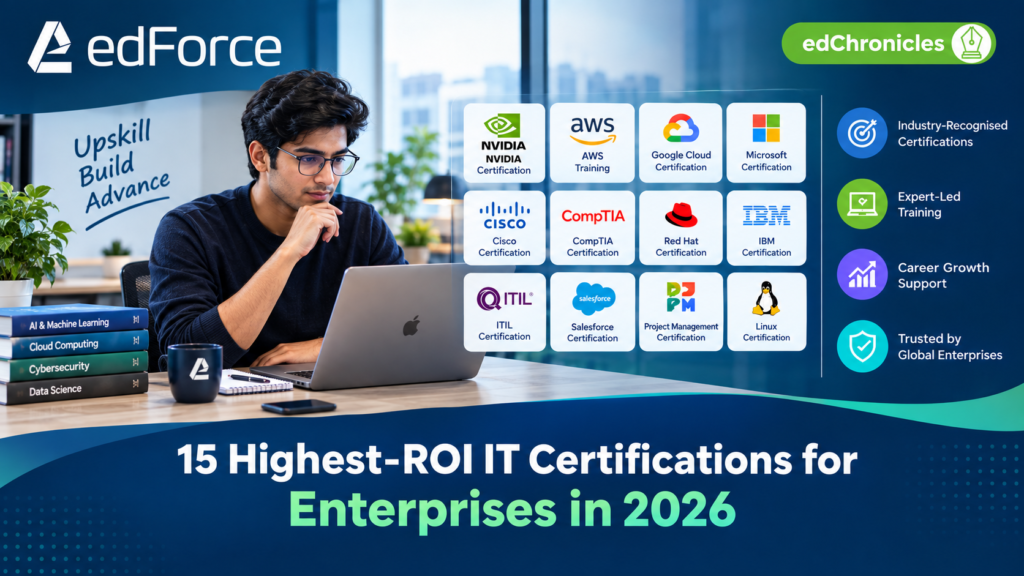
An IT certification is easy to measure by its exam price. Its return on investment is much harder to measure. For an enterprise, an IT certification can be valuable when it helps a cloud engineer manage infrastructure more effectively, gives a security team stronger technical capability, helps developers modernise delivery, or prepares employees for an AI initiative. The certificate is only the visible part. The real return comes from what the employee can do differently afterward. That is why enterprises should not ask only, “Which IT certification is most popular?” The better question is: Which certification can strengthen a business critical skill without creating unnecessary training cost? The 15 certifications below cover cloud, cybersecurity, AI, data, DevOps and enterprise infrastructure. The list is not a ranking. ROI depends on the company’s technology stack, existing workforce and business priorities. 1. AWS Certified Solutions Architect For organisations running significant workloads on AWS, architecture skills can influence infrastructure cost, reliability, security and scalability. AWS describes its certification exams around the knowledge and skills recquired to perform defined job responsibilities. The Solutions Architect path is therefore useful when employees are responsible for designing cloud environments rather than simply operating individual services. The enterprise ROI comes from connecting architecture knowledge with real cloud decisions. 2. AWS Certified DevOps Engineer DevOps teams sit close to some of the most important enterprise delivery processes. The AWS DevOps Engineer certification focuses on operating and managing distributed applications on AWS, including automation and continuous delivery. It can be particularly relevant when development and operations teams are under pressure to release faster without weakening reliability. For enterprises already invested in AWS, developing this capability internally can support more consistent delivery practices. 3. Microsoft Certified: Azure Administrator Associate Azure remains deeply embedded in many enterprise environments, particuarly organisations already using Microsoft 365, Entra and other Microsoft services. The Azure Administrator Associate certification covers areas including identity and governance, storage, compute, networking and monitoring. The ROI case becomes stronger when organisations are expanding Azure adoption and need administrators who can manage the environment beyond basic configuration. 4. Microsoft Azure Solutions Architect Expert Architecture decisions become increasingly expensive as cloud environments grow. The Azure Solutions Architect Expert path focuses on designing identity, governance, monitoring, storage, business continuity and infrastructure solutions. For enterprises with complex Azure environments, architecture capability can influence both technical resilience and long term cloud spending. 5. Microsoft Certified: DevOps Engineer Expert Modern software delivery increasingly depends on automation, source control, build pipelines, release processes, security and monitoring. Microsoft’s DevOps Engineer Expert certification assesses skills across those areas, including source control, build and release pipelines, security and compliance, and instrumentation. For enterprises trying to shorten release cycles while maintaining governance, these skills can have a direct operational impact. 6. Microsoft Cybersecurity Architect Security architecture is becoming harder as identity, cloud, applications, data and security operations converge. Microsoft’s Cybersecurity Architect certification covers security operations, identity, compliance, infrastructure, applications and data. For organisations heavily invested in Microsoft security technologies, this can help develop architecture level capability rather than isolated security tool knowledge. 7. Microsoft Information Security Administrator Not every organisation needs another security architect. Many need professionals who can actually impliment information protection, data loss prevention, retention and risk controls. The Microsoft Information Security Administrator Associate certification focuses on those operational capabilities. Its potential ROI comes from strengthening the people responsible for turning security policies into technical controls. 8. NVIDIA Certified Associate: AI Infrastructure and Operations AI infrastructure is creating a new skills requirement for enterprises deploying accelerated computing. NVIDIA’s Associate certification validates foundational knowlege around AI computing infrastructure and operations. For organisations beginning to build GPU based environments, this can provide a foundation before employees move into more advanced infrastructure responsibilities. 9. NVIDIA Certified Professional: AI Infrastructure Enterprises operating serious AI infrastructure need skills beyond understanding GPUs. NVIDIA’s Professional AI Infrastructure certification covers the ability to deploy, configure and validate advanced NVIDIA AI infrastructure. The business case is closely tied to utilisation, deployment quality and operational reliability. AI infrastructure is expensive. Developing people who understand how to operate it can therefore have practical financial implications. 10. NVIDIA Certified Professional: AI Operations Building an AI environment is one problem. Keeping it healthy is another. NVIDIA’s AI Training certification focuses on monitoring, troubleshooting and optimising NVIDIA AI infrastructure. For enterprises running production AI infrastructure, operational expertise becomes increasingly important as workloads scale. 11. NVIDIA Certified Professional: Generative AI LLMs Generative AI projects can move quickly from experimentation to production. The NVIDIA Certified Professional Generative AI LLM certification covers advanced capabilities related to designing, training and optimising LLMs, including distributed training and fine tuning. The ROI depends heavily on whether the organisation is actually building or operating LLM based solutions. For a company only consuming third party AI tools, this may be unneccessary depth. For an organisation building AI products, the equation is very different. 12. NVIDIA Certified Professional: Agentic AI Enterprise AI is moving beyond single prompt and response interactions. Agentic systems can involve multiple agents, tools, workflows, governance and autonomous actions. NVIDIA’s Professional Agentic AI certification focuses on building and governing advanced agentic AI solutions, including multi agent interaction and scalability. For organisations actively developing agentic applications, this is a newer certification area worth monitoring as enterprise adoption grows. 13. Red Hat Certified System Administrator Linux remains a major component of enterprise infrastructure, cloud platforms and modern application environments. Red Hat certifications are particularly relevant where organisations depend heavily on Red Hat Enterprise Linux and related technologies. The standard list price for a Red Hat certification exam is currently $500, although regional pricing can vary. Red Hat Learning Subscription options can also bundle training access with exam eligibility and, depending on the tier, retakes and multiple exam attempts. The ROI becomes clearer when certification supports an environment the organisation already operates. 14. Red Hat Certified Engineer For organisations running larger Linux and automation environments, RHCE skills can go beyond basic administration. The certification path is associated with automation and more advanced system
How to Run a Skills Gap Assessment Before Choosing a Training Program
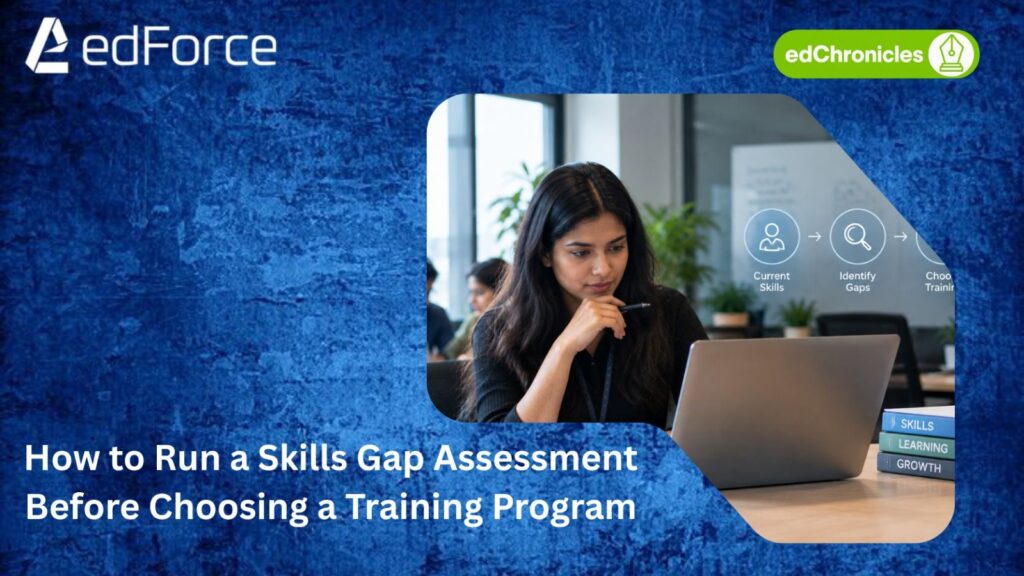
Choosing a training program before understanding the skills gap is like buying software before knowing what problem the business needs to solve. The course may be excellent. The trainer may be experienced. The technology may be current. Yet employees can finish the program without gaining the capability the business actually needs. This is becoming a bigger problem as technology skills change faster. Gartner reported in July 2026 that approx 50%+ of CHROs felt skill needs were changing faster than their organisations could develop support plans. The World Economic Forum also found that 63% of employers see skills gaps as a major barrier to business transformation. A skill gap report helps answer a more useful question: What should our employees be able to do, what can they do today, and what needs to change? Only after answering that question should you choose the training. Start With Business Goals, Not Course Catalogues The first step is to identify what the business is trying to achieve. Perhaps the company is moving workloads to the cloud. Maybe it is introducing generative AI, strengthening cybersecurity, modernising software development, or expanding its data capabilities. Each objective creates different skill requirements. For example, an organisation adopting AI may need prompt and tool literacy for some employees, AI engineering skills for developers, data skills for analysts, governance knowledge for risk teams, and stronger AI judgment for managers. Starting with the business goal prevents a common mistake: choosing popular courses and then trying to find a reason for employees to take them. Gartner’s current skills research recommends focusing development resources on the skills that matter most to core business workflows rather than attempting to create an exhaustive list of every possible skill. Map the Roles That Matter Most You do not need to assess every employee at the same depth on day one. Start with roles that have the greatest connection to the business objective. For a cloud migration, that could mean: Cloud engineers → DevOps → Security → Architects → IT operations For an AI initiative: Developers → Data teams → Product teams → Business users → Managers This creates a practical boundary for the assessment. Then define what each role needs to do differently. That last part matters. Do not simply write “needs AI skills” or “needs cloud skills.” Write the actual capability. For example: “Can build, test and deploy an AI enabled application using the organisation’s approved architecture.” That is measurable. Measure Current Capability, Not Just Employee Confidence A self assessment is useful, but it should not be the only source of information. Employees may rate themselves highly because they have used a tool for several months. Another employee may rate themselves conservatively despite having strong practical skills. Use several signals where possible: Self assessment Manager assessment Practical assessment Project performance Certifications Work samples Technical interviews Assessment or lab results The World Economic Forum found that 48% of employers expect to use skills assessments as an assessment mechanism during 2025 to 2030, while work experience remains the most common mechanism. The lesson is simple: what employees know and what employees can actually do are not always the same thing. Build a Simple Current vs Required Skills Matrix Once the information is collected, put it into a matrix. Skill Required Level Current Level Gap Priority Cloud architecture Advanced Intermediate High High Cloud security Advanced Basic High High Infrastructure automation Intermediate Intermediate Low Medium AI literacy Intermediate Basic Medium High Data analysis Intermediate Basic Medium Medium You do not need a complicated enterprise platform to begin. The purpose is to make the gap visible. More importantly, the matrix helps separate real capability gaps from assumptions. If a team already has strong Python skills, sending everyone through a beginner programming course is unlikely to solve the business problem. Prioritise the Gaps That Affect Real Work Not every gap deserves immediate training. Imagine an IT team has ten areas where proficiency is below the desired level. If only two of those skills affect a critical transformation project, those two should probably receive attention first. A useful prioritisation model looks at: Business impact + urgency + number of affected employees + difficulty of closing the gap You can also ask: Will this gap delay an important project? Does it create security or compliance risk? Is the skill difficult to hire externally? Does the skill affect several teams? Will improving it create measurable productivity gains? This prevents the training budget from being spread thinly across dozens of low-impact skills. Decide Whether Training Is Actually the Answer This is one of the most important parts of the assessment. A performance problem is not always a training problem. If employees know how to perform a task but lack access to the right software, training will not fix the issue. If a proccess is badly designed, another course may simply teach employees to work around it. If managers do not give employees time to practise a new skill, even good training may have little effect. Before selecting a programme, ask: Is the gap caused by knowledge, skill, tools, process, experience or management support? Training is most useful when the underlying problem is genuinely a capability gap. Match the Training Format to the Gap Once the gap is clear, choose the learning format. A short workshop may be enough when employees only need awareness or a specific new capability. A deeper technical programme may be appropriate when employees need hands-on expertise. Certification preparation can make sense when a role requires validated technical knowledge. Labs and project-based learning are useful when employees need to demonstrate that they can apply concepts rather than simply remember them. For enterprise technology teams, a blended approach can often work better than one large course. Employees may need instructor-led learning, practical labs, assessments, projects and reinforcement over time. The format should follow the gap. Not the other way around. Define What Success Looks Like Before Training Begins This step is frequently skipped. Before employees start the programme, define the outcome. For
What Is Hire-Train-Deploy (HTD) and Why Are Enterprises Adopting It?
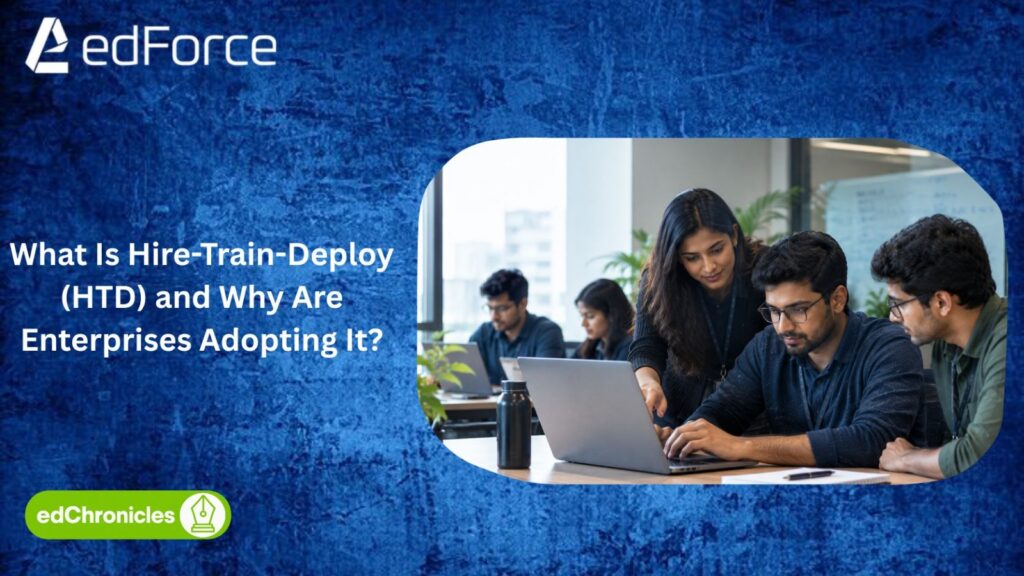
A company can have hundreds of open technology positions and still not be able to find people who are ready to work on its exact tech stack. “It’s not necessarily a shortage of candidates. Often, there is a lack of individuals who are ready for the position with the correct balance of technical skills, commercial context, and practical experience. That’s where Hire Train Deploy, or HTD, comes in. Rather than looking for people already possessing all the skills, a company can discover candidates with the correct base and learning potential, train them to the requirements of the role, assess their preparedness, and then deploy them into the business. This strategy is gaining particular relevance as organizations and Global Capability Centers in India seek to grow teams in domains like AI, cloud, cybersecurity, data engineering, and enterprise applications. Current HTD providers are literally building the model on skills that are tough to get through traditional employment. What Is the Hire Train Deploy Model? Hire Train Deploy (HTD) integrates three tasks that companies have historically managed separately: Hire Source individuals for aptitude, fundamental knowledge, and role fit. Train Teach the technical, functional, and workplace skills essential for the chosen job. Deploy Once trained candidates are deemed to have the requisite readiness level, move them to the right enterprise team or project. The crucial difference is that the organization does not expect every candidate to turn up fully trained. Job-based training. For example, when a company needs engineers with experience in Java, cloud platforms, and DevOps processes, the HTD program may assess candidates on their basic programming abilities and train them on the needed stack. Current HTD programs in India include Java, .NET, full-stack development, DevOps, SAP, Salesforce, AWS, Azure, ServiceNow, and testing. Why Old-School Hiring Can’t Keep Up With New Skills The process of hiring usually begins with a job description. The company has ten or fifteen standards, and they want applicants that already meet them. This works quite effectively if the talents are established and readily available. It is more difficult when the role is for a new or very niche talent. Take an enterprise creating an AI engineering team. It could be seeking people with knowledge of Python, cloud infrastructure, APIs, Generative AI, RAG, agents, evaluation, and corporate security. It can be difficult to find hundreds of individuals that already have that identical mix. HTD modifies the question from: “Who has all the skills we require?” to: “Who has the base and potential to develop the skills that we need?” That’s a separate pool of talent. More Than Training: HTD Post-Hiring And that is a huge difference. Traditional training usually starts after someone has already been hired. The employee joins the company, enters the role, and then receives training to improve their existing capabilities. Hire Train Deploy (HTD) works differently. The training is designed around the role before deployment. Candidates are selected based on their foundation and potential, trained against the actual requirements of the position, and assessed before they enter the enterprise team. This makes training part of the hiring process rather than something that happens separately after hiring. How the Hire Train Deploy Process Works A typical HTD program can be structured into five stages: 1. Define the Role The organization first identifies the exact skills required for the position. This could include a technology stack, functional knowledge, business processes, communication requirements, or specific enterprise tools. 2. Assess Candidates Candidates are evaluated for their existing knowledge, aptitude, problem-solving ability, and potential to learn the required skills. The objective is not necessarily to find someone who already knows everything. It is to identify candidates who have the right foundation to become productive in the role. 3. Train for the Required Skills Selected candidates then go through structured training based on the target role. For example, an organization building a cloud engineering team may train candidates on AWS or Azure, Linux, networking, DevOps, security, and relevant enterprise processes. 4. Assess Readiness Training completion alone does not mean that a candidate is ready for deployment. Candidates can be evaluated through technical assessments, practical projects, simulations, interviews, and role-specific evaluations. This helps the organization determine whether they can actually perform the expected work. 5. Deploy Candidates who meet the required readiness level are deployed into the appropriate enterprise team or project. At this stage, the organization is no longer simply hiring based on potential. It is bringing in candidates who have already gone through a structured process designed around the actual role. Why HTD Is Becoming Important for AI and Emerging Technologies The model becomes particularly useful when the technology itself is changing faster than the talent market. AI is a good example. Organizations may need people who understand Python, cloud infrastructure, APIs, Generative AI, RAG, AI agents, model evaluation, data, and enterprise security. Finding large numbers of professionals with this exact combination of experience can be difficult. An HTD model allows organizations to identify people with strong foundations and then build the missing capabilities around a specific business requirement. The same approach can apply to cloud, cybersecurity, data engineering, DevOps, enterprise applications, and other technology areas where experienced talent is difficult to source at scale. HTD and Global Capability Centers Global Capability Centers (GCCs) in India are another area where HTD can be useful. As GCCs expand their technology teams, they often need to build capabilities across multiple roles at the same time. Instead of relying entirely on experienced hiring, organizations can create structured talent pipelines for specific technologies and functions. For example, a GCC could build separate cohorts for: Cloud engineering Cybersecurity AI and data DevOps SAP Salesforce ServiceNow Full-stack development The training can then be aligned with the technologies, processes, and business requirements of the organization. What Makes an HTD Program Successful? Not every training program automatically becomes a successful HTD model. The biggest factor is alignment between hiring, training, assessment, and deployment. If candidates are trained on generic content that does not match the company’s technology environment,
Why Every IT Team Needs at Least One Certified Security Professional
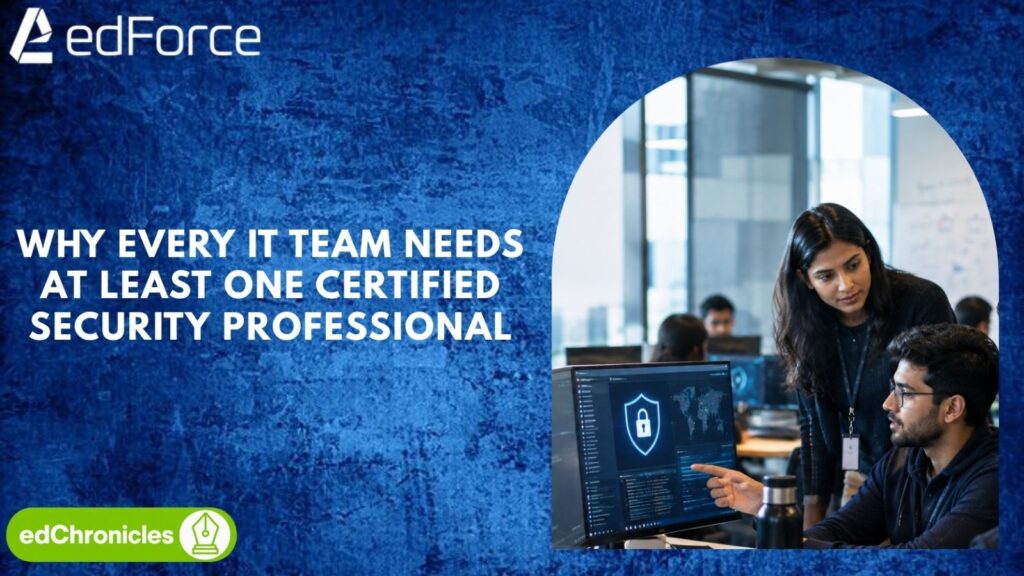
A security incident rarely starts with a dramatic warning on someone’s screen. It can start with an outdated server, a forgotten access permission, a misconfigured cloud resource, or an employee who clicks a convincing phishing link. The technology team may notice the problem only after it has moved further into the environment. This is why cybersecurity cannot sit entirely with a separate security department. Even smaller IT teams need someone who understands security deeply enough to recognise risk, challenge unsafe decisions, and connect everyday IT work with the organisation’s security posture. That does not mean every IT employee needs to become a cybersecurity specialist. It means every IT team benefits from having at least one person with verified, structured security expertise. Why General IT Knowledge Is No Longer Enough Modern IT environments have become difficult to separate from security. Cloud infrastructure, identity management, APIs, remote access, SaaS applications, endpoints, software development and AI systems all create security considerations. An administrator changing permissions is making a security decision. A developer choosing how an application handles credentials is making a security decision. A cloud engineer exposing a service to the internet is making a security decision. The challenge is that general technical knowledge doens not always provide enough depth to evaluate these risks. NIST’s NICE Framework describes cybersecurity work through specific tasks, knowledge and skills rather than treating security as a single generic capability. Its framework is designed to help organisations identify, develop and retain cybersecurity talent. A certified professional can provide that deeper layer of expertise inside an otherwise broader IT team. One Security Specialist Can Change Everyday Decisions The value of having a certified security professional is not limited to incident response. Their influence can appear much earlier. When the team is selecting a cloud service, reviewing an architecture, configuring access controls, deploying a new application or evaluating a vendor, that person can ask questions others may overlook. Who has access? What happens if this credential is compromised? Where is sensitive data stored? What is logged? How would we detect unusual activity? What happens when the system fails? These questions can prevent security from becoming an expensive clean-up exercise later. The certified professional does not need to approve every technical decision. Their role can be to bring security thinking into conversations that might otherwise focus only on cost, speed or functionality. Certification Creates a Common Security Standard Experience is valueable, but it can be difficult for organisations to measure consistently. Someone may have worked in IT for ten years without developing strong skills in incident response, identity security, vulnerability management or security architecture. A certification does not automatically prove that someone can handle every real-world security problem. But a credible certification can provide evidence that the professional has studied a defined body of knowledge and met an established assessment standard. NIST itself notes that education, certification, training and experiential learning can act as capability indicators when organisations develope cybersecurity career paths. That makes certification useful for both employees and employers. It gives the employee a structured development target and gives the organisation a clearer way to identify specialised capability. The Skills Gap Is Getting More Complicated Cybersecurity teams are not simply struggling to find more people. They are struggling to find the right skills. The 2025 ISC2 Cybersecurity Workforce Study found that many of respondents reported critical or significant skills needs, while 95% had at least one skills need within their teams. The research also points to growing demand for capabilities connected to AI, cloud computing, risk assessment, application security and governance. That matters for ordinary IT departments too. A team may already have enough employees but still lack expertise in a specific security area. Adding one appropriately skilled security professional can sometimes address a capability gap more effectively than expecting every employee to become moderately knowledgeable about everything. AI Makes Security Knowledge More Valuable AI is creating another reason for IT teams to strengthen their security capability. Employees are adopting AI tools. Developers are using AI coding assistants. Organisations are connecting AI systems to internal data and business applications. Each delevopment creates new questions around access, data exposure, identity, application security and governance. The security professional’s role is therefore expanding. They may need to understand not only traditional network and endpoint security, but also AI security, cloud environments, application security and risk management. NIST’s NICE Framework has continued to evolve in this direction. Its 2025 update included an updated AI Security competency area, while the 2026 version added DevSecOps as a competency area and a new Cybersecurity Supply Chain Risk Management work role. That evolution reflects a wider change in cybersecurity work. Security is becoming embedded into more technology functions. What Should This Person Actually Know? The answer depends on the organisation. A company heavily dependent on cloud infrastructure may need stronger cloud security expertise. A software company may benefit more from application security and DevSecOps capability. A financial organisation may place greater emphasis on risk, compliance, identity and data protection. A useful starting point is to map the organisation’s major technology risks against the security skills available internally. The certified professional should ideally understand areas such as: Identity and access management Network and endpoint security Vulnerability management Incident detection and response Cloud security Security architecture Risk and governance Application or DevSecOps security The goal is not to create another checklist. It is to identify the security knowledge that the IT team currently lacks. One Certified Professional Is Not a Security Strategy This distinction is important. Hiring or developing one certified professional does not make an organisation secure. Security still requires appropriate technology, policies, monitoring, access controls, employee awareness, incident processes and leadership support. The certified professional should act as a capability anchor, not as the person who carries every security responsibility. A small IT team might use that individual to establish standards, review architecture, coordinate incident response and identify training gaps. A larger organisation might use the person as a bridge between infrastructure, development, operations and the
Why AI Assistants Are Becoming Part of Everyday Enterprise Work
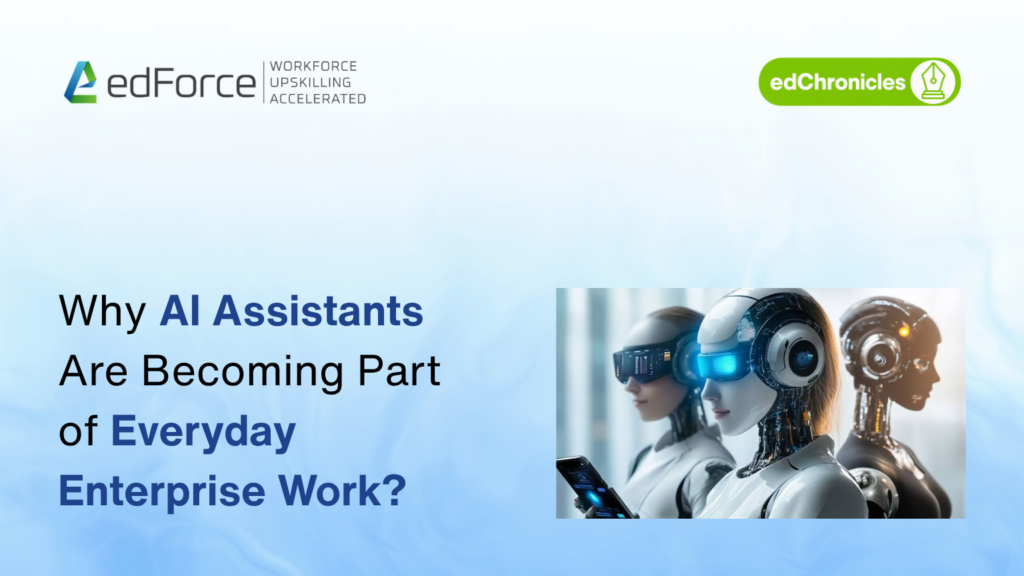
A Few Years Ago, Using an AI Assistant at Work Felt Like an Experiment Someone might ask it to rewrite an email, summarise a long document, or suggest ideas for a presentation. The result was interesting, but the actual work still happened somewhere else. That relationship is changing. In 2026, AI assistants are increasingly becoming part of the normal working day. They’re showing up inside development environments, productivity platforms, customer service systems, business applications, and internal knowledge tools. Employees aren’t always opening a separate AI website anymore – in many cases, AI is simply becoming part of the software they already use. That shift matters because it changes the question enterprises need to ask. It’s no longer just “Should our employees use AI?“ It’s becoming “How should AI assist our employees while they work?“ AI Is Moving Closer to the Work The most useful AI assistant may not be the one with the most impressive demo. It may be the one that shows up at exactly the right moment. A developer gets help while writing code. A sales employee gets a summary before a customer meeting. An analyst can ask questions about a business document instead of reading every page manually. A support employee receives suggested responses while handling a customer issue. The common thread is context. AI becomes genuinely useful when it understands enough about the task to offer relevant assistance – without forcing the employee to constantly switch between applications. This is one reason enterprise AI adoption is moving from experimentation toward integration. Employees Don’t Want Another Tool to Manage There’s a practical reason AI assistants are gaining traction. Employees already juggle dozens of applications. Adding another standalone platform means another login, another interface, another process, and another place where information needs to be copied over. An assistant built into an existing workflow feels different. If a developer gets coding assistance inside their development environment, there’s far less disruption. If a sales professional can summarise customer information within the system they already use, the benefit is immediately clear. The future of workplace AI may be less about telling employees to “go use AI” and more about bringing AI into the places where work already happens. The First Productivity Gains Are Often Small Not every AI use case needs to transform an entire department. Some of the most useful improvements are refreshingly ordinary. An employee might spend 20 minutes turning meeting notes into action items – AI can cut that down to a few minutes. A manager might spend an hour summarising several reports before a meeting – an assistant can produce a first draft the manager simply reviews. A developer might spend time searching documentation or explaining repetitive code – AI can handle the first pass. Individually, these savings can look small. Across hundreds or thousands of employees, they add up to something significant. This is exactly why enterprises need to be careful about how they measure AI productivity. The value often doesn’t show up as one dramatic cost reduction — it emerges through hundreds of small improvements repeated daily. AI Assistants Are Not Replacing Human Judgement The word “assistant” is useful because it describes the role fairly accurately. An assistant can prepare, organise, suggest, summarise, and accelerate. The employee still decides. For important business decisions, AI output still needs to be checked against reliable information, and employees need to recognise when a response might be incomplete or unsuitable. This matters even more when AI is handling sensitive information. A solid enterprise AI strategy needs both capability and clear boundaries. Employees should know what they’re allowed to ask an assistant to do, what information they can share with it, and when human approval is required. The Nature of Work Is Changing Too There’s another effect that gets less attention. When AI takes on some of the smaller tasks surrounding a job, employees often end up spending more time on the parts of their role that genuinely require judgement. Take a software engineer: if AI handles repetitive code, documentation, debugging suggestions, and test generation, the engineer can spend more time thinking about architecture and system behaviour. A sales professional may spend less time preparing information and more time actually speaking with customers. An analyst may spend less time formatting data and more time interpreting what it actually means. This isn’t just about doing the same work faster. It can genuinely change where employees direct their attention. AI Assistants Are Becoming More Context-Aware Early AI assistants relied almost entirely on what the user typed into a prompt. Enterprise systems are moving toward something different. An assistant can now potentially draw on information already available within the user’s authorised environment — documents, project details, customer records, code, internal knowledge, or business processes. That opens up far more useful interactions. Instead of asking: “Summarise this document.” an employee might ask: “What changed from the previous version, and what do I need to act on?” That second question requires real context. As enterprise AI becomes more connected to business systems, context is likely to become one of the biggest differentiators between basic AI usage and genuinely useful AI assistance. This Is Where AI Skills Become Important Giving an employee an AI assistant doesn’t automatically teach them how to work with it. Employees need to understand how to provide useful context, evaluate responses, protect sensitive information, and recognise when the system needs human direction. They also need to understand where the technology’s limits lie. A professional who knows how to question an AI response can extract far more value from the same tool than someone who accepts every answer at face value. This is why AI literacy is increasingly a workplace capability, not just a technical skill. Enterprises Will Need Different AI Skills for Different Roles A common mistake is treating AI training as a single subject for everyone. It isn’t. A developer may need AI-assisted coding and application-development skills. A cloud engineer may need to understand AI infrastructure and deployment. A business
How Much Do IT Certifications Actually Cost, and How to Save on Them
Exam fees are rarely the entire cost of a certification. The price of a certification may seem affordable, but it can be much higher once you factor in the cost of training, labs for practice, study time, retakes and other costs. The difference between paying retail or using a voucher or learning program can be significant for professionals who plan to obtain multiple certifications. The better question to ask is: “What will it cost me to be certified?” The price of certifications is more variable than most people think IT certifications are not priced in a standard way. Professional and specialist certifications may cost hundreds of dollars per attempt, but entry-level exams are relatively cheap. Microsoft’s certification tests also vary based on location and level. Microsoft states that Associate and Expert exams cost an average of US$165. Regional pricing and taxes may also affect the final price. There are also specialized certifications. NVIDIA currently offers a portfolio of certifications that ranges in price from $125 for Associate exams up to $500 for Professional AI Operations. The certification name alone is not enough to tell you about the investment. The Exam is Only One Part Of the Bill Imagine that an exam costs Rs 12,000. This does not mean that your certification journey will cost Rs 12,000. Additional learning time, structured training, practice tests, cloud resources, books or hands-on labs may be required. There is a second exam fee if the first attempt fails. The hidden cost for someone who prepares independently can be time. Even if you spend 10 hours searching for tutorials that are not connected, it is still a worthwhile investment. It is also possible to spend time on topics that do not relate to the exam, or learn for weeks without knowing if the required skills have been acquired. Structured learning can reduce costs, even if the training is expensive. The cheapest certification course may not be the best option. Vouchers can change the economics Exam vouchers are a great way to save money on certification. A voucher is basically a pre-paid value that, depending on the program, can cover part or all of an exam fee. AWS, for example, supports vouchers to cover certification exams, both at full price and at a discount. In its policies, it also states that a voucher of 50% is applied to the price of the exam at the time of purchase. Check the terms and conditions before you buy. Examine the certification level, the expiration date, the percentage discount, the eligible exams and whether taxes or any other charges are included. Not all vouchers are valid for every certification. Check for Discounts before Paying Retail Certification providers often run specials, such as learning programmes, events or other promotions that reduce the cost of exams. NVIDIA offers a discount code for 50% off exams in conjunction with its webinar on 2026 certification. NVIDIA offers vouchers and credits for training and certification exams. It creates an important habit for candidates. Before purchasing an exam, check for official discounts. Five minutes of checking can save you a lot, especially if you plan to take multiple exams. Be careful when buying vouchers from unofficial sellers. It is useless to pay less if a voucher is restricted, expired or obtained from an unauthorised source. The biggest savings can be made by sponsoring employers Working professionals may not look first at discount websites. The employer may be responsible. Many organisations allocate budgets to learning and development for certifications. This is because they know that certified employees are better able to support cloud migrations and AI initiatives, as well as security initiatives, infrastructure programmes and customer requirements. Ask your company if they cover the cost of: Certification exam fees Training programs Practice labs Exam vouchers Retake fees Learning subscriptions When the request is linked to business value, it will be more persuasive. One type of conversation is, “I’m interested in getting certified.” This statement is much stronger: “This certification supports our cloud platform that we are deploying.” Don’t buy training before checking the certification It’s easy to lose money this way. Some people purchase large training packages only to discover later that they are being prepared for an outdated syllabus or a wider technology area than what they need. Begin with your certification provider. Check the latest exam guide for objectives, recommended experience or prerequisites, pricing and validity. Also, check the available preparation resources. AWS notes explicitly that its exam guide defines the relevant domains, objectives and training resources. NVIDIA offers recommended learning and training resources for each certification exam. Select preparation based on these requirements. The certification should dictate the learning path and not the reverse. The cost of a failed attempt can be more than better preparation Budgeting for certification often overlooks the cost of retakes. The cost of an exam can be increased by Rs 40,000 if you fail two times. If you add preparation time, the opportunity costs can be even higher. It does not mean that candidates should spend excessive amounts of money on training. The preparation for the exam should be matched to the level of difficulty. Hands-on experience can be as important as reading for advanced certifications. NVIDIA recommends that hands-on practice is required for certain professional certifications. AWS, on the other hand, states that relevant experience cannot be substituted for. Savings can be made by planning your first effort well. Create a budget for certification, not a shopping list Calculate the total journey if you plan to take multiple certifications. Simple budgets can include: Exam fee + preparation + labs and practice tests + possible retakes + time investment Compare that to employer assistance, vouchers, official discounts or learning credits. The decision is no longer “Which test is the cheapest?” but rather, “Which certification gives me the strongest value for my skills?” This is a better way of thinking about professional development. The cheapest certification is not always the best investment Certifications should be able to solve problems