

Why Every Enterprise Will Need an “AI Skills Audit” by 2027
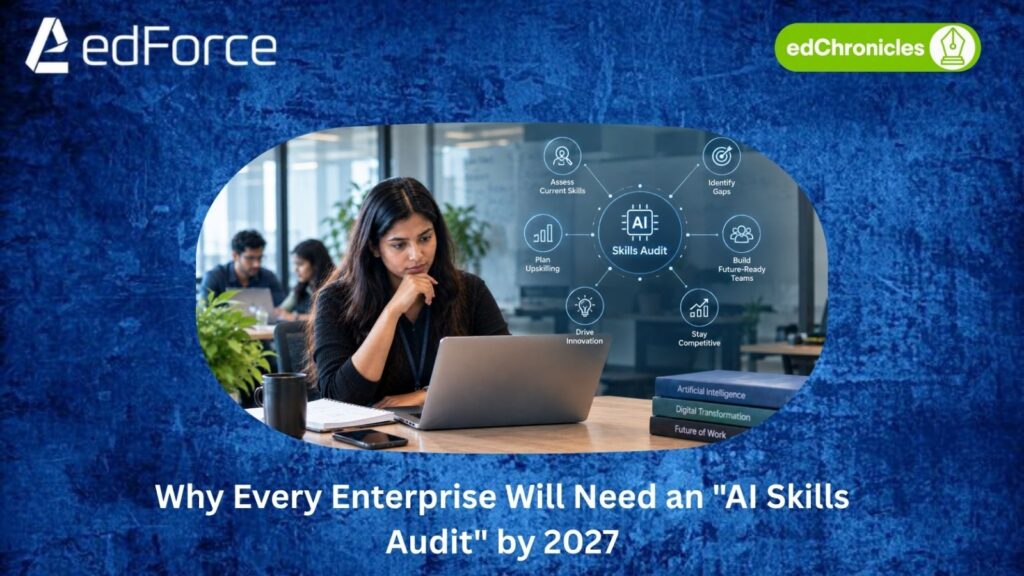
Most companies already have an idea of where they want to use in AI. Much less know whether their workers have the abilities to use it safely, efficiently, and at scale. By 2027, that will matter more. The use of AI is moving beyond experiments with chatbots and productivity aids. Employees are adopting AI for research, coding, analysis, content, customer service, decision support, and, increasingly, agent based processes. Meanwhile the abilities required to use these systems effectively are developing rapidly. The World Economic Forum says that 63% of companies now list skills deficiencies as a major impediment to transforming their businesses, and 77% anticipate to upskill or reskill their staff in response to AI by 2030. That’s why an AI skills audit is expected to become a regular part of company labor planning. What is a Skills Audit for AI? An AI skills audit is a formal evaluation of the AI skills an organization currently possesses, against the skills they will need or to check the Skill Gap report of their company. This is not just a test of how good employees are at using ChatGPT or Copilot. A good audit considers numerous layers: Skills area What the organization should check AI literacy Understanding of AI capabilities, limitations and responsible use Use of AI tools Ability to employ sanctioned AI tools well Prompting Ability to provide clear instructions and enhance outputs Critical evaluation Ability to evaluate correctness, bias, reliability Data skills Ability to understand data dangers and to work with data AI Technical Skills Development, Integration, Deployment and Supervision Privacy, security, compliance and responsible AI AI management Human talents Critical thinking, Judgment, Communication, Decision making The thing is that not all employees require the same amount of AI capacity. A financial analyst, a software engineer, an HR manager and a cloud architect might all be using AI but the skills they will require will be very different. Why Same-Training-for-Everyone Won’t Work One of the simplest mistakes an organization can make is to develop a one-size-fits-all AI training program for the whole workforce. Sounds efficient. Usually it isn’t. A developer might need abilities like APIs, integrating models, evaluating them and developing applications for AI. Sometimes a sales professional is good at research and content creation and customer analysis. An manager might need to comprehend AI dangers, workflow reform and how to evaluate AI helped judgments. Some Companies report on AI capabilities in India also depicts a similar development from AI informed employees and AI users to AI integrators, AI builders and AI experts. An audit gives you a sense of where each individual or function falls on that competency range. The AI Skills Gap Is Turning Into an Enterprise Problem The question is not any more if organizations can hire AI expertise. Enterprises require thousands of workers who can work effectively with AI. So leadership is faced with a tricky question: Are employees genuinely gaining the skills to turn access to AI into commercial value? One method to answer this is with an AI skills audit. What should an enterprise audit really measure? A useful audit shouldn’t just question if staff have received AI training. Activity metric Training completion Capability is measured as an outcome. For example, an enterprise could evaluate if employees can: Choosing the proper AI technology for a commercial task Effective directions to write and improve Identify incorrect or falsified outputs Safeguard private corporate data Verify AI-generated analysis Explain when human review is needed Automate suitable aspects of a workflow Know the limits of standard artificial intelligence systems Work responsibly with AI agents Apply particular AI talents for real business tasks in roles This gives a far better image than a certificate or attendance slip. Audit Must Connect Skills to Actual Work The best way to go is to begin by establishing roles and workflows, not technology. Think of an organisation’s finance team. It is not the question: “Is the finance group aware of generative AI?” A better question to ask is: “Which finance workflows could be enhanced with AI, and what skills would employees need to use it securely? This could encompass financial research, report writing, document analysis, forecasting support and retrieval of internal knowledge. The same approach can be implemented in IT, HR, legal, marketing, customer support, operations and engineering. This shifts the conversation from AI training to labor capacity. AI Skills Are Going To Keep Evolving The other reason why audits will be significant is that the life span of AI skills is short. According to the World Economic Forum, roughly 40% of skills needed on the job are likely to change by 2030. The technology itself is likewise advancing rapidly. Employees who have so far been taught in basic prompting may soon have to interact with AI agents, automated workflows, multimodal systems and organization specific AI platforms. Microsoft’s 2026 Work Trend Index characterizes this change as AI and agents doing more of the execution, and people increasingly leading work, making decisions and owning outcomes. That implies an AI skills assessment shouldn’t be considered as a once a year HR task. It should be part of ongoing workforce planning. From Skills Audit to Skills Roadmap – The audit is only as good as what follows thereafter. A useful enterprise roadmap might classify three groups: Prepared: Employees already possess the capabilities required for their present AI enabled role. Developing: Employees have a rudimentary knowledge of AI, but they require systematic training and experience. Priority gap: Employees don’t have skills that are growing vital to their role or business function. The organization can then link each group with a learning route. That may be AI literacy for one person, prompt and process training for another, cloud and AI infrastructure training for an IT team, or advanced AI engineering certification for specialist technical jobs. Structured enterprise programs or trainings by well known corporate training provider such as edForce.co can aid this kind of role focused workforce upskilling strategy. The Real Reason for an AI Skills Audit An
How to Run a Skills Gap Assessment Before Choosing a Training Program
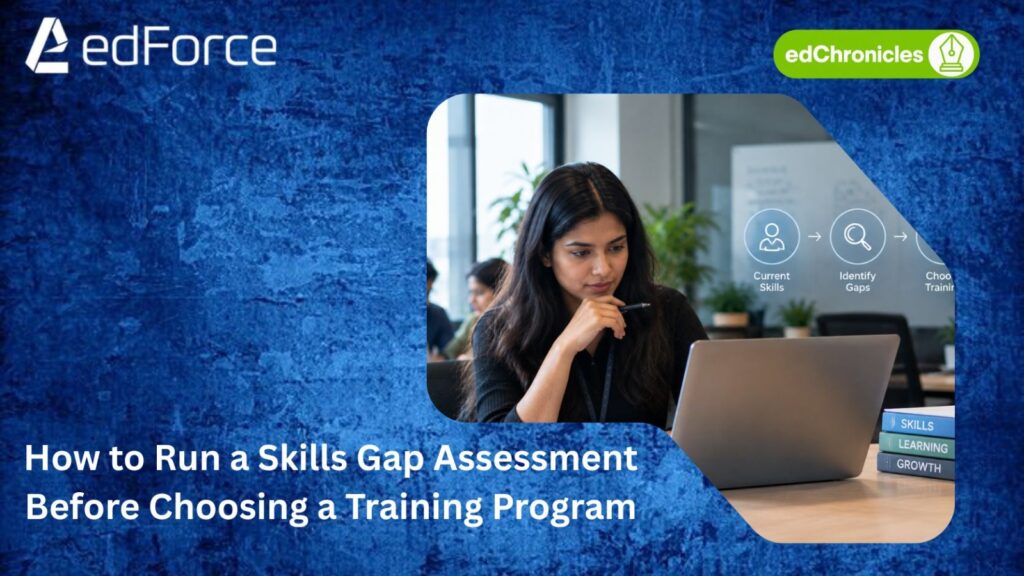
Choosing a training program before understanding the skills gap is like buying software before knowing what problem the business needs to solve. The course may be excellent. The trainer may be experienced. The technology may be current. Yet employees can finish the program without gaining the capability the business actually needs. This is becoming a bigger problem as technology skills change faster. Gartner reported in July 2026 that approx 50%+ of CHROs felt skill needs were changing faster than their organisations could develop support plans. The World Economic Forum also found that 63% of employers see skills gaps as a major barrier to business transformation. A skill gap report helps answer a more useful question: What should our employees be able to do, what can they do today, and what needs to change? Only after answering that question should you choose the training. Start With Business Goals, Not Course Catalogues The first step is to identify what the business is trying to achieve. Perhaps the company is moving workloads to the cloud. Maybe it is introducing generative AI, strengthening cybersecurity, modernising software development, or expanding its data capabilities. Each objective creates different skill requirements. For example, an organisation adopting AI may need prompt and tool literacy for some employees, AI engineering skills for developers, data skills for analysts, governance knowledge for risk teams, and stronger AI judgment for managers. Starting with the business goal prevents a common mistake: choosing popular courses and then trying to find a reason for employees to take them. Gartner’s current skills research recommends focusing development resources on the skills that matter most to core business workflows rather than attempting to create an exhaustive list of every possible skill. Map the Roles That Matter Most You do not need to assess every employee at the same depth on day one. Start with roles that have the greatest connection to the business objective. For a cloud migration, that could mean: Cloud engineers → DevOps → Security → Architects → IT operations For an AI initiative: Developers → Data teams → Product teams → Business users → Managers This creates a practical boundary for the assessment. Then define what each role needs to do differently. That last part matters. Do not simply write “needs AI skills” or “needs cloud skills.” Write the actual capability. For example: “Can build, test and deploy an AI enabled application using the organisation’s approved architecture.” That is measurable. Measure Current Capability, Not Just Employee Confidence A self assessment is useful, but it should not be the only source of information. Employees may rate themselves highly because they have used a tool for several months. Another employee may rate themselves conservatively despite having strong practical skills. Use several signals where possible: Self assessment Manager assessment Practical assessment Project performance Certifications Work samples Technical interviews Assessment or lab results The World Economic Forum found that 48% of employers expect to use skills assessments as an assessment mechanism during 2025 to 2030, while work experience remains the most common mechanism. The lesson is simple: what employees know and what employees can actually do are not always the same thing. Build a Simple Current vs Required Skills Matrix Once the information is collected, put it into a matrix. Skill Required Level Current Level Gap Priority Cloud architecture Advanced Intermediate High High Cloud security Advanced Basic High High Infrastructure automation Intermediate Intermediate Low Medium AI literacy Intermediate Basic Medium High Data analysis Intermediate Basic Medium Medium You do not need a complicated enterprise platform to begin. The purpose is to make the gap visible. More importantly, the matrix helps separate real capability gaps from assumptions. If a team already has strong Python skills, sending everyone through a beginner programming course is unlikely to solve the business problem. Prioritise the Gaps That Affect Real Work Not every gap deserves immediate training. Imagine an IT team has ten areas where proficiency is below the desired level. If only two of those skills affect a critical transformation project, those two should probably receive attention first. A useful prioritisation model looks at: Business impact + urgency + number of affected employees + difficulty of closing the gap You can also ask: Will this gap delay an important project? Does it create security or compliance risk? Is the skill difficult to hire externally? Does the skill affect several teams? Will improving it create measurable productivity gains? This prevents the training budget from being spread thinly across dozens of low-impact skills. Decide Whether Training Is Actually the Answer This is one of the most important parts of the assessment. A performance problem is not always a training problem. If employees know how to perform a task but lack access to the right software, training will not fix the issue. If a proccess is badly designed, another course may simply teach employees to work around it. If managers do not give employees time to practise a new skill, even good training may have little effect. Before selecting a programme, ask: Is the gap caused by knowledge, skill, tools, process, experience or management support? Training is most useful when the underlying problem is genuinely a capability gap. Match the Training Format to the Gap Once the gap is clear, choose the learning format. A short workshop may be enough when employees only need awareness or a specific new capability. A deeper technical programme may be appropriate when employees need hands-on expertise. Certification preparation can make sense when a role requires validated technical knowledge. Labs and project-based learning are useful when employees need to demonstrate that they can apply concepts rather than simply remember them. For enterprise technology teams, a blended approach can often work better than one large course. Employees may need instructor-led learning, practical labs, assessments, projects and reinforcement over time. The format should follow the gap. Not the other way around. Define What Success Looks Like Before Training Begins This step is frequently skipped. Before employees start the programme, define the outcome. For