


How Can You Determine the ROI of IT Training for Corporate Employees? (With an Easy Formula
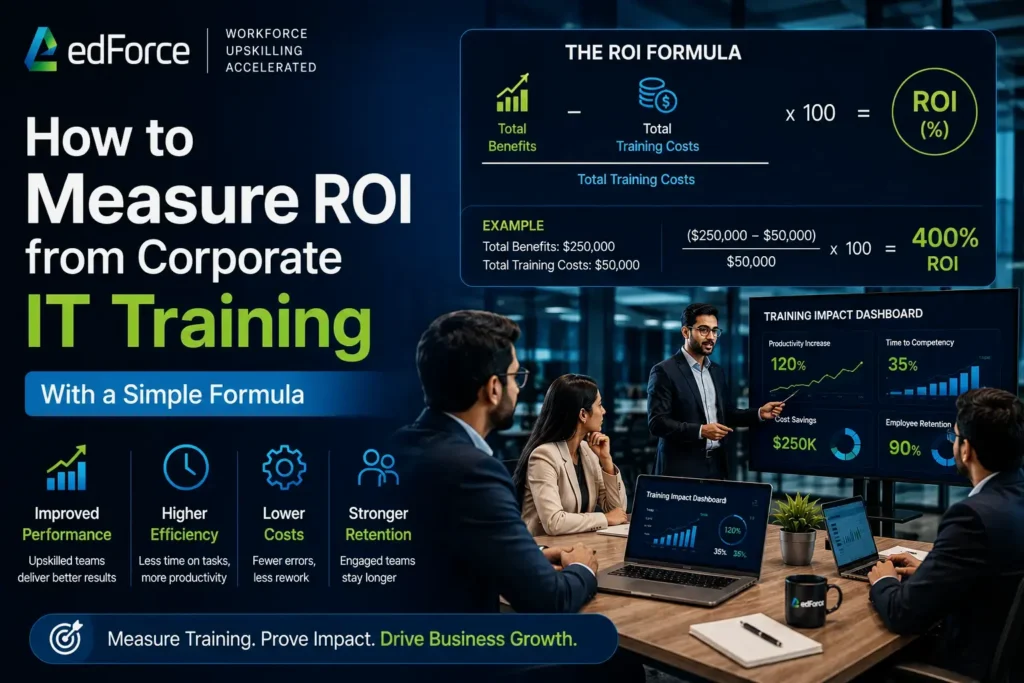
One of the biggest mistakes companies make when it comes to corporate training is treating it as a cost rather than an investment. When a business invests in new software, management expects measurable results. If a company spends on marketing, sales, or infrastructure, performance is carefully tracked. Training often gets different treatment. Many organizations spend thousands or even millions of rupees on employee development programs, yet very few can answer one simple question: “What business value are we actually getting from this training?” This is becoming an even bigger issue in 2026 as training budgets continue to grow. Technology is evolving rapidly, new skills are constantly emerging, and companies are investing heavily in areas such as AI, cloud computing, cybersecurity, Red Hat, NVIDIA, and data technologies. Leadership teams increasingly need to justify these investments. The good news is that training ROI is not as difficult to measure as many organizations think. The real challenge is that most companies track learning activities rather than business outcomes. The Wrong Way to Measure Training Success Many organizations focus on numbers that look impressive in reports but reveal very little about actual business impact. For example: Number of employees trained Course completion rates Certification counts Training hours completed Workshop attendance These metrics can be useful, but they do not answer the question executives care about most: Did the training improve business performance? An employee may complete a certification but never apply the knowledge. Another employee may attend fewer sessions but use new skills to improve project quality, reduce costs, or solve operational challenges. Only one of those examples creates measurable business value. That is why organizations need to move beyond learning metrics and focus on performance metrics. Why Measuring ROI Has Become More Important A few years ago, many organizations viewed training as a long-term investment that was difficult to measure. Today’s leadership teams expect greater visibility. The reason is simple. Technology skills directly affect business outcomes. A well-trained cloud team can reduce infrastructure costs. An AI-enabled workforce can improve productivity. Cybersecurity training can reduce business risk. DevOps training can speed up deployment cycles. These improvements directly influence revenue, efficiency, customer satisfaction, and operational performance. Training is no longer separate from business strategy. It has become a critical part of it. A Simple Formula for Training ROI Many companies overcomplicate ROI calculations. The basic formula is straightforward: Training ROI (%) = [(Business Benefit – Training Cost) / Training Cost] × 100 Let’s look at a simple example. Suppose a company spends ₹10,00,000 on cloud training for its infrastructure team. After the training: Cloud costs decrease by ₹8,00,000 per year Productivity improvements save another ₹7,00,000 per year Total Benefit = ₹15,00,000 Applying the formula: ROI = [(15,00,000 – 10,00,000) / 10,00,000] × 100 ROI = 50% In this example, the company achieved a 50% return on its training investment. The formula is simple. The challenge is identifying the right benefits to measure. What Business Benefits Should You Track? This is where many organizations struggle. Training rarely creates value in just one area. Instead of focusing on a single metric, companies should track multiple business outcomes. Depending on the training program, improvements may include: Faster project delivery Lower operational costs Higher productivity Improved employee retention Reduced support tickets Better compliance performance Faster deployment cycles Fewer security incidents Improved customer satisfaction Not every benefit will apply to every training program. The goal is to identify outcomes that are directly connected to the skills being developed. The Hidden ROI Many Companies Ignore An important area often overlooked is internal capability building. When organizations lack critical skills, they usually solve the problem in one of three ways: Hiring external talent Bringing in consultants Delaying projects All three options can be expensive. A skilled internal workforce reduces dependence on external resources. This benefit often does not appear in training reports, but it can create significant long-term value. For example, a company with strong internal AI expertise may avoid hiring expensive consultants for every new AI initiative. Over time, those savings can become substantial. Why Certifications Alone Are Not Enough Many organizations still measure training success through certification counts. While certifications have value, they should not be the ultimate goal. The real goal is application. A cloud certification matters because it helps improve cloud operations. A cybersecurity certification matters because it strengthens security practices. An AI certification matters because it supports innovation and business outcomes. When organizations focus only on certifications, they risk missing the bigger picture. The best training programs create measurable performance improvements, not just certificates. The Best Time to Measure ROI Another common mistake is measuring ROI too early. Learning takes time to translate into business results. An employee may complete training today but not apply those skills until the next project begins. That is why many organizations measure training impact in phases. 30 Days Knowledge acquisition Course completion Certification progress 90 Days Skill application Workflow improvements Productivity gains 6–12 Months Business outcomes Cost savings Operational improvements Long-term impact This approach provides a more realistic view of training effectiveness. A Prediction for the Future of Corporate Training Over the next few years, training budgets will likely face greater scrutiny. Organizations will continue investing in AI, cloud computing, cybersecurity, automation, and other emerging technologies. At the same time, leadership teams will increasingly demand proof that training investments generate business value. As a result, companies may begin evaluating learning programs the same way they evaluate technology investments. The question will no longer be: “How many employees completed the training?” Instead, it will be: “What business outcomes improved because of the training?” That shift is already happening. How Leading Organizations Measure Training Success The most successful companies do not treat training as an HR initiative alone. They connect learning directly to business goals. Before launching a program, they identify: The skills being developed The business problem being solved The performance metrics that matter The expected outcomes This creates a clear link between workforce development and business performance. When learning aligns
Why Trainer Quality Directly Impacts Learning ROI
Enterprise learning programs often appear well-designed–robust platforms, structured curricula, and clear learning paths. But, many organizations are struggling to observe measurable improvements in terms of performance or knowledge. The cause is usually not the technology that is used for learning itself. It’s more often the lack of instant feedback. In the fast-paced corporate environment Learning without immediate guidance can be disengaged from actual work and actual outcomes. Learning Without Feedback Lacks Direction If learners aren’t given timely feedback, they’re not sure of: Learning becomes something that’s passive. Employees might complete their training yet without feedback it is impossible to find a way to improve. The real-time feedback system is clear, it helps learners understand what they can improve as they learn, while it is fresh and useful. Delayed Feedback Weakens Skill Application In many businesses Feedback is given months or even weeks later via the form of reports or reviews. In the end, The best way to develop skills is when feedback is In the absence of this, learning is only a theoretical concept and does not transform into real-world skills. Engagement Declines Without Feedback Loops Corporate learners are pragmatic and focused on outcomes. If feedback is not provided: Employees don’t stop learning because it is difficult, but rather because they feel disconnected from their progress. Continuous feedback helps keep learners interested by making their progress evident and relevant. Managers and L&D Lose Visibility Without continuous feedback, leaders are unable to grasp: Reports on completion provide hindsight, not real-time insight. In real-time, feedback allows managers and L&D team members to make adjustments earlier and direct performance in the moments that matter most. Learning Becomes a Compliance Exercise One of the greatest risk in enterprise-level learning is when it transforms into a checklist activity: This occurs when the success of learning is measured solely by percentages of completion. Real-time feedback shifts attention away towards the completion of training to making it more effective. Feedback Connects Learning to Business Impact Enterprise learning is only successful when it can drive: Real-time feedback is the link between performance and learning. Companies who invest in learning that is based on feedback, and supported by strategic learning partners such as edforce.co are better positioned to transform training programs into real-world workforce capabilities. What Effective Real-Time Feedback Looks Like Enterprise learning environments that are high-impact utilize feedback that: This method transforms learning into a continuous performance method instead of a single event. Final Thoughts Corporate training does not fail because of a lack of tools or content. It is a failure when learners don’t receive prompt signals to help them improve. With no real-time feedback Learning becomes adaptable, meaningful and quantifiable. This is exactly what modern businesses require to be successful.
How to Measure ROI of Employee Training Without Guesswork

Every forward-thinking company has realized that employee training is a vital investment. One question is always asked by HR, L&D, and business leaders. Is training working? You may have already faced this problem if you are an active professional or business decision maker. When training programs appear good on paper, but do not have a measurable impact on the business, then you are in real trouble. How can you determine the ROI for employee training, without relying solely on gut feelings or assumptions? Here’s a look. Why Measuring ROI on Training is Important Many organizations have training programs because it is deemed necessary. Training becomes a cost if you don’t measure the results. Measuring ROI can help you: ROI measures ensure that every dollar and hour spent on resources is justified. What is the ROI of training? The Training ROI shows you the return on investment that your organization receives from its training investments. It compares training costs to the benefits they produce. Many companies use the following formula: Aspect The word “meaning” is used to describe the meaning of the phrase Benefits Reduced errors, increased productivity, improved performance, and better customer satisfaction Costs Trainer fees, employee time, and resources ROI = (Training Cost – Training Benefits) / 100 Are you going to launch a new initiative in training? You will make better decisions if you know how to calculate ROI. How to measure ROI of training without guesswork 1. Set clear training goals Define success. As an example, you might define success as faster task completion, higher sales, reduced compliance errors or increased retention. 2. Measure pre-training performance First, you need to understand the situation. Start by collecting baseline data, such as employee output or time spent per task. 3. Track skill gains during and after training Assesses, real-project evaluations and manager observations can be used to determine if the employees have improved. 4. Connect Business Metrics with Outcomes Many companies have difficulty in this area. Converting improvements into measurable values is a challenge for many companies. As an example: 5. Calculate your Final ROI Your ROI will become clearer once you compare the benefits with the costs. There are many tools and platforms that can help Modern learning platforms enable businesses to track employee performance, growth and alignment of cost-benefit. Solutions like edforce.co, for example, offer structured training frameworks and skill gap analytics that allow organizations to make data-driven decision rather than relying solely on assumptions. Common mistakes to avoid Simple Example Training Focus Cost Measurement of Impact ROI (Return on Investment) Customer handling training 1,00,000 Approx Retention of clients worth 250,000 Positive ROI of 150% Cybersecurity Awareness 75,000 Approx Averted a possible security incident of 5,00,000 Strong ROI Case The following simple comparison shows the transformation of training into real business value. Do You Want a Smarter Learning Strategy? It’s time to move from guesswork and learning measurements to evidence-based measurement if your training investment is not showing results. How to show you care about growth When approached systematically, calculating ROI isn’t difficult. Training can be a powerful tool for business growth when it is done with clarity, tracking and the correct tools.