


How NVIDIA GPUs Are Used in AI Training and Inference
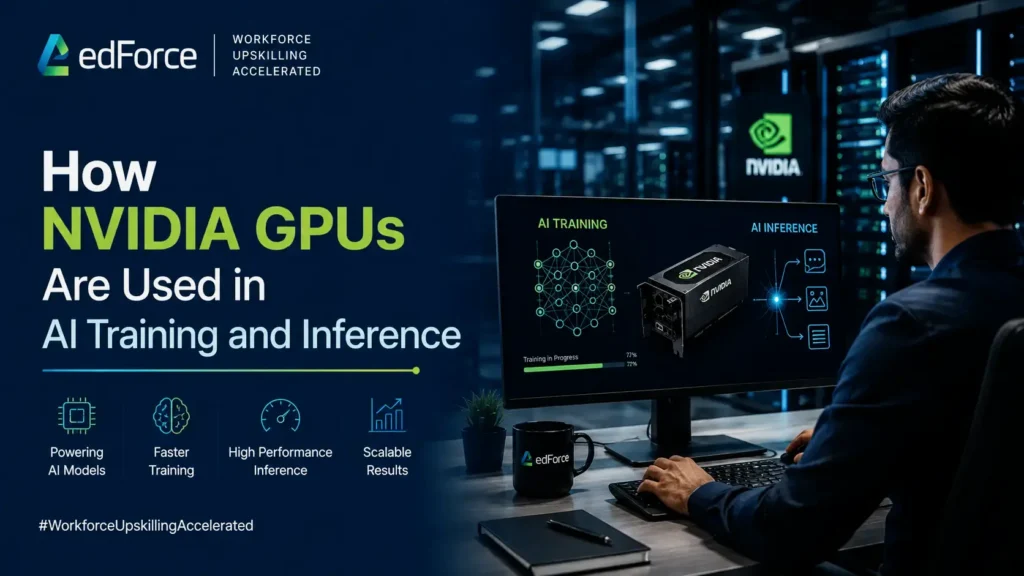
Several years ago, the main reason for buying faster hardware was to improve performance. Today’s topic is making AI practical. Each enterprise is looking for AI that can respond quickly, scale smoothly, and deliver reliable results. Behind the scenes, whether it’s an internal chatbot or AI assistant for employees, recommendation engines, or Agentic AI applications, there is one thing that makes it all possible. The GPU is a graphics processing unit. NVIDIA is known for its powerful graphics cards. But in the AI industry NVIDIA GPUs play a larger role. They are used to power some of the largest AI models in the world, as well as supporting enterprise AI infrastructure and helping organizations create applications that millions of users use every day. Many professionals are still unsure of what GPUs do. Why are they important? Why do companies invest in NVIDIA? Understanding the answers will help you understand why GPU-accelerated computing is one of the fastest growing skill areas in AI. AI Needs more than powerful software Most AI conversations begin with models when businesses embark on their AI journey. Should we use the Large Language Model for our linguistics? What AI platform should be chosen? How accurate is this model? They are good questions, but overlook an important part of the equation. Even the most intelligent AI models need computing power to process information, learn and generate responses. Imagine this: A model of AI is like an experienced employee. The GPU is the workspace which allows an employee to work efficiently. Even excellent AI models can become slower, more costly to operate and harder to scale if they lack enough computing power. The fact that AI and infrastructure are increasingly seen as being two sides of a single strategy is why many enterprises view them this way. What does AI training actually mean? It is important to know what AI training is before comparing it with inference. The AI model is trained by analyzing huge amounts of data. The model analyses millions of examples or even billions, identifies patterns and improves its prediction. It gradually becomes more accurate. This process is extremely computationally intensive. Imagine having one employee read all the books in a large collection. It would take many years. Imagine thousands of employees sharing their knowledge and experiences from reading books. This is similar to the way GPUs can accelerate AI training. They perform thousands of simultaneous calculations instead of one after the other. Modern AI training is made possible by parallel processing. NVIDIA GPUs are effective for AI training The traditional processor is designed to perform a wide range of computing tasks. GPUs are built differently. They excel in performing thousands of simultaneous operations of the same type. AI training is heavily dependent on this capability. All of these applications, including computer vision systems and recommendation engines, require millions upon millions of calculations per second. NVIDIA GPUs manage this workload. It is for this reason that they are the first choice of organizations developing enterprise AI solutions. Training advanced AI models without GPU acceleration would be much slower and more expensive. What is AI Inference? After a model of AI has completed learning, it moves on to the next stage known as inference. Inference is the moment that people begin to use the model. As an example: A worker asks a question to an AI assistant. A customer uploads an analysis document. AI provides medical insights to a doctor A recommendation engine suggests products. The model no longer learns. The application of what has been learned. Although it may seem easier than training, this stage has its own challenges. Businesses expect AI systems that respond almost immediately. Customers are rarely willing to wait for several seconds between interactions. Fast inference is just as important for accurate training as it is to have a fast response. Why inference is just as important as training Some people believe that AI training is difficult and that inference happens automatically. In fact, companies often spend more effort thinking about inference. Why? Inference is a problem for business. Customer experience is negatively affected if an AI-powered system for customer support takes too long. Productivity drops if an AI assistant delays answering questions during meetings. Scaling an AI application that cannot handle thousands users at once is difficult. NVIDIA GPUs can help overcome these challenges because they provide fast and efficient inference performance, while simultaneously supporting a large number of requests. AI applications are responsive to demand even if it grows. NVIDIA GPUs in Enterprises: Where are they used today? GPU-accelerated computing is not limited to the research laboratories. NVIDIA AI Training are used in a wide range of industries to support AI. Some of the most common enterprise applications are: Generate AI assistants Retrieval-Augmented Generation systems (RAGs) Workflows for Agentic AI Computer vision solutions Fraud detection Medical Imaging Financial Analysis Manufacturing Automation Intelligent customer support All these uses cases are connected by speed. AI systems are a must for organizations that want to process information efficiently without compromising accuracy. GPU acceleration is most valuable in this area. GPU Skills are Increasingly Valuable A new trend in hiring is emerging. AI is no longer the only thing that companies are looking for. Also, they are looking for AI professionals. AI adoption is growing and businesses need to hire employees who can understand it. GPU-accelerated computing NVIDIA AI Platforms AI deployment Model optimization AI Performance Tuning Enterprise AI infrastructure It is a great opportunity for those professionals who want to develop their NVIDIA AI capabilities. A prediction is becoming more and more realistic. In the coming years, AI infrastructure may be as important as AI talent. Building Enterprise AI Teams AI is not just about technology. People do. Many organizations have already access to powerful AI platforms, cloud-based tools, and GPU infrastructure. It is often the workforce that makes the difference. Can teams use AI effectively? Is they optimize their inference performance? Can they manage enterprise AI environments Can they scale
The Growing Demand for GPU Accelerated Computing Skills
A few years ago, GPU computing was mainly connected with gaming, graphics rendering, and specialized environments. Today, it has become one of the key technologies behind modern AI, cloud computing, and data processing. The demand for GPU-accelerated computing skills is growing rapidly across industries as businesses adopt AI and large-scale computing workloads. However, many companies are now facing a new challenge. They are investing heavily in GPU infrastructure and AI systems but still struggle to find professionals who understand how to work effectively with these environments. This skill gap is becoming a major workforce challenge in 2026. Why GPU Computing Is Becoming So Important Modern businesses process far more data today than ever before. Companies now work with: Traditional CPU-based systems often struggle to handle these workloads efficiently at scale. GPU-accelerated computing allows systems to process large numbers of parallel tasks much faster. GPUs are now a major part of: GPUs are now at the center of many AI technologies businesses use today. AI Growth Is Increasing the Demand for GPU Skills One major reason GPU computing skills are becoming more valuable is the rapid growth of AI adoption. Today, businesses are building: AI projects require more than just software knowledge. Organizations also need professionals who understand: AI workloads are becoming larger and more complex. Companies investing in AI need teams that can support these systems not only conceptually, but also operationally. Companies Are Realizing Infrastructure Skills Matter Again Infrastructure capability is becoming important again in enterprise technology. Earlier, many companies focused mainly on software innovation while depending heavily on external providers for infrastructure expertise. As AI systems become more important for businesses, companies are realizing the need for stronger in-house technical capability. Businesses are starting to understand that: This is why GPU-accelerated computing skills are becoming highly valuable in enterprise environments. GPU Computing Is No Longer Limited to Research Teams Earlier, GPU computing was mostly used by research labs, universities, and highly specialized technical teams. That is changing quickly. Today, GPU workloads are used across: Businesses now need professionals who understand GPU-powered systems. The demand is growing far beyond niche technical roles. Why Practical GPU Skills Matter More Than Theory Many companies are realizing that theoretical knowledge of GPU computing alone is not enough. Real-world systems involve: Professionals need practical understanding of how accelerated computing works in operational environments. That is why hands-on GPU training is becoming more valuable than passive theory alone. When employees work with: They build skills that are much more useful in enterprise environments. The Rise of NVIDIA GPU-Centric AI Infrastructure NVIDIA technology now powers a large part of modern AI infrastructure worldwide. As organizations adopt more AI systems, demand is increasing for professionals who understand: Companies are also realizing something important. Buying advanced infrastructure is much easier than building teams that know how to use it effectively. That is why there is strong demand for training focused on GPU-accelerated computing skills by Nvidia Training. Why GPU Skills Create Long-Term Career Value One major advantage of GPU-accelerated computing skills is that they connect with many future-focused technologies. Professionals with GPU knowledge work in areas like: This creates strong long-term career flexibility. As AI adoption grows, GPU-related skills will likely remain highly relevant because accelerated computing powers many modern AI systems. Businesses Need Teams That Can Scale AI Effectively Scalability is another major reason GPU expertise matters. Many organizations launch AI projects successfully but struggle to scale them across enterprise environments. This often happens because: Professionals who know how to scale AI systems while maintaining performance and cost control are in very high demand. GPU-accelerated computing is now becoming a mainstream enterprise workforce skill. Why Continuous Learning Is Important in GPU Computing GPU technologies and AI infrastructure continue evolving very quickly. Continuous learning is important because: Businesses increasingly prefer professionals who continue building technical skills over time. In accelerated computing environments, outdated knowledge quickly loses value. Enterprise Workforce Development Around GPU Skills Many organizations are now investing in GPU-focused workforce training instead of relying only on outside specialists. At edForce, NVIDIA and GPU-accelerated training programs focus on real-world implementation, enterprise AI workflows, and hands-on learning environments so professionals can build practical computing skills for modern AI systems. This helps organizations: Final Thoughts The growing demand for GPU-accelerated computing skills reflects larger changes and CUDA training happening across the technology industry. Businesses are moving beyond simple AI experimentation and building larger, infrastructure-heavy systems that require practical technical expertise. Professionals who understand GPU-accelerated environments will become increasingly valuable as AI, cloud computing, and high-performance workloads continue expanding. By 2026, strong computing capability will no longer depend only on software knowledge. Understanding the infrastructure behind modern intelligent systems will become equally important.
NVIDIA AI Certification: Is It Worth It for Enterprises in 2026?

Artificial Intelligence is no longer an experimental initiative within enterprises. In 2026, AI is becoming an important part of daily operations across different industries. Businesses are integrating AI to support customer service, analytics, automation, security, product development, and internal operations. However, there is one challenge many organizations are facing. They are investing heavily in AI tools and systems, but their employees are not fully equipped with the skills needed to use these systems effectively. This gap between technology adoption and workforce capability is one reason why certifications and formal AI training are getting so much attention. One name that often comes up in these discussions is NVIDIA. The main question for companies is not whether NVIDIA AI certifications are popular. The real question is whether they deliver actual business value. Why Enterprises Are Taking AI Certifications More Seriously Just a few years ago, AI skills were limited to specialized technical teams. Today, the situation is very different. Companies are building AI-focused teams across: However, business leaders are under pressure to make sure AI investments deliver real results. Buying AI tools is only one part of the process. Building teams that can use AI effectively is another. This is where structured certification programs become useful. They help companies move from scattered learning to focused skill development. What Makes NVIDIA AI Certification Different One reason NVIDIA certifications are receiving strong attention is because they are closely connected to real enterprise AI environments. NVIDIA is no longer seen only as a hardware company. Its ecosystem now includes: This makes the certification more practical than programs that stay mostly theoretical. Employees are not only learning concepts. They are also learning how AI systems actually work in business environments. For businesses trying to build internal AI capabilities, this practical exposure is extremely important. The Real Value Is Not the Certificate Itself This is something many companies misunderstand. The most valuable part is not the certification badge itself.It is the skills teams develop during the learning process. Many organizations are dealing with challenges such as: Structured AI training can help reduce these problems by building stronger internal understanding. That is where the real business value comes from. Why Team-Based AI Learning Works Better One common mistake enterprises make is training only a few selected individuals while expecting company-wide AI transformation. This approach rarely works well. AI adoption affects multiple teams. Cloud engineers, developers, analysts, and operations teams often need shared understanding and alignment. If only a small group understands the systems properly, execution becomes dependent on a few people. This slows adoption and creates bottlenecks. That is why many businesses are now adopting team-based AI learning models instead of only individual certification programs. Businesses are increasingly working with corporate learning partners such as edforce.co, which also offers NVIDIA-focused AI training programs that help teams build practical AI skills aligned with real business use cases. Where NVIDIA AI Training Helps Enterprises Most From a business perspective, NVIDIA AI certification programs can be highly useful in areas such as: For technical teams working directly with AI systems, these skills are becoming more valuable. They also help businesses strengthen internal capabilities instead of depending completely on external support. The Bigger Challenge Is Still Skill Application Even the best training programs have limited value if learning is disconnected from real business work. This is where many organizations still struggle. Employees may successfully complete certification programs, but if those skills are not applied in real projects, the impact remains limited. Businesses seeing the strongest results are the ones connecting training directly with implementation. Many companies are now using structured learning ecosystems with partners like edforce.co to ensure AI learning supports real execution instead of just course completion. That shift creates a major difference. Is It Worth the Investment in 2026? For businesses seriously planning to invest in AI, NVIDIA certification can definitely be worth the investment. However, it depends on how companies approach it. If the goal is only certification, the value remains limited.If the goal is to build long term AI capability across teams, the value becomes much higher. This can lead to: This is where companies begin to see meaningful business impact. My Practical View In today’s corporate environment, the companies moving fastest with AI are not simply the ones buying the latest technology. They are the ones building teams that can confidently use the tools they already have. That is why structured AI learning is now becoming a business investment strategy rather than just a learning activity. Certifications connected to real enterprise ecosystems, such as NVIDIA’s, are becoming more important because they help bridge the gap between AI goals and real execution. Final Thoughts NVIDIA AI certification can be highly valuable for enterprises in 2026, especially for businesses building serious AI capabilities across teams. However, the real value is not in the certificate itself. It depends on how employees apply those skills in real business environments. Enterprises that treat AI learning as a long term capability strategy instead of a one time certification activity are likely to gain the greatest benefit. In the end, AI success is not only about technology.It is about whether teams are prepared to use it effectively.