


edForce Claude AI Training: Use Cases, Benefits, and Learning Paths

Many companies have already experimented with AI. Employees use AI tools to write emails, create reports, develop content, organize information, and simplify everyday tasks. On the surface, AI adoption appears successful. However, a different picture often emerges when you look more closely. Some employees use AI confidently and achieve excellent results. Others use the same tools but struggle to generate useful outcomes. Teams work differently, processes become inconsistent, and managers begin asking a familiar question: “We are using AI tools, so why aren’t we getting the results we expected?” This is becoming a common challenge across industries. The problem is usually not the AI platform itself. It is the gap between having access to AI and knowing how to use it effectively in real business situations. This is exactly why Claude AI training is becoming increasingly important for organizations in 2026. Companies are no longer looking for employees who simply know AI exists. They want teams that can use AI to improve communication, streamline workflows, manage information more effectively, and support better decision-making. Why Claude AI Is Getting Attention in Enterprises Most workplace tools generate more information. Claude AI is gaining attention because it helps employees make sense of that information. Think about how much time teams spend every week: Reading documents Preparing reports Reviewing proposals Organizing knowledge Responding to emails Creating internal communications These tasks are important, but they consume a significant portion of the workday. Claude AI helps reduce that burden. Its value goes beyond generating text. It helps employees understand, process, and organize large amounts of information more efficiently. That makes it useful across a wide range of business functions. The Real Challenge Is Not Learning the Tool One common mistake organizations make is assuming AI adoption is simply a software training issue. Employees learn which buttons to click. They attend a workshop. They receive access. The training ends. But that rarely changes behavior. The real challenge is helping employees understand how AI fits into their daily responsibilities. For example, a marketing team may use Claude AI very differently from an HR team. A project manager has different needs than a business analyst. Without role-specific guidance, employees often fall into two groups. Some use AI for everything. Others barely use it at all. Neither approach delivers consistent business value. This is why workforce training is becoming just as important as AI access itself. Where Businesses Are Using Claude AI Today Another reason Claude AI is becoming popular is its ability to support work across multiple departments. In many organizations, teams use it for communication, research, documentation, and information-heavy tasks. Common enterprise use cases include: Summarizing long documents and reports Writing business communications Creating meeting notes and action items Research and analysis support Building internal knowledge resources Improving documentation workflows Assisting with training content development What makes these use cases valuable is that they improve work employees are already doing every day. Claude AI does not always create entirely new ways of working. It often improves existing processes. That makes adoption easier for many teams. The Biggest Benefit Is Better Decision-Making Most AI discussions focus on productivity. Productivity is important, but many organizations are discovering another benefit that receives less attention. Better information often leads to better decisions. Employees frequently spend hours searching for information, reviewing documents, and trying to understand complex situations before taking action. Claude AI helps shorten that process. When employees can access information faster, understand it more clearly, and organize it more effectively, decision-making often improves as well. This is particularly valuable for managers, team leaders, and professionals working in information-intensive environments. Why AI Skills Are Becoming Career Skills A few years ago, AI knowledge was viewed as a specialist skill. That is changing rapidly. Today, employers increasingly expect professionals across different roles to understand how AI can support their work. The expectation is not that everyone becomes an AI expert. The goal is to make employees comfortable working alongside AI systems. This shift resembles what happened when cloud technology became mainstream. Cloud skills were once limited to technical teams. Today, cloud awareness exists across many business functions. AI appears to be following the same path. Professionals who develop practical AI skills now may be better positioned as workplace expectations continue to evolve. What an Effective Learning Path Looks Like One reason some AI training programs fail is that they try to teach everything at once. Employees leave with a lot of information but very little confidence. The most effective learning paths are usually progressive. Stage 1: Understanding the Technology The first stage focuses on understanding how Claude AI works and where it fits within business workflows. Stage 2: Practical Application The second stage focuses on real-world use. Employees learn how to apply AI to role-specific tasks and daily responsibilities. Stage 3: Optimization and Consistency The final stage focuses on improving quality, maintaining consistency, and integrating AI into larger workflows. This approach often delivers stronger long-term results because employees can apply new knowledge immediately instead of trying to remember everything at once. A Trend Many Organizations Are Beginning to Notice An interesting trend is emerging in enterprise environments. The gap between high-performing employees and average performers is no longer based solely on technical skills. Increasingly, it comes down to how quickly people can adapt to new technologies. AI tools continue to evolve. New platforms will emerge. Workflows will change. The people who adapt the fastest may become some of the most valuable employees within an organization. That is why AI training should not be viewed only as a technology initiative. It is also a workforce development initiative. Organizations that build strong learning cultures often adapt to technological change faster than those that focus only on technology. Why Enterprises Are Investing in Structured AI Training Many organizations began with informal AI adoption. Employees experimented independently and learned through trial and error. That approach worked in the early stages. As AI becomes more deeply integrated into business operations, organizations need greater consistency. Leadership teams are
Top Claude AI Skills Employees Need in 2026
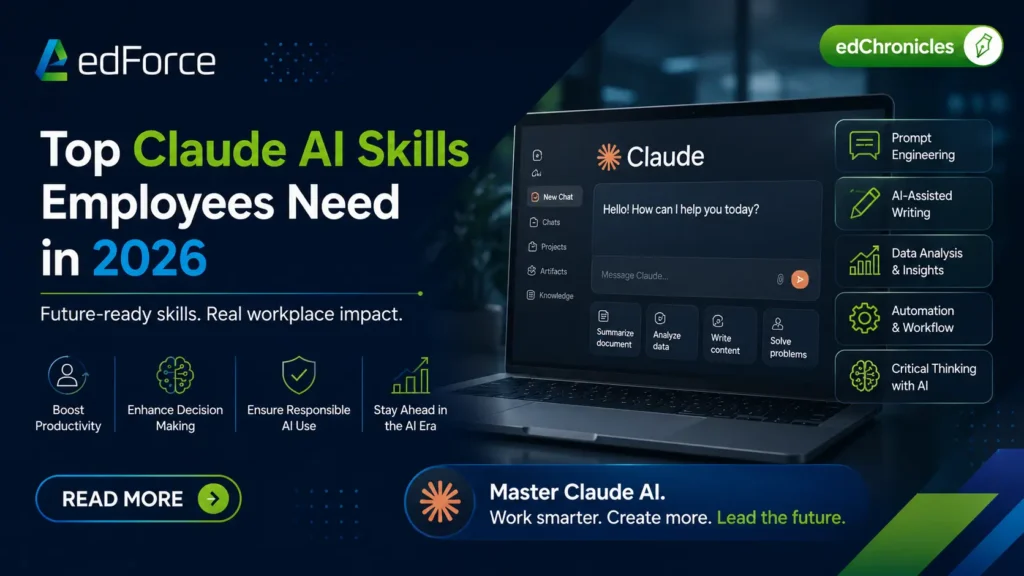
In the year prior, many employees were still asking if AI could affect their work. In 2026, the conversation has completely changed. The focus now shifts to a different area. The companies are no longer asking whether employees should use AI. They are now asking whether employees are aware of how to use it effectively. Tools such as Claude AI are becoming part of the daily work of departments. The teams are using these tools to research and content production, workflow support document analysis, report-writing, and internal communications. However, being able to access AI tools does not suffice. The workers who add the most worth are those who are able to use AI successfully, not in a casual way. Writing Better Prompts Is Becoming a Real Workplace Skill One of the most commonly held misconceptions regarding AI instruments is that they function perfectly by themselves. They aren’t. Quality of the output is heavily dependent on how employees interact in a system. This is the reason prompt writing is fast growing to be one of the essential useful AI abilities. Employees who have the ability to: generally, you will get more effective results using tools such as Claude. It is no longer a technical ability. It’s now a business capability across all the different roles. Employees Need to Learn How to Verify AI Output Another problem that businesses are experiencing is the overreliance on AI-generated response. Claude AI can save time however, employees will still require judgement. Employees with a strong work ethic are able to: This balance is becoming increasingly crucial in professional settings. The firms that reap the most benefits from AI aren’t replacing human thinking by AI. They combine AI efficiency with the human capacity to make decisions. Context Handling Is Becoming More Valuable One reason why many businesses are moving to Claude AI is because it handles large conversations and longer-form context better than previous AI tools. However, employees must be aware of managing this context effectively. In terms of practicality it refers to: People who are aware of this can perform better using AI systems. AI-Assisted Communication Is Growing Fast One area that is rapidly changing within businesses is communication. Employees are currently making use of AI instruments to But businesses do not require automated communications. They are still looking for clarity precision, accuracy, and professional judgement. This is the reason employees who are able to utilize Claude AI, while maintaining the human touch and understanding of business are increasing in value. Critical Thinking Matters More Than Ever In a way, AI is accelerating the importance of human brains. Many employees believe that AI eliminates the necessity to think critically. However, the reverse is taking place. As AI-generated content becomes more and more popular companies are increasingly looking to hire employees who are able to: AI can generate answers quickly. Whether those answers are logical is the domain of a human. Workflow Understanding Is More Important Than Tool Knowledge One thing that many professionals do wrong is not focusing on acquiring the tool itself. The companies are more concerned with how employees can enhance their workflows with the help of AI. This includes: The workers who comprehend workflow improvement typically create greater value than those who only know AI features. Why Enterprises Are Investing in Claude AI Training As AI adoption increases, a lot of organisations are beginning to realize that unstructured AI use can cause inconsistencies. Some employees use AI effectively. Other employees do not use it at all or apply it improperly. Many companies are spending money on structured AI capacity development and tools like claude Training via Learning partners such as edforce.co specifically for teams who work using AI-based generative AI tools such as enterprise workflows, corporate workflows, as well as AI-based productivity tools. The aim isn’t just AI access. The aim is to be practical AI ability. The Biggest Shift Happening in Workplaces The main shift isn’t the fact that AI instruments are replacing workers. The result is that workers who are able to effectively use AI are far more productive than employees who don’t. The gap in productivity is growing rapidly. In many organizations this is already happening: This is the reason AI abilities are no longer considered to be optional job-related abilities. Final Thoughts By 2026 Claude AI abilities aren’t only about learning to understand the functions of a machine. They’re about learning to be more efficient in AI-powered environments. People who can manage AI effectively, check outputs, consider the implications, and improve workflows will be in an edge in the modern workplaces. The future of work isn’t just human as well as AI jobs.It is humans and AI working in tandem to achieve success.