

15 Highest-ROI IT Certifications for Enterprises in 2026
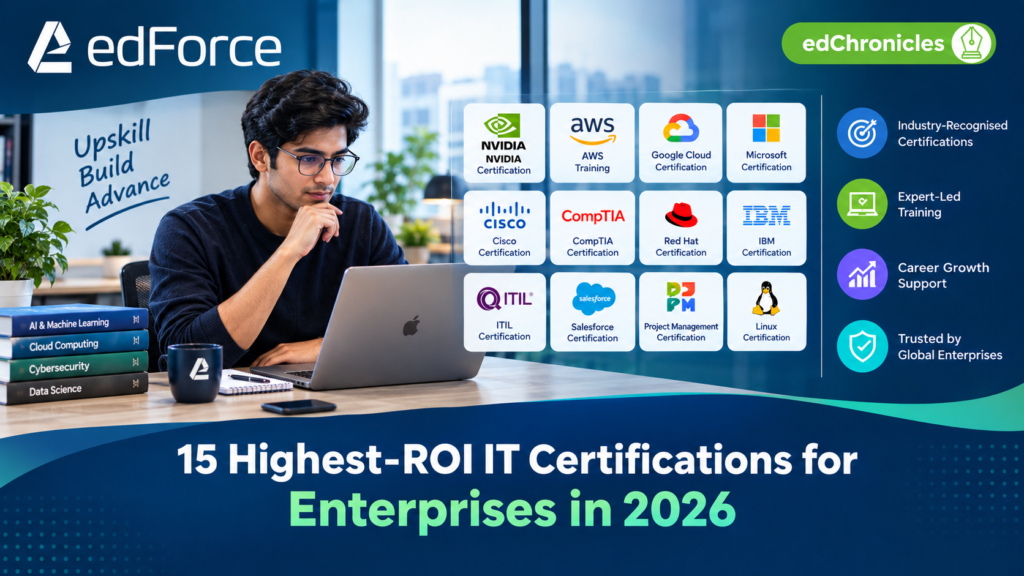
An IT certification is easy to measure by its exam price. Its return on investment is much harder to measure. For an enterprise, an IT certification can be valuable when it helps a cloud engineer manage infrastructure more effectively, gives a security team stronger technical capability, helps developers modernise delivery, or prepares employees for an AI initiative. The certificate is only the visible part. The real return comes from what the employee can do differently afterward. That is why enterprises should not ask only, “Which IT certification is most popular?” The better question is: Which certification can strengthen a business critical skill without creating unnecessary training cost? The 15 certifications below cover cloud, cybersecurity, AI, data, DevOps and enterprise infrastructure. The list is not a ranking. ROI depends on the company’s technology stack, existing workforce and business priorities. 1. AWS Certified Solutions Architect For organisations running significant workloads on AWS, architecture skills can influence infrastructure cost, reliability, security and scalability. AWS describes its certification exams around the knowledge and skills recquired to perform defined job responsibilities. The Solutions Architect path is therefore useful when employees are responsible for designing cloud environments rather than simply operating individual services. The enterprise ROI comes from connecting architecture knowledge with real cloud decisions. 2. AWS Certified DevOps Engineer DevOps teams sit close to some of the most important enterprise delivery processes. The AWS DevOps Engineer certification focuses on operating and managing distributed applications on AWS, including automation and continuous delivery. It can be particularly relevant when development and operations teams are under pressure to release faster without weakening reliability. For enterprises already invested in AWS, developing this capability internally can support more consistent delivery practices. 3. Microsoft Certified: Azure Administrator Associate Azure remains deeply embedded in many enterprise environments, particuarly organisations already using Microsoft 365, Entra and other Microsoft services. The Azure Administrator Associate certification covers areas including identity and governance, storage, compute, networking and monitoring. The ROI case becomes stronger when organisations are expanding Azure adoption and need administrators who can manage the environment beyond basic configuration. 4. Microsoft Azure Solutions Architect Expert Architecture decisions become increasingly expensive as cloud environments grow. The Azure Solutions Architect Expert path focuses on designing identity, governance, monitoring, storage, business continuity and infrastructure solutions. For enterprises with complex Azure environments, architecture capability can influence both technical resilience and long term cloud spending. 5. Microsoft Certified: DevOps Engineer Expert Modern software delivery increasingly depends on automation, source control, build pipelines, release processes, security and monitoring. Microsoft’s DevOps Engineer Expert certification assesses skills across those areas, including source control, build and release pipelines, security and compliance, and instrumentation. For enterprises trying to shorten release cycles while maintaining governance, these skills can have a direct operational impact. 6. Microsoft Cybersecurity Architect Security architecture is becoming harder as identity, cloud, applications, data and security operations converge. Microsoft’s Cybersecurity Architect certification covers security operations, identity, compliance, infrastructure, applications and data. For organisations heavily invested in Microsoft security technologies, this can help develop architecture level capability rather than isolated security tool knowledge. 7. Microsoft Information Security Administrator Not every organisation needs another security architect. Many need professionals who can actually impliment information protection, data loss prevention, retention and risk controls. The Microsoft Information Security Administrator Associate certification focuses on those operational capabilities. Its potential ROI comes from strengthening the people responsible for turning security policies into technical controls. 8. NVIDIA Certified Associate: AI Infrastructure and Operations AI infrastructure is creating a new skills requirement for enterprises deploying accelerated computing. NVIDIA’s Associate certification validates foundational knowlege around AI computing infrastructure and operations. For organisations beginning to build GPU based environments, this can provide a foundation before employees move into more advanced infrastructure responsibilities. 9. NVIDIA Certified Professional: AI Infrastructure Enterprises operating serious AI infrastructure need skills beyond understanding GPUs. NVIDIA’s Professional AI Infrastructure certification covers the ability to deploy, configure and validate advanced NVIDIA AI infrastructure. The business case is closely tied to utilisation, deployment quality and operational reliability. AI infrastructure is expensive. Developing people who understand how to operate it can therefore have practical financial implications. 10. NVIDIA Certified Professional: AI Operations Building an AI environment is one problem. Keeping it healthy is another. NVIDIA’s AI Training certification focuses on monitoring, troubleshooting and optimising NVIDIA AI infrastructure. For enterprises running production AI infrastructure, operational expertise becomes increasingly important as workloads scale. 11. NVIDIA Certified Professional: Generative AI LLMs Generative AI projects can move quickly from experimentation to production. The NVIDIA Certified Professional Generative AI LLM certification covers advanced capabilities related to designing, training and optimising LLMs, including distributed training and fine tuning. The ROI depends heavily on whether the organisation is actually building or operating LLM based solutions. For a company only consuming third party AI tools, this may be unneccessary depth. For an organisation building AI products, the equation is very different. 12. NVIDIA Certified Professional: Agentic AI Enterprise AI is moving beyond single prompt and response interactions. Agentic systems can involve multiple agents, tools, workflows, governance and autonomous actions. NVIDIA’s Professional Agentic AI certification focuses on building and governing advanced agentic AI solutions, including multi agent interaction and scalability. For organisations actively developing agentic applications, this is a newer certification area worth monitoring as enterprise adoption grows. 13. Red Hat Certified System Administrator Linux remains a major component of enterprise infrastructure, cloud platforms and modern application environments. Red Hat certifications are particularly relevant where organisations depend heavily on Red Hat Enterprise Linux and related technologies. The standard list price for a Red Hat certification exam is currently $500, although regional pricing can vary. Red Hat Learning Subscription options can also bundle training access with exam eligibility and, depending on the tier, retakes and multiple exam attempts. The ROI becomes clearer when certification supports an environment the organisation already operates. 14. Red Hat Certified Engineer For organisations running larger Linux and automation environments, RHCE skills can go beyond basic administration. The certification path is associated with automation and more advanced system
What Is a Certification Voucher and How Does It Work?

It is not always easy to pay for a certification test by booking the exam and then showing up at the scheduled time. Vouchers are used by many professional certification providers to simplify the registration process for individuals, businesses, and training partners. You may already be familiar with the term voucher if you plan to take an IT certification. What is a voucher, what are its uses, and how should it be purchased? A certification voucher is a code, digital credential, or other form of payment that can be used to reduce or pay the full cost of a certification exam. The candidate can enter the voucher code instead of paying the entire exam fee during registration. It is important to note that vouchers are usually linked to specific rules for exams. A voucher may be tied to a particular exam, have a set expiry date, or include conditions for redemption. Why Do Certification Vouchers Exist? Vouchers simplify the certification process, especially when several employees are required to obtain the same certification. Imagine an organisation wants 50 cloud engineers certified. It can be inefficient to ask each employee to pay and submit their expenses separately. Instead, a company can purchase vouchers and distribute them among eligible employees. As part of their learning programmes, training providers can also include an exam voucher. The learner receives a voucher after completing the course. This allows for a better connection between training, preparation, and certification. There is another benefit for businesses. Before employees start booking exams, the organisation can plan its certification budget. How Does a Certification Voucher Work? It is very simple to use. A candidate must first receive a valid voucher, either from their employer, trainer, certification organisation, or other authorised source. The candidate registers on the official platform for the certification exam. There is often an option to enter the voucher code during checkout or payment. If the voucher is valid, the applicable amount will be deducted from the exam fee. The voucher may cover all or part of the examination fee, depending on its terms. Once the registration process is complete, the candidate will receive an appointment or confirmation of the exam date. It is important to note that the exact process varies between providers. Candidates should always read the instructions on their voucher before redeeming it. What Can a Certification Voucher Include? Not all vouchers work the same way. Some vouchers cover the entire cost of a certification exam, while others offer a fixed discount. Depending on the certification provider, certain programmes may also include additional benefits. A voucher may specify: Voucher Detail What Does It Mean? Exam The specific certification or exam it can be used for Value The discount or amount covered Expiration The voucher’s expiry date Attempts Whether it covers one attempt only, or includes additional conditions Region Test regions or countries where it is valid Delivery Online or authorised in-person testing options, depending on the provider Restrictions Rules regarding refunds, replacements, and transfers This is important because a voucher cannot usually be used for any certification offered by the same organisation — only specific ones. Do Certification Vouchers Expire? Yes, in many cases. It is important to verify this before purchasing or accepting a voucher. The validity of a voucher depends on the certificate provider and the particular programme. The expiry date is usually based on the redemption date, not the date you start preparing. This distinction is crucial. If you receive a voucher expiring in September, you may not have enough time to complete your training. It may be necessary to redeem or book the exam before the deadline. Plan in reverse: confirm the voucher’s validity against the exam date you intend to choose. Can You Transfer a Certification Voucher to Another Person? This depends on the terms of the voucher. Some vouchers are allocated to a specific candidate. Others may be distributed internally by an organisation. Some carry restrictions on resale and transfer. Candidates should not assume a voucher is automatically transferable to someone else. Before redistributing vouchers, an organisation should verify the terms if a worker leaves the company or changes their certification plans. What Happens If You Fail the Exam? It is a common misconception that all certification vouchers include a free retake. This is not always true. A standard voucher might only cover one attempt at an exam. Whether retakes are available depends on the certification provider and the specific voucher package. As part of their terms, some training programmes offer extra exam attempts or retake support. Understanding what your voucher covers before booking an exam can help you avoid unexpected costs later. Certification Voucher vs. Certification Training These terms are often used interchangeably, but they aren’t the same thing. Training helps you prepare for certification. A voucher lets you pay for or access the exam itself. You can purchase them separately or combine them into one programme. An enterprise learning programme may include instructor-led training, practice materials, hands-on exercises, and an exam voucher — giving the learner a single path to both preparation and certification. This is especially useful for employers who want employees to build practical skills, not just collect certificates. Are Certification Vouchers Worth It? A voucher is useful for someone who has already decided to take the exam – it reduces the cost or simplifies payment. For organisations, the value can be even greater. Companies can better align certification goals with actual workforce needs when vouchers are combined with structured training. Instead of leaving employees to choose certifications on their own, businesses can build learning pathways around priority skills. This distinction matters more as technology continues to change rapidly. A certificate proves someone passed an exam. Training demonstrates whether that person can apply the knowledge in a real working environment. How Businesses Can Make Better Use of Certification Vouchers It’s best to avoid distributing vouchers simply because they’re available. Start by identifying your business need. Cloud certifications can help a company move workloads to the