

Agentic AI vs Generative AI: What Enterprises Should Train Teams On in 2026
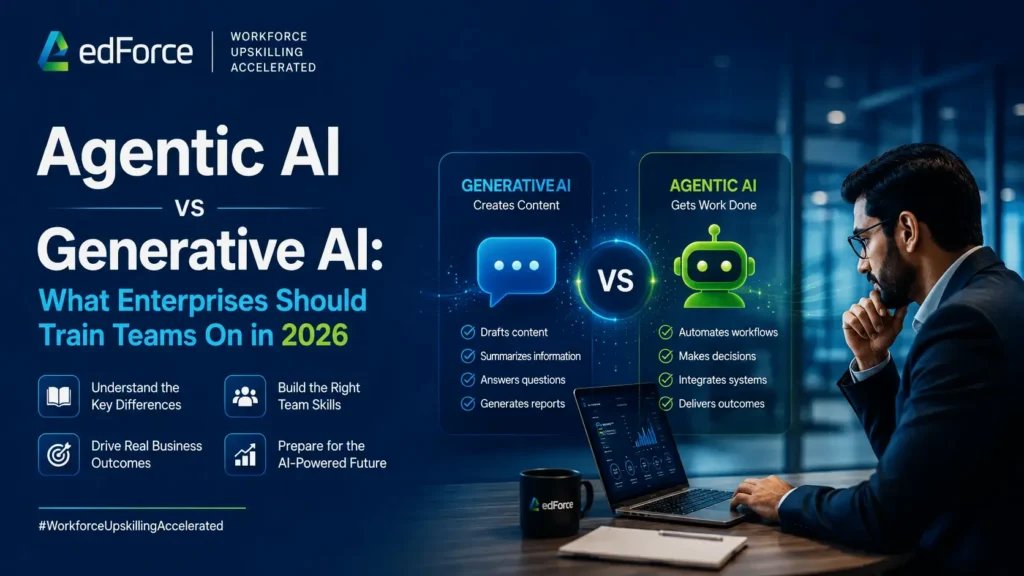
In the past two years, the majority of discussions in the workplace on AI have been focused on AI tools that produce documents, create emails, summarize information, generate reports, or respond to questions. Employees became accustomed to chat-based AI systems, and companies eagerly explored productivity improvements. The conversation is now evolving. Many companies are wondering if the next stage of AI isn’t solely about creating content, but also about finishing work. This is where Agentic AI enters the picture. Many business leaders are being introduced to terms such as Generative AI, Agentic AI, AI agents, or self-contained workflows. The problem is that these terms are often used as if they’re all the same thing. They’re not. Understanding the distinction is important since it directly affects workforce education choices. Many businesses are already planning Agentic AI initiatives while their employees are still learning to utilize Generative AI effectively. This gap could be one of the major issues facing workers in 2026. The First Wave Was About Content Creation Generative AI has changed the way individuals interact with information. How Teams Started Using Generative AI Teams began using AI to: Draft emails Summarize documents Create content Research and support Create systems for storing information Generate reports For many companies, this was their first experience with AI within routine work processes. The value was evident. Employees can complete information-based tasks faster and spend less time on repetitive work. However, something very interesting occurred. The most significant productivity improvements did not come from employees who simply used AI tools. These gains came from employees who learned to integrate these tools into their routine processes. This is crucial because it’s being repeated through Agentic AI. Agentic AI Is About Action, Not Just Output Generative AI primarily helps employees create information. Agentic AI was designed to act. What AI Agents Can Do Instead of producing reports and waiting for users to decide what to do next, an AI agent can: Collect details Analyze information Trigger workflows Communicate with systems Perform multiple tasks at once This is a significant difference. Generative AI aids work. Agentic AI participates in work. Many companies are excited about its potential. It is also the reason workforce readiness is becoming more crucial. Many Companies Are Asking the Wrong Question A common question in boardrooms today is: “Should we train employees on Generative AI or Agentic AI?” A better question is: “Which skills will employees need as AI becomes more autonomous?” Since, in the real world, businesses require both. Generative AI and Agentic AI solve different problems. One helps employees work faster. The other changes how work gets done. Businesses that view these technologies as rivals could overlook the larger opportunity. What Should Enterprises Train Teams On First? The most common error organizations make is chasing the latest technology without establishing foundational capabilities. The Foundation Still Matters Many companies are eager to explore Agentic AI, but some teams are still struggling with: Prompt quality Output verification Responsible AI usage Workflow integration Information management Without these fundamentals, Agentic AI adoption can become chaotic. Employees need to understand how AI integrates into workflows before they can effectively manage systems that make decisions or perform tasks on their own. For many companies, Generative AI literacy remains the primary step. Not because it is more important, but because it provides the foundation for everything that follows. The Real Skill Gap Is Not Technical The majority of discussions on AI are focused on technology. The most difficult challenge is often behavior. Skills Employees Need to Develop Many people are just beginning to learn: When to trust AI When to question AI outputs How to review details How to ensure accountability How to work with automated systems These abilities become more essential as organizations shift toward Agentic AI. One prediction that is becoming more likely is that future AI education programs will spend less time teaching tools and more time teaching decision-making. As AI systems become smarter, human judgment becomes more important, not less. Why Workforce Training Will Change Traditional corporate training usually focuses on teaching employees how to operate a platform. AI is different. Future Workforce Capabilities Today’s employees must understand: Workflow redesign AI supervision Operational accountability Exception handling Governance practices These are not purely technical capabilities. They are business capabilities. This is why many organizations are realizing that AI readiness can no longer remain only within IT departments. Management teams, operations teams, HR managers, project teams, and other business functions require an understanding of how AI can affect the way work is done. The Enterprises Seeing Success Are Taking a Different Approach Some companies still view AI implementation as a software rollout. Others describe it as a workplace transformation initiative. The second group is typically seeing better results. Why Transformation Beats Technology Alone Because technology adoption is usually more straightforward than changing behavior. Most employees can master a new tool quickly. Changing how people make decisions, collaborate, review work, and manage workflows often takes longer. The companies that are planning effectively for Agentic AI are usually the ones investing in workforce capabilities before large-scale deployment. What Skills Will Matter Most in 2026? Interestingly, the most valuable AI skills in 2026 may not be the ones people expect. The Skills That Will Define Future Teams Businesses are increasingly seeking employees who can: Redesign workflows Critically evaluate AI outputs Manage AI-assisted processes Work with automated systems Maintain quality and accountability These capabilities apply to employees using either Generative AI or Agentic AI. The next workforce advantage may belong to those who can combine AI efficiency with strong human judgment. Why Agentic AI Training Cannot Wait Too Long Though many organizations are still building Generative AI capabilities, waiting too long to prepare for Agentic AI could create its own challenges. Preparing for Autonomous Workflows As autonomous systems become more common, workers will need to understand: How AI agents function When human supervision is required How workflow ownership changes How accountability is managed The businesses that begin building this understanding
The One Thing AI Can’t Fix in Your Career
Artificial intelligence is revolutionizing the way work is completed. It is able to write code analyze data, produce content, create reports and even aid in decision-making. Many professionals find that AI has already proven to be an incredible career boost. But there’s one important thing that AI can’t help you for you in your professional life. This gap is more important than any other gap in technical skills in the corporate world, particularly where roles, expectations and technologies evolve more quickly than job titles. AI Can Improve Performance, Not Direction AI tools are great for helping you accomplish tasks faster and more efficiently. They can help with research, make repetitive work easier and provide suggestions based on patterns in data. What AI can’t do is to decide the direction your career should take. It is unable to comprehend: Many professionals mistake efficiency for advancement. AI Training could make you more effective in your current job however, efficiency without direction is often the cause of stagnation in your career. The Real Career Risk Is Passive Growth In many companies career paths are created by default. People change roles due to: AI is able to support the operational aspects of all these changes. AI is not able to ensure that those changes are in line to your personal growth. Passive growth is the process of taking only the skills that is required by the job in the present. As time passes, it creates individuals who are skilled in their specific jobs, but struggle to change when the job itself is no longer needed. It is also where careers slowly slow down. Skills Are Not the Same as Capability AI driven learning platforms usually concentrate on the specific skills. They are easily measured and simple to recommend. The scope of capability is greater. Capability refers to: AI can recommend courses. AI cannot inform you of which capabilities are important to your organization in the next within the next two years or how you can combine capabilities into real-world leverage for your career. This is the reason that many professionals earn certifications but aren’t sure where to go. Career Ownership Is a Human Responsibility Career ownership is the act of taking active decisions about: AI will assist with execution after these decisions have been taken. AI can’t make these decisions for you. In the corporate world the responsibility of this is often under-appreciated. Employees are expected to have systems, managers or other tools to facilitate development. Organizations expect their employees to be active. This gap is the point at which the disengagement starts. Why AI Cannot Replace Career Judgement Career choices aren’t always rational. They require: AI analyzes patterns that are derived from the past. Careers are shaped through choices made in the face of uncertain conditions. For instance: These decisions are based on judgement and not recommendations. The Most Valuable Skill Is Still Learning Intent Learning intent is the reason you’re learning something and not only what you’re learning. Intentionally or not: With intention: AI can help in the process of the process of learning but is not able to identify the intent. This must come from the individual, backed by clearness in the organisationsuch as those often explored through platforms like edforce.co. What This Means for Professionals Professionals, for instance. The issue isn’t whether AI can replace your job. The most important thing is whether you’re active in shaping your role to ensure it is still valuable. This is why: AI can be powerful when it is employed in conjunction with the direction of. What This Means for Organisations For organizations, AI adoption without career clarity can result in short-term effectiveness and risk in the long run. The employees may be performing better today, but are unsure about the future. This causes attrition, disengagement and weak skill development. The most effective upskilling strategies are those that are structured when they assist employees: This is the point where intentional learning ecosystems can be more efficient than tools that are isolated. The One Thing That Still Matters Most AI can’t help clarify career ownership. It is not able to substitute for reflection, intention or judgment. It is not able to define what success means for a person or for an organization. The experts who are successful with AI won’t be those who employ the most software. They will be those who know where they are heading and why. Technology can help grow. Ownership drives it. This is the only thing that AI cannot automate.