


What Enterprises Actually Expect From AI Skilled Employees
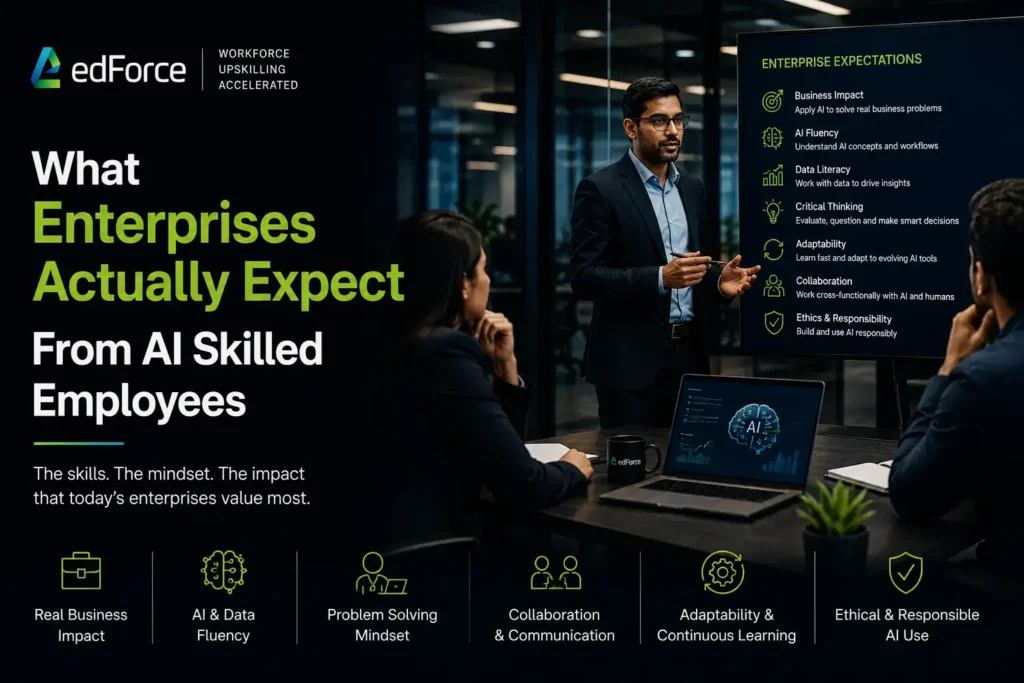
Many professionals believe that “AI skills” simply means knowing how to use AI software. But workplace expectations are changing. Companies are no longer impressed just because employees can create content with AI or write prompts. Businesses now want professionals who can use AI in real operational environments in a responsible and workflow-focused way. This shift is becoming much bigger in 2026. The conversation around AI skills is moving beyond: “Can employees use AI?” toward: “Can employees improve business performance using AI?” This difference is important. Enterprises Do Not Want Random AI Usage One major problem companies face after adopting AI is inconsistency. Some employees use AI in ways that improve productivity. Others use AI in ways that create confusion, poor results, or workflow disruptions. This creates uneven work quality across teams. Without structure, AI can create operational problems instead of efficiency. That is why employers increasingly expect employees to understand: These skills are far more valuable than basic AI experiments. Practical Thinking Is the Most Valuable AI Skill Many online discussions still focus heavily on prompts and AI tools. But in enterprises, the most valuable employees are the ones who think strategically. Professionals who understand business operations are in high demand. This includes understanding: AI becomes useful only when employees can apply it effectively in these areas. For example, employers value employees who can: This is very different from using AI casually. Businesses Expect Employees to Work With AI, Not Depend on It Enterprise environments are moving away from blind dependence on AI. Many organizations are becoming more careful about how employees rely on AI-generated outputs. Companies increasingly expect AI-skilled professionals to: This is especially important in: Businesses are not looking for uncontrolled automation. They want balanced and responsible AI usage. AI Skills Are Becoming Important Across Every Department Earlier, AI skills were mostly associated with technical teams. That is changing rapidly. Today, AI is becoming important across departments such as: Why? Because modern work has become highly information-driven. Employees now spend large amounts of time: AI can simplify many of these tasks, but only when employees know how to use it properly. That is why businesses now see AI skills as more than just technical knowledge. Businesses Value Adaptability More Than Tool Expertise Hiring priorities are changing. Companies are becoming less focused on mastery of a single AI tool and more focused on adaptability. Businesses understand that AI platforms will continue evolving quickly. New systems, models, and workflows will keep appearing. Because of this, employers increasingly prefer professionals who can: Developing the right mindset is becoming more important than memorizing AI features. The strongest AI-skilled employees are usually the ones who can adapt their work style as technology changes. Workflow Understanding Matters More Than Prompt Writing Many professionals still think AI expertise is mainly about writing prompts. But enterprises are increasingly focused on workflow integration. Anyone can use AI tools to generate output. The bigger challenge is understanding: Many businesses still struggle in these areas. Employees may know AI tools, but team workflows often remain inconsistent. This is one reason businesses are investing more in workforce AI training instead of only providing access to tools. Why AI Communication Skills Matter Clear communication has become an increasingly valuable skill. AI-assisted work requires: The way employees communicate with AI systems directly affects output quality. Businesses increasingly value professionals who can: Interestingly, AI is making strong communication skills even more valuable. Businesses Expect Employees to Improve Productivity Responsibly Many companies adopted AI expecting instant productivity improvements. Now businesses realize productivity improvements are not automatic. Employees need to understand: This requires more than technical curiosity. It requires operational maturity. That is why enterprises increasingly value practical AI literacy over surface-level AI awareness. Why Workforce AI Training Is Becoming More Important Businesses now understand that successful AI adoption depends heavily on workforce capability. Without proper training: That is why enterprises are investing more in structured AI workforce development programs. At edForce, enterprise AI training focuses not only on AI tools, but also on responsible usage, workflow understanding, and operational learning. This helps teams apply AI effectively in real business environments instead of treating AI as a separate tool. Real Skill Is What Enterprises Actually Need In the end, employers are not simply looking for employees who “know AI.” They want professionals who can: This combination of AI knowledge and practical thinking is far more valuable. Final Thoughts Employer expectations for AI-skilled professionals are changing quickly. Businesses are no longer interested in isolated AI knowledge or random AI experimentation. They want professionals who can integrate AI into real workflows and improve operational efficiency. In 2026, strong AI capability will be less about casually using tools and more about helping organizations work faster, smarter, and more consistently.