

Why Giving Employees AI Tools Doesn’t Guarantee Better Productivity
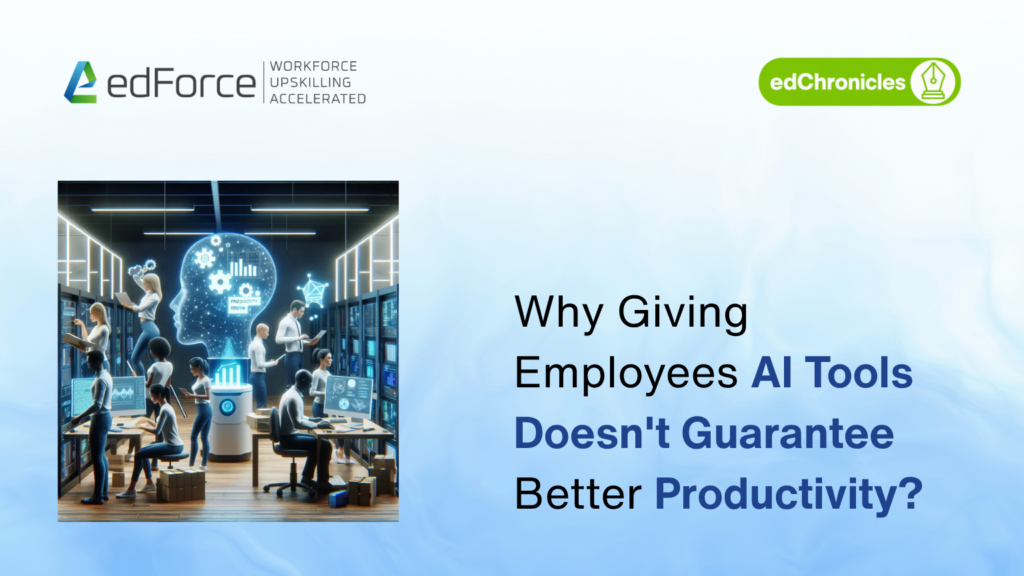
Even If a Company Gives Every Employee Access to AI Tools, Productivity Won’t Change Much This may seem strange at first. Why not give people the ability to use AI? It can automate research, write code, analyse and summarise reports, generate content, and handle repetitive tasks. Not quite that simple. It’s not about access. The real challenge is understanding how AI fits into the work, what employees should actually do with it, and what happens once AI provides an answer. In 2026, this has become a major issue for businesses. Many organisations have stopped asking whether AI is a good idea. The more important question now is whether the teams using these tools are getting real results. The Two Are Not the Same Imagine a company gives 500 employees access to an AI assistant. Some start using it immediately. Others try it once and give up. Some use it daily but only to rewrite emails. One group uses it to draft reports but never checks the output. The company has adopted AI on a technical level. It is not, however, an AI-capable organisation. Productivity doesn’t come from tools alone — it comes from the combination of technology, human judgment, and skill. In the hands of someone unfamiliar with how to use it well, even a powerful AI system can end up worthless. Employees Need to Know What AI Should Actually Do The first mistake companies make is telling employees to “use AI more” without showing them how it can meaningfully improve their work. Left without direction, employees end up experimenting with random tasks. A marketing team might use AI to create social media posts. Finance might use it to summarise documents. A software team might use it to assist with code. Customer service might use it to draft responses. The real value comes from understanding the entire workflow. Instead of simply asking AI to write a reply to a customer, a team can use it to classify the incoming request, extract the key information, generate a response using approved company materials, and escalate the case to a human expert when judgment is required. It’s not enough to bolt an AI tool onto a process — the process itself needs to improve. AI Can Make Poor Processes Faster – Not Better This trips up many organisations. AI won’t fix problems that already exist in a business process — excessive approval chains, repetitive data entry, unclear ownership, or outdated information. Sometimes it just makes those problems happen faster. Imagine an employee who spends hours building a report because the data comes from five different sources. An AI assistant might help them produce the document more quickly — but the underlying problem, fragmented data, is still there. Connecting the right information sources is often a better starting point for an AI strategy than deploying a chatbot. This is why AI adoption should start with a review of processes. The more useful question isn’t “Where can we use AI?” It’s “Where is our process actually broken?” That question tends to surface far better opportunities. Training Changes How Employees Use AI There’s a real difference between showing someone how an AI tool works and showing them how to apply it to their specific job. A basic introduction or team training can teach employees to write prompts, summarise text, or generate ideas. That’s useful — but not sufficient. A cloud engineer needs different AI skills than a sales professional. A developer needs a different foundation than an HR manager. A data professional may need familiarity with APIs, models, pipelines, and evaluation methods. Enterprise AI training should be role-based. The goal isn’t to turn every employee into an AI engineer – it’s to help each person understand how AI can genuinely enhance the work they already do. Better Prompts Aren’t the Whole Answer The quality of someone’s prompting skill does affect outcomes – that’s still true. But enterprise productivity is about more than a clever instruction. Employees also need to understand context, data verification, privacy, and workflow design. Imagine an employee asking AI to generate a business summary. Even a polished, confident-sounding response can contain inaccurate numbers if the source information was incomplete. Employees need to know how to check results – and what information they need to supply in the first place. In practice, good judgment is often more valuable than a clever prompt. Productivity Isn’t the Same as Activity This is another area where companies commonly misjudge AI adoption. If AI lets an employee produce 20 documents instead of 5, that can look like a productivity win. But did those 20 documents actually help the business? Output doesn’t automatically translate into value. AI makes it easy to generate emails, presentations, reports, images, and code — but without clear goals, employees may simply end up producing more, not better. A more useful measure is whether AI is improving something that actually matters: Has response time gone down? Are engineers spending less time on repetitive work? Are analysts reaching valuable insights faster? Are customer complaints resolved more quickly? Are employees spending more time on complex, high-value work? These metrics tell a far better story than counting AI-generated outputs. Human Review Still Matters AI-driven productivity doesn’t mean removing people from workflows. Human review remains essential in many situations. Employees need to be able to recognise when an AI response is incomplete, uncertain, or inconsistent with the available information — and they need to know what information should never be fed into an AI system without proper safeguards. This is a genuinely new kind of workplace skill. Employees are increasingly responsible for directing, evaluating, and improving machine-generated work — not just producing it themselves. That requires training. It also requires clear organisational policy. The Next Productivity Gap May Form Between Teams This is a trend worth watching closely. The biggest AI productivity gaps may not appear between companies that use AI and those that don’t — they may appear within the same company. One team might build repeatable