

From the Charkha to AI: Why India’s Next Chapter of Self-Reliance Will Be Built on Capability

India’s technology journey is entering a different phase. For years, the conversation was largely about access — access to computing, connectivity, cloud infrastructure, digital platforms and global technology ecosystems. Today, access is increasingly only the starting point. Organisations can adopt sophisticated technologies at remarkable speed. Artificial intelligence is moving into products, operations and decision-making. Cloud platforms have become fundamental to modern enterprise infrastructure. Automation is changing how work gets done, while cybersecurity and data capabilities are becoming increasingly central to business operations. But technology adoption creates another question that is becoming harder to ignore: Do organisations have the workforce capability to turn these technologies into value? That question brings an idea from India’s past into a very different technology context: self-reliance. The charkha became significant in Gandhi’s programme not simply as a tool, but as a symbol connected with work, livelihoods, Swadeshi and economic participation. The historical record around the charkha and khadi connects it with work, livelihoods, Swadeshi and economic participation. The Gandhi Heritage Portal, for example, carries archival material under the theme “Swadeshi for self reliance.” The tool mattered. But the larger idea was what people could do with it. That distinction has an interesting relevance in an economy increasingly shaped by technology. The tools have changed. The capability question has not. The charkha belongs to a very different India. Today’s tools include AI systems, cloud platforms, advanced data technologies, cybersecurity solutions, automation and increasingly powerful computing infrastructure. Yet the underlying principle remains remarkably relevant: A tool creates potential. People turn that potential into outcomes. An enterprise can deploy an AI platform without becoming AI-capable. It can migrate workloads to the cloud without developing the skills required to architect, secure and operate those environments. It can invest in sophisticated cybersecurity technologies without automatically having the people who know how to use them effectively. Technology investment and workforce capability, therefore, cannot be treated as completely separate conversations. The value of one increasingly depends on the strength of the other. Why Workforce Upskilling Is Becoming a Business Capability Every major technology shift changes more than systems. It changes roles, workflows and the skills required to perform them — and, in some cases, the roles themselves. According to the World Economic Forum’s Future of Jobs Report 2025, employers expect 39% of workers’ core skills to change by 2030. The report also identifies AI and big data, networks and cybersecurity, and technology literacy among the fastest-growing areas of skill demand. For enterprises, this creates a challenge that cannot be solved simply by hiring more people with today’s skills. The skills themselves are moving. A technology team may need new cloud capabilities today and new AI capabilities tomorrow. A cybersecurity professional may need to understand increasingly automated threat environments. A business team adopting AI may need to understand not only how to use new tools, but how to redesign processes around them. This is why continuous workforce upskilling is becoming a business requirement rather than an occasional learning initiative. From training activity to workforce capability Workforce upskilling has traditionally been associated with training programmes: identify a technology, put employees through a course, complete the learning and perhaps earn a certificate. But technology does not evolve according to an annual training calendar. As technology cycles accelerate, learning has to become more closely connected to business requirements, job roles, technology skills and practical application. The question is no longer simply: How many employees completed training? The more useful question is: What can the workforce do now that it could not do before? That is the shift from participation to capability. It changes how organisations identify learning requirements. It changes how programmes are designed. It increases the importance of hands-on environments and practical application. And it makes assessments and certifications more meaningful when they validate capabilities that matter to the organisation. A more useful model for enterprise learning Modern enterprise learning can be viewed as a continuous progression: Identify the capabilities the organisation needs Learn the concepts and technologies Practise through hands-on environments Apply skills to real scenarios Validate proficiency through assessment Evolve as technology and roles change The final step is particularly important. A certification can validate a point in time. A capability has to keep evolving. AI is accelerating the shift Artificial intelligence makes this challenge particularly visible because the technology cycle is moving exceptionally quickly. Consider what an enterprise needs when introducing AI. It needs technology professionals who understand the underlying infrastructure and platforms. It needs data professionals who can work with increasingly intelligent systems. It needs security teams that understand new risks and attack surfaces. It needs business teams that can identify where AI can genuinely improve productivity or customer outcomes. And it needs leaders who can make informed decisions about where AI belongs — and where it does not. These are different requirements for different roles. There is no single “AI training” programme that can address all of them. This is why the future of enterprise upskilling will increasingly need to be role-specific, technology-specific and outcome-oriented. What does self-reliance mean in an AI economy? This is where the connection with the charkha becomes more meaningful. India’s idea of self-reliance was shaped in a very different economic and technological environment. Applying that idea to today’s economy does not mean reproducing the tools or methods of that era. It means asking a more contemporary question: what does self-reliance require now? In a technology economy, it could mean having the capability to: understand emerging technologies, adopt them effectively, build and operate them, apply them to business problems, and continuously develop the skills required as those technologies evolve. India already has access to much of the world’s leading technology. The next question is about capability at scale. Can enterprises build technology-ready workforces quickly enough? Can existing employees transition into emerging technology roles? Can new talent become productive faster? Can organisations continuously close skills gaps rather than waiting for them to become business problems? These are workforce questions. Increasingly,
Why AI Assistants Are Becoming Part of Everyday Enterprise Work
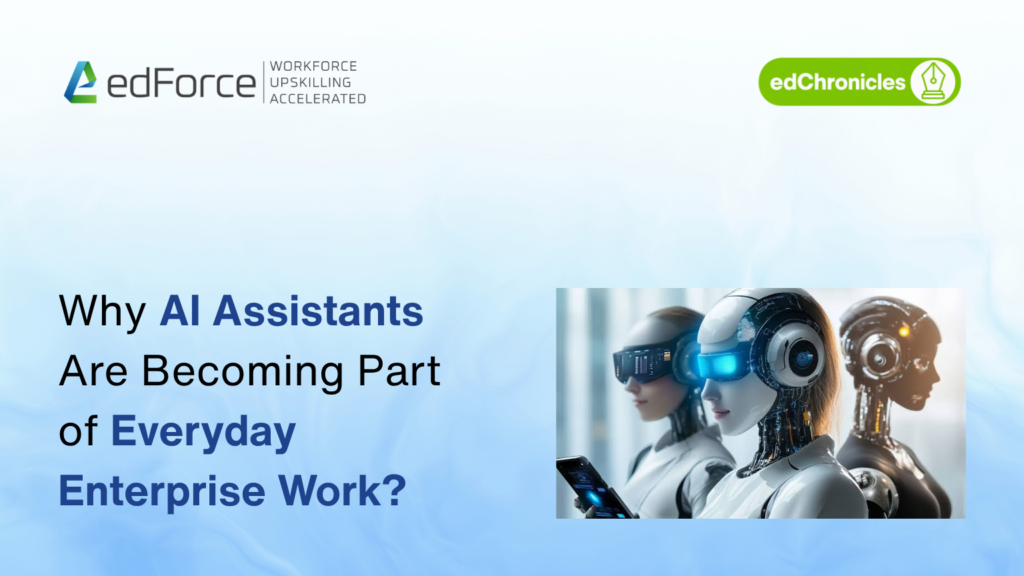
A Few Years Ago, Using an AI Assistant at Work Felt Like an Experiment Someone might ask it to rewrite an email, summarise a long document, or suggest ideas for a presentation. The result was interesting, but the actual work still happened somewhere else. That relationship is changing. In 2026, AI assistants are increasingly becoming part of the normal working day. They’re showing up inside development environments, productivity platforms, customer service systems, business applications, and internal knowledge tools. Employees aren’t always opening a separate AI website anymore – in many cases, AI is simply becoming part of the software they already use. That shift matters because it changes the question enterprises need to ask. It’s no longer just “Should our employees use AI?“ It’s becoming “How should AI assist our employees while they work?“ AI Is Moving Closer to the Work The most useful AI assistant may not be the one with the most impressive demo. It may be the one that shows up at exactly the right moment. A developer gets help while writing code. A sales employee gets a summary before a customer meeting. An analyst can ask questions about a business document instead of reading every page manually. A support employee receives suggested responses while handling a customer issue. The common thread is context. AI becomes genuinely useful when it understands enough about the task to offer relevant assistance – without forcing the employee to constantly switch between applications. This is one reason enterprise AI adoption is moving from experimentation toward integration. Employees Don’t Want Another Tool to Manage There’s a practical reason AI assistants are gaining traction. Employees already juggle dozens of applications. Adding another standalone platform means another login, another interface, another process, and another place where information needs to be copied over. An assistant built into an existing workflow feels different. If a developer gets coding assistance inside their development environment, there’s far less disruption. If a sales professional can summarise customer information within the system they already use, the benefit is immediately clear. The future of workplace AI may be less about telling employees to “go use AI” and more about bringing AI into the places where work already happens. The First Productivity Gains Are Often Small Not every AI use case needs to transform an entire department. Some of the most useful improvements are refreshingly ordinary. An employee might spend 20 minutes turning meeting notes into action items – AI can cut that down to a few minutes. A manager might spend an hour summarising several reports before a meeting – an assistant can produce a first draft the manager simply reviews. A developer might spend time searching documentation or explaining repetitive code – AI can handle the first pass. Individually, these savings can look small. Across hundreds or thousands of employees, they add up to something significant. This is exactly why enterprises need to be careful about how they measure AI productivity. The value often doesn’t show up as one dramatic cost reduction — it emerges through hundreds of small improvements repeated daily. AI Assistants Are Not Replacing Human Judgement The word “assistant” is useful because it describes the role fairly accurately. An assistant can prepare, organise, suggest, summarise, and accelerate. The employee still decides. For important business decisions, AI output still needs to be checked against reliable information, and employees need to recognise when a response might be incomplete or unsuitable. This matters even more when AI is handling sensitive information. A solid enterprise AI strategy needs both capability and clear boundaries. Employees should know what they’re allowed to ask an assistant to do, what information they can share with it, and when human approval is required. The Nature of Work Is Changing Too There’s another effect that gets less attention. When AI takes on some of the smaller tasks surrounding a job, employees often end up spending more time on the parts of their role that genuinely require judgement. Take a software engineer: if AI handles repetitive code, documentation, debugging suggestions, and test generation, the engineer can spend more time thinking about architecture and system behaviour. A sales professional may spend less time preparing information and more time actually speaking with customers. An analyst may spend less time formatting data and more time interpreting what it actually means. This isn’t just about doing the same work faster. It can genuinely change where employees direct their attention. AI Assistants Are Becoming More Context-Aware Early AI assistants relied almost entirely on what the user typed into a prompt. Enterprise systems are moving toward something different. An assistant can now potentially draw on information already available within the user’s authorised environment — documents, project details, customer records, code, internal knowledge, or business processes. That opens up far more useful interactions. Instead of asking: “Summarise this document.” an employee might ask: “What changed from the previous version, and what do I need to act on?” That second question requires real context. As enterprise AI becomes more connected to business systems, context is likely to become one of the biggest differentiators between basic AI usage and genuinely useful AI assistance. This Is Where AI Skills Become Important Giving an employee an AI assistant doesn’t automatically teach them how to work with it. Employees need to understand how to provide useful context, evaluate responses, protect sensitive information, and recognise when the system needs human direction. They also need to understand where the technology’s limits lie. A professional who knows how to question an AI response can extract far more value from the same tool than someone who accepts every answer at face value. This is why AI literacy is increasingly a workplace capability, not just a technical skill. Enterprises Will Need Different AI Skills for Different Roles A common mistake is treating AI training as a single subject for everyone. It isn’t. A developer may need AI-assisted coding and application-development skills. A cloud engineer may need to understand AI infrastructure and deployment. A business