


Every company agrees that upskilling is important. The challenge begins when training moves from strategy to execution.
Leaders want employees to learn new technologies. Managers want stronger capabilities across teams. Employees want opportunities to grow and advance.
At the same time, projects still need to be delivered. Customers still expect deadlines to be met. Business goals do not pause simply because a training program has started.
This creates one of the biggest challenges enterprises face today:
How do you upskill hundreds of employees without affecting productivity, project timelines, and customer commitments?
The answer is not simply “more training“
Many large-scale learning initiatives struggle because organizations treat training as a separate activity instead of integrating it into the way people work.
The companies seeing the best results in 2026 are taking a different approach. They are building workforce upskill programs that support business operations rather than compete with them.
The Biggest Mistake Enterprises Make
Many organizations still follow an outdated model.
A training program is announced. Employees are expected to attend long learning sessions. Project managers suddenly lose access to key team members. Deadlines become harder to manage.
Eventually, learning starts feeling like an obligation rather than an opportunity.
The issue is not the training itself.
The issue is the assumption that learning and delivery must happen separately.
Modern enterprises cannot afford to choose between skill development and execution. They need both at the same time.
That is why workforce development strategies are evolving rapidly.
Why Traditional Training Models Struggle at Scale
Training ten employees is manageable.
Training one hundred employees is a completely different challenge.
The complexity increases because every team works differently.
Some employees are involved in critical projects. Others support customers. Some work remotely, while others manage daily delivery responsibilities.
When organizations apply the same learning model to everyone, participation drops and outcomes become inconsistent.
This is one reason many enterprise training programs deliver weaker results than expected.
The learning content may be valuable, but the delivery model often does not reflect workplace realities.
The Best Learning Programs Work Around Business Priorities
A common pattern appears among the most successful organizations.
They do not stop work for learning.
They build learning into work.
Instead of asking employees to step away from their responsibilities for long periods, they create structured learning pathways that fit into existing schedules.
Teams continue delivering while gradually building new capabilities.
This creates less disruption and stronger adoption.
Employees are far more likely to engage with learning when it feels manageable rather than overwhelming.
Why Role-Based Learning Matters
Not every employee needs the same skills.
This sounds obvious, yet many organizations still run training programs that treat everyone the same.
A cloud engineer has very different learning needs than a project manager.
A data analyst requires different capabilities than a customer support professional.
When learning paths are role-based, employees immediately see how new knowledge connects to their day-to-day responsibilities.
This improves engagement and increases the chances that learning will be applied in real-world situations.
Role-based training also helps organizations focus on what matters most instead of trying to teach everything to everyone.
Learning Should Support Business Goals
One reason some training programs fail is because employees do not clearly understand why they are learning something.
When learning feels disconnected from business objectives, participation becomes passive.
The most successful workforce development programs answer simple questions:
- Why do we need to learn this?
- How will it help the projects we work on?
- How will it improve performance?
- How will it support future business growth?
When employees can see the connection between learning and business outcomes, motivation naturally increases.
This becomes especially important when training large groups across multiple teams.
Why Managers Play a Bigger Role Than Most Companies Realize
Many organizations focus heavily on learners but overlook managers.
This is a mistake.
Managers often determine whether training succeeds or fails.
Employees look to their managers to understand priorities.
If learning is treated as less important than project work, participation declines.
If managers actively support workforce development, employees are far more likely to engage.
Many successful enterprise learning initiatives involve managers from the beginning instead of treating training as an HR-only responsibility.
When leadership, managers, and employees align around the same goals, learning becomes part of the company culture rather than a separate activity.
The Rise of Continuous Learning
In the past, many organizations viewed training as something that happened once or twice a year.
That approach is becoming less effective.
Technology evolves too quickly.
AI continues to advance.
Cloud platforms keep expanding.
New tools and technologies enter the workplace every day.
As a result, many companies are moving toward continuous learning models.
Instead of large training events, employees build skills gradually throughout the year.
This approach often improves retention while reducing business disruption.
It also helps employees stay current as technology continues to evolve.
A Prediction Enterprises Should Pay Attention To
Over the next few years, companies may compete less on technology and more on workforce adaptability.
Many organizations will have access to similar tools.
Many will use the same platforms.
What will differentiate high-performing companies is how quickly employees learn and apply new skills.
The ability to learn could become a major competitive advantage.
Organizations that can upskill hundreds of employees efficiently are likely to adapt faster than those that rely mainly on external hiring.
That shift is already underway.
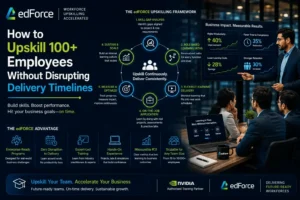
What Successful Large-Scale Upskilling Looks Like
Organizations that achieve the strongest results typically follow a few common principles.
They:
- Align learning with business objectives
- Create role-based learning pathways
- Involve managers early
- Measure outcomes, not just attendance
- Integrate learning into existing workflows
Most importantly, they recognize that workforce development is not separate from business performance.
It directly influences business performance.
When employees learn faster and adapt more effectively, organizations become more agile, productive, and resilient.
How edForce Helps Enterprises Upskill at Scale
At edForce.co, enterprise training programs are built around a simple reality: business cannot stop while training takes place.
Whether organizations are developing skills in AI, cloud computing, cybersecurity, data technologies, Red Hat, NVIDIA, or other emerging technologies, the focus is on creating scalable learning pathways that fit alongside project delivery rather than interrupt it.
This enables businesses to strengthen workforce capabilities while maintaining operational momentum and customer commitments.
Final Thoughts
Upskilling 100+ employees is not just a training challenge.
It is a business planning challenge.
The organizations that succeed understand that workforce development and delivery timelines do not need to compete with each other.
With the right learning structure, role-based pathways, and leadership support, companies can build new capabilities while continuing to achieve business goals.
In 2026 and beyond, the organizations that learn the fastest may also be the ones that grow the fastest.
That is what makes large-scale upskilling one of the most valuable investments a business can make.