

Why Giving Employees AI Tools Doesn’t Guarantee Better Productivity
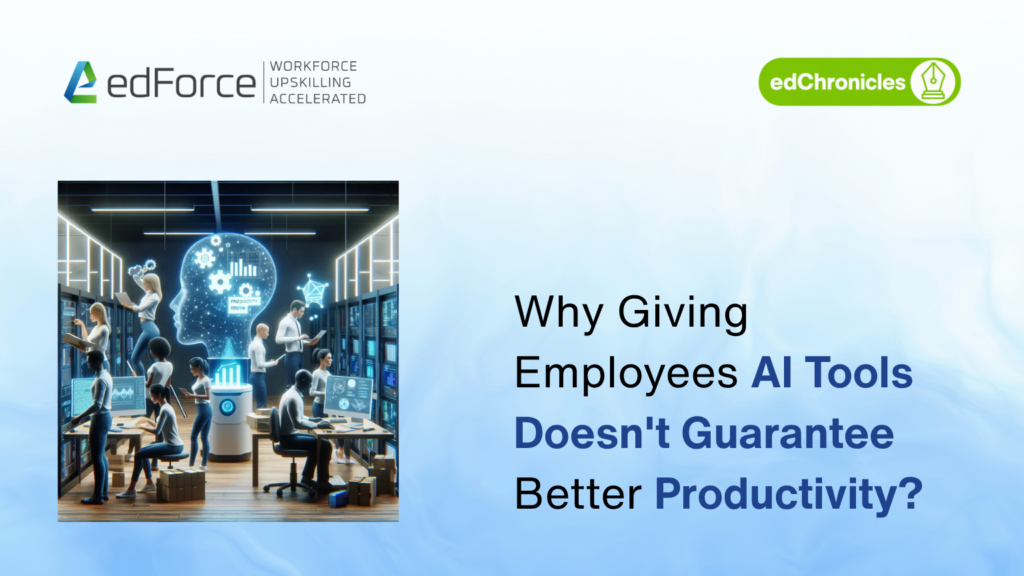
Even If a Company Gives Every Employee Access to AI Tools, Productivity Won’t Change Much This may seem strange at first. Why not give people the ability to use AI? It can automate research, write code, analyse and summarise reports, generate content, and handle repetitive tasks. Not quite that simple. It’s not about access. The real challenge is understanding how AI fits into the work, what employees should actually do with it, and what happens once AI provides an answer. In 2026, this has become a major issue for businesses. Many organisations have stopped asking whether AI is a good idea. The more important question now is whether the teams using these tools are getting real results. The Two Are Not the Same Imagine a company gives 500 employees access to an AI assistant. Some start using it immediately. Others try it once and give up. Some use it daily but only to rewrite emails. One group uses it to draft reports but never checks the output. The company has adopted AI on a technical level. It is not, however, an AI-capable organisation. Productivity doesn’t come from tools alone — it comes from the combination of technology, human judgment, and skill. In the hands of someone unfamiliar with how to use it well, even a powerful AI system can end up worthless. Employees Need to Know What AI Should Actually Do The first mistake companies make is telling employees to “use AI more” without showing them how it can meaningfully improve their work. Left without direction, employees end up experimenting with random tasks. A marketing team might use AI to create social media posts. Finance might use it to summarise documents. A software team might use it to assist with code. Customer service might use it to draft responses. The real value comes from understanding the entire workflow. Instead of simply asking AI to write a reply to a customer, a team can use it to classify the incoming request, extract the key information, generate a response using approved company materials, and escalate the case to a human expert when judgment is required. It’s not enough to bolt an AI tool onto a process — the process itself needs to improve. AI Can Make Poor Processes Faster – Not Better This trips up many organisations. AI won’t fix problems that already exist in a business process — excessive approval chains, repetitive data entry, unclear ownership, or outdated information. Sometimes it just makes those problems happen faster. Imagine an employee who spends hours building a report because the data comes from five different sources. An AI assistant might help them produce the document more quickly — but the underlying problem, fragmented data, is still there. Connecting the right information sources is often a better starting point for an AI strategy than deploying a chatbot. This is why AI adoption should start with a review of processes. The more useful question isn’t “Where can we use AI?” It’s “Where is our process actually broken?” That question tends to surface far better opportunities. Training Changes How Employees Use AI There’s a real difference between showing someone how an AI tool works and showing them how to apply it to their specific job. A basic introduction or team training can teach employees to write prompts, summarise text, or generate ideas. That’s useful — but not sufficient. A cloud engineer needs different AI skills than a sales professional. A developer needs a different foundation than an HR manager. A data professional may need familiarity with APIs, models, pipelines, and evaluation methods. Enterprise AI training should be role-based. The goal isn’t to turn every employee into an AI engineer – it’s to help each person understand how AI can genuinely enhance the work they already do. Better Prompts Aren’t the Whole Answer The quality of someone’s prompting skill does affect outcomes – that’s still true. But enterprise productivity is about more than a clever instruction. Employees also need to understand context, data verification, privacy, and workflow design. Imagine an employee asking AI to generate a business summary. Even a polished, confident-sounding response can contain inaccurate numbers if the source information was incomplete. Employees need to know how to check results – and what information they need to supply in the first place. In practice, good judgment is often more valuable than a clever prompt. Productivity Isn’t the Same as Activity This is another area where companies commonly misjudge AI adoption. If AI lets an employee produce 20 documents instead of 5, that can look like a productivity win. But did those 20 documents actually help the business? Output doesn’t automatically translate into value. AI makes it easy to generate emails, presentations, reports, images, and code — but without clear goals, employees may simply end up producing more, not better. A more useful measure is whether AI is improving something that actually matters: Has response time gone down? Are engineers spending less time on repetitive work? Are analysts reaching valuable insights faster? Are customer complaints resolved more quickly? Are employees spending more time on complex, high-value work? These metrics tell a far better story than counting AI-generated outputs. Human Review Still Matters AI-driven productivity doesn’t mean removing people from workflows. Human review remains essential in many situations. Employees need to be able to recognise when an AI response is incomplete, uncertain, or inconsistent with the available information — and they need to know what information should never be fed into an AI system without proper safeguards. This is a genuinely new kind of workplace skill. Employees are increasingly responsible for directing, evaluating, and improving machine-generated work — not just producing it themselves. That requires training. It also requires clear organisational policy. The Next Productivity Gap May Form Between Teams This is a trend worth watching closely. The biggest AI productivity gaps may not appear between companies that use AI and those that don’t — they may appear within the same company. One team might build repeatable
The Difference Between Using AI and Actually Working With AI
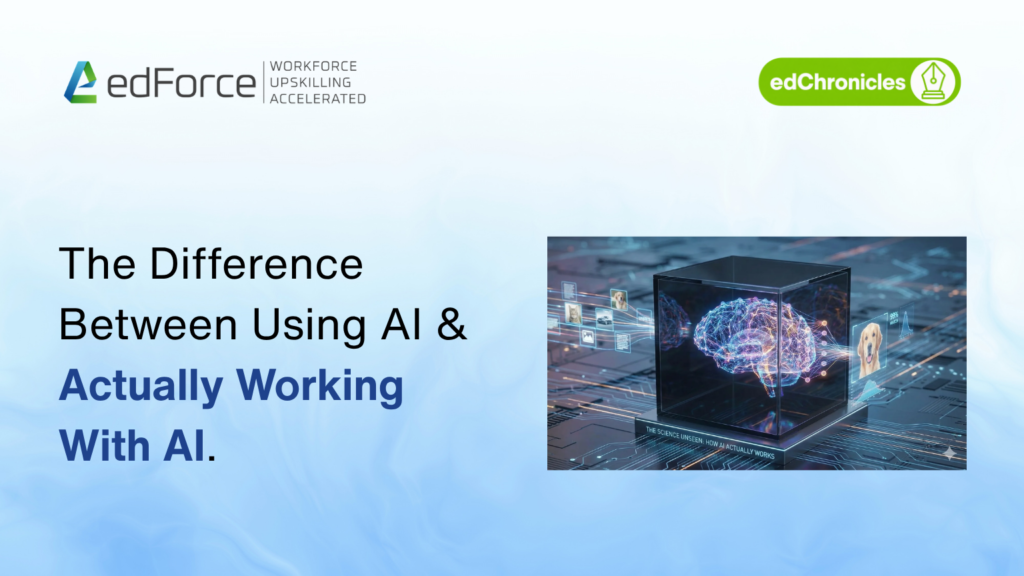
There’s a Big Difference Between Using an AI Tool and Actually Knowing How to Use AI AI can be used to create presentations, write emails, summarise reports, or even explain difficult topics. This is a useful first layer — but there’s more to it than that. AI is more than just a tool. Knowing what AI is and what it does, knowing how to use its output to improve business processes, and knowing how to verify that output are all part of genuinely working with AI. In 2026, this distinction matters more than ever, because AI has evolved from a personal productivity tool into a system woven into everyday business operations. The Easy Part of AI Is Using It Most professionals can learn the basics of AI assistants quite quickly: Ask a question Re-read the answer Change a few things Apply the result This may be enough for simple tasks. Imagine an employee who uses AI to create a report for a client. The tool produces a polished response, but some of the figures are outdated. The employee accepts it anyway because it sounds convincing. The AI wasn’t at fault. It was a lack of process. This is where the difference between using AI and working with AI becomes clear. What Does It Actually Mean to Work With AI? AI is best used as part of a broader workflow, not as a standalone application. Professionals working seriously with AI tend to ask questions like: What information does the system actually need? What tasks should AI perform? Where is human approval still required? How should the output be checked for accuracy? Can the process be safely repeated? What happens if AI gets it wrong? These questions go well beyond writing a good prompt. They require data awareness, process design, evaluation skills, and domain knowledge. AI skills, in other words, have become more than knowing how to operate a chatbot. AI Literacy Is Becoming a Core Workplace Skill In the past, many office roles depended on knowing how to use spreadsheets. Basic AI literacy today is similar. Employees are increasingly expected to understand what AI is capable of, where it excels, and where human judgment is still necessary. HR professionals might use AI to organise candidate information. Finance teams might use it to spot patterns across large documents. A software team might use it to explain or generate code. The tool itself changes depending on the department. But the underlying skill stays the same: using AI effectively and responsibly. Prompting Is Useful – But It’s Not the Whole Skill Prompt engineering was the first AI skill to gain widespread attention, because better instructions tend to produce better results. Enterprise AI training use, however, is moving beyond simple prompting. A good AI user knows how to provide context. A strong AI practitioner also knows where that context should come from, what shape it should take, and how to evaluate the results it produces. Take a customer service team as an example. The common approach is asking AI to “write a reply to this client.” A stronger approach gives AI access to relevant information – approved product data, customer history, company policy, and response guidelines. The second approach is far closer to how AI will actually be used across businesses going forward. Knowing What Not to Automate through AI This may become one of the most important AI skills in the coming years. It’s tempting to automate everything that can be automated. But AI isn’t the right answer for every problem. Even when AI can produce a quick answer, decisions involving legal responsibility, sensitive employee information, financial risk, or customer safety may still require human review. The strongest AI professionals understand these boundaries clearly. They don’t ask, “Can AI do this?” They ask, “Should AI do this — and under what conditions?” That’s a far more useful question for any enterprise to be asking. Working With AI Requires Verification AI can produce a response in seconds. That doesn’t mean the response is correct. Professionals who work well with AI develop the habit of checking important outputs against reliable sources, and learning to recognise when something looks off — rather than assuming fluent writing means accurate reasoning. This shifts workplace behaviour in a meaningful way. Employees are no longer just producing and reviewing their own work. In many workflows, they’re now reviewing machine-generated work before it reaches another employee, a customer, or a business system. That takes judgment. And judgment isn’t something you can automate with another prompt. From AI Tools to AI Workflows The next wave of enterprise AI adoption will likely involve fewer isolated experiments and more integrated workflows. Picture a process where AI summarises customer conversations, identifies next steps, drafts a proposal, updates internal records, and flags where human approval is needed. The salesperson is still involved. But their role has shifted. Instead of manually completing each step, they now supervise an automated workflow — letting AI handle repetitive tasks while they focus on relationships, decisions, and exceptions. Agentic AI is likely to expand this shift significantly. Rather than simply responding to individual requests, AI will increasingly complete sequences of tasks within defined parameters. Why Businesses Need a Different Kind of AI Training A short introduction is enough to teach employees how to use an AI tool. But enterprise training needs to answer a different question: Can this technology genuinely help our teams work better? That requires training built around real business scenarios. A software engineer may need AI-assisted development skills. A cloud engineer may need familiarity with AI infrastructure. A data team may need to work directly with AI models and pipelines. Business teams may need skills in AI-assisted analysis and workflow automation. The right training path depends on the employee’s role. A generic AI course simply can’t close every skill gap. The Future AI Employee May Not Look Like an “AI Specialist” This shift is worth paying attention to. AI skills won’t be limited to people with “AI” in
Looking for a Nvidia Certification Voucher? Here’s What to Know First
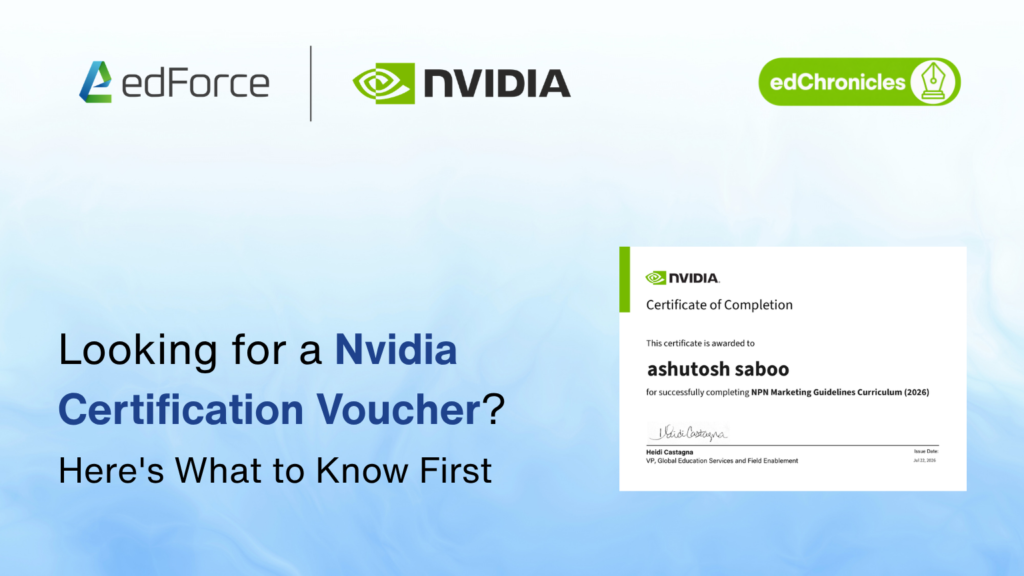
NVIDIA certifications can be an effective way to demonstrate technical expertise in fields such as AI infrastructure, generative AI, data science, and accelerated computing. Before booking an exam, learners often come across a confusing term: the NVIDIA certification voucher. Does it work the same way as a coupon code? Does it cover the entire exam fee? Where does it come from? Can you buy it online? It depends on what type of voucher you have and how it’s issued. Understanding how exam vouchers work can help you avoid overpaying for the wrong exam, missing the redemption window, or assuming a voucher comes with benefits it doesn’t actually offer. What Is an NVIDIA Certification Voucher? An NVIDIA certification voucher can be used to register for an NVIDIA exam. Think of it as a way to cover or reduce the cost of the exam — not as a certification in itself. edForce.co currently offers Associate and Professional-level exams in areas like AI infrastructure, data science, generative AI, and simulation. Exam prices differ by certification, so the value and conditions attached to a voucher matter. Where Can You Get an NVIDIA Certification Voucher? There are a few different ways to receive one. Enterprise Learning Credits. Organisations can convert NVIDIA Learning Credits into vouchers or codes for their learners. NVIDIA states that Learning Credits are valid for certification exams. Training packages. An exam voucher can be bundled into a training package. NVIDIA, for example, offers training-and-certification packages that combine learning resources with a voucher for an Associate-level exam. Promotional offers. These may exist too — NVIDIA’s 2026 Certification webinar, for instance, offered attendees a 50% discount code on the exam. Promotional offers are usually tied to specific conditions, dates, or audiences, and shouldn’t be confused with general-use vouchers. This distinction matters when someone searches online for a “cheap NVIDIA certification voucher” — a discount code and an actual exam voucher are not the same thing. Does the Voucher Cover the Full Exam Fee? Not always. Some vouchers cover the full cost of an exam; others only offer a discount. Exam pricing varies by certification – NVIDIA lists Associate exams at a different price point than Professional exams, and some Professional certifications are significantly more expensive. NVIDIA recommends checking each exam page for current pricing. Before assuming your voucher gets you a free exam, confirm three things: Which exam does it cover? What is the voucher’s value? Does it cover a single attempt only, or are there other conditions? These three details can save you from unpleasant surprises during registration. Don’t Buy a Voucher Before Choosing Your Certification This sounds obvious, but it’s one of the most common mistakes. Someone may purchase a voucher toward an NVIDIA certification before deciding on their technical path — only to later discover the voucher covers an exam that doesn’t match their role. Choose the certification first. An infrastructure professional may be better suited to the NVIDIA Certified Associate: AI Infrastructure and Operations certification, while an AI professional working with large language models might need a generative AI certification instead. NVIDIA’s current certification portfolio includes role-based paths across several technical areas. The voucher should follow your learning plan — not the other way around. What Should You Check Before Using a Voucher? Read the voucher’s conditions carefully. Check which exam it’s eligible for, its expiration date or redemption conditions, and any geographic restrictions. Also confirm whether it covers a discount or the full exam cost. Check whether the voucher is transferable – don’t assume a code issued to one person can automatically be passed to someone else. This matters especially for enterprise programmes, where companies purchase Learning Credits or training packages for multiple employees. NVIDIA Learning Credits can fund team training and can also be redeemed against certification exams or other training services. Voucher or Training? Both Matter, but They Solve Different Problems A voucher helps with exam registration. Training helps you build the skills needed to pass the exam — and to actually apply the certification afterward. This distinction is important. A voucher won’t prepare you to take an NVIDIA certification exam, and it won’t fill knowledge gaps if you’re new to GPU computing or AI infrastructure. NVIDIA recommends preparing through relevant learning and training resources beforehand. This matters most for working professionals — a certification should confirm skills usable on real projects, not just serve as a credential. Can Enterprises Use NVIDIA Vouchers for Teams? Yes – this is exactly where vouchers add value. Imagine an organisation has 30 engineers moving into AI infrastructure roles. Instead of having employees purchase exams individually, the organisation can plan its learning requirements, provide appropriate training, and use NVIDIA Learning Credits or eligible training packages to support certification. This approach also makes budgeting easier. It lets learning teams tie certifications to real business needs — the goal being a team that can actually apply the technology, not just accumulate certifications on an internal dashboard. What If You Fail the NVIDIA Certification Exam? A voucher doesn’t guarantee unlimited attempts. NVIDIA’s certification FAQ states that candidates who fail can retake the exam after a 14-day waiting period, with a limit of five attempts per exam within a 12-month period. That’s another reason not to rush into an exam just because you have a voucher. Use the voucher once you’re actually prepared — cost is only one part of the equation. How to Prepare Before Redeeming Your Voucher Start with the official certification exam page. Review the recommended resources and exam blueprint to identify your weak areas, and add hands-on practice wherever possible. Someone preparing for an AI infrastructure certification may need a deeper understanding of infrastructure operations, deployment, configuration, and validation. A generative AI learner might need a mix of LLM knowledge, application development, and deployment experience. Preparation should be built around the specific certification — not a generic AI course. NVIDIA Certification Vouchers: A Simple Way to Think About It Picture the journey in four phases: Select the right certification Build
What Is a Certification Voucher and How Does It Work?

It is not always easy to pay for a certification test by booking the exam and then showing up at the scheduled time. Vouchers are used by many professional certification providers to simplify the registration process for individuals, businesses, and training partners. You may already be familiar with the term voucher if you plan to take an IT certification. What is a voucher, what are its uses, and how should it be purchased? A certification voucher is a code, digital credential, or other form of payment that can be used to reduce or pay the full cost of a certification exam. The candidate can enter the voucher code instead of paying the entire exam fee during registration. It is important to note that vouchers are usually linked to specific rules for exams. A voucher may be tied to a particular exam, have a set expiry date, or include conditions for redemption. Why Do Certification Vouchers Exist? Vouchers simplify the certification process, especially when several employees are required to obtain the same certification. Imagine an organisation wants 50 cloud engineers certified. It can be inefficient to ask each employee to pay and submit their expenses separately. Instead, a company can purchase vouchers and distribute them among eligible employees. As part of their learning programmes, training providers can also include an exam voucher. The learner receives a voucher after completing the course. This allows for a better connection between training, preparation, and certification. There is another benefit for businesses. Before employees start booking exams, the organisation can plan its certification budget. How Does a Certification Voucher Work? It is very simple to use. A candidate must first receive a valid voucher, either from their employer, trainer, certification organisation, or other authorised source. The candidate registers on the official platform for the certification exam. There is often an option to enter the voucher code during checkout or payment. If the voucher is valid, the applicable amount will be deducted from the exam fee. The voucher may cover all or part of the examination fee, depending on its terms. Once the registration process is complete, the candidate will receive an appointment or confirmation of the exam date. It is important to note that the exact process varies between providers. Candidates should always read the instructions on their voucher before redeeming it. What Can a Certification Voucher Include? Not all vouchers work the same way. Some vouchers cover the entire cost of a certification exam, while others offer a fixed discount. Depending on the certification provider, certain programmes may also include additional benefits. A voucher may specify: Voucher Detail What Does It Mean? Exam The specific certification or exam it can be used for Value The discount or amount covered Expiration The voucher’s expiry date Attempts Whether it covers one attempt only, or includes additional conditions Region Test regions or countries where it is valid Delivery Online or authorised in-person testing options, depending on the provider Restrictions Rules regarding refunds, replacements, and transfers This is important because a voucher cannot usually be used for any certification offered by the same organisation — only specific ones. Do Certification Vouchers Expire? Yes, in many cases. It is important to verify this before purchasing or accepting a voucher. The validity of a voucher depends on the certificate provider and the particular programme. The expiry date is usually based on the redemption date, not the date you start preparing. This distinction is crucial. If you receive a voucher expiring in September, you may not have enough time to complete your training. It may be necessary to redeem or book the exam before the deadline. Plan in reverse: confirm the voucher’s validity against the exam date you intend to choose. Can You Transfer a Certification Voucher to Another Person? This depends on the terms of the voucher. Some vouchers are allocated to a specific candidate. Others may be distributed internally by an organisation. Some carry restrictions on resale and transfer. Candidates should not assume a voucher is automatically transferable to someone else. Before redistributing vouchers, an organisation should verify the terms if a worker leaves the company or changes their certification plans. What Happens If You Fail the Exam? It is a common misconception that all certification vouchers include a free retake. This is not always true. A standard voucher might only cover one attempt at an exam. Whether retakes are available depends on the certification provider and the specific voucher package. As part of their terms, some training programmes offer extra exam attempts or retake support. Understanding what your voucher covers before booking an exam can help you avoid unexpected costs later. Certification Voucher vs. Certification Training These terms are often used interchangeably, but they aren’t the same thing. Training helps you prepare for certification. A voucher lets you pay for or access the exam itself. You can purchase them separately or combine them into one programme. An enterprise learning programme may include instructor-led training, practice materials, hands-on exercises, and an exam voucher — giving the learner a single path to both preparation and certification. This is especially useful for employers who want employees to build practical skills, not just collect certificates. Are Certification Vouchers Worth It? A voucher is useful for someone who has already decided to take the exam – it reduces the cost or simplifies payment. For organisations, the value can be even greater. Companies can better align certification goals with actual workforce needs when vouchers are combined with structured training. Instead of leaving employees to choose certifications on their own, businesses can build learning pathways around priority skills. This distinction matters more as technology continues to change rapidly. A certificate proves someone passed an exam. Training demonstrates whether that person can apply the knowledge in a real working environment. How Businesses Can Make Better Use of Certification Vouchers It’s best to avoid distributing vouchers simply because they’re available. Start by identifying your business need. Cloud certifications can help a company move workloads to the