


How NVIDIA GPUs Are Used in AI Training and Inference
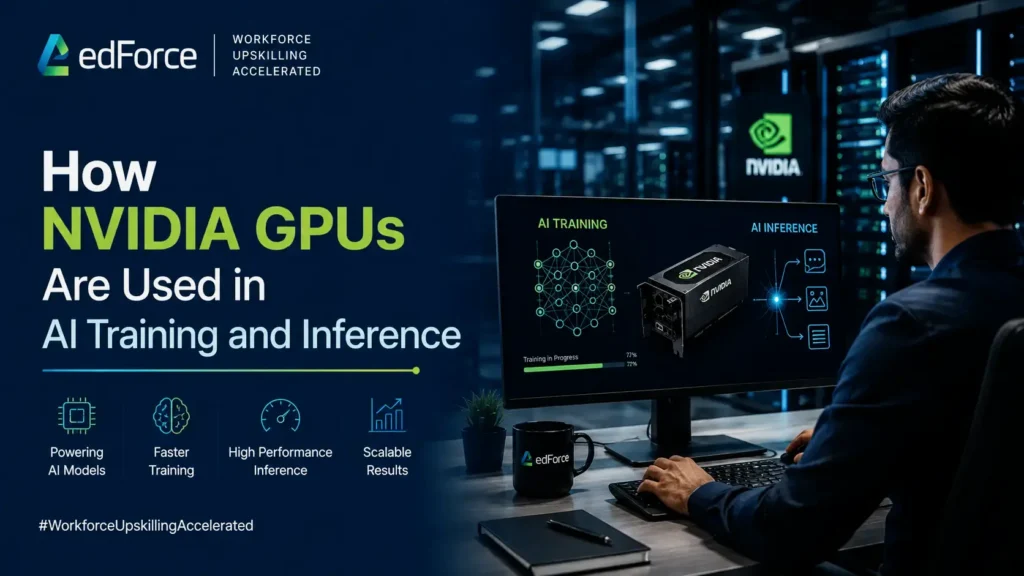
Several years ago, the main reason for buying faster hardware was to improve performance. Today’s topic is making AI practical. Each enterprise is looking for AI that can respond quickly, scale smoothly, and deliver reliable results. Behind the scenes, whether it’s an internal chatbot or AI assistant for employees, recommendation engines, or Agentic AI applications, there is one thing that makes it all possible. The GPU is a graphics processing unit. NVIDIA is known for its powerful graphics cards. But in the AI industry NVIDIA GPUs play a larger role. They are used to power some of the largest AI models in the world, as well as supporting enterprise AI infrastructure and helping organizations create applications that millions of users use every day. Many professionals are still unsure of what GPUs do. Why are they important? Why do companies invest in NVIDIA? Understanding the answers will help you understand why GPU-accelerated computing is one of the fastest growing skill areas in AI. AI Needs more than powerful software Most AI conversations begin with models when businesses embark on their AI journey. Should we use the Large Language Model for our linguistics? What AI platform should be chosen? How accurate is this model? They are good questions, but overlook an important part of the equation. Even the most intelligent AI models need computing power to process information, learn and generate responses. Imagine this: A model of AI is like an experienced employee. The GPU is the workspace which allows an employee to work efficiently. Even excellent AI models can become slower, more costly to operate and harder to scale if they lack enough computing power. The fact that AI and infrastructure are increasingly seen as being two sides of a single strategy is why many enterprises view them this way. What does AI training actually mean? It is important to know what AI training is before comparing it with inference. The AI model is trained by analyzing huge amounts of data. The model analyses millions of examples or even billions, identifies patterns and improves its prediction. It gradually becomes more accurate. This process is extremely computationally intensive. Imagine having one employee read all the books in a large collection. It would take many years. Imagine thousands of employees sharing their knowledge and experiences from reading books. This is similar to the way GPUs can accelerate AI training. They perform thousands of simultaneous calculations instead of one after the other. Modern AI training is made possible by parallel processing. NVIDIA GPUs are effective for AI training The traditional processor is designed to perform a wide range of computing tasks. GPUs are built differently. They excel in performing thousands of simultaneous operations of the same type. AI training is heavily dependent on this capability. All of these applications, including computer vision systems and recommendation engines, require millions upon millions of calculations per second. NVIDIA GPUs manage this workload. It is for this reason that they are the first choice of organizations developing enterprise AI solutions. Training advanced AI models without GPU acceleration would be much slower and more expensive. What is AI Inference? After a model of AI has completed learning, it moves on to the next stage known as inference. Inference is the moment that people begin to use the model. As an example: A worker asks a question to an AI assistant. A customer uploads an analysis document. AI provides medical insights to a doctor A recommendation engine suggests products. The model no longer learns. The application of what has been learned. Although it may seem easier than training, this stage has its own challenges. Businesses expect AI systems that respond almost immediately. Customers are rarely willing to wait for several seconds between interactions. Fast inference is just as important for accurate training as it is to have a fast response. Why inference is just as important as training Some people believe that AI training is difficult and that inference happens automatically. In fact, companies often spend more effort thinking about inference. Why? Inference is a problem for business. Customer experience is negatively affected if an AI-powered system for customer support takes too long. Productivity drops if an AI assistant delays answering questions during meetings. Scaling an AI application that cannot handle thousands users at once is difficult. NVIDIA GPUs can help overcome these challenges because they provide fast and efficient inference performance, while simultaneously supporting a large number of requests. AI applications are responsive to demand even if it grows. NVIDIA GPUs in Enterprises: Where are they used today? GPU-accelerated computing is not limited to the research laboratories. NVIDIA AI Training are used in a wide range of industries to support AI. Some of the most common enterprise applications are: Generate AI assistants Retrieval-Augmented Generation systems (RAGs) Workflows for Agentic AI Computer vision solutions Fraud detection Medical Imaging Financial Analysis Manufacturing Automation Intelligent customer support All these uses cases are connected by speed. AI systems are a must for organizations that want to process information efficiently without compromising accuracy. GPU acceleration is most valuable in this area. GPU Skills are Increasingly Valuable A new trend in hiring is emerging. AI is no longer the only thing that companies are looking for. Also, they are looking for AI professionals. AI adoption is growing and businesses need to hire employees who can understand it. GPU-accelerated computing NVIDIA AI Platforms AI deployment Model optimization AI Performance Tuning Enterprise AI infrastructure It is a great opportunity for those professionals who want to develop their NVIDIA AI capabilities. A prediction is becoming more and more realistic. In the coming years, AI infrastructure may be as important as AI talent. Building Enterprise AI Teams AI is not just about technology. People do. Many organizations have already access to powerful AI platforms, cloud-based tools, and GPU infrastructure. It is often the workforce that makes the difference. Can teams use AI effectively? Is they optimize their inference performance? Can they manage enterprise AI environments Can they scale