


Why Companies Are Investing in Agentic AI Training
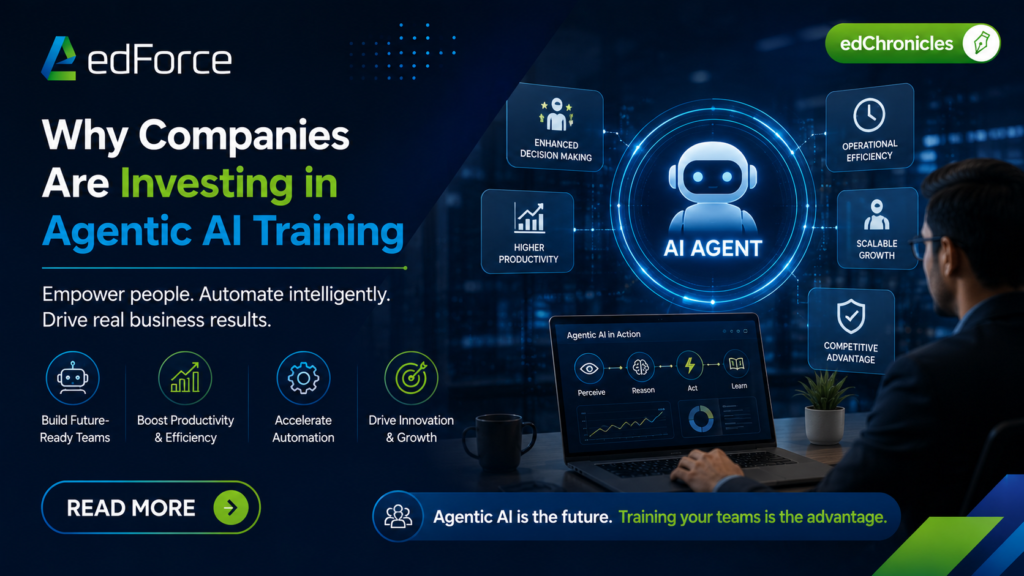
In the past few years, most companies have been using AI mainly as a support tool. Employees used AI to ask questions, create documents, generate content, or automate small tasks. Now, the conversation is changing. In 2026, businesses are moving toward something bigger. AI systems are becoming capable of making decisions, managing workflows, handling tasks within limits, and completing actions with less human involvement. This is why Agentic AI is becoming one of the most talked about technologies in enterprises. While businesses are investing heavily in AI systems, they are also realizing something important. Technology alone is not enough. Employees also need to understand how to use these systems properly. This is exactly why Agentic AI training is growing rapidly across companies. What Is Agentic AI in Simple Terms? Agentic AI refers to AI systems that can complete tasks on their own instead of only responding to instructions. Unlike traditional AI tools that wait for commands, Agentic AI systems can: In simple terms, the AI behaves more like an active digital assistant rather than just a chatbot. This is changing how businesses use AI completely. Why Businesses Are Taking It Seriously Many companies are already seeing the limitations of basic AI usage. Employees may save time using content generation or automation, but businesses still face challenges such as: Agentic AI is attracting attention because it can help reduce these operational bottlenecks. For example, businesses are exploring AI systems that can: This moves AI from support toward execution. The Real Reason Training Matters Many businesses are becoming more practical in their approach. Companies understand that advanced AI systems can create confusion if employees do not understand: Without proper training, AI adoption often becomes inconsistent. Some teams become too dependent on AI, while others avoid using it completely. Neither approach works well in business environments. Training helps create balance. Employees Need a Different Mindset for Agentic AI One major change happening today is that employees are no longer expected to only use software tools. They are increasingly expected to: This requires a very different skill set compared to traditional software usage. Employees need to understand how AI decisions affect: This is one reason businesses are investing heavily in structured AI capability building instead of casual experimentation. Why Enterprises Cannot Treat Agentic AI Casually From what many organizations are experiencing, Agentic AI creates both opportunities and risks. The benefits are clear: However, businesses also worry about: That is why companies are becoming more careful about workforce readiness. Organizations successfully implementing Agentic AI are not only using tools. They are also preparing employees to work with these systems effectively. Team Training Is Becoming More Important Than Individual Learning Another major shift is happening inside enterprises. AI adoption is no longer limited to small technical teams. Agentic AI affects operations teams, support staff, managers, analysts, and business workflows across departments. Because of this, companies are investing more in team based AI learning instead of focusing only on individual training. Many organizations are now working with enterprise learning partners like edforce.co to help teams build practical understanding of AI workflows, automation systems, and responsible AI usage in real business environments. The goal is not only AI awareness.It is operational readiness. What Companies Actually Want From Employees A clear trend is now visible in hiring and workforce development. Businesses are not expecting every employee to become an AI engineer. However, they do need employees who can: These are quickly becoming valuable workplace skills. My Practical View The companies gaining the most value from AI today are not the ones rushing to automate everything immediately. They are the ones preparing their teams properly before scaling AI adoption. Preparation matters because Agentic AI changes how employees work inside organizations. Employees who understand these systems will become far more valuable in the coming years. Businesses already understand this. Final Thoughts Companies are investing in Agentic AI training because the future of work is moving from basic AI assistance toward AI supported execution. As AI systems become more autonomous, businesses need employees who can guide, monitor, and work with these systems responsibly.The real challenge is no longer getting access to AI tools.It is building teams that understand how to use them effectively in real business environments
Companies Are Spending More on Training but Seeing Less Impact, Why?
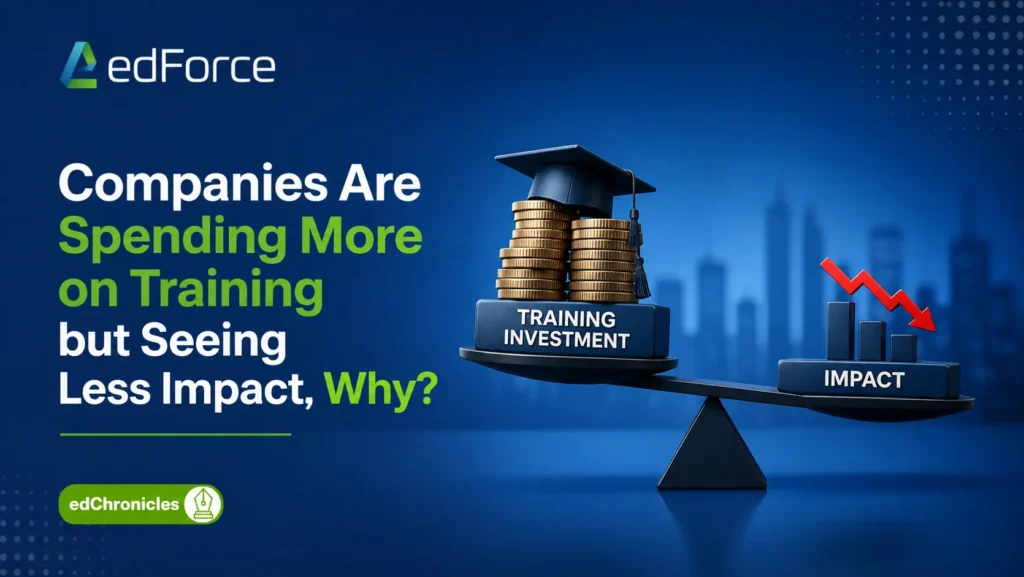
Budgets for training are growing rapidly. The learning platforms are getting better. More content is available than ever before. Yet many organizations are facing an unpleasant real-world. Despite the increased expenditure into corporate education, its actual effect on performance is a bit sporadic. Enterprises are not hesitant to invest in education. They’re trying to transform learning into quantifiable capabilities. More Training Does Not Mean Better Outcomes One of the most common misconceptions about enterprise education is more education is always a guarantee for better results. It’s not. In many organisations learning has become quantity driven. More classes and better sessions. More sessions completed. In dashboards, it appears like progress. In teams, few happens. Learning is viewed as a process, not as a system of performance. The Disconnect Between Learning and Work This is where the most impact is missed. Training often happens in isolation. Participants attend training sessions, learn concepts, only to return to the same environment where those concepts aren’t repeated or are not required. There was no application. No follow-up. No accountability. The knowledge is lost. If learning is not integrated in everyday work it is merely in the realm of theory. Learning that is theoretical does not enhance business results. Completion Metrics Are Misleading Leaders Many companies still rely on numbers of completed tasks to determine their success. It is simple to follow. It is simple to track. But it’s also a bit misleading. Completion simply tells you that employees were present or completed something. It doesn’t tell you: This can create a false perception of efficiency. The company is evaluating the activity, not the impact. Generic Training in a Role Specific World The work has become extremely specific. A single team could require different abilities according to projects, tools or even business goals. However, training is typically provided in a standard style. Similar content. Similar structure. Same expectations. This decreases the importance. Employees are disengaged when they don’t discern how training is linked to their work. If the relevance of training decreases retention and the application decrease along with it. Lack of Manager Involvement One of the most neglected areas is at the manager at the manager level. Managers are in charge of the setting where learning happens. If they’re not involved in the learning process, it is not tied to performance. In high-impact organizations Managers: In the absence of this element, the best planned training fails to produce outcomes. No Real Time Feedback or Reinforcement Learning without feedback is not complete. Employees must know if they’re using their skills in the right way. They require guidance while they are learning, not just weeks later. In many organizations feedback is often delayed or not available. This can slow down the process of the process of improvement and reduces retention. Continuous feedback helps transform learning to progress. If it isn’t there, the process of learning is in uncertainty. The Missing Link: Skill Based Thinking The fundamental issue is straightforward yet crucial. Training is mostly focussed on content. High impact companies are moving to more skill-based models. Instead of asking “What should we teach?” They instead ask“What capability do we need to build?“ This alters everything. Learning becomes organized. The outcomes are obvious. The progress is measurable. Companies that make this change begin to see real returns. Numerous companies are working with partners such as edforce.co to create learning systems that link the development of skills directly to the performance of their business, rather than only delivering training courses. What High Impact Organizations Do Differently The most important thing is that they view learning as an important job function and not as a support task. Final Thoughts The issue isn’t the fact that companies spend too much money on training. The issue is that a lot of this spending isn’t turning into capacity. As long as learning is not tied to actual work, reinforced by feedback, and evaluated through the performance of learners, impact is likely to be insignificant. Enterprises that can close this gap do not only improve the quality of training. They will create more powerful, faster and more flexible teams. In the current competitive environment it is the most important competitive advantage and upgrading skills.