


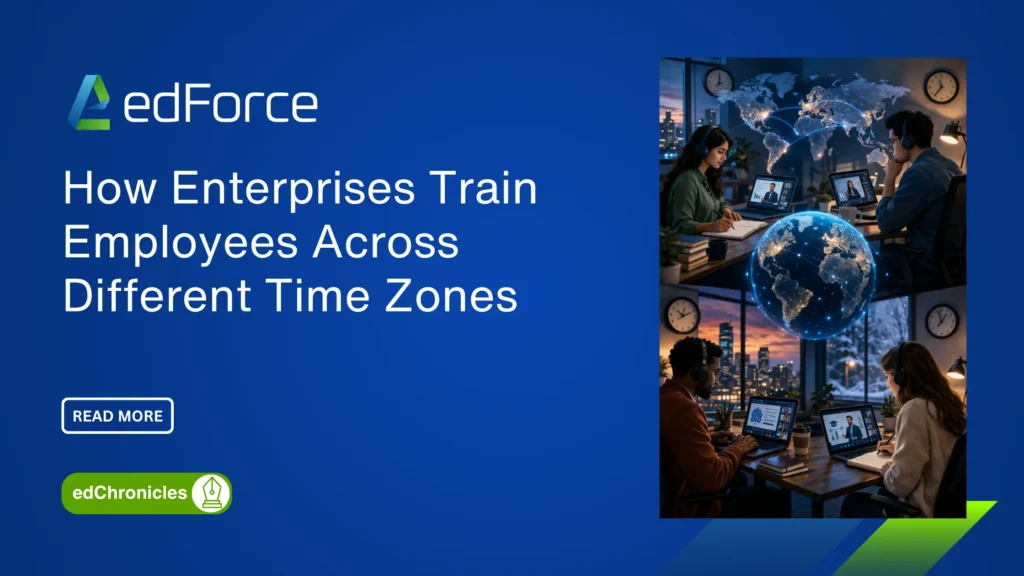
As companies expand internationally the challenge of globalization becomes inevitable. Teams are no longer confined to one place, or even the same time zone.
A course of instruction that works for one area might be difficult or impossible for an entirely different region. However, the goal remains the same. Learning should be consistent, enjoyable and efficient throughout the entire workforce.
Businesses that thrive in this context don’t depend on one approach. They develop learning systems that are flexible and structure with real time connectivity.
Moving Beyond One Time Training Sessions
Traditional training was designed to be used by teams that co-located. A fixed schedule. The shared space. A single delivery.
The model is broken in a global setting.
Companies are now designing courses that aren’t only limited to one time. Instead, they develop learning experiences which allow employees to participate in a variety of ways and without loosing consistency.
This ensures that learning is easily accessible and not limited by location.
Combining Live and Flexible Learning
Live sessions are still important. They provide dialogue, interaction, and clarity.
However, in teams with global reach there are many people who cannot be able to attend the same event simultaneously. This is the reason why businesses offer live training and the ability to access training in a variety of ways.
Sessions are usually held in multiple time slots or aided by recordings and resources for follow-up. Employees are able to revisit the content as they need to, which can improve comprehension.
This combination of real-time and flexible learning allows for more flexible training.
Designing for Clarity Across Cultures
The training across different time zones isn’t solely about timing. It’s also about communication.
Teams have diverse professional and cultural backgrounds. The design of learning must be simple, clear and well-organized to allow everyone to learn easily.
Case studies, examples and explanations should be appropriate across all regions. If the content feels familiar to the audience, it increases engagement regardless of the location.
Strong Facilitation Keeps Global Learners Engaged
In virtual environments, attention can drop quickly. This can be even more difficult when people are interacting at different times during the day.
Enterprises invest in skilled trainers who are able to maintain their the energy of their students, promote participation and be able to adapt to a variety of audiences.
Interactive elements like discussions polls, discussions, and actual scenarios keep students engaged even when they are in remote settings.
Using Technology to Connect Distributed Teams
Technology plays an important role in global education.
Learning platforms, tools for collaboration, and virtual classrooms let employees to network with each other, exchange ideas, and collaborate regardless of distance.
Additionally the tools aid in maintaining continuity. Every student receives the same level of instruction, regardless of where they are located.
Continuous Support Beyond the Session
In international organizations the learning process cannot stop at the time of session’s end.
Employees might require clarification in the future because of time differences. Enterprises can help with discussions forums, follow-ups as well as access to the trainer or mentor.
This support continues to ensure that learning is always active and easily accessible.
Many companies also collaborate with formal learning partners such as edforce.co to develop scalable training systems that ensure high-quality across different regions and time zones.
Final Thoughts
Training in different time zones isn’t only a logistical issue. It’s also a design problem.
Businesses that succeed are focused on clarity, flexibility, and engagement. They develop systems in which learning isn’t linked to a date, but is integrated into the processes teams use.
As global teams continue increase, the capability to provide consistent and efficient education across different time zones is going to be an essential element of the planning for the development of workers.