


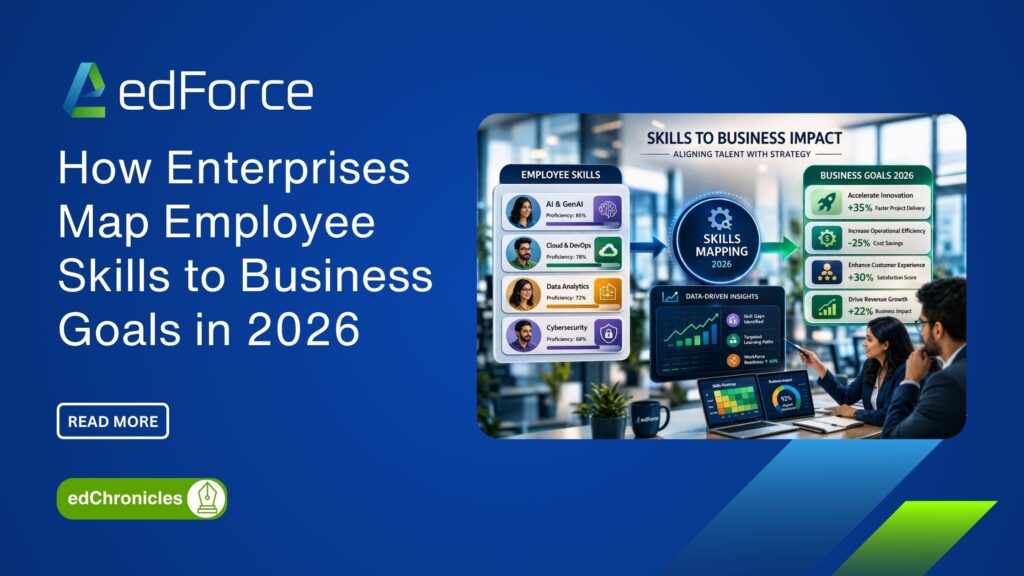
In 2026, planning for the workforce will no longer be focused on roles only. It’s about the ability to communicate, clarity, and align.
Enterprises are moving away generic job descriptions, and instead asking more directly. Are we equipped with the capabilities to meet our business objectives?
Since in the present world, strategy is not failing due to a lack of understanding however, it is due to a the lack of ability.
It Starts With Clear Business Direction
Skill mapping is not a process that begins with employees. It begins with the business goals.
The first step is to define where the organizations intend to go. Expansion into new markets. Adoption of AI. Digital transformation. Efficiency in operations. Innovation in product design.
Each of these objectives will require specific capabilities.
In 2026, the most successful companies divide their business strategies into requirements for skills. Instead of stating “we need to grow,” they determine what skills are required to allow for that growth..
At the top, clarity provides direction throughout the workforce.
From Job Roles to Skill Clusters
Traditional models of work centered on the roles. However, roles are changing too rapidly.
Today, companies are focusing upon the cluster of skills. A single job could require a range of capabilities in technologies, data, communication and problem-solving.
For instance, a programmer might require coding cloud understanding, cloud comprehension, or AI awareness. A manager might require leadership, analytics, and digital fluency.
This allows companies to better map their work and train employees to take on new tasks.
Using Data to Understand Current Capability
After the skill requirements have been defined then the next step is to determine what is already in place.
Enterprises make use of assessments as well as performance data and management inputs to determine current levels of competence. This gives a clear understanding of the strengths and weaknesses.
In lieu of guessing companies are relying on data to help solve key questions.
- Where are we strong?
- Where do we need to improve?
Things that require urgent attention
The ability to see clearly is the basis of a successful workforce planning.
Identifying Skill Gaps That Impact Business
The gaps in skills are not all equally significant.
In 2026, companies will focus on gaps based on their business impact. Skills that directly impact the efficiency of their business, revenue or risk, are first addressed.
The result is that the learning efforts are centered and relevant.
Instead of educating anyone on everything, businesses develop specific plans for development that help solve business-related issues.
Building Structured Upskilling Pathways
When gaps are discovered and gaps are identified, the priority shifts to the development.
Enterprises are implementing structured learning experiences that align with particular roles and future needs. These aren’t regular training sessions. They are mapped out ways to build capacity in a step-by-step manner.
Many companies work with other organizations such as edforce.co to create skill-based programs that blend practical education and real-world application and quantifiable improvements.
This method of structured learning ensures that learning is a catalyst for an improvement in the quality of life.
Continuous Tracking and Adaptation
Skill mapping isn’t just an event that happens only once.
When priorities in business change the requirements for skilled workers also change. Companies continuously monitor developments, update skills frameworks and adjust their strategies for learning.
This results in a dynamic system in which the capabilities of workforces change with the business requirements.
Companies that view the skill mapping process as a continuous process stay more agile and ready for the future.
Connecting Skills to Performance and Growth
The most efficient companies take an extra step. They link their skills directly to performance goals.
Employees are aware of how their skills impact their work. Managers can tie the development of skills to productivity, innovation and team performance.
This increases the level of engagement as learning is perceived as valuable and relevant.
Final Thoughts
In 2026, the most successful businesses will not be just managing employees. They manage capabilities.
When employees are able to align their skills to business objectives, companies achieve clarity, increase efficiency and create an employee workforce that is prepared to adapt.
The benefits do not come in having a larger workforce. It’s about having the necessary skills in the proper location at the right time.